
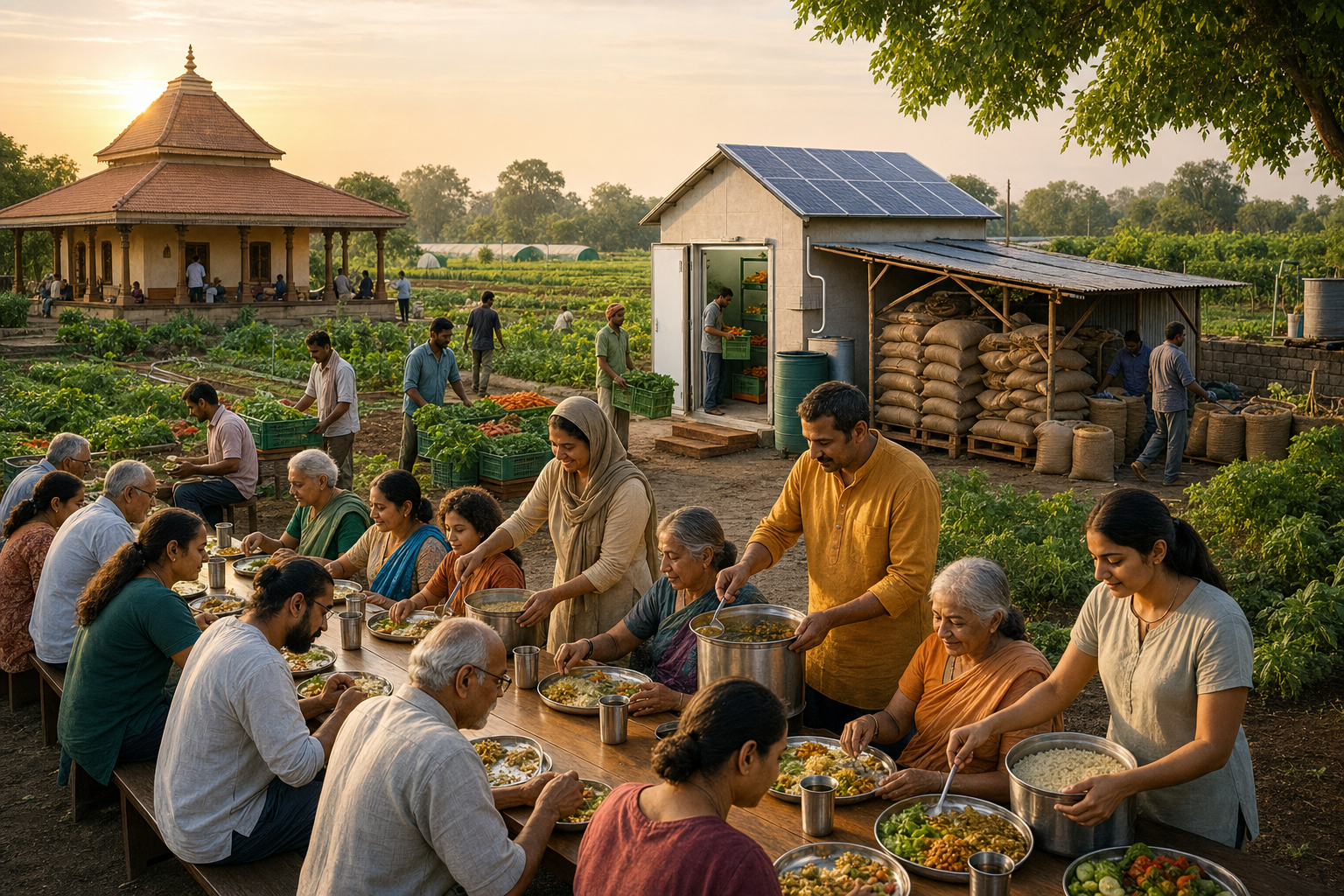
You have a food-service budget, willing volunteers, and a difficult choice. Should your mandir, gurdwara, Jain sangh, Buddhist vihara, or Dharmic association serve more meals, support farmers, build storage, or start growing food? The most visible option may relieve hunger today without repairing the local conditions that will produce hunger again.
A sound Dharmic response connects immediate nourishment with long-term responsibility. It feeds people without humiliation, protects the land that must feed the next generation, reduces avoidable waste, and keeps producers economically capable of planting again. You can use the framework below to decide where your institution has real leverage and where it needs partners.
Start by diagnosing the broken link, not by assuming a shortage
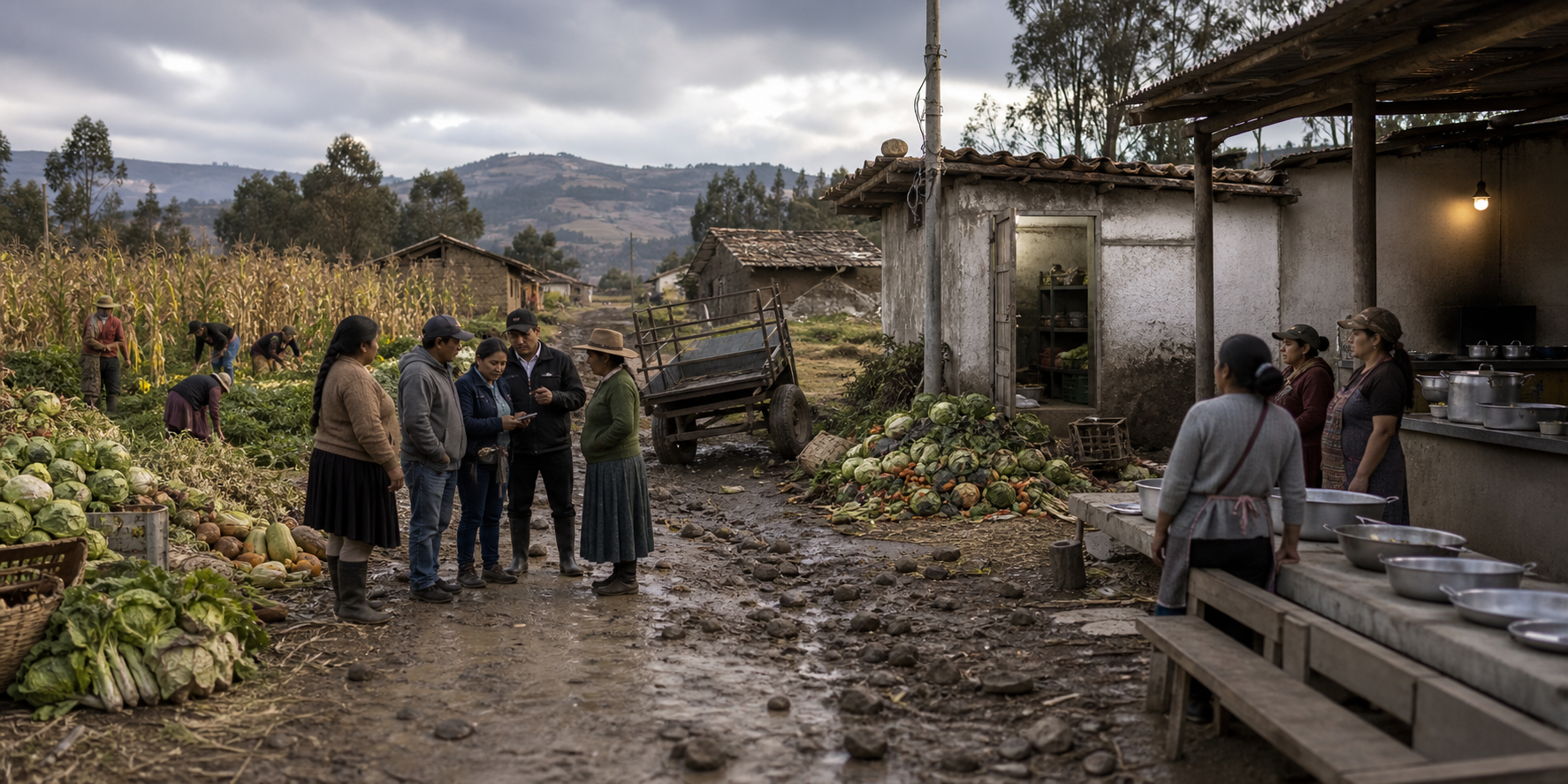
When food is missing from a family’s plate, the failure may have occurred far from the field. Food can be lost through poor storage, delayed transport, weak processing, distorted incentives, inaccessible prices, or the absence of a reliable route from surplus areas to hungry households. Increasing production addresses only one of those failures. In some places it is essential; in others it merely sends more food into the same broken chain.
Before approving a project, trace one important food through five links:
- Production: Is the crop actually scarce, or is output unstable because soil, water, seed, credit, or weather information is inadequate?
- First-mile handling: How much edible food is damaged, contaminated, or left unsold between harvest and the first market?
- Processing and storage: Can seasonal abundance be dried, cooled, milled, preserved, or safely held for later use?
- Market and access: Does food exist nearby but remain unaffordable, physically inaccessible, or commercially unattractive to move?
- Ecological foundation: Is today’s supply being maintained by degrading soil, exhausting water, removing habitat, or transferring risk to farmers and animals?
Turn the diagnosis into one plain sentence: People lack this food during this period because this link fails between these two actors. If your committee cannot complete that sentence with evidence, it is not ready to select an intervention. A garden, cold room, feeding programme, or irrigation system is a tool, not a diagnosis.
This discipline also prevents a common mistake: treating every uncultivated parcel as wasted land. Suitable fallows, seasonally idle acreage, and peri-urban plots may offer opportunities, and remote sensing can help identify them. Wetlands, rangelands, biodiversity corridors, and other ecologically important areas must remain outside the cultivation target. Verify ecological function, water availability, tenure, and market access on the ground before calling land underused.
The same caution applies to urban agriculture. A community garden, rooftop plot, or hydroponic unit can supply fresh produce, shorten a local chain, teach food skills, and provide a buffer during disruption. It should be presented honestly as a supplement to rural production, not as a substitute for it.
Make dharmic values operational
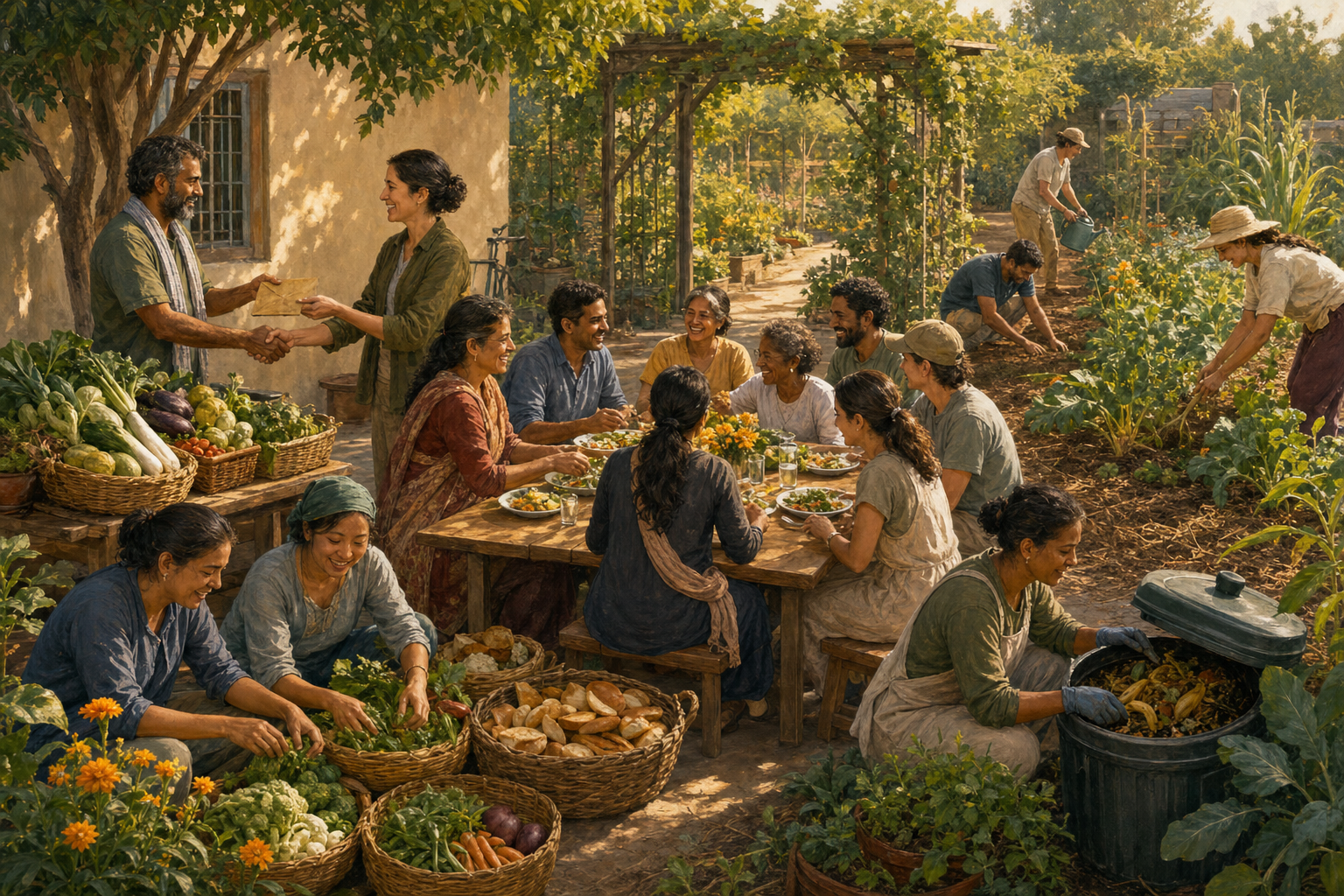
Hinduism, Buddhism, Jainism, and Sikhism are not interchangeable traditions. Yet their ethical vocabularies offer a powerful set of questions for food-system design. The value of that vocabulary appears when it changes a budget, contract, cultivation practice, or distribution rule.
Dharma: assign responsibility across the whole chain
Dharma turns food security from a charitable aspiration into a set of duties. The grower has duties to soil and food safety; the buyer has duties concerning timely payment and honest grading; the warehouse has duties concerning preservation; the state has duties concerning fair rules and emergency protection; the consumer has duties concerning restraint and waste.
For your project, name the responsible party at every handoff. Do not write that storage will be monitored; name who records temperature, moisture, infestation, stock age, or spoilage, who reviews the record, and who acts when it moves outside the acceptable range for that food. Shared responsibility without named ownership usually becomes neglected responsibility.
Ahimsa: count harms that ordinary accounting hides
Ahimsa does not mean that agriculture can avoid every disturbance. It requires you to identify and reduce unnecessary harm. That includes hunger and farmer distress, but also preventable animal suffering, soil degradation, water depletion, food destruction, chemical misuse, and habitat conversion.
Apply an ahimsa screen before funding a production increase: What happens to additional output if prices fall? Will edible produce be discarded? Will livestock become disposable during a surplus cycle? Will new acreage displace an ecologically valuable landscape? Where dairying is locally important, excess milk can be redirected to appropriate nutrition programmes or converted into storable products such as powder, cheese, or ghee rather than making destruction or culling the default response. Any redistribution must still meet food-safety requirements; compassionate intent does not make an unsafe product safe.
Aparigraha: distinguish prudent reserves from wasteful excess
Aparigraha, or restraint in possession and consumption, challenges the idea that maximum throughput is the same as security. A buffer stock held transparently for a foreseeable lean period is prudent. Food accumulated without rotation, a buyer, or a release plan is not. The operational questions are simple: Why is this stock being held, who can authorize its release, how will older stock move first, and what happens before it becomes unsafe?
Restraint also belongs at the consumer end. Kitchen waste, oversized servings, poor menu planning, and rejection of cosmetically imperfect but safe produce squander the land, water, labour, and energy already embodied in food. Measure waste separately at preparation, storage, and plate stages; each has a different cause and therefore a different remedy.
Karuna and seva: make access dignified and dependable
Karuna and seva direct attention to the person who is excluded by an otherwise efficient system. Annadana and the Sikh langar show how nourishment can be offered as a shared human entitlement rather than a test of status. Their deeper lesson for programme design is regularity, welcome, and non-discrimination, not merely the number of plates served.
Ask whether a person can use the service without public humiliation, complicated proof, unsafe travel, or a menu that ignores local dietary needs. Then ask whether the service will still operate after a price spike or poor harvest. Compassion becomes dependable when procurement, storage, finance, volunteers, and contingency plans support it.
A global Dharmic approach should carry these ethical tests across borders without exporting a single agricultural template. Crops, cuisines, rainfall, land tenure, and institutions differ. Bharat’s civilizational contribution is a disciplined relationship among duty, restraint, non-harm, service, and nourishment. Each region must express that relationship through its own ecology and social arrangements.
Build one working chain from soil to plate
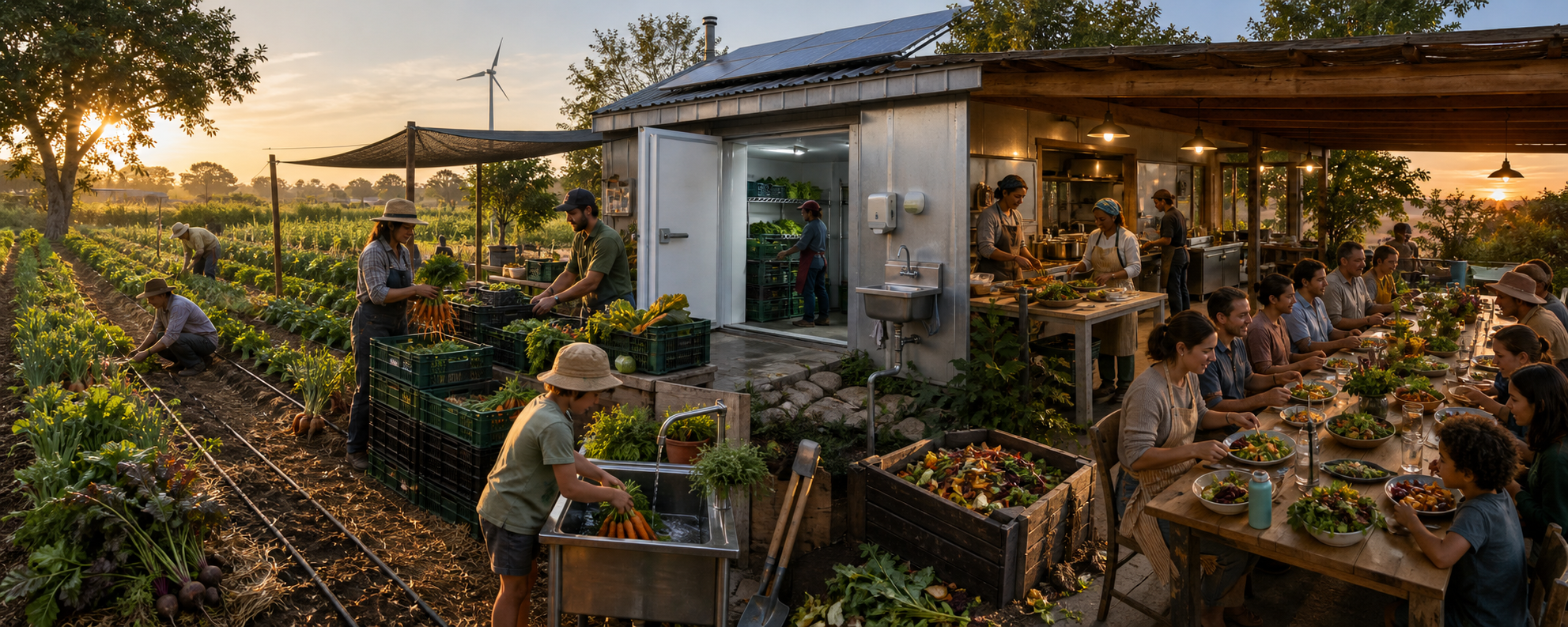
Once you know which link is failing, design the intervention as part of a complete route to the eater. The following sequence prevents an isolated farm input or piece of equipment from becoming an expensive dead end.
- Set ecological boundaries first. Exclude wetlands, rangelands, habitat corridors, and other land whose ecological role would be damaged by cultivation. On genuinely suitable land, check tenure, water, soil condition, access, labour, and the intended destination of the harvest before expansion.
- Rebuild the soil rather than chasing yield alone. Cover crops, rotations that include legumes, balanced nutrient application, biofertilizers, conservation tillage, and additions of organic matter can improve nutrient cycling and water retention. Establish a baseline and follow soil-organic-carbon trends, micronutrient balance, and biological activity so that regeneration is measured rather than assumed.
- Measure food produced per unit of water. Drip or sprinkler irrigation, on-farm rainwater harvesting, and irrigation scheduled through crop stage, weather, soil information, and satellite-derived evapotranspiration can reduce avoidable water loss. Track kilograms of usable food per cubic metre of water alongside total yield; otherwise a larger harvest can conceal worsening water dependence.
- Diversify with an eater and buyer in mind. Pulses, oilseeds, millets, fruits, vegetables, and spices can broaden diets, spread production risk, and, in the case of legumes, support soil fertility. Choose crops appropriate to local ecology and cuisine, then identify storage, processing, procurement, and menu uses before planting at scale. A longer crop list without a route to consumption is not yet a food-security strategy.
- Close nutrient and income loops. Agroforestry, intercropping, and integrated crop-livestock-fish systems can turn outputs from one activity into inputs for another. Trees may provide fruit, fodder, shade, and other products; crop residues may become appropriate feed or soil inputs; properly managed manure can return nutrients to the land. Evaluate animal welfare, disease management, feed sources, and manure handling as core design requirements rather than afterthoughts.
- Design preservation before the harvest arrives. Match the technology to the actual failure: hermetic storage for suitable dry staples, solar drying where controlled dehydration fits the food and climate, packhouses where sorting and handling cause damage, and cold-chain links for perishables that truly require them. Include cleaning, maintenance, reliable energy, operator training, and a plan for managing aflatoxin and other food-safety risks.
- Secure the route to a paying or protected destination. Farmer-producer organisations, cooperatives, community-owned processing, transparent grading, traceability, digital market access, and institutional procurement can help small producers aggregate supply and negotiate. The route may end in an ordinary market, a community kitchen, a school or maternal-nutrition programme, or a calibrated public reserve. It must be identified before surplus becomes distress.
Sequence matters. Irrigation without soil care can intensify resource pressure. Production without preservation can increase loss. Storage without stock management can defer waste rather than prevent it. Diversification without buyers can expose farmers to new price risks. Cheap procurement that undermines farm income may feed people briefly while weakening the next planting season.
A complete project brief should therefore name the food basket, producer group, seasonal risk, ecological safeguards, post-harvest method, intended destination, access mechanism, responsible institutions, and measures of success. If one of those fields is blank, the missing link deserves attention before capital is committed.
Use your institution where it has real leverage
A Dharmic institution rarely controls an entire regional food system. It can still act at three levels: relief, resilience, and reform. Choose one as the project’s primary purpose, then connect it deliberately to the others.
Relief: protect dignity and nutrition now
If people are hungry now, serve food now. Do not delay a meal until a perfect agricultural programme exists. Make the service regular, accessible, culturally appropriate, and non-discriminatory. Record demand, stockouts, preparation waste, plate waste, and the foods most often left uneaten. Those observations should change procurement and menus.
Separate edible surplus from food whose safety cannot be verified. Before redirecting prepared food, establish who controls storage time, temperature, transport, allergen information, and final acceptance. When those controls are absent, use unopened ingredients or newly prepared meals instead of transferring an unknown risk to people with fewer choices.
Resilience: invest where local food is being lost
Use the chain diagnosis to select shared infrastructure. If grain deteriorates after harvest, hermetic storage and warehouse management may matter more than additional seed. If vegetables are damaged before sale, field crates, a packhouse, coordinated transport, or a buyer schedule may outperform a new growing project. If drought timing is the problem, rainwater harvesting, soil-moisture improvement, micro-irrigation, and local advisories may belong in one package.
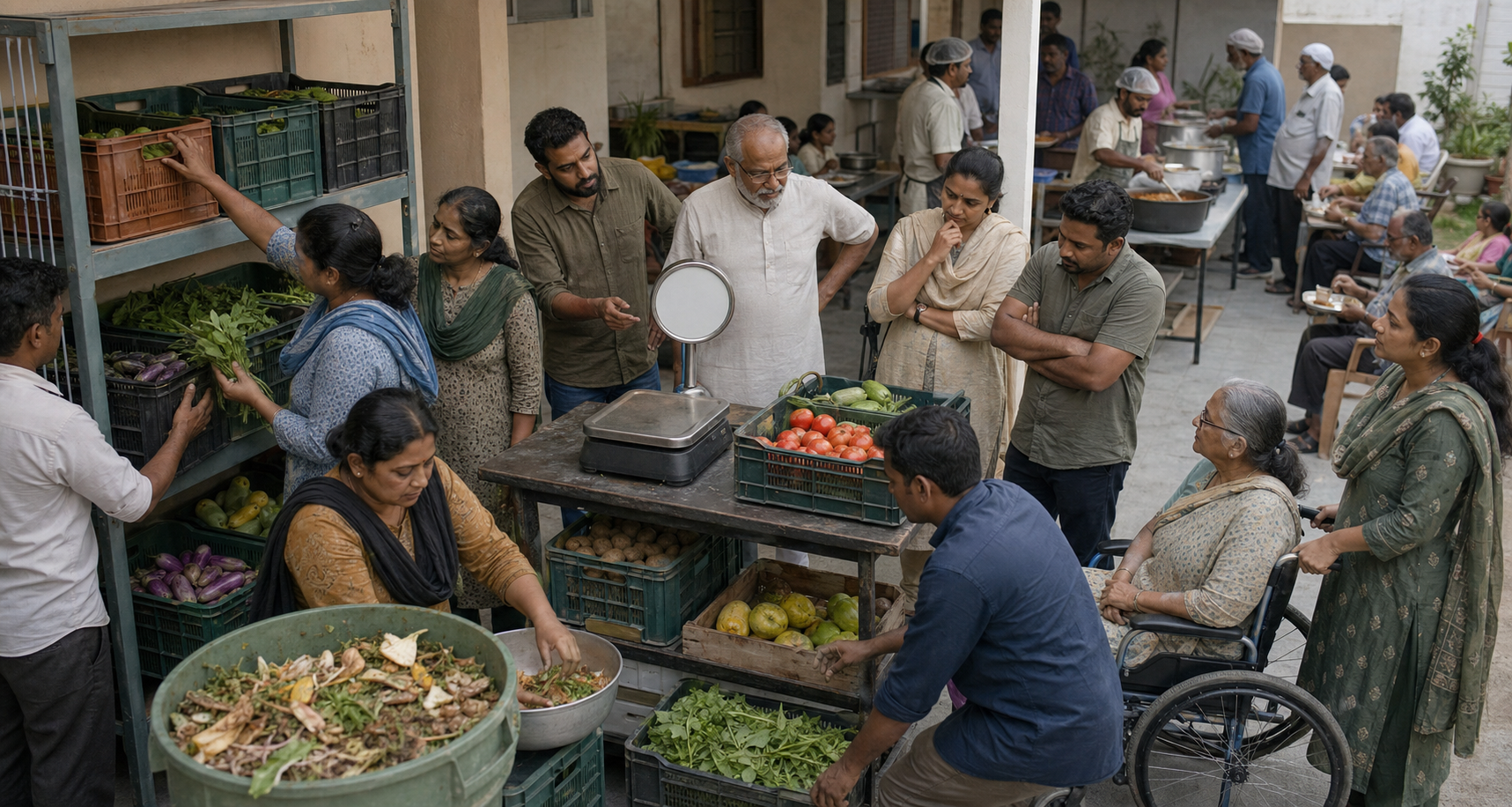
Procurement is one of an institution’s strongest levers. Where feasible, aggregate demand across community kitchens, agree on transparent grades and delivery schedules with a farmer cooperative, and build menus around appropriate seasonal produce, pulses, or millets. The arrangement should protect food affordability without forcing the producer to absorb every fluctuation. Track the farmer’s net income, not merely the price paid per unit, because transport, rejected produce, payment delays, and input costs affect whether the relationship is sustainable.
Community gardens and rooftop plots fit here when their purpose is explicit: fresh-food supplementation, education, seed stewardship, neighbourhood connection, or a modest emergency buffer. They should not absorb funds needed to repair a larger and already documented storage or access failure simply because a garden is easier to display.
Reform: change incentives that manufacture scarcity
Some failures exceed the reach of a kitchen or farm partnership. Destruction of edible surplus, abrupt trade changes, insecure tenure, inadequate rural credit, and weak public procurement require policy action. Advocate for calibrated buffer stocks, nutrition-sensitive safety nets, predictable trade rules, real-time market information, fair land rights, and procurement systems that protect both the eater and the producer.
Finance belongs in the same conversation. Affordable credit, weather-index insurance, warehouse-receipt financing, digital payments, climate services, and early-warning systems can help producers act before a shock becomes a loss. These tools require transparent terms and accessible grievance processes. A risk instrument that farmers cannot understand, afford, or successfully claim against does not create resilience.
Support for rural processing, storage, renewable-energy microgrids, broadband, and logistics can make village livelihoods more viable while improving urban supply. The aim is not to prevent migration. It is to make migration a genuine choice rather than the consequence of a food economy that captures value everywhere except where food is grown.
When evaluating a policy, ask three questions together: Will consumers be able to obtain nourishing food? Will producers retain the capacity and incentive to produce the next harvest? Will soil, water, animals, and biodiversity remain capable of supporting the system? A policy that secures only one of these is postponing its cost.
Key takeaways: test the project before you fund it
- Name the broken link. Is the primary failure production, handling, storage, processing, market access, household access, or ecological decline?
- State the project’s level. Is it mainly immediate relief, local resilience, or structural reform, and how will it connect to the other two?
- Assign dharma at every handoff. Who is responsible for quality, payment, preservation, release of reserves, and corrective action?
- Apply an ahimsa screen. Which harms to people, farmers, animals, soil, water, and habitat could the project prevent or create?
- Plan for abundance before producing it. Where will a bumper harvest go, how will it remain safe, and who is committed to receiving it?
- Protect both sides of the market. Can households afford the food, and can producers earn enough to continue supplying it?
- Do not crop ecological assets. Verify land function, tenure, water, and biodiversity before treating uncultivated land as available.
- Measure outcomes, not activity alone. Meals served, hectares planted, or equipment purchased do not prove that hunger, loss, or ecological risk declined.
Choose a compact scorecard that matches the diagnosed failure. Useful measures include cropping intensity, food produced per cubic metre of water, soil-organic-carbon trends, micronutrient balance, post-harvest loss rates, dietary diversity, smallholder net income, and biodiversity markers such as pollinator presence. For a community kitchen, add stockouts and preparation and plate waste. Publish who records each measure and when the committee will change course if results deteriorate.
Where a project needs an international policy frame, connect its measures to SDG 2 on hunger, SDG 12 on responsible consumption and production, SDG 13 on climate action, and SDG 15 on life on land. The point is not to decorate a proposal with four labels. It is to prevent a gain in food output from concealing losses in responsible consumption, climate resilience, or living ecosystems.
Before your next budget meeting, choose one food your institution serves often and map its path from producer to plate. Verify the first serious break, select the smallest intervention that repairs it, name the partner responsible for the next handoff, and agree on the measure that will reveal whether conditions improved. That is where a Dharmic commitment to nourishment becomes durable food security.