
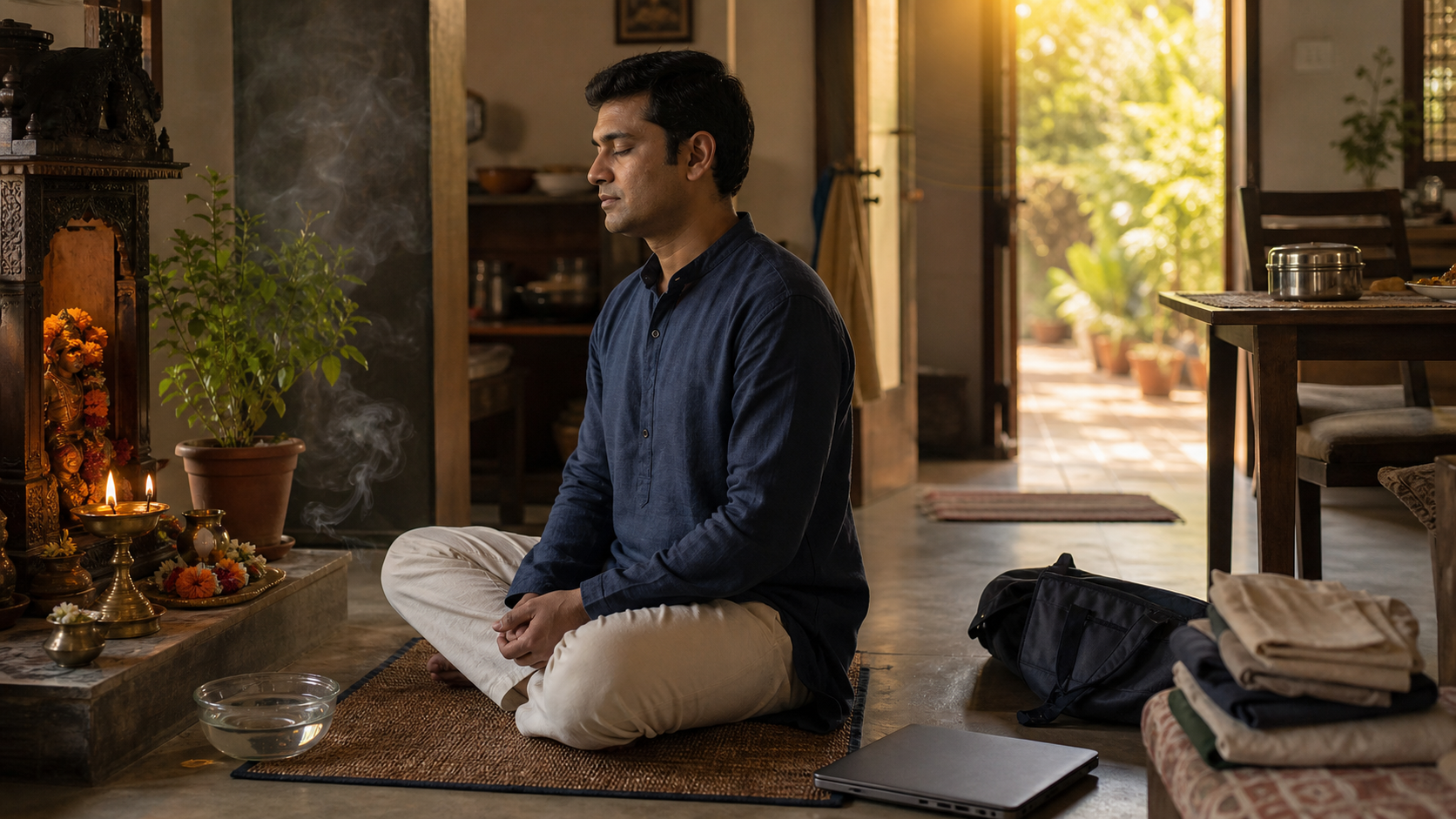
You can understand karma yoga, quote the Gita, recognize the language of Vedanta, and still lose your balance when a colleague insults you or a family duty becomes inconvenient. That gap does not mean your study was wasted. It means the teaching has reached your memory but has not yet become your default response.
Embodied practice closes that gap. It brings Dharma into breath, posture, speech, work, worship, and relationships until what you know begins to shape what you do. The aim is not a dramatic spiritual experience. It is a life in which your discernment remains available precisely when habit, fear, anger, or vanity would normally take control.
The real test begins before you have time to perform

It is easy to sound dharmic when nothing important is at stake. Embodiment becomes visible in the interval between a trigger and your response: the breath tightening under fear, the voice sharpening under provocation, the mind composing excuses, or the hands withdrawing from an unwelcome responsibility.
Use those moments as evidence. Do not ask only whether you agree with ahimsa, satya, seva, or vairagya. Ask what your body and conduct did when the virtue became costly. A useful measure of practice is whether understanding becomes steadier conduct under pressure.
- When fear appears, notice whether you immediately obey it or first regain contact with an ordinary, unforced breath.
- When you are contradicted, notice whether you listen, retaliate, become sarcastic, or retreat into injured silence.
- When duty is inconvenient, notice whether you act cleanly or begin bargaining for recognition.
- When you make a mistake, notice how long it takes to admit it, repair what you can, and stop defending your self-image.
This is not an invitation to monitor yourself with hostility. Shame makes observation less accurate because it encourages concealment. The purpose is to find the exact place where a teaching disappears from practice. Once you know that place, you can train there.
Turn one teaching into a rehearsed response
Vedanta describes a movement from shravana to manana to nididhyasana: receive the teaching carefully, examine it through reason, and internalize it so deeply that it reorganizes perception. You can apply that movement to one recurring difficulty.
- Choose one principle. It might be truthfulness, non-possessiveness, patience, devotion, or responsibility.
- State it in your own words. If you cannot explain what it requires in a real situation, you do not yet understand it well enough to practise it.
- Name the situation in which you usually abandon it. Be concrete: a particular meeting, family disagreement, purchase, temptation, or neglected duty.
- Choose a bodily cue that will interrupt the old pattern. Feel your feet, soften your jaw, complete one unforced breath, or touch your mala before answering.
- Decide the smallest visible action that would express the principle. Speak one honest sentence, delay an impulsive reply, return what is not yours, perform the duty, or make the needed apology.
- Review the event later without editing the story in your favour. Keep the cue if it helped; simplify it if you could not remember it under pressure.
The bodily cue is not the virtue itself. It creates enough space for the virtue to become possible. Repetition then joins understanding to action. This is abhyasa supported by vairagya: return to the practice, and release the demand to look spiritually impressive while doing it.
Build sadhana around the transitions already in your day

A practice that depends on ideal conditions will disappear when life becomes crowded. Place sadhana at transitions that already occur: waking, beginning demanding work, carrying out a duty, returning home, and preparing for sleep. These points matter because they are where one mental current gives way to another.
- Dawn: sit before the day begins making claims on your attention. Let the breath become natural, practise a short mantra-japa, and choose one quality you intend to protect in action.
- Before demanding work: re-establish posture and breath before opening the message, entering the meeting, or beginning the task. Recall the quality selected at dawn.
- During daily duty: treat one ordinary responsibility as karma yoga. Do it carefully because it is yours to do, not because praise is guaranteed.
- Through seva: choose one useful act that reduces another person’s burden. Mentoring someone, resolving a disagreement fairly, helping a neighbour, or doing unnoticed household work all make Dharma socially tangible.
- In the evening: read a small portion of the Gita, an Upanishad, or a trusted teaching. Paraphrase its meaning, sit with it silently, and connect it to something that actually happened that day.
- Before sleep: name what deserves gratitude, where you acted in alignment, and where a correction is still due. Turn the correction into a definite next action rather than a vague promise to improve.
If you miss one anchor, resume at the next one. Do not turn a missed dawn practice into permission to abandon the entire day. Continuity is built by returning, not by maintaining an image of perfection.
Let the balance shift from intake to assimilation
At first, study supplies orientation. Over time, the balance should move toward contemplation, sitting, ethical correction, and service. More books cannot compensate for a teaching that is never rehearsed in life.
After reading, close the text and answer three questions: What does this teaching claim? Where does my present conduct resist it? What will I do differently at the next relevant moment? If you cannot answer, reread less material more carefully. If you can answer but never act, your next need is repetition rather than another explanation.
The paths of jnana, bhakti, dhyana, and karma yoga need not compete. Study can clarify devotion; devotion can soften intellectual pride; meditation can expose hidden motives; service can test whether either knowledge or devotion survives inconvenience. Choose an emphasis suited to your temperament, but let the other dimensions correct its weaknesses.
Use ritual to educate attention, not merely occupy the hands
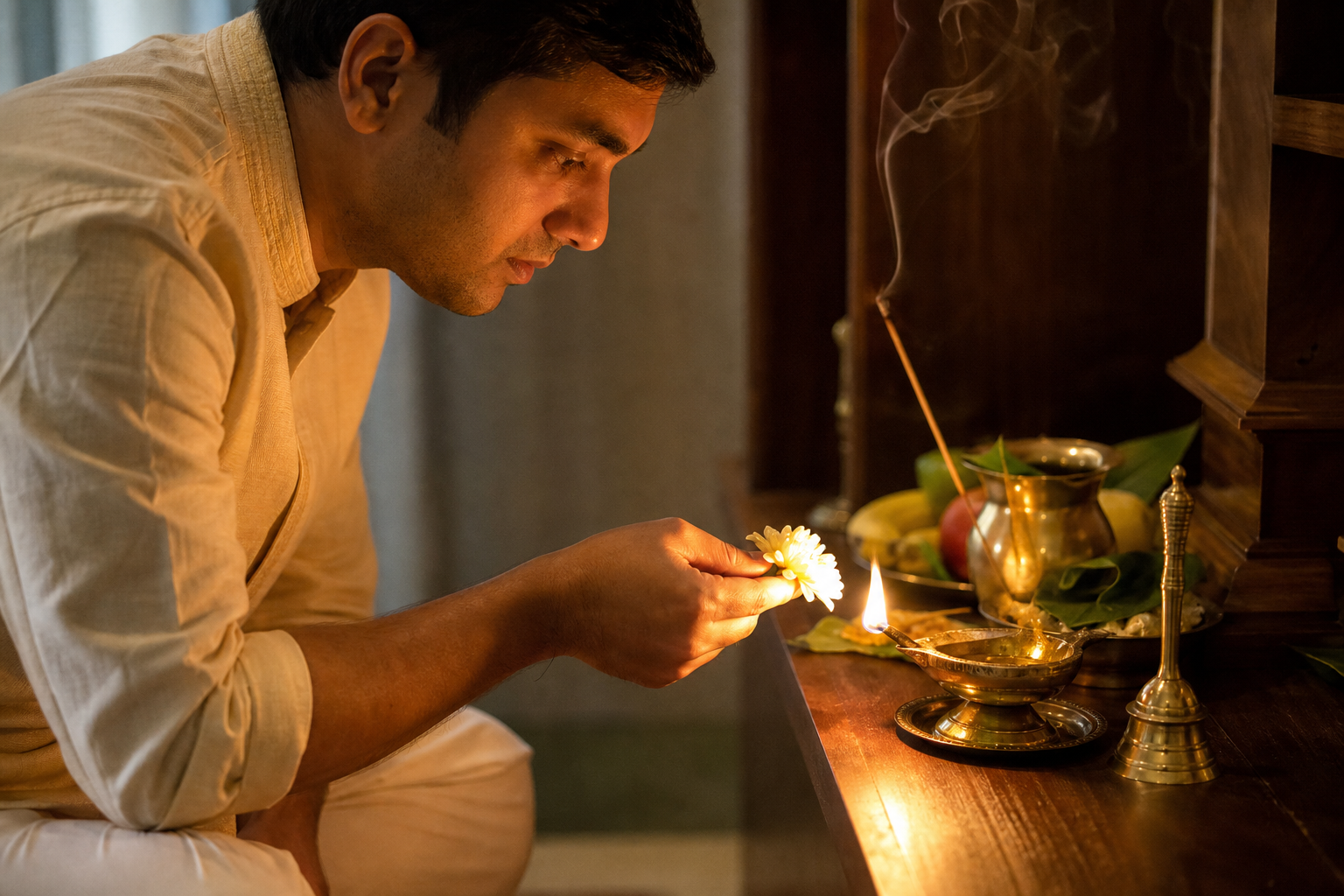
Ritual is one of Sanatana Dharma’s most practical forms of embodied learning. A flame, mantra, circumambulation, offering, or act of abhishekam gives the senses a disciplined task. The body participates in a truth that the intellect might otherwise hold at a distance.
- During arati, let the eyes follow the flame without allowing the mind to turn the act into background scenery. Receive the light as a demand for clearer seeing.
- During japa, pronounce or hear the mantra attentively. When thought wanders, return to the next repetition without irritation and without rushing to compensate.
- During pradakshina, keep the sacred centre central in both movement and attention. The act loses much of its formative value when the feet circle while the mind remains elsewhere.
- During abhishekam, allow touch, offering, mantra, and reverence to converge. Ask what must be cleansed in conduct, not only what blessing you hope to receive.
Mimamsa places kriya, meaningful action, at the heart of religious life. The practical implication is demanding: an act is not merely an illustration of an inner state. Repeated action also helps form the state. Posture can support recollection, vocal rhythm can gather attention, and a physical offering can train the mind away from possession.
Mechanical ritual is not repaired by adding more ritual. Reduce the number of actions if necessary and restore attention to the ones you keep. Before beginning, name the quality being rehearsed. During the act, return whenever attention wanders. Afterwards, carry one implication into the day. If worship ends at the puja space while impatience governs the household, the bridge between ritual and conduct still needs work.
Keep breath practice gentle unless you have competent guidance for more demanding pranayama. If manipulating the breath causes dizziness, pain, panic, or marked air hunger, stop and return to normal breathing. Spiritual practice should not be used as a substitute for appropriate medical or psychological care.
Make ethics, seva, and community the proof of practice
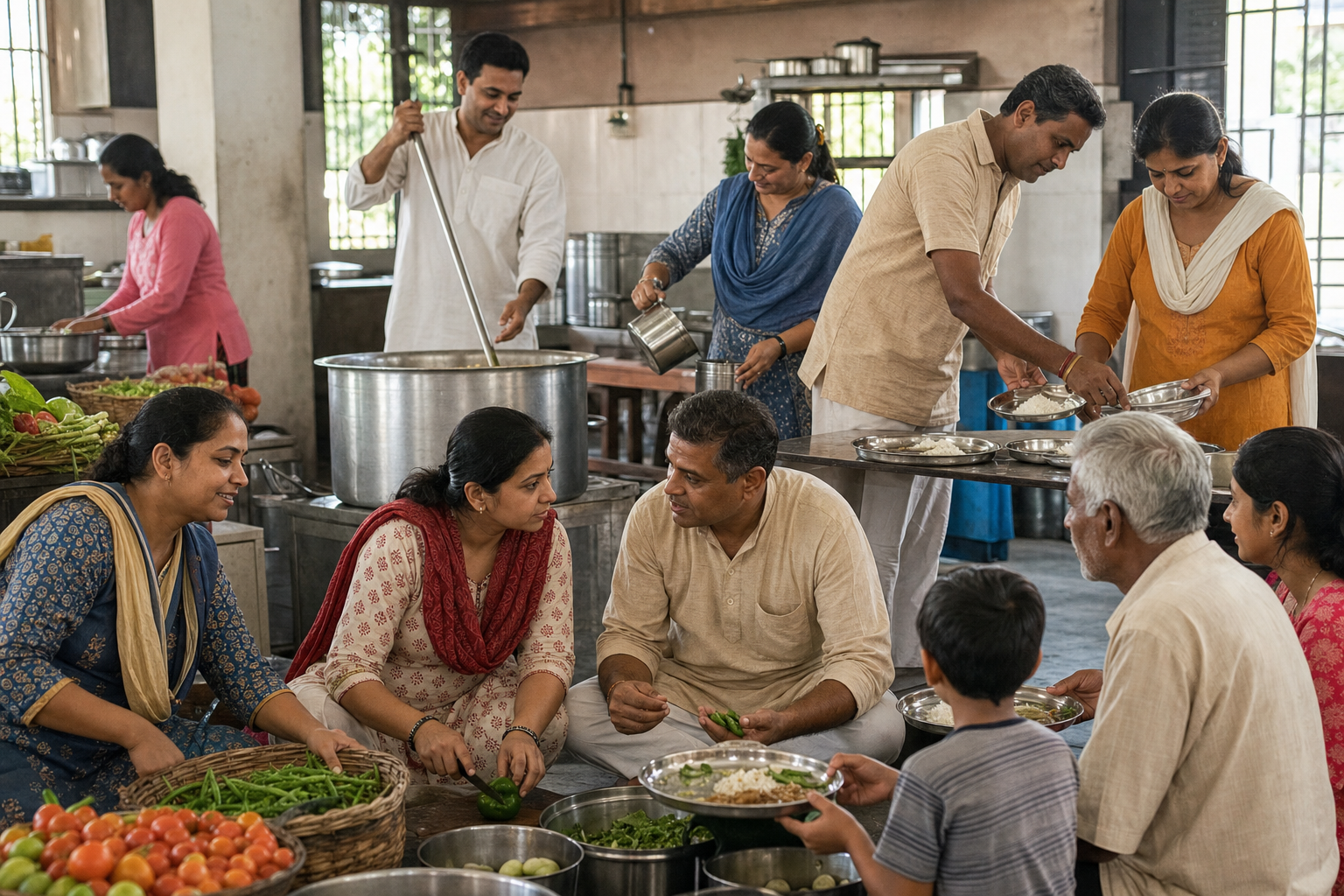
Inner calm is not enough if it coexists with deception, exploitation, or neglected duty. The yamas and niyamas give practice a structure that can be inspected in ordinary life: ahimsa, satya, non-stealing, disciplined use of energy, non-possessiveness, purity, contentment, sustained effort, self-study, and surrender.
Each principle becomes useful only when translated into the form your present life requires. Satya may require an inconvenient correction rather than a grand declaration. Non-stealing may concern credit, attention, or another person’s time. Aparigraha may ask you to release the need to own every object, argument, or outcome. Tapas may mean completing a necessary responsibility without waiting for the preferred mood.
Choose the ethical discipline at your most frequent point of friction. Then define what observance and violation look like in behaviour. A vague intention such as being more compassionate is hard to test. Listening without preparing a counterattack, refusing to humiliate an opponent, or correcting an unfair decision can be observed and reviewed.
Seva prevents sadhana from curving inward around the practitioner. It asks whether your clarity makes you more useful. Perform an available duty without turning it into a display of moral identity. Before the act, ask what is genuinely needed. During it, notice any demand for gratitude or control. After it, let the act belong to the good it served.
Recognize shared dharmic discipline without erasing differences
Hindu, Buddhist, Jain, and Sikh traditions retain their own doctrines, lineages, vows, and forms of realization. They should not be flattened into interchangeable terminology. Yet each refuses to reduce spiritual life to opinion. Meditation and breath awareness, ethical restraints, Jain samayik, Buddhist shila, Sikh simran and seva, and Hindu yoga all insist in their different ways that truth must enter conduct.
This recognition supports principled pluralism. Ishta allows devotion to take a form suited to the devotee: Krishna may awaken relational love and discernment, Shiva may draw one toward interiority, Devi may reveal power and nurture, and Ganesha may steady beginnings and obstacles. Jain Anekantavada adds a discipline of intellectual humility by reminding you that reality exceeds any single angle of description.
Pluralism does not require weak conviction. It requires you to distinguish commitment from contempt. Practise your path deeply, learn its vocabulary accurately, and refuse the vanity that treats another sincere dharmic discipline as inferior merely because its form differs from yours.
Community makes that discipline harder to evade. A guru-shishya relationship, sangha, Jain teacher-householder relationship, or Sikh sangat can provide method, correction, and examples of mature conduct. Healthy guidance should make you more truthful and responsible, not more dependent on charisma or more willing to excuse exploitation. Look for a community in which teachings are visible in the behaviour of those who hold authority.
Measure progress by what loses its hold on you
Do not make unusual experiences your main scoreboard. Early progress is often quieter. You react less quickly, catch self-deception sooner, release resentment more readily, tell the truth when concealment would be convenient, and recover from agitation without exporting it to everyone nearby.
Track events rather than spiritual self-ratings. A simple practice record can contain five entries: the trigger, the first bodily signal, the action you took, any repair still required, and the cue you will use next time. This keeps reflection tied to conduct. It also makes improvement visible when dramatic feelings are absent.
Ask someone who knows you well whether your practice is changing the atmosphere around you. Family members and colleagues may detect patterns that private reflection misses. Do you interrupt less? Keep commitments more reliably? Apologize without qualification? Carry disagreement without contempt? The answer may be uncomfortable, but embodied Dharma must be able to survive honest observation.
Key takeaways
- Test a teaching at the moment it becomes inconvenient, not only when you are reading or discussing it.
- Use breath, posture, mantra, or touch as a cue that creates space for a dharmic response.
- Place short returns to practice at transitions already built into your day.
- Pair study with paraphrase, contemplation, silent sitting, and one visible change in conduct.
- Restore attention to ritual before adding more ritual.
- Judge progress by reduced reactivity, faster repair, truthful action, dependable duty, and unadvertised seva.
Several detours can imitate progress. Collecting quotations can produce a refined vocabulary around unchanged habits. Repetition without attention can hollow out ritual. Online argument can consume the energy needed for sadhana. Activism without inner discipline can reproduce the aggression it claims to oppose. Whenever one of these patterns appears, reduce the input and return to a practice that produces an observable obligation.
At your next difficult transition, do not try to embody the whole of Sanatana Dharma at once. Remember one principle, complete one unforced breath, and perform the next duty in a way that does not betray it. That small return is where knowledge begins becoming character.