
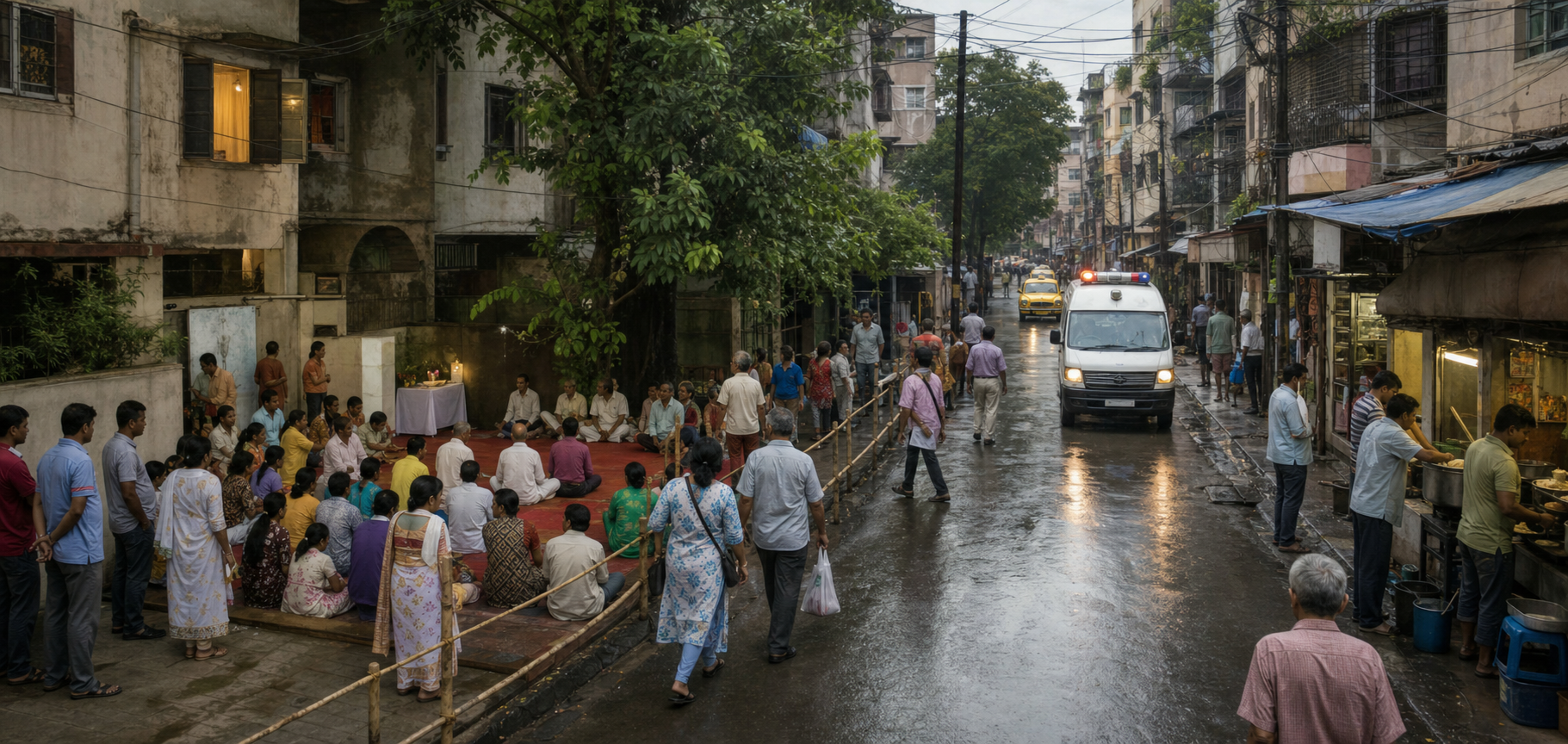
If you arrive in Rajabazar and find a road blocked during prayer, you should not have to choose between respecting worship and insisting on passage. The useful question is more concrete: was the public road being used with permission, within a narrow time and footprint, while pedestrians, traders and emergency vehicles retained workable access?
That test applies whether the gathering is Jumma Namaz, a Durga Puja installation, a Muharram procession, a Sikh Nagar Kirtan, a Jain procession or a Vaishnava kirtan. Kolkata needs neither hostility to public religion nor selective indulgence. It needs one predictable civic rulebook.
Separate the right to worship from a claim over the road
On May 16, 2026, tension reportedly arose in Kolkata’s Rajabazar over the temporary use of a public road for Jumma Namaz. The location matters. Narrow carriageways, intense footfall, busy markets and concentrated Friday attendance can turn a short interruption into a conflict among worshippers, commuters, pedestrians and shopkeepers.
Whether that particular closure had valid permission, and what its exact duration and footprint were, is not established here. Those gaps must not be filled with communal assumptions or decontextualized video clips. The legal and civic principles can still be stated clearly.
Article 25 protects freedom of religion, but expressly subjects its exercise to public order, morality and health. Article 19 protects movement as well as the ability to carry on a trade or profession. Neither set of rights erases the other. Worship enjoys constitutional protection; occupying a shared carriageway does not therefore become unconditional.
The Supreme Court’s jurisprudence on prolonged road occupation establishes a general limit on treating public ways as indefinite assembly grounds. The Calcutta High Court has likewise emphasized permission-based use of shared public space. That does not mean every brief, authorized religious use is forbidden. It means duration, authorization, safety, necessity and proportionality matter.
When you evaluate any religious use of a Kolkata road, ask five questions:
- Was permission obtained in advance, with the affected lane, route and time clearly identified?
- Could excess attendance have been accommodated in a nearby ground, courtyard, hall or other non-road space?
- Was the occupation kept to the smallest workable area and shortest workable period?
- Did pedestrians, ambulances, fire services and other emergency responders retain a clear passage?
- Would officials apply the same criteria to another religious or political gathering in the same location?
If the answer to one of these questions is no, the remedy belongs with police, municipal authorities and event organizers. Private citizens should not attempt to disperse worshippers or enforce traffic rules themselves. That creates a new public-order risk without resolving the first one.
A workable permission must govern the whole street, not just the ceremony
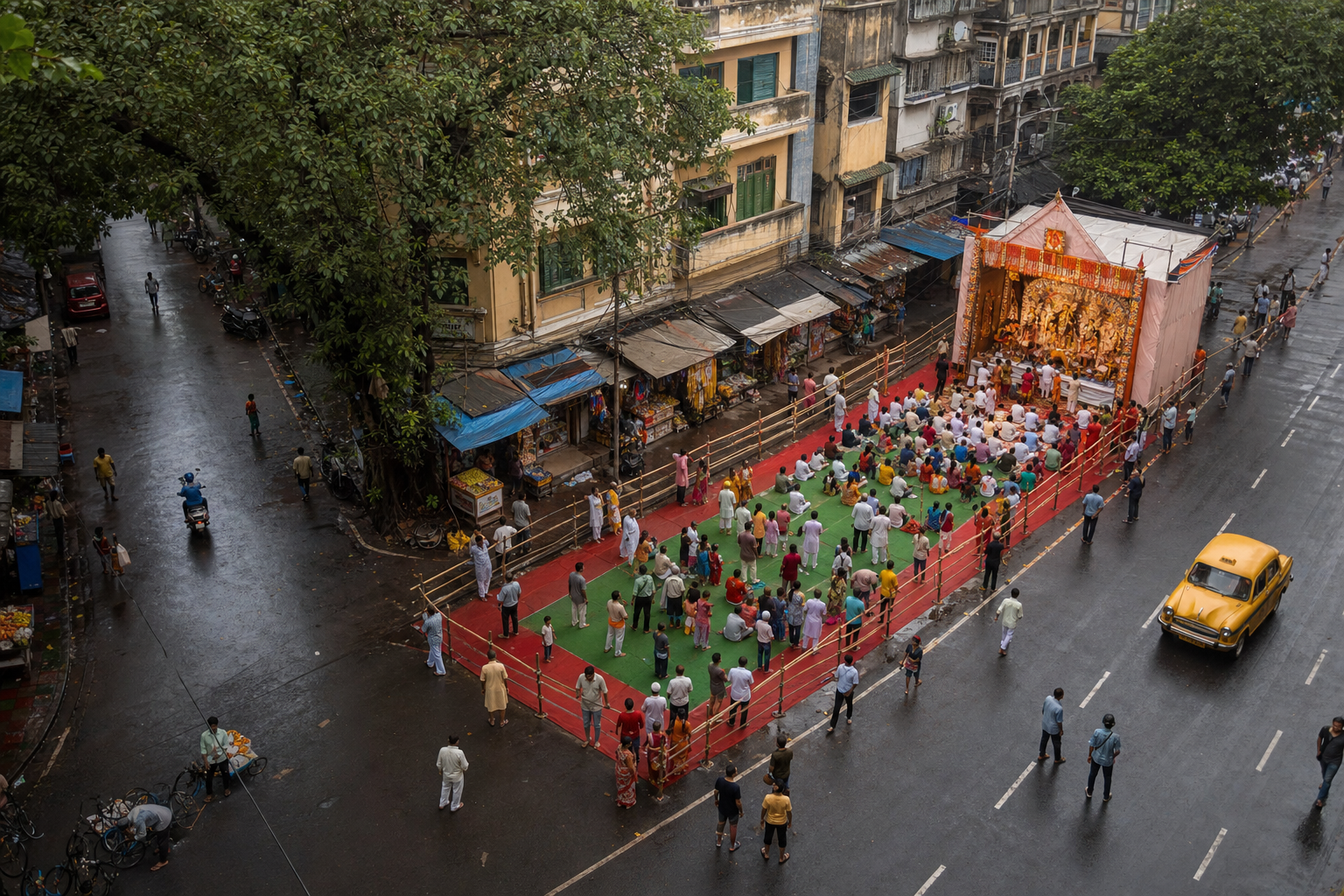
A vague understanding that a community may gather is not an adequate traffic plan. The arrangement must tell everyone what will happen before the first worshipper arrives and how normal movement will resume after the gathering ends.
- Estimate attendance before choosing the space. A mosque, temple, gurdwara or other institution should compare expected turnout with its usable internal capacity. Recurring overflow is a planning condition, not a weekly surprise.
- Use non-road overflow first. A nearby open ground or other suitable space should take priority over a carriageway whenever it can safely serve the congregation.
- Define the permitted footprint. Mark the lane or section that may be used and preserve the rest for movement. An informal spillover that expands with the crowd defeats the purpose of permission.
- Set a closure and reopening window. The plan should cover arrival, worship and dispersal. Police and volunteer stewards should know when barriers move and who confirms that the road is clear.
- Separate entry, exit and through-movement. Ingress and egress routes should not converge at the narrowest choke point. Pedestrians who are not attending still need an intelligible way around the gathering.
- Protect emergency access without exception. An ambulance lane, hydrant access and a police response path cannot be treated as optional because the closure is brief.
- Notify the neighborhood early. Signs at the affected approaches, multilingual notices and police or civic alerts should state the road, time and diversion. A notice that appears only after traffic is trapped has failed.
- Reopen promptly and review what went wrong. Barriers, mats and temporary equipment should be removed as soon as dispersal permits. Recurring congestion should trigger a revised plan before the next gathering.
Minimal disruption is the governing discipline. If guided dispersal can restore a lane within a short period, a broad neighborhood closure is excessive. If one lane is sufficient, two should not be taken. If a non-road location can absorb overflow, convenience alone should not transfer the burden to commuters and traders.
Equal treatment does not require identical arrangements at every event. A procession moves; congregational prayer remains in one place; a puja installation may affect a junction for longer. Officials should apply the same decision criteria while tailoring the route, footprint and duration to the actual event.
Crowd pressure can become dangerous before tempers rise
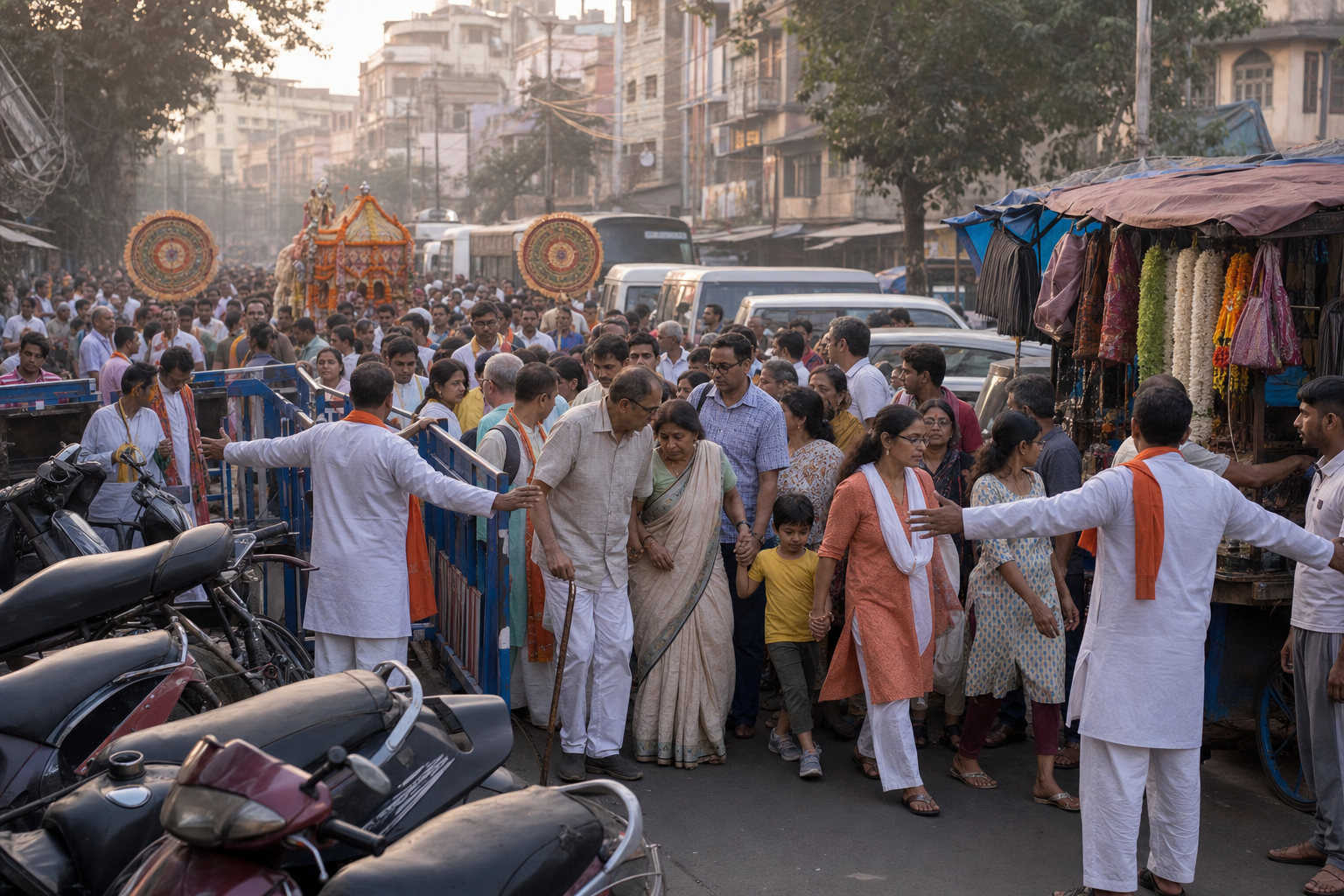
Road access is not only a dispute about convenience or legal principle. It is also a crowd-safety problem. As density approaches four to five people per square metre, mobility and situational awareness deteriorate. At that point, a blocked exit, sudden counterflow or attempt to force a vehicle through can expose worshippers and passers-by to avoidable danger.
Organizers should therefore map more than the prayer area. They need to identify narrow carriageways, corners, bus movements, market entrances, loading points and emergency corridors. Expected attendance should then be overlaid on those constraints. The objective is to stop crowd compression before it forms, not to manage it after people can no longer move freely.
Visible stewards are essential. Their duties should be practical and limited: guide arrivals, keep the marked boundary intact, preserve exits, direct overflow to the approved alternative space, support orderly dispersal and relay verified instructions. Volunteers should also receive basic first-aid and rumor-control training. They are not a substitute for police and should never act as an informal coercive force.
If you encounter a visibly compressed crowd, do not push through it or steer a two-wheeler into the flow. Move away from the pressure point using the route indicated by police or stewards. Report a fallen person, medical emergency or obstructed ambulance immediately. A debate about responsibility can wait; restoring safe movement cannot.
What to do when a religious gathering blocks your route
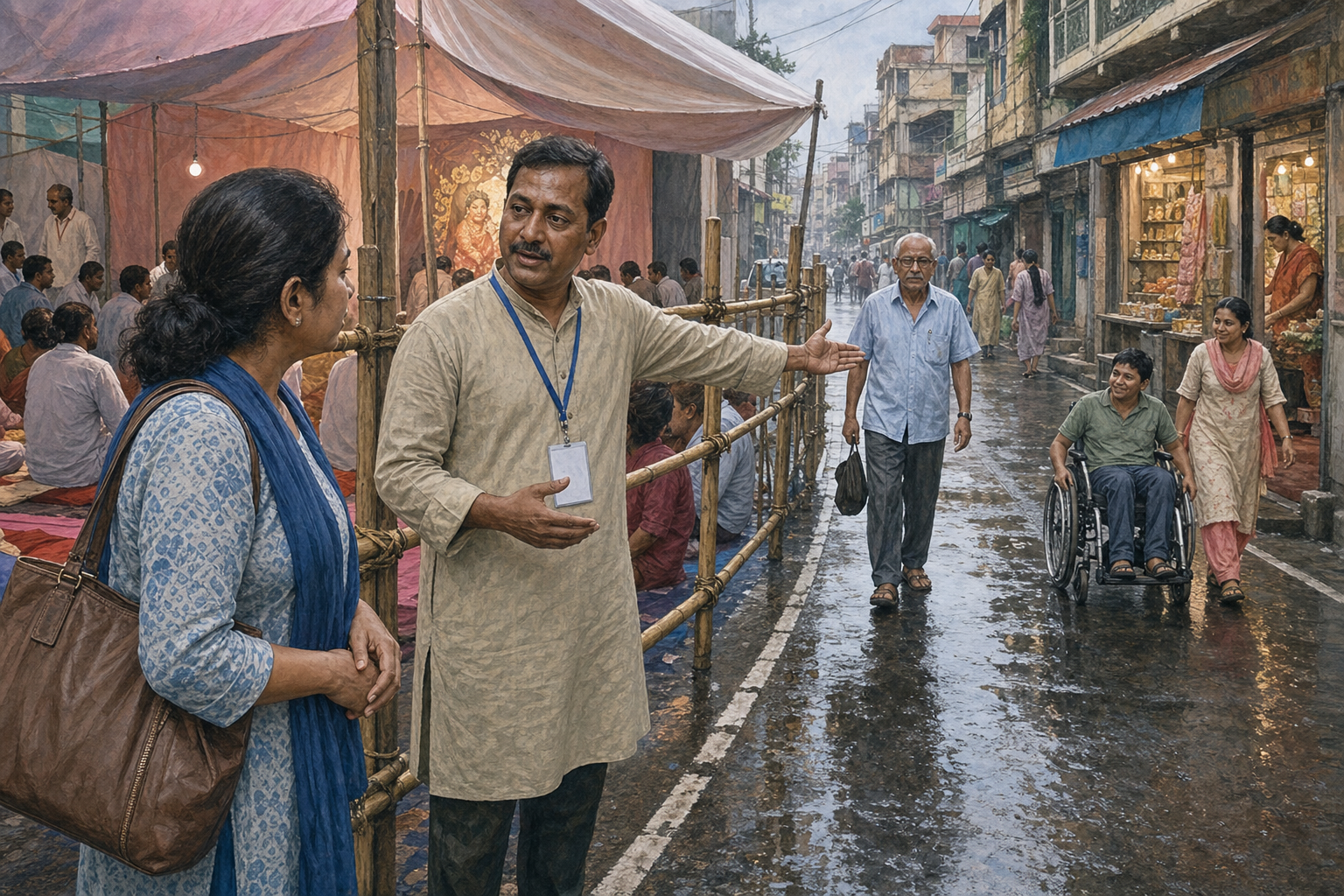
Your response should depend on the problem in front of you. An emergency, a delayed commute, a blocked shop entrance and a recurring unauthorized occupation do not call for the same action.
- State urgent needs plainly. If you are carrying a patient, responding to an emergency or need access for an emergency vehicle, tell the nearest police officer or designated steward at once. Do not try to negotiate your way through the congregation.
- Use the managed diversion. A slightly longer route is safer than forcing a car or motorcycle into a dense pedestrian area. If no diversion is marked, ask police for the safest available exit.
- Record operational facts. Note the exact road, affected lanes, approximate start and reopening times, whether pedestrian or emergency access remained open, and whether advance signs were visible. These details make a civic complaint useful.
- Do not forward contextless clips. A short video may omit the permission, duration, diversion or police instructions. Check verified bulletins from Kolkata Police, the relevant borough office or the responsible faith institution before amplifying a claim.
- Ask for a specific remedy. Request an off-road overflow site, an earlier notice, a protected loading window, a narrower footprint, a clearer diversion or a fixed reopening time. A remedy-focused representation is harder to dismiss than a general accusation against a community.
- Escalate serious consequences properly. If the incident involves injury, property damage, detention or a recurring restriction you believe unlawful, preserve your records and seek advice from a qualified lawyer. Social-media commentary is not a substitute for advice on your individual legal position.
Traders should pay particular attention to timing. Friday midday overlaps with market activity and daily-wage livelihoods in Rajabazar. A recurring plan can preserve loading access before the gathering, shift it for a defined interval and restore it immediately afterward. Without that precision, even a brief closure can transfer the cost of accommodation to people least able to absorb it.
A dharmic standard requires parity and self-restraint
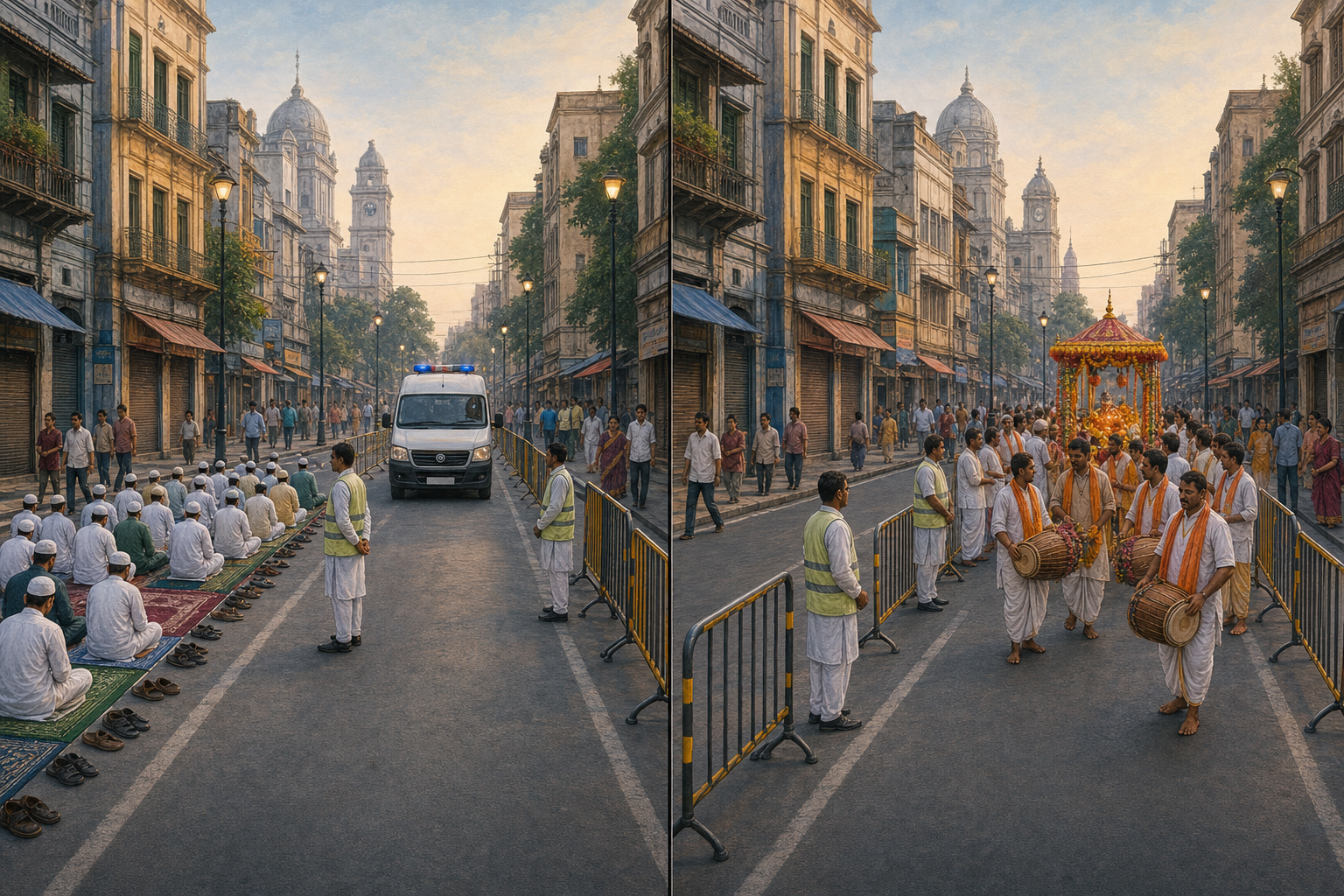
For a dharmic audience, equal rules are not an argument for driving religion out of public life. Bharat’s traditions have long expressed devotion through yatra, seva, kirtan, festival, procession and collective worship. The relevant distinction is between visible religious life and an unchecked claim to a shared civic asset.
Hindus do not weaken the protection of Durga Puja, a shobha yatra or a Vaishnava kirtan by insisting that public-road rules also govern Jumma Namaz. We strengthen the demand that the state act without appeasement, prejudice or selective enforcement. The same is true for Sikhs protecting Nagar Kirtan, Jains organizing a Paryushan procession and Muslims assembling for Friday prayer.
Parity must be visible in administration, not merely promised in speeches. Police and municipal officials should publish the criteria used for temporary closures, apply them across traditions and explain any location-specific difference. Communities are more likely to accept inconvenience when they know its limits and can see that their neighbors face the same rule.
Kolkata would benefit from a standing multi-faith coordination cell that meets regularly rather than assembling only after tension. Imams, mahants, seers, bhikkhus, granthis, Jain representatives, police, municipal officers, traders and residents could keep its agenda strictly operational:
- Maintain an inventory of suitable overflow spaces that do not obstruct arterial roads.
- Map recurring religious schedules against bus movements, market cycles and known choke points.
- Train a shared pool of volunteer marshals in first aid, basic traffic guidance and rumor control.
- Agree on multilingual notification templates so residents receive the same essential information for every tradition.
- Review each significant closure for delayed reopening, crowd compression, blocked access and preventable commercial disruption.
- Update standard operating procedures before the next event instead of relying on memory or informal bargaining.
This is not theological dialogue disguised as traffic management. It is neighborhood stewardship. When representatives solve ordinary questions about lanes, timings, exits and notices together, they build trust before a provocative message or disputed video tests it.
Key takeaways
- Freedom of worship does not create an unconditional right to occupy a public road; restrictions must still be lawful, proportionate and even-handed.
- Non-road overflow space should be the first option. Any road use should be authorized, demarcated, time-bound and stewarded.
- Emergency access is non-negotiable, even during a short closure.
- Crowd density nearing four to five people per square metre is a safety warning, not merely an inconvenience.
- Residents and traders should document times, lanes, access failures and missing notices, then ask authorities for a concrete operational remedy.
- The same criteria must govern Jumma Namaz, Durga Puja, Muharram, Nagar Kirtan, Jain processions and other public religious observances.
If you are a resident, trader, commuter or faith-committee member, take one practical request to the relevant police and civic officials before the next gathering: identify the off-road overflow site, protected emergency path, permitted time and reopening plan. Kolkata’s pluralism will be safer when accommodation is planned in advance and bounded by equal law.