
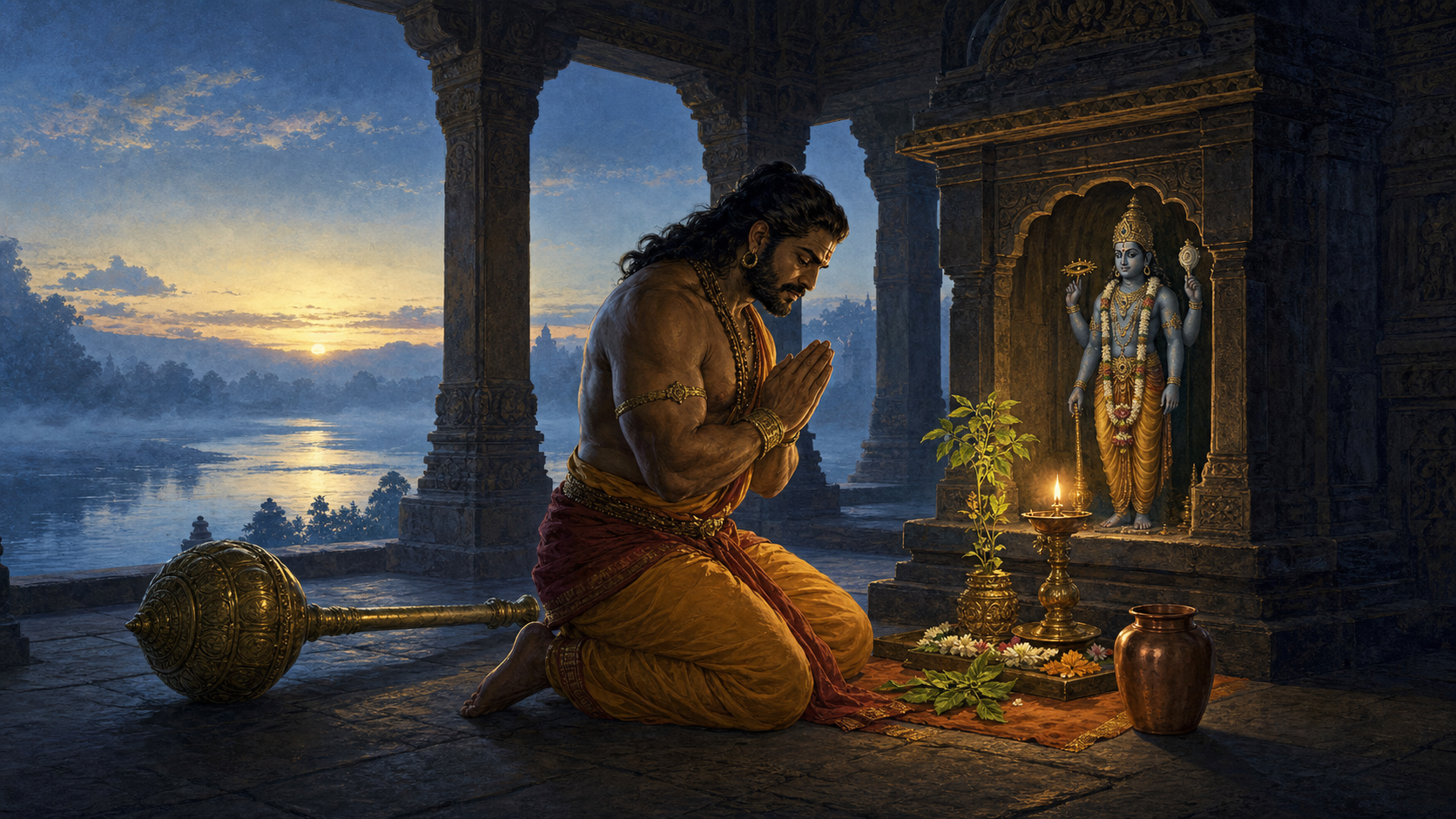
If you are deciding whether to keep Nirjala Ekadashi, the hardest question is not whether you can endure one day of thirst. It is whether the vow you make will be truthful, devotional, and safe. Bhima’s own difficulty with fasting is precisely why this vrata bears his name.
For 2026, most Indian panchangs place Nirjala Ekadashi on Thursday, 25 June, with Dwadashi parana on Friday, 26 June. Your civil date and fast-breaking window can differ outside India or under a particular sampradaya, so settle the local timing before taking your sankalpa.
Bhima’s difficulty is the point of the vrata
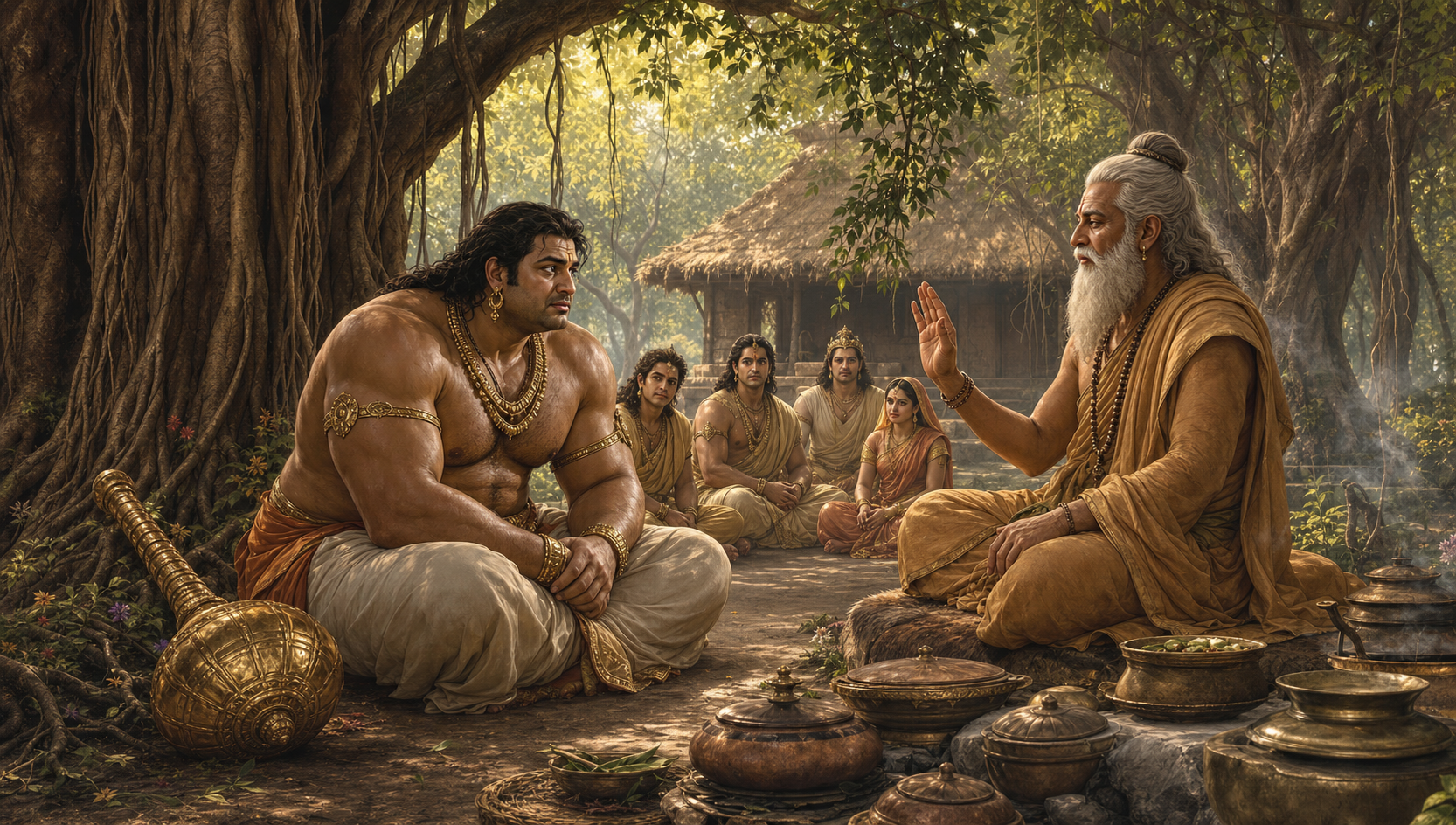
Bhima was renowned for strength, courage, and an enormous appetite. Yet the regular Ekadashi fast was difficult for him. He did not solve that difficulty by pretending to possess a discipline he could not maintain. He approached Veda Vyasa and asked for a path he could follow honestly.
The answer was one exceptionally demanding observance: a waterless fast on Jyeshtha Shukla Ekadashi. The traditional account of Bhima’s fast holds that its punya is equivalent to observing the twenty-four Ekadashis of an ordinary lunar year. This association gives the day its other familiar names: Bhima Ekadashi, Bhimseni Ekadashi, Pandava Ekadashi, and Nirjala Ekadashi.
That teaching should not be reduced to spiritual arithmetic. Nirjala Ekadashi is not a loophole through which one difficult day purchases permission to neglect remembrance for the rest of the year. Bhima accepts a concentrated discipline suited to his actual limitation. His example joins three things that are often separated: honesty about capacity, trust in guidance, and wholehearted effort once a vow has been chosen.
This also clarifies the meaning of upavasa. The word points to dwelling near the Divine. Abstinence is the outer structure; nearness to Vishnu is the purpose. If the entire day is spent counting the hours until food and water return, the dietary rule may have been kept while much of the opportunity has been missed. Japa, worship, restraint of speech, scripture, and seva are what turn hunger into sadhana.
Choose a form you can keep without harming yourself

Strict Nirjala means no food and no water from the beginning of the Ekadashi observance until the prescribed Dwadashi parana. It is intentionally exacting, and the hot Jyeshtha season can make water abstention especially demanding. Do not treat physical danger as proof of devotion.
Traditional exemptions include children, older people, pregnant or nursing women, people who are infirm or have medical conditions, and those doing strenuous physical work. If water is required for your health or prescribed medicine, strict Nirjala is not the appropriate form of the vrata. Do not skip medicine or change its timing merely to preserve a fast; discuss fasting with a qualified clinician who knows your condition.
- Strict Nirjala: Abstain from both food and water until the proper Dwadashi parana. Choose this only if it is safe for you and you can reduce exertion throughout the observance.
- Water-only or phalahara Ekadashi: Take water, or fruit and other foods permitted by your family or sampradaya, while continuing to avoid grains and beans. State this form clearly in your sankalpa rather than promising a waterless fast.
- Standard anna-tyaga: Give up grains and beans while following the Ekadashi rules taught in your tradition. Increase japa, study, and Vishnu worship so the observance does not become merely a change of menu.
- Manasa upavasa: When fasting itself is unsuitable, keep the mind close to Vishnu through nama-japa, simple sattvika food, self-restraint, charity, and service.
A modified vrata is not a dishonest Nirjala; it is an honest Ekadashi suited to your capacity. Make that decision before the day begins. If you become faint, confused, or acutely unwell during a strict fast, stop, take water, and obtain medical help. Ahimsa includes the body through which you are trying to perform the sadhana.
Plan the observance from Dashami to Dwadashi
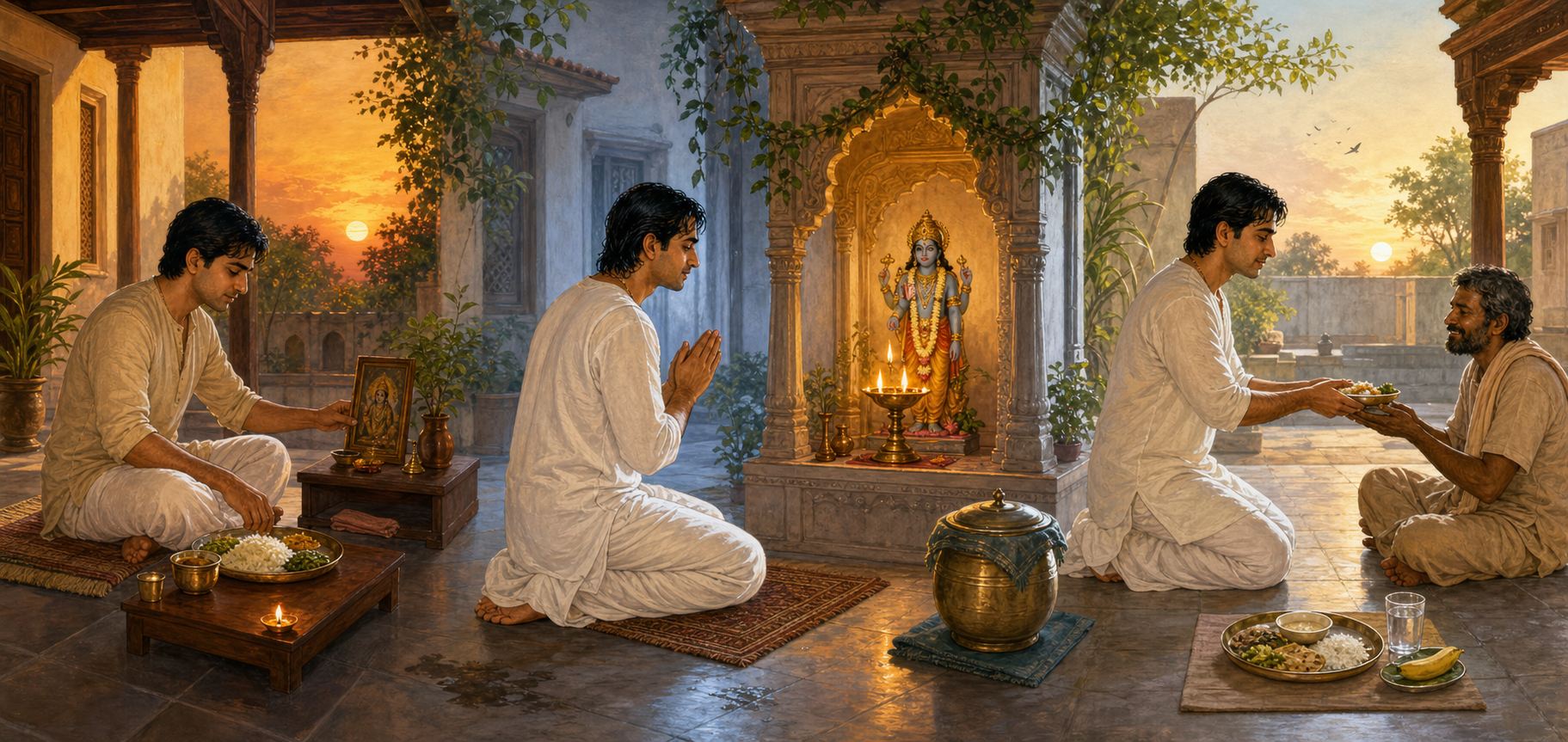
The avoidable mistakes usually occur before the fast starts or when it ends. A heavy Dashami evening, an unclear sankalpa, strenuous work scheduled for Ekadashi, or an assumed parana time can turn a disciplined vrata into confusion. Use the following sequence.
- Confirm the local calendar. Look up Jyeshtha Shukla Ekadashi in a panchang calculated for your location. Record the observance date, local sunrise, the end of Hari Vasara, and the stated Dwadashi parana window. Do not copy an Indian time into a diaspora calendar.
- Check your sampradaya’s rule. Smarta and Vaishnava calendars can occasionally assign observance to different civil dates because they apply sunrise and tithi-overlap rules differently. Follow the panchang, temple, guru-parampara, or family convention you normally use.
- Prepare on Dashami. Eat a light sattvika evening meal, avoid intoxicants and tamasic habits, and reduce unnecessary stimulation. Clean the altar and arrange the lamp, flowers, Tulasi, incense, and reading material before the fast begins.
- Make an exact sankalpa on Ekadashi morning. After bathing, state the form you are observing: strict Nirjala, water-only, phalahara, anna-tyaga, or manasa upavasa. Dedicate it to Sri Vishnu and ask for steadiness, purity of mind, and freedom from vanity.
- Keep the day for Vishnu. Worship Narayana, Krishna, Vamana, or the form of Vishnu honored in your home. Offer Tulasi, flowers, a lamp, and water to the Deity even though a strict observer does not personally drink it.
- Reduce physical and sensory strain. Stay out of unnecessary heat, postpone strenuous exercise or labor where possible, and do not fill the day with entertainment. The energy saved should go toward remembrance rather than distraction.
- Perform parana at the stated time. Parana is not automatically at midnight and should not be guessed from sunrise alone. On Dwadashi, wait until sunrise and until Hari Vasara, the first quarter of Dwadashi, has passed. Then break the fast within the local panchang’s prescribed window.
Many traditions begin parana with Tulasi-sanctified water, tirtha, or charanamrita, followed by light sattvika food. After a long waterless period, a heavy celebratory meal defeats the body’s need for a careful transition. Keep the first intake simple, and let gratitude rather than appetite set the pace.
Give the day a devotional rhythm, not an empty schedule

Thirst repeatedly pulls attention toward the body. You need a prepared response each time that happens. Choose one short mantra for repetition, one substantial recitation or reading, and one act of seva. A complicated programme is less useful than a modest one you will actually sustain.
- For japa: Repeat Om Namo Narayanaya, Om Namo Bhagavate Vasudevaya, or the Hare Krishna Mahamantra according to your practice.
- For recitation: Read or chant Vishnu Sahasranama. Bhagavad-Gita Chapter 15, Purushottama Yoga, or a selected Bhagavata passage can anchor a quieter period of reflection.
- For the evening: Light a lamp, perform simple archana, and join kirtan or bhajan if available. Jagaran may be kept where health and circumstances permit; otherwise, mindful rest is better than forcing an exhausted vigil.
- For conduct: Restrain anger, gossip, compulsive media use, and needless argument. Fasting from food while feeding agitation leaves the senses in command.
Practices involving water vary. Some lineages permit minimal achamana for ritual purity, while others defer even charanamrita until parana. Follow the maryada you received rather than combining rules from unrelated traditions midway through the vrata.
Nirjala reaches its fullest ethical expression when personal thirst awakens care for the thirst of others. Jal-dana can mean supporting a public water point, donating a matka, supplying safe drinking water, helping animals and birds through the hot season, or contributing umbrellas and cooling aids. Tree-shade work and community food service extend the same concern beyond a single day.
Arrange this seva before Ekadashi if you plan to keep a strict fast. You should not have to travel in severe heat or perform heavy work while dehydrated. A family member, temple group, or community organisation can handle distribution while you sponsor, prepare, or support it. The symbolism is exact: the water you voluntarily forgo becomes water freely offered to another being.
Key questions before you take the sankalpa
Are Nirjala, Bhima, Bhimseni, and Pandava Ekadashi different days?
No. These names refer to the same vrata on Jyeshtha Shukla Ekadashi. Nirjala names its waterless discipline, while Bhima, Bhimseni, and Pandava Ekadashi recall its connection with Bhima.
Does this fast really equal all twenty-four Ekadashis?
Vaishnava vrata tradition attributes the accumulated punya of the year’s Ekadashis to a devout and correctly observed Nirjala Ekadashi. Receive this as praise of concentrated devotion, not as a transaction or permission to abandon regular sadhana. The teaching asks for sincerity, self-mastery, Vishnu-bhakti, and charity together.
Does taking a sip of water end strict Nirjala?
Ordinary drinking is incompatible with the strict waterless form. Rules for minimal achamana differ by lineage. If you must drink for health, do so; continue the day as a modified Ekadashi with japa and worship rather than hiding the change or endangering yourself.
What are the correct 2026 date and parana time?
Most Indian almanacs place the vrata on Thursday, 25 June 2026, and Dwadashi parana on Friday, 26 June. The exact parana window depends on local sunrise, tithi boundaries, Hari Vasara, and sampradaya convention. A reliable location-specific panchang is therefore part of the observance, not an optional detail.
Before you take the vow, open your local panchang, choose the form that is safe for your body, write down the parana window, and select your mantra and jal-dana. Then keep the commitment without display. Bhima’s fast is powerful because limitation was acknowledged honestly and answered with disciplined devotion.
References
- Hindu Pad – Bhim Ekadashi (Nirjala) 2026: Exact Date, Transformative Fasting Guide & Pandava Heritage
- Hindu Pad – Nirjala Ekadashi 2026: Ultimate Waterless Vrat Guide – Date, Vidhi, Parana, and Profound Blessings