
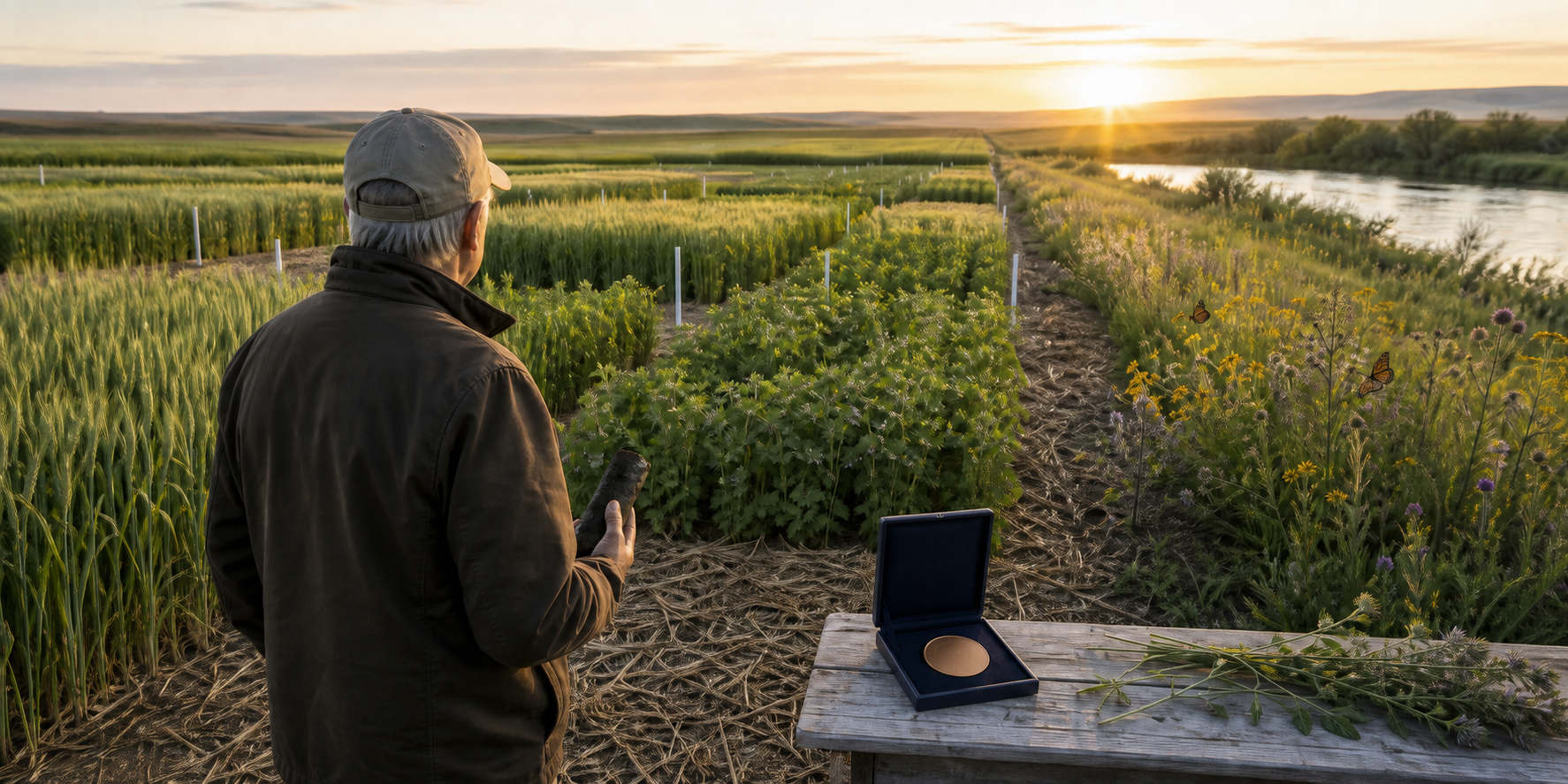
You may have seen Dr. Sahota’s CSA honour and wondered whether it is simply professional recognition or whether it tells you something useful about the future of farming. The better question is this: what kind of agronomic leadership deserves to be honoured when farmers must protect yields, livelihoods, soil, water and biodiversity at the same time?
Dr. Sahota’s recognition points to an answer: sustainable agronomy becomes credible when scientific rigour leads to decisions that work in actual fields. That gives you a practical standard for evaluating a new input, a farming practice, a research programme or an agricultural policy.
What the CSA honour tells us, and what it does not
The Canadian Society of Agronomy honours leadership that advances crop and soil science through combinations of research, teaching, extension and professional service. The important word is leadership. Producing an interesting result is valuable, but agronomic leadership carries that result across the difficult boundary between a controlled experiment and a farmer’s decision.
Without the formal award citation, it would be careless to attach unverified projects, numerical outcomes or career milestones to Dr. Sahota. The responsible reading is narrower and more useful: the honour recognises agronomic leadership, while its wider significance lies in the standard that such recognition places before the profession.
Read that standard at two levels. At the personal level, the honour acknowledges sustained professional contribution. At the public level, it signals that good agronomy must join scientific knowledge to farmer realities, environmental stewardship and resilient food production. An agronomist has not completed the work merely by identifying what can increase yield. The next questions are whether the result is repeatable, profitable, locally appropriate and compatible with the long-term condition of soil and water.
This distinction matters because the word sustainable is easily weakened. A practice does not become sustainable because it uses less of one input, carries an ecological label or incorporates a digital tool. It must produce a defensible chain of outcomes: a well-defined intervention, a measurable field response, a viable farm result and an environmental consequence that has not simply been shifted elsewhere.
Sustainable agronomy needs a complete evidence chain
Judge the cropping system, not an isolated input
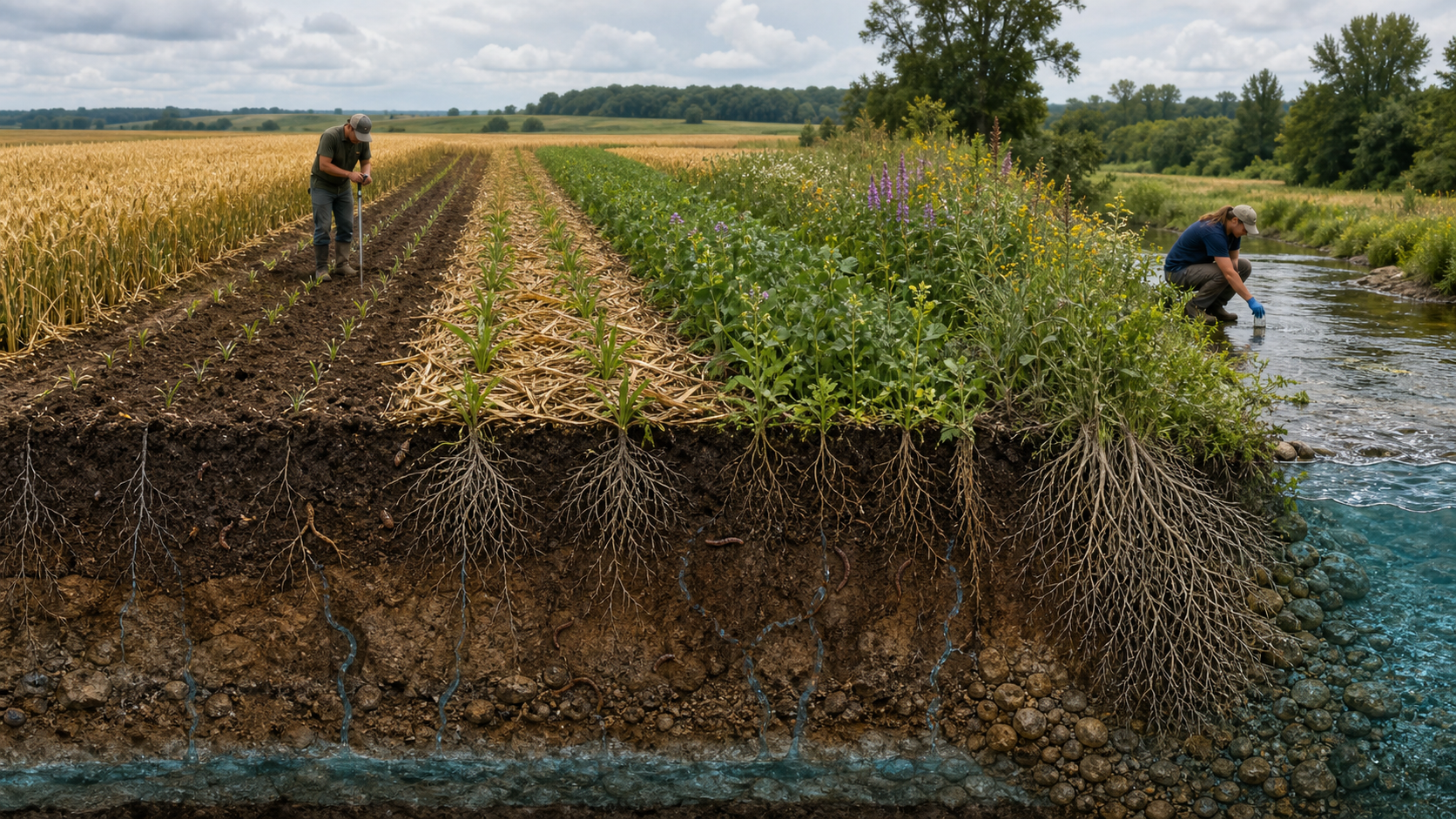
A single-season yield response can be real without revealing what happens to the whole system. Multi-year rotations involving cereals, oilseeds and pulses can alter nitrogen cycling, water use, disease pressure and pest cycles. Those effects may emerge over different parts of the rotation, so the correct unit of judgment is often the sequence of crops rather than the crop presently being harvested.
When you assess a rotation, ask what mechanism is expected to change. Is a pulse contributing to nitrogen supply? Is rotational diversity interrupting a pathogen or weed cycle? Is residue protecting the soil or delaying establishment under local conditions? Naming the mechanism tells you what must be measured and when a disappointing result should lead to adaptation rather than a vague claim that sustainability takes time.
Soil health requires the same discipline. Soil organic carbon is important, but no single indicator describes the entire soil. Aggregate stability, particulate organic matter, potentially mineralisable nitrogen, permanganate-oxidisable carbon, infiltration and bulk density illuminate different functions. Select indicators that correspond to the proposed benefit. If the claim concerns water entry, measure infiltration. If it concerns nitrogen supply, examine a biologically relevant nitrogen indicator. A convenient measurement that cannot test the claim is not evidence.
Connect nutrient efficiency to water and air
The 4R nutrient-stewardship framework asks whether a farmer is using the right nutrient source, at the right rate, at the right time and in the right place. Each choice affects the others. A suitable rate applied at the wrong time can still be lost, while careful placement cannot rescue a rate that ignores crop demand and soil supply.
Use more than one efficiency measure. Agronomic efficiency asks how much additional crop output is obtained from the nutrient applied. Partial factor productivity relates total output to the amount of nutrient used. Recovery efficiency asks how much of the applied nutrient the crop recovers. These measures answer different questions; improving one does not automatically prove that the whole nutrient system has improved.
The field boundary is not the environmental boundary. In landscapes with tile drainage, dissolved phosphorus can leave through pathways that are easy to miss when evaluation stops at the soil surface. Subsurface nutrient placement, controlled drainage, riparian buffers and edge-of-field wetlands address different parts of that pathway. Phosphorus indices and field-scale mass balances can help connect a farm decision to its watershed consequence. The practical lesson is simple: trace where a nutrient can travel before declaring that a loss has been prevented.
Make precision agriculture prove its precision
A yield map, satellite image or soil-sensor layer describes variability. It does not by itself tell you what action will improve the field. Precision agriculture becomes agronomy only when the data changes a decision: where to alter seeding, how to vary fertiliser, which management zone needs investigation or where no change is justified.
Replicated strip trials are especially useful because field variability can otherwise make a promising treatment look effective when it merely occupied better ground. Keep the comparison interpretable, repeat treatments across relevant zones and record the management and weather context. Bayesian methods or machine-learning models can help analyse noisy field data, but sophisticated analysis cannot repair a comparison that was poorly designed.
Before paying for another data layer, ask what decision it will alter, how that decision will be tested and what result would cause you to stop using it. If nobody can answer those questions, the technology may be producing information without producing agronomic value.
Build resilience without creating a new vulnerability
Reduced tillage, residue retention, cover crops, interseeding and living mulches can protect soil and moderate environmental stress. They also interact with water availability, crop establishment and the length of the growing season. In a short season, species choice and termination timing can determine whether a cover crop protects the main crop’s environment or competes with it.
That is why climate resilience is not a catalogue of approved practices. It is the matching of cultivar, phenology and management to a particular environment and risk. The relevant test is not whether a practice is generally beneficial, but whether it improves the stability of the local system under the stresses that matter there.
Integrated pest management follows the same logic. Threshold-based scouting, degree-day models, competitive crop canopies, varied modes of action, mechanical interventions and harvest weed-seed control are tools within a decision process. IPM does not mean refusing every intervention. It means acting on evidence while reducing avoidable treatment, resistance pressure and dependence on any single control.
Biodiversity should also be tied to function. Rotational diversity, pollinator-friendly margins and habitat strips may support beneficial insects, while roots, microbes and mycorrhizal relationships influence nutrient cycling and disease suppression. Ask which organisms or ecological processes a practice is intended to support and how that support connects to the farm system. Biodiversity invoked only as a general virtue is difficult to manage and impossible to verify.
A field-ready test for any sustainability claim
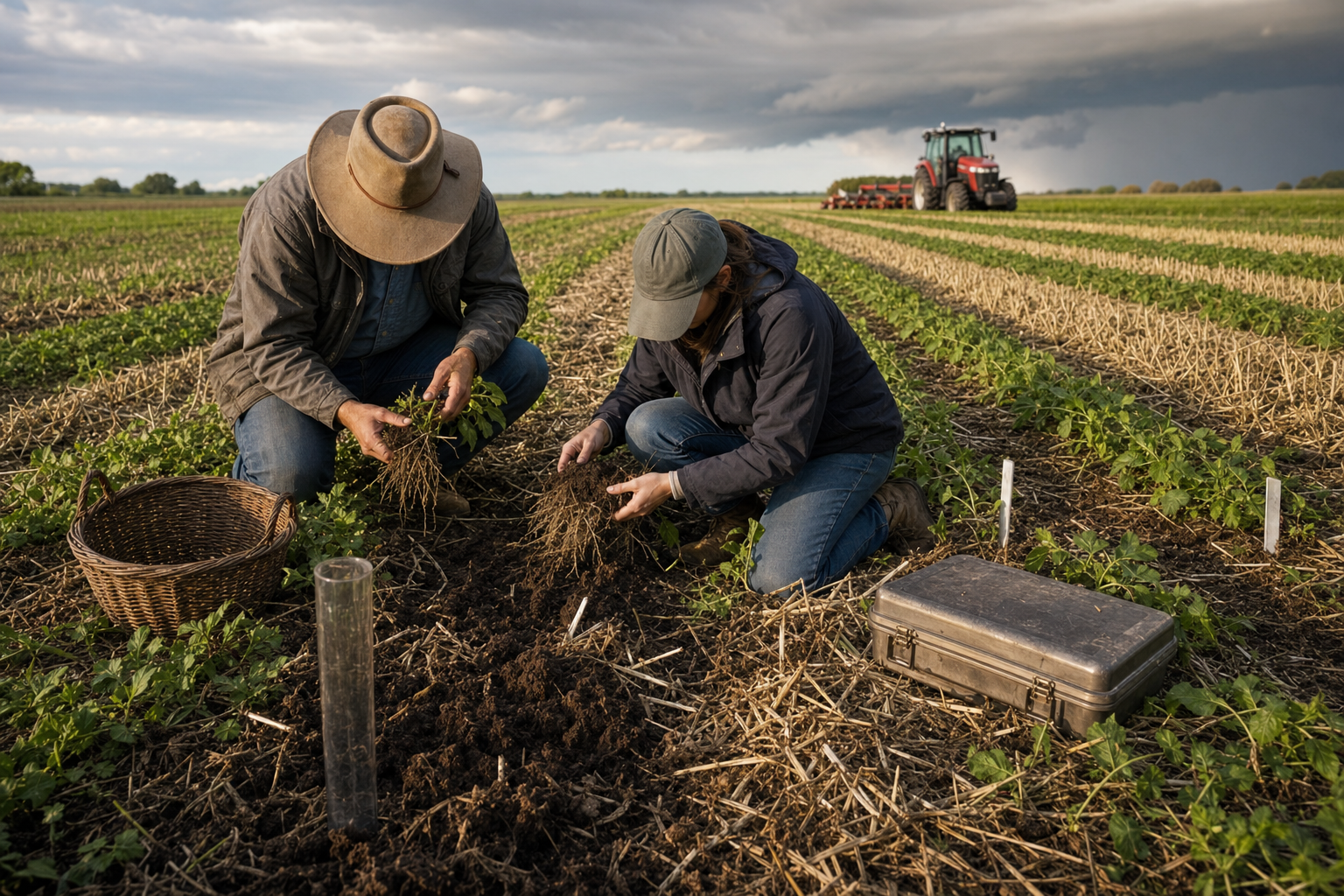
You do not need a laboratory to ask disciplined questions. Before adopting, recommending or funding an agronomic practice, work through this sequence:
- Name the constraint. State whether the problem is unstable yield, nutrient loss, poor infiltration, pest resistance, input cost, drought exposure or something else. A practice cannot be evaluated against an unnamed problem.
- Describe the mechanism. Explain how the proposed change should affect that constraint. This determines what you need to observe instead of leaving success open to reinterpretation.
- Establish a fair comparison. Use a baseline and, where practical, replicated strips within comparable parts of the field. Do not treat differences between unrelated fields as proof of treatment effects.
- Choose a balanced scorecard. Include yield stability and net return alongside relevant soil, nutrient, water, greenhouse-gas or biodiversity measures. Select only metrics capable of testing the stated mechanism.
- Track the whole pathway. Check whether an apparent improvement has moved a cost or pollutant to another season, field, waterway or part of the farm business.
- Use the right time horizon. A fertiliser-rate decision may show a rapid crop response, while soil-carbon change or rotation effects require repeated observation. Do not force every outcome into a single-season verdict.
- Test whether people can use it. Include labour, safety, equipment, management complexity and farmer knowledge. An intervention that works only under conditions farmers cannot maintain is not yet a practical solution.
For a whole-field change involving nutrient rates, drainage or an unfamiliar cover-crop system, use locally relevant soil, climate and regulatory guidance. A poorly matched change can reduce income or redirect environmental loss instead of preventing it. Start with a comparison that preserves the farmer’s ability to learn and adjust.
Credible measurement also protects farmers from exaggerated expectations. Environmental farm plans, cost-sharing programmes and carbon markets depend on measurement, reporting and verification. Before accepting a claimed benefit, ask what was measured, where the boundary was drawn, how long it was observed and whether the same outcome would have occurred without the intervention.
Dharmic stewardship raises the standard of evidence
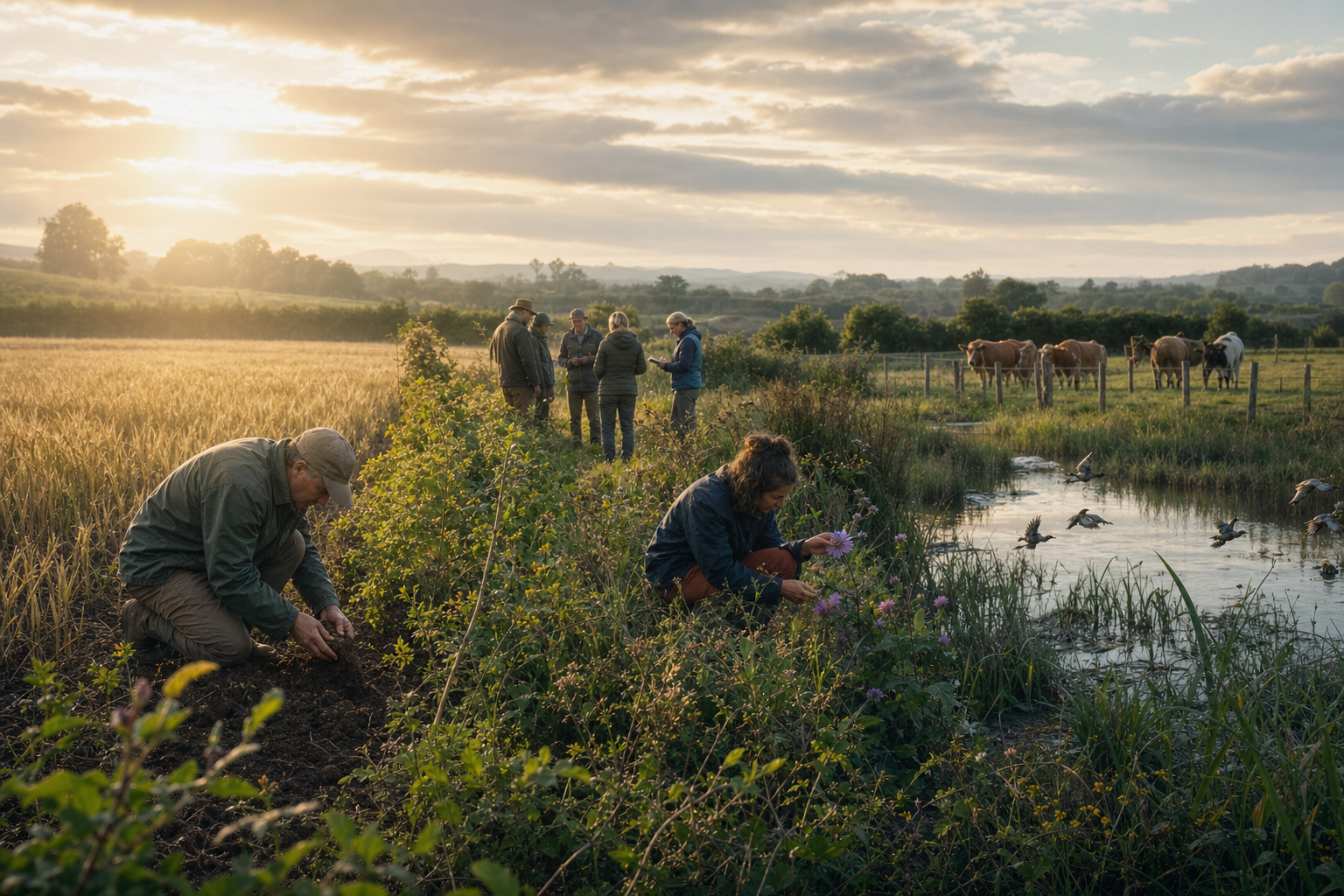
Ahimsa and Seva offer a moral vocabulary for sustainable agriculture without replacing agronomic evidence. Ahimsa directs attention toward avoidable harm to living systems. Seva asks whether knowledge and professional skill are being used in service of farmers, workers, consumers and the communities that inherit agricultural land and water.
Neither principle permits sentimental shortcuts. Agriculture cannot avoid every disturbance, and a farm cannot serve its community if it is made economically unviable. Yet profitability cannot justify exporting preventable costs to water bodies, future soil fertility or rural health. Responsible stewardship holds those realities together rather than using one to erase the others.
This is where the Dharmic outlook adds something important to technical sustainability. It treats restraint, service and responsibility as active disciplines. Asking whether a nutrient is applied at the right rate is simultaneously a scientific question, an economic question and a question about avoiding waste. Protecting beneficial organisms is not merely a public-relations gesture when those organisms participate in the ecological processes on which cultivation depends.
The Guru-Shishya spirit also illuminates why mentorship and knowledge transfer matter. A strong agronomic leader does more than issue recommendations. Such a leader equips researchers, advisers and farmers to understand the reasoning, test it in their own conditions and teach others. Field days, living laboratories, peer learning and farmer-researcher collaboration turn knowledge from a private possession into a shared capacity.
For readers considering agriculture in Bharat, the lesson is not to copy Canadian prescriptions without adaptation. Soil, climate, farm structure and institutions shape what will work. The transferable part is the method: long-term observation, region-specific trials, farmer participation, transparent measurement and accountability for both livelihood and ecological outcomes.
Key takeaways
- Dr. Sahota’s CSA honour is a meaningful signal of agronomic leadership, but it should not be expanded into unverified claims about particular projects or results.
- A sustainable practice must connect a defined intervention to a measurable field response, a viable farm outcome and an environmental consequence.
- No single indicator proves sustainability. Match soil, nutrient, water, climate and biodiversity metrics to the mechanism being claimed.
- Precision tools create value only when their data changes a decision and that decision is tested through an interpretable field comparison.
- Ahimsa and Seva deepen agronomic responsibility by keeping avoidable harm, farmer well-being and service to future communities within the same frame.
At your next field day, planning meeting or policy discussion, take one proposed practice and ask three questions: What precise problem does it solve? What evidence would show that it worked? Where could the cost or harm reappear? If the answers are concrete, you have the beginning of sustainable agronomy. If they remain slogans, more work is needed.
That is the most useful way to receive Dr. Sahota’s honour: not as a distant professional accolade, but as an invitation to demand agronomy that farmers can use, ecosystems can bear and future generations can trust.