
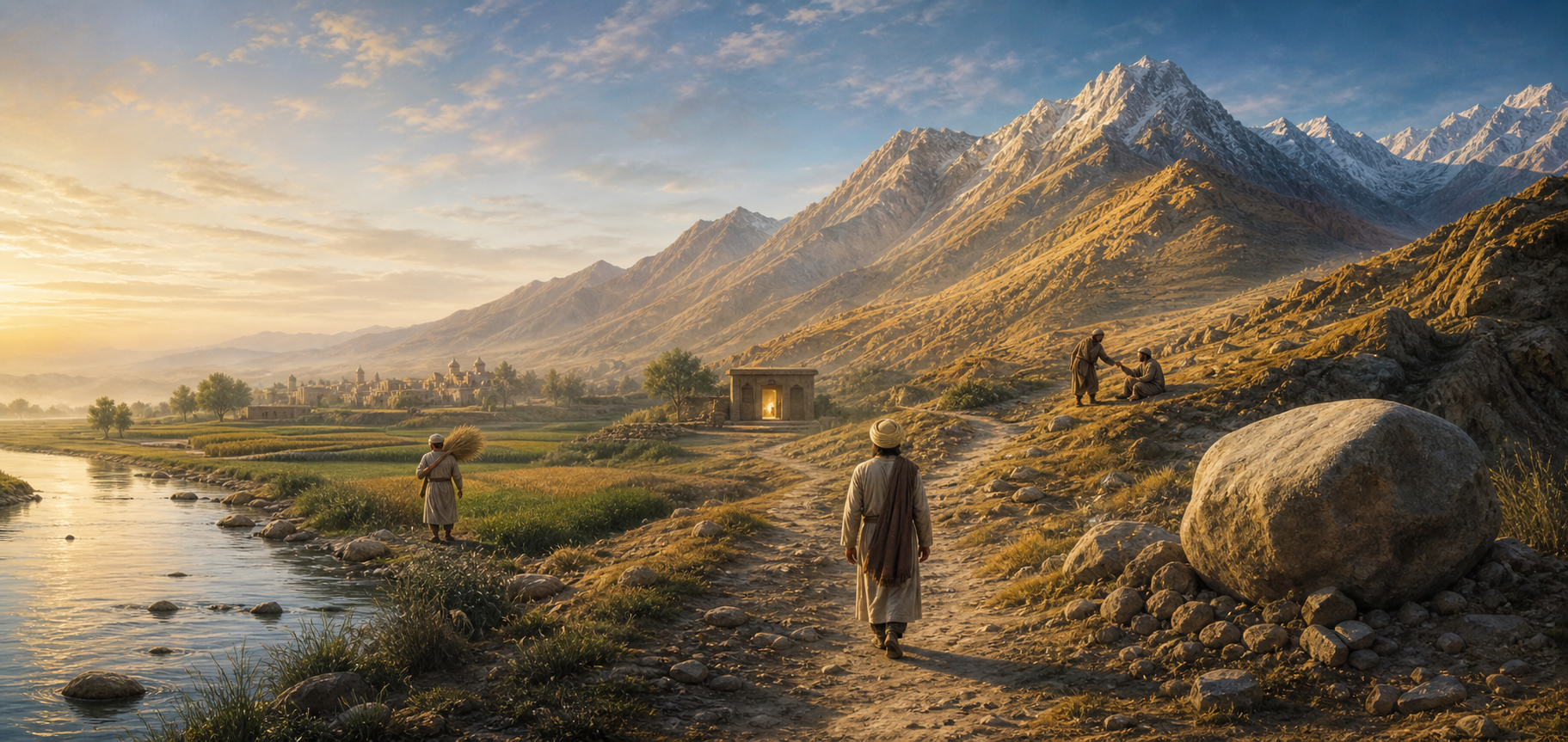
You may know the names Sultanpur Lodhi and Pathar Sahib yet still wonder what makes them part of one sacred geography. Is the connection simply that Guru Nanak visited both places, or does the landscape itself help you understand his teaching?
The more useful answer is ethical. Sultanpur Lodhi shows contemplation becoming public responsibility; Pathar Sahib shows fearlessness answering violence without enmity. Read the two places together and Guru Nanak’s journeys stop looking like a collection of holy destinations. They become a map for carrying realization into work, conflict, hospitality, and care for the world around you.
Read sacred geography through event, practice, and ethic
A sacred site can be approached in three registers. Keeping them distinct prevents two common mistakes: reducing the place to a historical marker or treating every inherited narrative as though its only purpose were to provide modern documentary evidence.
- Event: What does Sikh memory associate with this location?
- Practice: What do people repeatedly do there through recitation, kirtan, langar, seva, or environmental care?
- Ethic: What conduct should follow when you leave?
This approach matters because Guru Nanak’s geography is not sacred merely through past contact. Its meaning is renewed when a congregation sings, a stranger is fed without discrimination, an adversary is met without hatred, or a damaged river is treated as a shared responsibility. The place carries memory; practice makes that memory active.
It also gives you a fair way to handle historical uncertainty. Janamsakhis preserve sacred biography, and oral traditions preserve local memory. Their narrative layers do not always function like a modern itinerary or administrative record. You can therefore ask historical questions without dismissing devotion, and receive the moral force of a story without pretending that every detail has been independently established.
Sultanpur Lodhi joins family, work, river, and mission
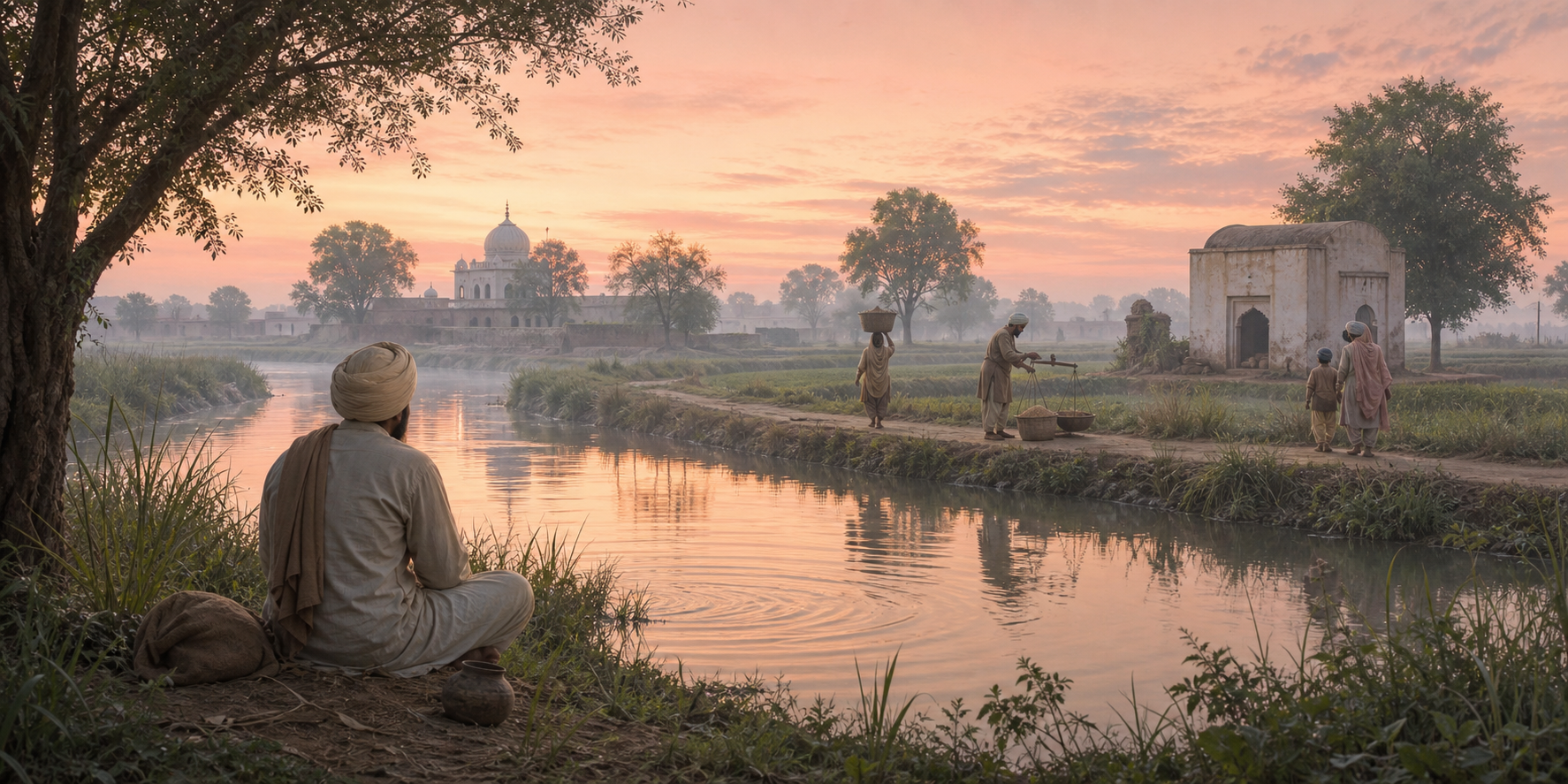
Sultanpur Lodhi is often approached through the transformative experience associated with the Kali Bein around 1499. That moment is central, but the town becomes more intelligible when you notice everything surrounding the river: kinship, employment, provisioning, worship, and an emerging public community.
Begin with the household, not the miracle
Guru Nanak came to Sultanpur through the support of his elder sister Bebe Nanaki and his brother-in-law Jai Ram, who served in the local administration. These relationships placed him within the working life of an administrative and market town. Sacred geography begins here with something easily overlooked: family support can help create the conditions in which a spiritual vocation matures.
When you visit or contemplate Sultanpur, do not mentally skip from Guru Nanak’s childhood to revelation. Notice the enabling role of Bebe Nanaki and Jai Ram. The practical lesson is not that every calling must remain private; it is that spiritual history often depends on people who recognize, shelter, and materially support another person’s integrity.
See the Modi Khana as part of the sacred landscape
Guru Nanak’s work at the Modi Khana, the state granary associated with provisioning and accounts, belongs inside the spiritual map. It places kirat karni, honest earning, beside Naam japna, remembrance of the Divine, and vand chhakna, sharing with others. The three disciplines correct one another. Remembrance without honest conduct can become performance; earning without sharing can become possession; sharing without integrity can become a gesture detached from justice.
This is why Sultanpur Lodhi should change how you understand ordinary employment. The relevant question is not whether your workplace feels sacred. Ask whether your effort is honest, whether your dealings preserve another person’s dignity, and whether the fruit of your labor remains available for sharing. The granary matters because spiritual responsibility entered a world of quantities, distribution, and daily accountability.
Let the river point back toward society
The experience at the Kali Bein is remembered as a decisive threshold after which Guru Nanak’s public mission took shape and the udasis carried his message across regions and communities. Its direction is crucial: realization did not culminate in permanent withdrawal. It returned to social life.
Ik Onkar gives this movement its theological center. If the Divine is One, reality cannot be divided into people whose dignity counts and people whose dignity does not. Satnam directs the seeker toward truth; Karta Purakh toward the creative presence active in existence; Nirbhau and Nirvair toward freedom from fear and enmity. These are not decorative attributes. They test conduct.
When you stand beside a sacred river, the question is therefore not only what happened there. Ask what must flow outward from the encounter. At Sultanpur, the answer appears in truthful labor, congregation, song, shared food, and goodwill toward all. Community efforts connected with cleaning and restoring attention to the Kali Bein add an ecological consequence: reverence for a river is incomplete if its physical condition is ignored.
Pathar Sahib carries the same ethic into the Himalaya
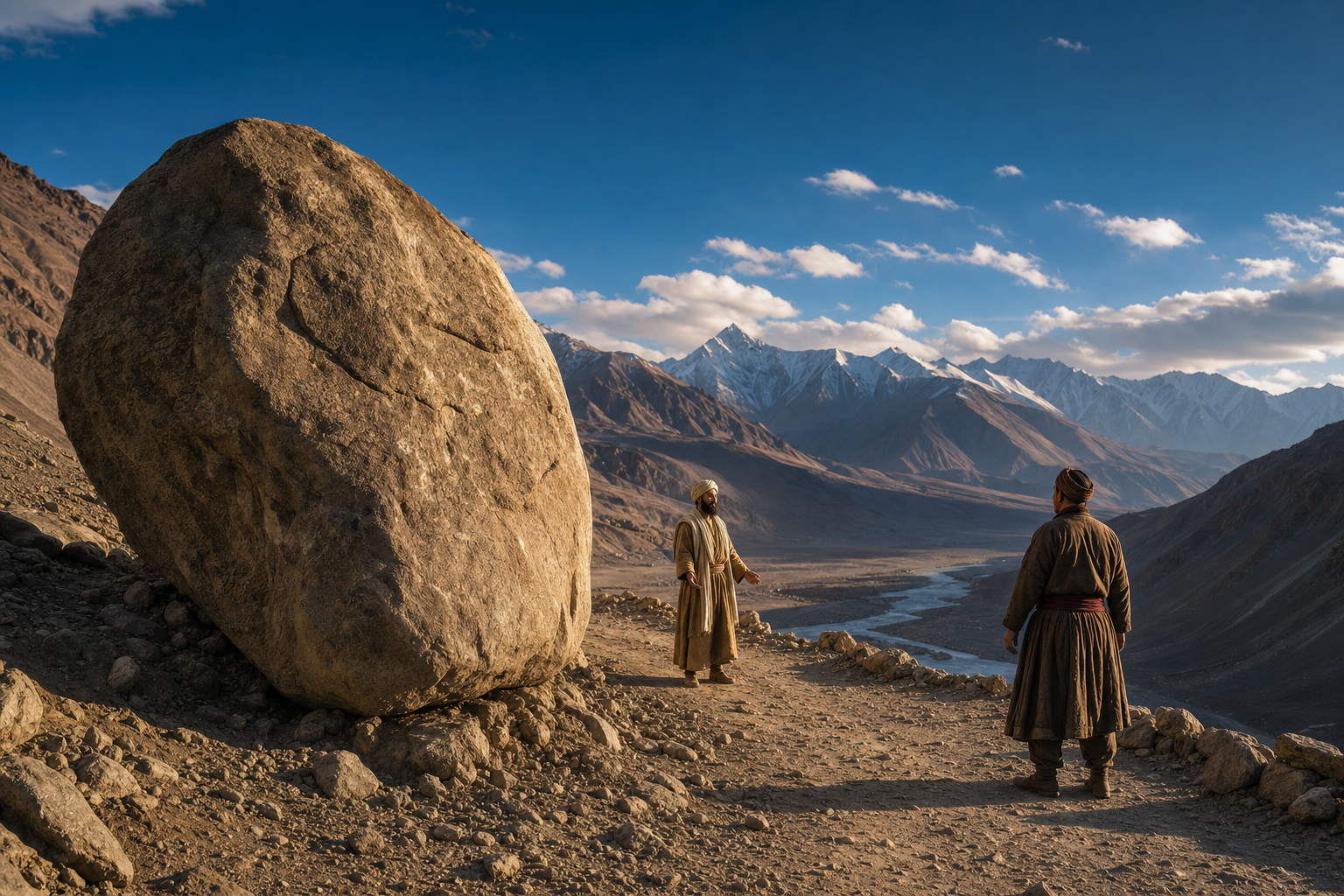
Pathar Sahib stands in a very different landscape, approximately 25 kilometers west of Leh in the Indus valley and at an elevation of roughly 3,500 to 3,600 meters. Sikh remembrance places it within Guru Nanak’s udasis into the trans-Himalayan world. Local recognition of him as Nanak Lama expresses a long cross-cultural memory shaped by the region’s Buddhist environment.
The best-known narrative tells of an aggressor who hurled a boulder at Guru Nanak while he meditated. The stone softened on contact and retained the impression of his form; the attacker was subdued and then transformed through compassion rather than punished through vengeance. For a devotee, the stone may be direct testimony to the miracle. For a historically critical visitor, the age or origin of the impression may remain an open question. Neither response exhausts the site’s meaning.
The sharper question is what kind of power the narrative honors. Guru Nanak is neither intimidated by violence nor reorganized around hatred of the attacker. Nirbhau prevents fear from ruling the encounter; Nirvair prevents resistance from hardening into enmity. Forgiveness here is not passivity or approval of harm. It is refusal to reproduce the aggressor’s moral condition.
If you are carrying a conflict into the site, use that distinction carefully. You need not deny the wrong, abandon a necessary boundary, or call injustice harmless. Instead, identify the next action that protects what is right without making revenge your purpose. Pathar Sahib’s moral demand is harder than vague niceness: remain steady before aggression, but do not let aggression decide who you become.
The gurdwara’s lived culture makes that teaching visible. Kirtan, paath, ardas, and langar welcome visitors across backgrounds, while the Indian Army’s role in maintaining the complex adds a civic layer to its custodianship. Sikh pilgrims, Ladakhi Buddhists, Hindu visitors, and other travelers encounter a shared space of worship, food, and service. The interfaith lesson does not require claiming that Sikh, Buddhist, Hindu, and Jain doctrines are identical. Their vocabularies remain distinct, while compassion, forgiveness, restraint, hospitality, and non-enmity create genuine ground for encounter.
Make your visit a pilgrimage rather than a sightseeing stop
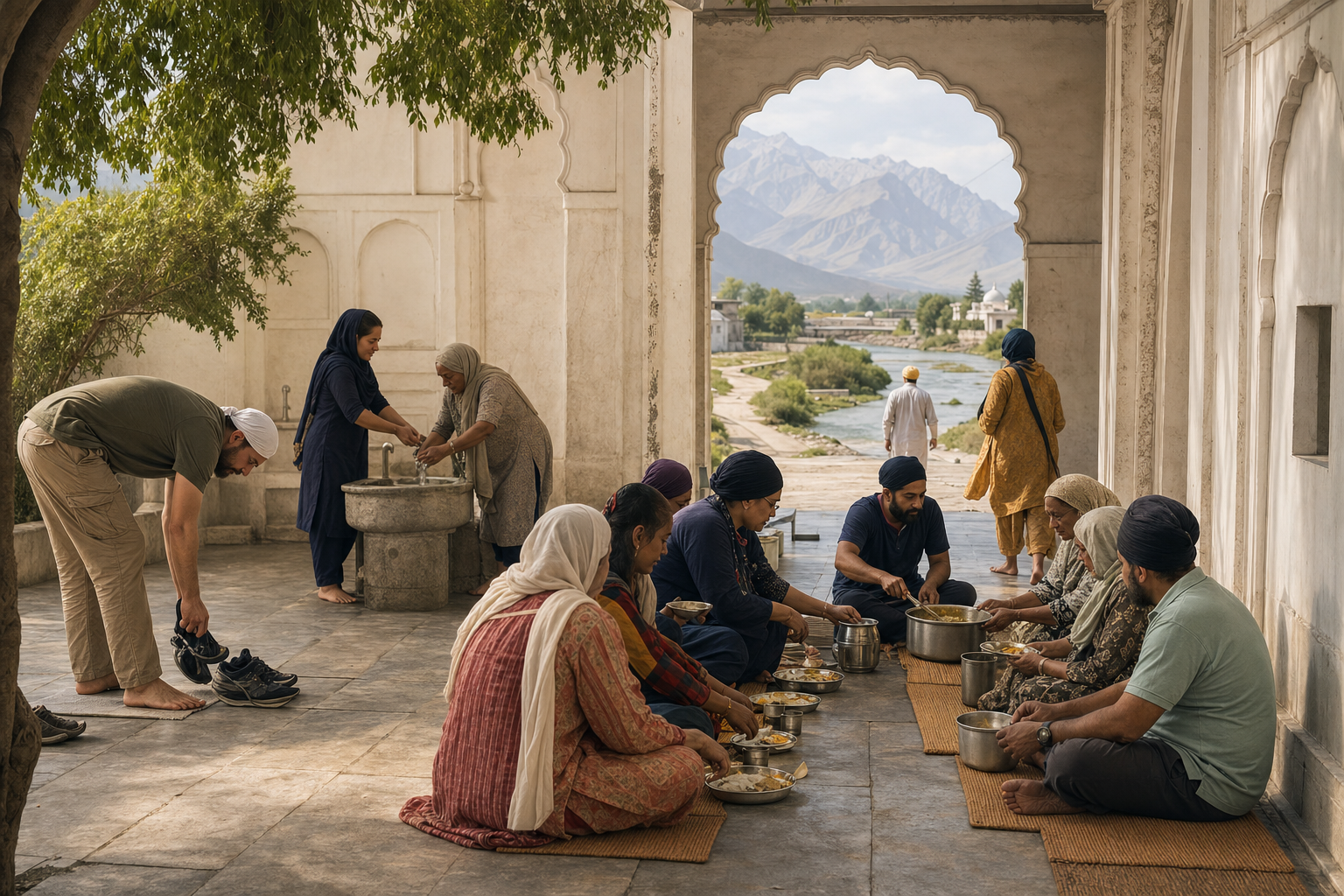
You do not need to cover every site associated with Guru Nanak to understand this geography. A slower visit to one place can teach more than a hurried sequence of photographs. Use the following discipline at Sultanpur Lodhi, Pathar Sahib, or another place carried in Guru Nanak’s memory.
- Name the setting. Before entering, notice the river, valley, workplace, road, or settlement. Ask why this teaching is remembered here rather than in an abstract location.
- Learn one associated event. Keep devotional meaning and historical certainty distinct. At Sultanpur, attend to the Kali Bein experience and the beginning of public mission. At Pathar Sahib, attend to the boulder narrative and the transformation of aggression.
- Join one living practice. Sit through kirtan or paath with attention, receive langar gratefully, or offer appropriate seva. Observation tells you what a building contains; participation shows you what the community sustains.
- Choose one governing principle. Sultanpur may direct you toward Naam japna, kirat karni, or vand chhakna. Pathar Sahib may direct you toward Nirbhau, Nirvair, daya, or forgiveness.
- Carry out one action after leaving. Share something earned honestly, repair an unfair dealing, serve without asking another person’s status, reduce hostility in a conflict, or care for the physical environment connected with the place.
Basic observance supports this attention. Cover your head, remove footwear, dress modestly, and maintain quiet during recitation or kirtan. Confirm photography rules locally rather than assuming that every part of a sacred complex is open to cameras. Alcohol and tobacco do not belong in gurdwara precincts.
At Pathar Sahib, treat the altitude as a practical limit, not a challenge to overcome quickly. Acclimatize, hydrate, and move without hurry. Ladakh’s cold-desert environment is fragile, so minimizing waste is part of the same discipline as respecting the sanctum. At Sultanpur Lodhi, an early visit along the Kali Bein followed by worship, langar, and seva lets the movement from contemplation to community become the structure of your day.
Key takeaways
- Guru Nanak’s sacred geography is best read as a map of transformed conduct, not merely a list of places attributed to his travels.
- Sultanpur Lodhi connects family support, honest labor, remembrance, sharing, riverine contemplation, and the beginning of public mission.
- Pathar Sahib interprets Nirbhau and Nirvair together: courage resists harm, while non-enmity refuses revenge as a spiritual goal.
- Janamsakhi and oral memories carry devotional and ethical truth even where precise dates, routes, or narrative layers remain open to historical inquiry.
- Interfaith significance does not depend on erasing doctrinal differences; it grows through shared practices of compassion, hospitality, restraint, and service.
- A pilgrimage is completed through the action you take afterward.
Choose one place and one discipline. After Sultanpur Lodhi, let honest work or sharing govern a concrete decision for the next seven days. After Pathar Sahib, take one necessary stand without feeding enmity. That is how Guru Nanak’s sacred geography moves from the map into your life.
References
- DharmaRenaissance Blog – Sultanpur Lodhi: Sacred Spring of Guru Nanak’s Mission, Sikh Heritage, and Dharmic Unity
- DharmaRenaissance Blog – Pathar Sahib, Leh: A Timeless Testament to Compassion, Forgiveness, and Dharmic Unity