
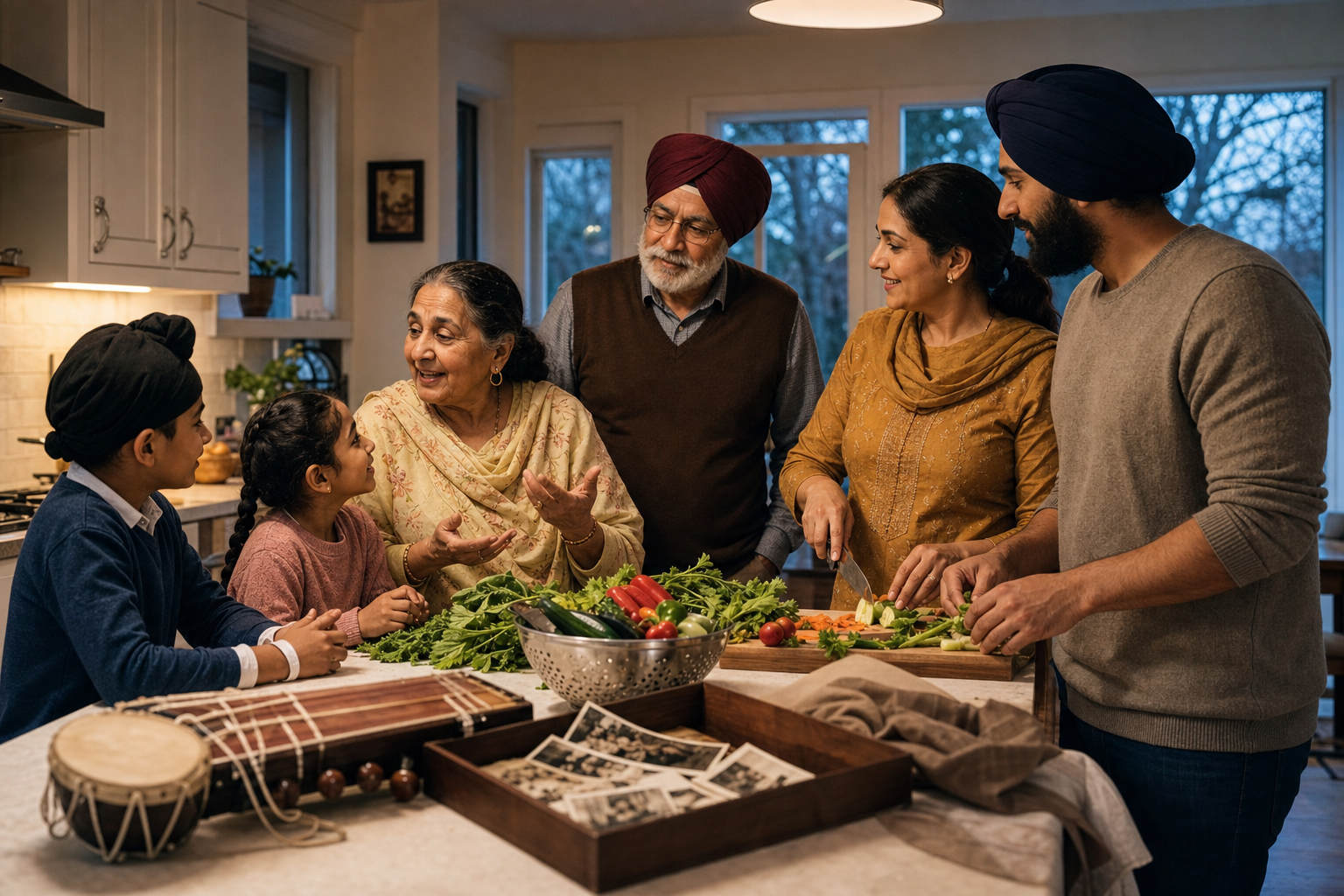
If your child understands Punjabi but answers in English, or recognizes Gurbani without being able to read or explain it, the inheritance is becoming passive. That does not mean the heritage is gone. It means your family needs a working chain of transmission, not simply more commemorative events.
The strongest chain joins everyday Punjabi, Gurmukhi literacy, Gurbani, Gurmat Sangeet, seva, family memory, and accountable community institutions. You do not need to repair every link at once. You do need to identify the weak one and give it a regular place in family or sangat life.
Key takeaways
- Treat Punjabi conversation, Gurmukhi reading, Gurbani comprehension, kirtan, seva, and historical memory as connected but distinct abilities. Familiarity with one does not guarantee competence in the others.
- Move children from passive recognition to active use: speaking, reading unfamiliar text, explaining meaning, singing with accuracy, and serving in a recurring role.
- Keep Shabad at the center of Sikh musical learning. Raag, taal, pronunciation, meaning, and maryada belong together.
- Digitize records without separating them from identity, provenance, consent, and context. An unexplained image file is not a preserved memory.
- Give young people responsibility for producing heritage – teaching, recording, cataloging, performing, translating, or researching – rather than treating them only as an audience.
Rebuild Punjabi as a language of ordinary life

A child who hears Punjabi only during religious instruction, family correction, or conversations among elders may understand it without learning to think and respond in it. The remedy is not a larger vocabulary list. Punjabi has to carry the child’s actual life: school, work, technology, friendship, humor, disagreement, plans, and questions.
Begin by finding the first missing ability in this progression:
- Conversation: Can the learner describe an ordinary experience and ask a follow-up question in Punjabi, rather than relying on memorized greetings?
- Gurmukhi decoding: Can the learner read an unfamiliar word instead of recognizing only familiar prayers by shape or sound?
- Accurate reading: Can the learner distinguish vowel signs, pause without breaking the sense, and accept correction in pronunciation?
- Understanding: Can the learner explain a sentence in plain language rather than merely repeat a translation?
- Expression: Can the learner write a short message or summarize a family story in Gurmukhi?
Start at the first answer that is no. A fluent speaker who cannot read needs a different lesson from a confident reader who does not understand the vocabulary. Placing both in the same generic heritage class hides the real gap.
Gurmukhi is not an ornamental identity marker. Its systematization under Guru Angad, followed by the compilation of the Adi Granth under Guru Arjan in 1604, placed literacy inside the institutional life of the Sikh tradition. A useful learning path therefore moves from letters and ordinary Punjabi prose toward Gurbani reading, santhiya, and meaning. Roman transliteration can help a beginner enter the lesson, but it should remain a bridge. If it becomes the permanent text, the learner stays dependent on someone else’s rendering of Punjabi sounds.
Attach each ability to a repeatable setting. Use Punjabi during a familiar family routine, not only when grandparents visit. Keep Gurmukhi material where children already read. Pair every recited line with a plain-language discussion of what it asks of the Sikh. Ask elders for proverbs, place names, agricultural vocabulary, migration memories, and family expressions that a textbook is unlikely to retain. This turns Punjabi from a school subject into a medium of relationship.
Do not make English or Hindi the enemy. The durable model is additive: Punjabi provides an early foundation while Hindi and English add regional and global mobility. If success in another language requires Punjabi to disappear, the program has confused opportunity with substitution.
Punjabi heritage also reaches beyond one script. Gurmukhi carries Sikh scripture and a major literary tradition, while Shahmukhi carries much of western Punjab’s Punjabi writing. A Sikh family should establish strong Gurmukhi literacy first, but a library, archive, or university program serving the wider Punjabi inheritance should record the script of every item and support careful cross-script discovery. Recognizing Gurmukhi and Shahmukhi as expressions of a shared linguistic continuum expands access without erasing their different histories.
Digital teaching needs the same discipline. Use Unicode-compliant Gurmukhi fonts and a consistent keyboard layout. If a project normalizes spellings or transliterates between scripts, document the rule rather than silently changing the text. Punjabi optical character recognition can accelerate transcription, but scanned Gurmukhi still requires human correction. Preserve the page image, the corrected text, and a note explaining how confident the transcription is.
A class has succeeded when a learner can do something outside the lesson: read a new paragraph, write to a relative, explain the sense of a Gurbani line, or use Punjabi to discuss a modern subject. Attendance and worksheet completion are inputs, not proof of continuity.
Put Shabad, music, and seva back into one practice
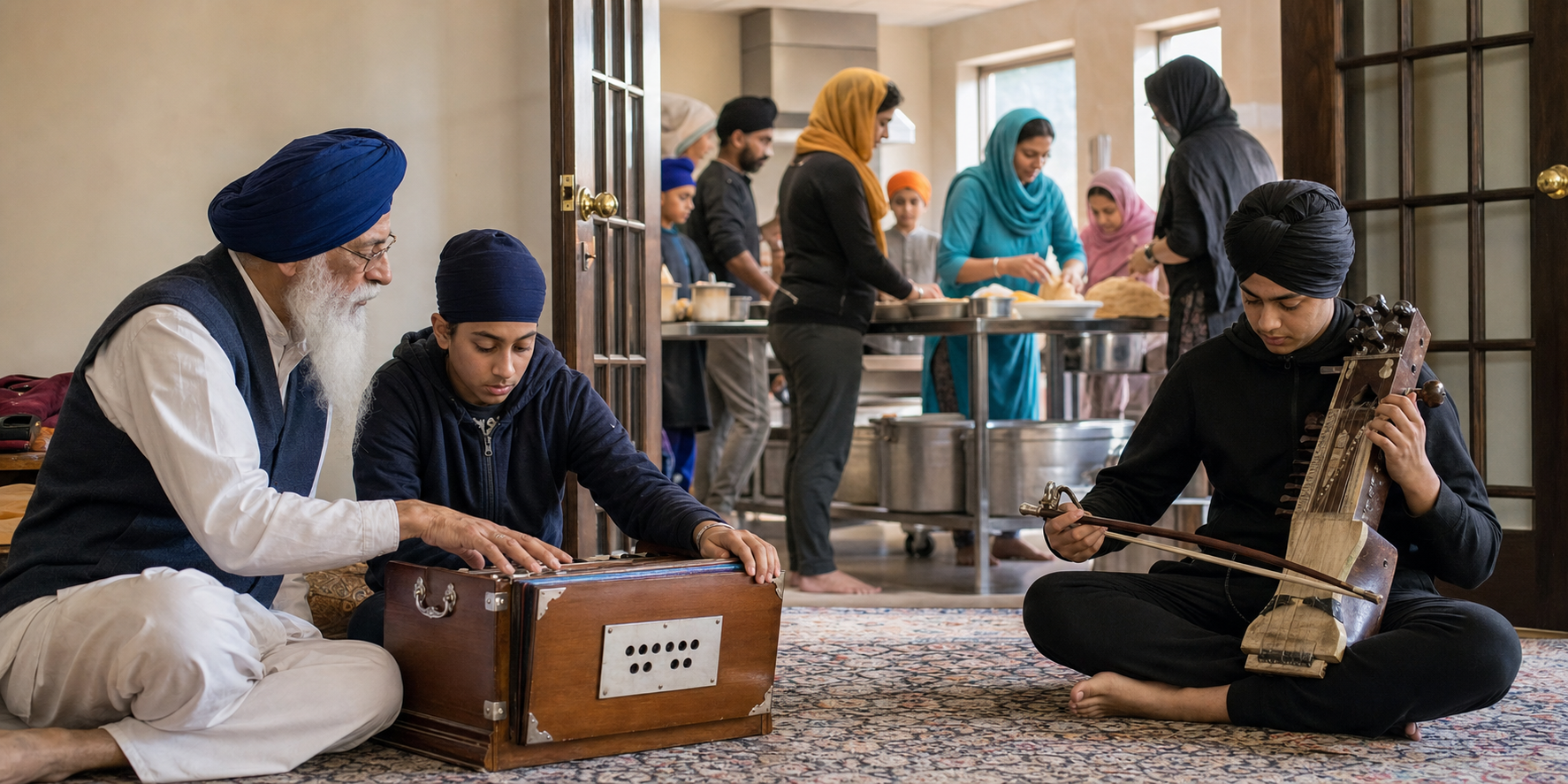
Sikh heritage and Punjabi culture overlap deeply, but they are not interchangeable. Punjabi food, dress, dance, and family customs can sustain regional belonging. They cannot replace the theological center of Sikhi. In the same way, Sikhi should not be reduced to an ethnic possession that excludes the wider historical and cultural inheritance of Punjab.
Keep Shabad at the center of musical learning
The Guru Granth Sahib places Bani within a canonical organization of thirty-one principal raags, with variants and prescribed dhunis for selected Vaars. This structure makes raag more than decoration. Melody, rhythm, verbal emphasis, and the emotional movement of the Shabad work together. The marker ਰਹਾਉ, or rahao, helps identify the thematic center and should shape the musical phrasing rather than disappear inside embellishment.
When you assess a kirtan teacher or academy, look beyond stage confidence. Serious Gurmat Sangeet training should connect these areas:
- Santhiya: accurate reading, vowel sounds, pronunciation, vishraam, and phrasing that protects meaning.
- Raag: swara accuracy, characteristic movement, and disciplined treatment of the assigned raag.
- Taal: a stable rhythmic cycle that supports the text rather than crowding it.
- Arth: enough understanding to explain why the rahao matters and why a musical phrase is being emphasized.
- Repertoire: familiarity with congregational and liturgical contexts, including dawn, celebratory, contemplative, and evening settings.
- Maryada: modest presentation, appropriate transitions, and pacing that permits sangat participation and reflection.
Virtuosity is not the final test. Ask whether the learner can render the Bani clearly, remain inside the raag, hold the taal, explain the Shabad’s central thought, and help the sangat sing. A certificate is valuable when it verifies those abilities; it is not a substitute for them.
Traditional instruments can deepen this continuity. The rabab, saranda, taus, dilruba, and jori-pakhawaj preserve timbres and techniques associated with Sikh musical history. They need not be deployed as museum props or as a rejection of contemporary harmonium practice. Support a learner who will study posture, tuning, tone production, accompaniment, and repertoire seriously enough to make the instrument useful in sangat.
Give every learner a recurring form of seva
Knowledge settles when it becomes responsibility. Langar, sangat, Nitnem, gatka, kirtan, and the disciplined path represented by Amrit Sanchar should not be presented as unrelated items in a cultural sampler. Each reveals how Sikh identity moves from belief into conduct: equality in pangat, attention to Bani, physical discipline, collective worship, and accountable commitment.
Give a young person a real role suited to their stage of learning:
- Record an elder’s migration or seva history after obtaining clear consent.
- Prepare a Gurmukhi description for an item in the community archive.
- Learn the congregational response and meaning of a Shabad before performing it.
- Assist a Punjabi teacher with younger learners and then prepare part of a lesson.
- Train in gatka through a program with a documented teaching lineage and safe practice.
- Document a langar recipe, its family or community context, and the operational knowledge needed to prepare it responsibly.
- Research a local connection to Amritsar, Anandpur Sahib, a historic gurdwara, or a family place of origin and present the result to the sangat.
The role must recur and produce something another person can use. A staged appearance at an annual celebration creates visibility; apprenticeship creates continuity.
There is also room for a confident dharmic conversation. Sikh, Hindu, Buddhist, and Jain traditions can recognize shared Indic musical grammar, contemplative sound, disciplined service, compassion, and ethical action. The boundary must remain clear: Sikh musical learning is grounded in Shabad-Guru and the sovereignty of the Guru Granth Sahib. Respect grows when distinct traditions meet without being flattened into a generic spirituality.
Build an archive that descendants can understand
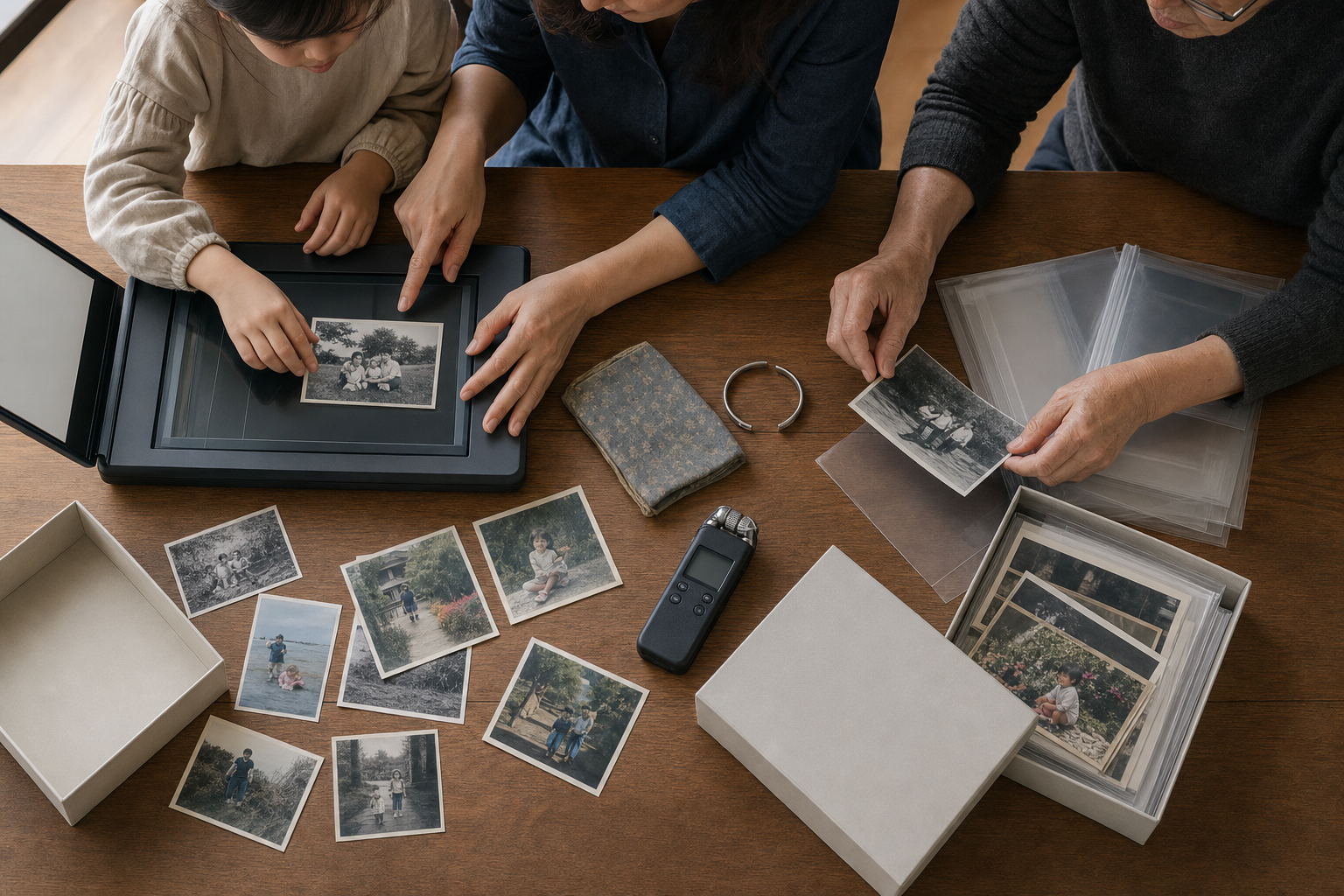
A cupboard of unidentified photographs and a cloud folder full of scans are both vulnerable in the same way: the objects may survive while their meaning disappears. Preservation requires the item, its story, its provenance, and a responsible access decision to remain connected.
Start with a household register
List what the family holds before scanning anything. Include pothis, gutkas, letters, photographs, audio cassettes, instruments, paintings, community registers, immigration papers, awards, and recordings. For each item, record what it is, who created or owned it, where it came from, the language and script, its physical condition, and who supplied the information. Mark uncertainty plainly. A tentative identification is more honest and more useful than a confident invention.
Ask about provenance while the people who know it can still answer. The valuable question is not merely, “Who is in this photograph?” Ask where it was made, what occasion brought the people together, which institution or village appears, why the image was kept, and whether anyone named in it would object to public circulation. Record the answer alongside the file, not in a separate messaging thread that will be lost.
Prioritize fragile and high-value material, but do not improvise conservation on manuscripts or unstable paintings. Historic paper benefits from stable temperature and humidity, limited light, acid-free housing, and minimal physical stress. Reversible techniques such as Japanese kozo tissue and wheat-starch paste belong in trained hands. If ink is flaking, pages are damp, a binding is failing, or mold is suspected, isolate the risk and seek a qualified conservator rather than applying household tape, cleaner, adhesive, or heat.
Separate preservation files from convenient copies
For a conservation-grade manuscript project, high-resolution capture at 600 dpi and 24-bit color, with calibrated targets and lossless TIFF masters, creates a stronger preservation record than compressed images alone. JPEG, JP2, or PDF/A copies can then be made for ordinary access. The master should remain unchanged; corrections, crops, watermarks, and compression belong in derivative files. Digitization reduces handling, but it does not justify discarding the original.
Every digital object needs enough metadata to be understood without the person who created the folder. A kirtan recording should identify the raag, taal, ang, opening words, performers, place, date if known, and the source lineage of the setting. An oral history should carry the speaker’s consent terms, access restrictions, a time-stamped summary, and relevant themes. A manuscript image should remain connected to its physical identifier, folio order, script, condition, and ownership history.
Keep preservation masters and access copies in managed storage, with redundant backups in geographically separate locations. Use checksums and a fixity schedule so silent corruption can be detected rather than discovered years later. A community archive that expects to exchange material with universities or museums should consider established frameworks such as Dublin Core for description, PREMIS for preservation metadata, and IIIF for interoperable image access.
Access is an ethical decision, not merely a technical setting. Gurbani demands accurate transcription and respectful presentation. Family testimony may expose conflict, immigration details, political risk, or information about living people. Obtain informed consent, allow restrictions or anonymization where appropriate, and distinguish public educational copies from sensitive records. The fact that a file can be uploaded does not mean the family or sangat has authorized publication.
Turn the gurdwara from event venue into a continuity system
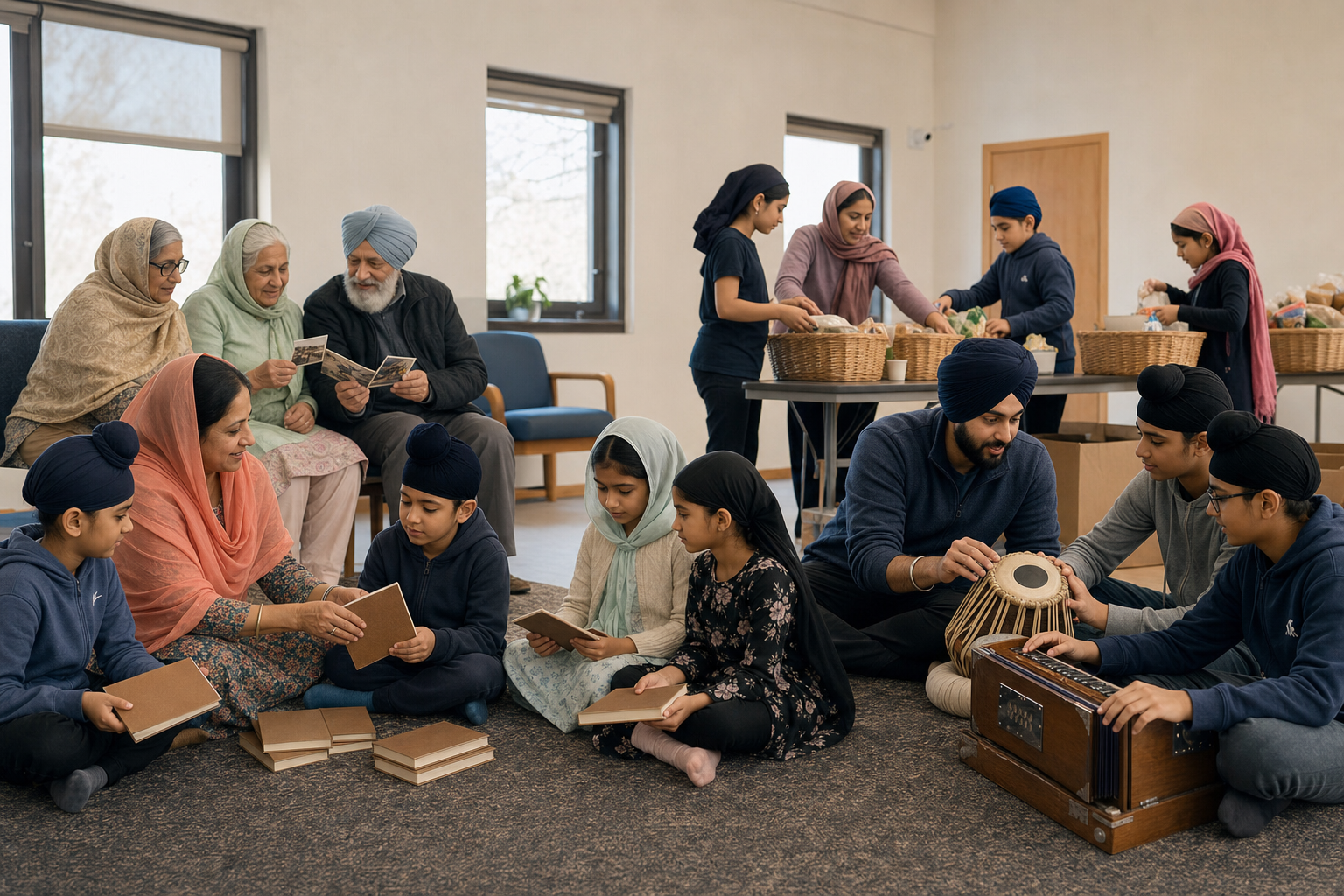
A household can begin the work, but durable transmission needs institutions. If you serve on a gurdwara committee, Punjabi school, cultural trust, or diaspora association, ask a direct question: what can a learner or volunteer do after participating here that they could not do before?
Build the program around the answer, then place governance underneath it:
- Survey first: create a whole-collection register and basic condition assessment before buying scanners, cabinets, or software.
- Stabilize immediate risks: address water, fire, smoke detection, pests, unsafe storage, and object tracking before increasing public access.
- Write collection rules: publish accession, deaccession, lending, reproduction, privacy, and sacred-material handling policies.
- Digitize by priority: begin with significant and at-risk items, then connect every file to complete metadata and provenance.
- Protect the digital archive: maintain preservation masters, access derivatives, checksums, and geographically separate copies.
- Create training pipelines: develop future Punjabi teachers, santhiya instructors, raagis, catalogers, conservators, oral historians, and technical stewards instead of depending indefinitely on a few elders.
- Invite competent review: combine volunteer seva with oversight from experienced raagis, scholars, archivists, conservators, and relevant craft specialists.
The order matters. If a roof leaks or storage is insecure, a new public portal is not the first need. If scans already exist but cannot be identified, metadata deserves funding before more capture. If classes attract learners but no advanced student becomes an instructor, the missing project is teacher formation. Spend against the broken link, not the most visible proposal.
Punjabi should also function inside the institution, not appear as a ceremonial translation after English decisions are complete. Offer Gurmukhi on forms, signs, class materials, catalogs, and digital interfaces. Maintain shared terminology so teachers and departments do not translate the same concept differently. Measure whether learners progress from letter recognition to Punjabi prose and Gurbani, not merely whether enrollment remains high.
Youth engagement becomes meaningful when it answers an institutional need. Students can improve Gurmukhi transcription, create cross-script discovery aids, index oral histories, document gatka pedagogy, produce contextual media about Anandpur Sahib, or help prepare a collection for digitization. Fellowships, supervised internships, and technical projects allow computer science, music, language, conservation, and public history skills to serve the Panth.
Publish a small accountability dashboard for the sangat. Useful measures include learners completing defined Gurmukhi abilities, Shabads prepared in their assigned raags, oral histories indexed with consent, artifacts entered in the collection register, folios digitized with complete metadata, preservation checks completed, and learners moving into teaching or stewardship. Money raised and people attending matter, but neither proves that knowledge crossed a generation.
Partnerships can extend capacity without surrendering community authority. Universities, museums, conservation laboratories, and dharmic institutions may contribute equipment, professional training, language technology, or exhibition expertise. Put provenance, sacred handling, licensing, and access conditions in writing before material leaves community custody or enters a shared platform.
At your next family gathering or committee meeting, name the weak link: spoken Punjabi, Gurmukhi, santhiya, raag-based kirtan, recurring seva, oral history, physical conservation, or digital stewardship. Assign responsibility for a visible outcome and connect it to someone who can learn the role next. Heritage becomes durable when it is practiced, documented, and deliberately handed on.
References
- SikhNet – Gurmat Sangeet Certification: Master Raags, Shabad Kirtan, and Timeless Sikh Devotional Heritage
- SikhNet – Global Sikhs, Enduring Heritage: How Diaspora Guardians Safeguard Sikhi Worldwide
- SikhNet – Defending Punjabi: Safeguarding Punjab’s Civilizational Soul Through Language, Script, and Policy