

You are standing before a Bhairava shrine. There is a trident, a drum, perhaps a skull-cup, and a dog near the deity’s feet. The image may be youthful and welcoming or severe enough to make you hesitate. Is this Batuk Bhairav, Kāla Bhairava, or one of the eight directional guardians?
The reliable answer does not come from the fiercest object in the image. You have to read the whole arrangement: age, expression, arms, gestures, ornaments, companions, pedestal, and location. Once you do, Bhairava’s iconography stops looking like a collection of frightening objects. It becomes a practical grammar of vigilance: what must be guarded, what must be faced, and what must be transformed.
Start with the whole form, not a single weapon
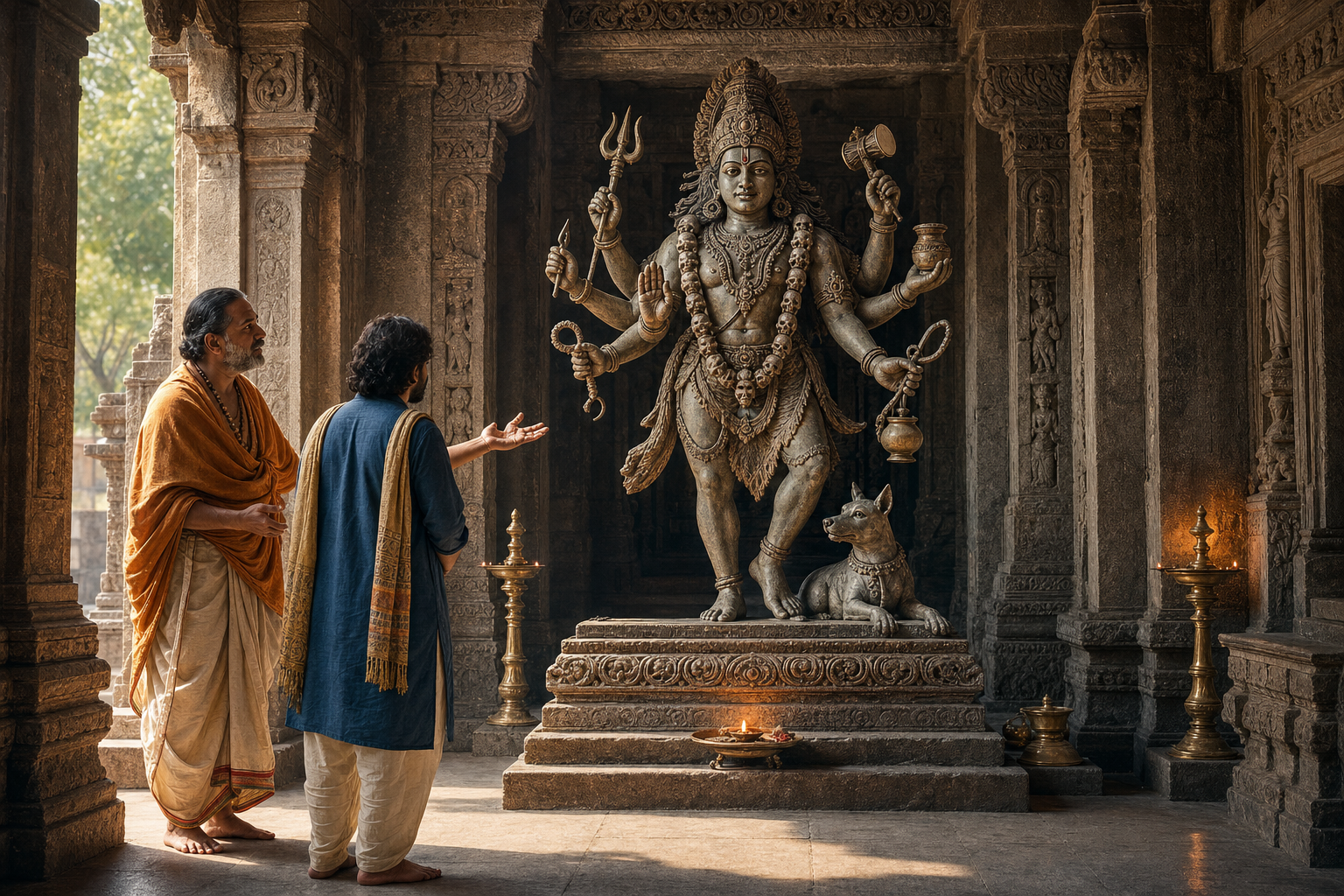
Bhairava expresses Shiva’s fierce, time-dissolving awareness. As kṣetrapāla, the guardian of a sacred field, he belongs especially to gateways, crossroads, temple boundaries, cremation grounds, and other places of transition. His fierceness is therefore functional. It confronts confusion and protects a boundary; it is not malice presented as holiness.
Use the following sequence when you are identifying a shrine image, museum sculpture, photograph, or household murti.
- Read the apparent age first. Batuk Bhairav is represented as a divine boy, often understood iconographically as about eight years old. Look for youthful proportions, a bright face, three eyes, and an expression that is calm but unmistakably alert. This is not a weaker Bhairava. It is primordial authority communicated through an approachable form.
- Compare serenity with ferocity. Batuk usually lacks the exaggerated terror of strongly ugra forms. A skull garland, if present, tends to be restrained rather than visually dominant. Fierce adult features, prominent macabre ornament, or a cremation-ground setting may point toward another Bhairava form, but no one feature settles the identity.
- Count the arms and read the attributes as a group. Two-armed and four-armed Batuk forms are common. The triśūla, ḍamaru, kapāla, and pāśa frequently appear, while a sword, skull-topped staff, or another drum may occur in particular traditions. Multi-armed forms exist, but they are less typical of the approachable Batuk pattern.
- Look at gestures, clothing, and ornaments. Abhaya, the fear-dispelling gesture, and varada, the boon-granting gesture, strongly support Batuk’s protective character. Ash, rudrākṣa, tiger skin or yellow clothing, a serpent sacred thread, and relatively restrained earrings further narrow the identification.
- Use the setting as evidence. A youthful Bhairava may sit on a lotus pedestal or simple platform near an entrance. A sequence of related shrines at gates, corners, or around an outer prākāra may belong to a directional system. The image’s local name, temple ritual, and place in the circumambulatory route are often more decisive than an isolated attribute.
The dog identifies the wider Bhairava grammar, but it does not identify one form by itself. Batuk Bhairav also has the canine vāhana. You should therefore resist the common shortcut of calling every dog-accompanied deity Kāla Bhairava. In Kāśī, Kāl Bhairav holds the specific role of the city’s kṣetrapāla; elsewhere, regional worship and iconography can organize Bhairava differently.
When the evidence remains mixed, describe what you can actually see: “a youthful Bhairava with canine attendant” is more responsible than forcing a precise name. Living Tantric and Āgamic traditions preserve genuine regional variation. A temple’s own lineage should take precedence over a chart brought from somewhere else.
Each symbol asks you to practise a specific discipline

Bhairava’s attributes are not horror props. Each one turns a difficult reality into a discipline. Read this symbolic language at two levels: what the object means within the image and what it asks you to change in your conduct.
| Symbol | What it expresses | What you can do with it |
|---|---|---|
| Triśūla | The alignment of icchā-śakti, jñāna-śakti, and kriyā-śakti: will, knowledge, and action | Before a consequential act, ask three questions: What do I intend? What do I know? Does my action honestly match both? |
| Ḍamaru | Spanda, the primordial pulse through which manifestation unfolds | Notice when haste has broken the rhythm of your thought or speech. Recover steadiness before you respond. |
| Kapāla | Mortality, impermanence, and the transformation of experience into wisdom | Name one identity, resentment, or status claim you are treating as permanent. Loosen it before it governs your next decision. |
| Dog | Loyalty, vigilance at a boundary, and courage in liminal places | Pair watchfulness with compassion. Protect a real boundary while extending practical care to vulnerable animals or beings around it. |
| Ash and rudrākṣa | Renunciation and remembrance of Rudra | Let remembrance interrupt possessiveness. Ask whether you are guarding dharma or merely defending ego and ownership. |
| Abhaya and varada | Fear dispelled and protection made beneficial | Refuse panic, then make your steadiness useful to someone else. Protection that serves only the protector remains incomplete. |
The skull-cup and cremation-ground setting make the same point with greater severity: what is impermanent cannot provide permanent identity. The symbolism does not glorify death. It removes the evasions that let fear, vanity, and attachment quietly direct a life.
This is also why Bhairava’s guardianship extends beyond a locked gate. A sacred field includes the quality of what happens inside it. A home is not fully guarded if speech within it is dishonest. A temple boundary is not honoured if worshippers carry exploitation across it. A community’s resources are not protected merely because they remain under someone’s control; they must be stewarded justly.
The eight directions turn guardianship into a complete practice

The Aṣṭa Bhairava system places eight principal forms around the eight directions, converting space into a mandala of disciplined awareness. One widely used Āgamic arrangement moves from Asitāṅga in the east to Saṁhāra in the northeast. The sequence is best used as a contemplative map, not as a rigid claim that every regional lineage must follow it.
| Direction and form | Inner work | A useful question |
|---|---|---|
| East: Asitāṅga | Detachment and clear resolve at the beginning | What must I release so that I can begin cleanly? |
| Southeast: Ruru | Learning, tapas, and disciplined speech | What do I need to understand before instinct takes charge? |
| South: Caṇḍa | Moral courage and uncompromising exposure of untruth | Where must I be firm without becoming cruel? |
| Southwest: Krodha | Transformation of anger into steady energy | What constructive duty can this heat serve? |
| West: Unmatta | Inward freedom and ecstasy governed by wisdom | Can I complete today’s work without clinging to its praise or result? |
| Northwest: Kapāla | Impermanence and leadership emptied of vanity | Which role have I mistaken for my permanent self? |
| North: Bhīṣaṇa | Protection of resources, community, generosity, and justice | What entrusted resource needs stewardship rather than possession? |
| Northeast: Saṁhāra | Removal of the residue that remains after insight | What can now be released without resentment? |
This circuit corrects a dangerous misunderstanding of fierceness. Caṇḍa does not authorize uncontrolled aggression. Krodha does not sanctify reactive anger. Bhīṣaṇa does not make domination sacred. Each form subjects force to discernment: firmness must defend truth, anger must become service, and power must protect the communal good.
The eight forms may also be paired with the Aṣṭa Mātṛkās. A common sequence associates Asitāṅga with Brahmāṇī, Ruru with Māheśvarī, Caṇḍa with Kaumārī, Krodha with Vaiṣṇavī, Unmatta with Vārāhī, Kapāla with Aindrī, Bhīṣaṇa with Cāmuṇḍā, and Saṁhāra with Narasiṁhī or Mahālakṣmī. The variation in the final pairing is important. Treat a Mātṛkā as corroborating evidence when identifying an ensemble, not as a universal identity card.
If you encounter these shrines during pradakṣiṇā, follow the temple’s established route rather than trying to reorganize the experience around a diagram. Pause long enough at each quarter to notice its demand: begin, learn, stand firm, transform, complete, release vanity, steward, and let go. The mandala becomes useful when one of those verbs changes what you do after leaving the temple.
Bring Bhairava worship home without flattening the tradition
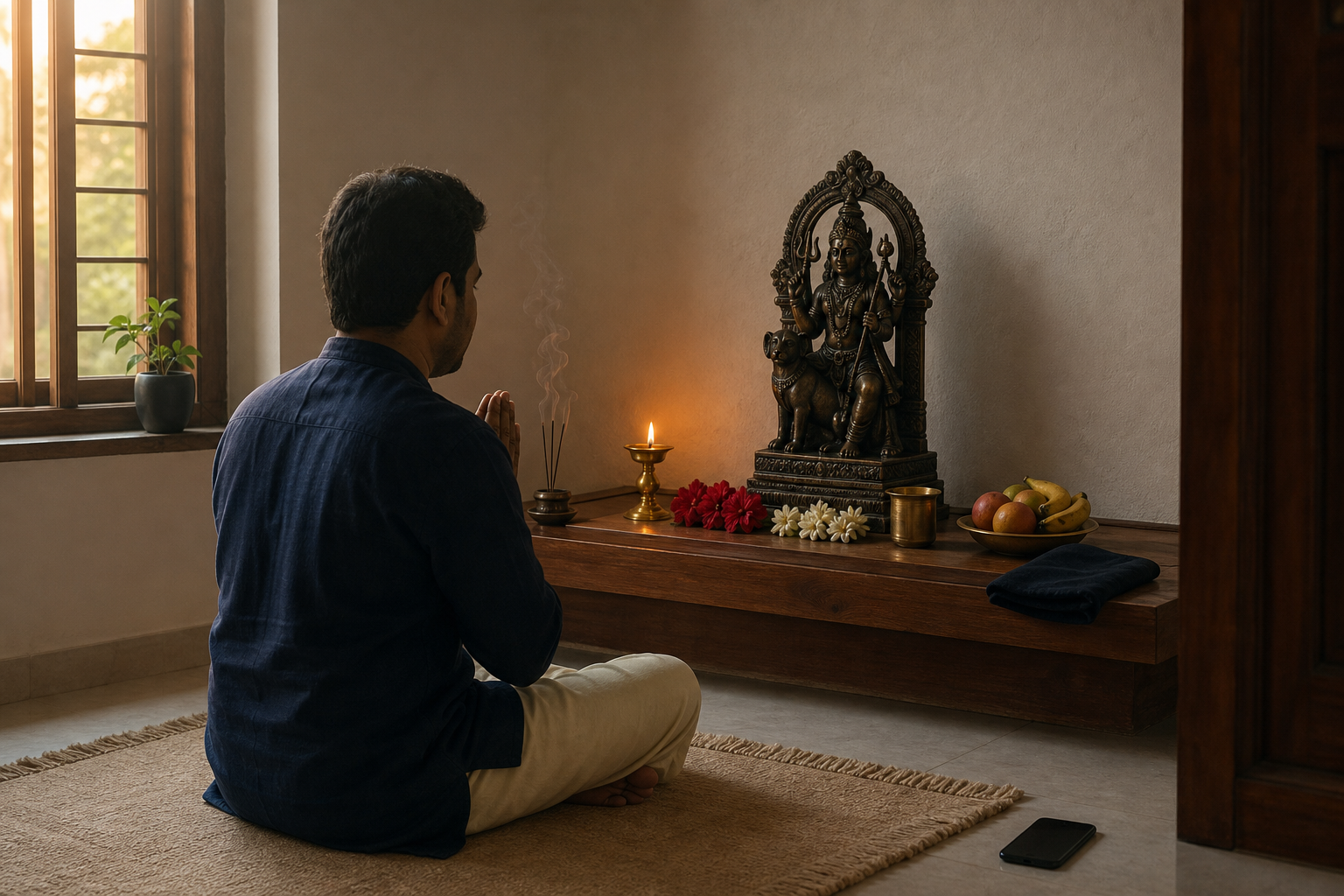
Batuk Bhairav is especially approachable for household worship because the child-form holds fierce vigilance within a gentle visual language. A small murti may be placed near an entrance or in a side alcove, subject to the customs of your household and lineage. The location should remind you that a threshold is both physical and moral: you decide what conduct is allowed to cross it.
A simple, sāttvic observance can remain modest and still be serious:
- Prepare the place. Clean the shrine and the nearby threshold. Do not let a guardian image become neglected decoration.
- Light the lamp attentively. Mustard-oil lamps are common in Bhairava worship, especially at dusk. Place any flame on a stable surface and never leave it unattended.
- Use an accessible invocation. “Om Batuk Bhairavaya Namah” is suitable for straightforward remembrance. Repeat it with attention rather than treating speed or a large count as the goal.
- Offer within your capacity. Incense, a lamp, sandal or bhasma, and a seasonal sweet or kheer fit the established devotional vocabulary. Formal ṣoḍaśopacāra and pañcāmṛta abhiṣeka may be undertaken where household custom and the murti’s material make them appropriate.
- Make protection concrete. Choose one boundary to guard after worship: truthful speech, a promise, the use of time, the safety of the home, or the fair handling of a shared resource.
- Complete devotion through compassion. Feeding or caring for dogs expresses respect for Bhairava’s vāhana. Do it in a way that is safe for the animals and appropriate to local conditions.
Kālāshtamī, the eighth lunar day of the dark fortnight each month, offers a natural occasion for extended observance. Kālabhairava Jayanti falls in the dark fortnight of Mārgaśīrṣa. Use the pañcāṅga followed by your community for the applicable local tithi rather than assuming a fixed Gregorian date.
Advanced Bhairava sādhana is a different matter. Tantric mantras, nyāsas, visualizations, and specialized offerings belong within competent lineage guidance. The availability of a mantra in print does not make its advanced use self-interpreting. A householder can cultivate daily remembrance, truthful speech, disciplined courage, and compassionate service without imitating an esoteric rite.
Sacred guardianship also has recognizable Dharmic echoes without making every tradition identical. Vajrayāna Buddhism works with Vajrabhairava or Yamāntaka and Mahākāla as fierce means for cutting ignorance. Newar Buddhist practice incorporates Aṣṭabhairava imagery in masked dances and processions. Jain devotion preserves distinct forms of kṣetrapāla guardianship, including Nakoda Bhairava, within an ahiṁsā-centred ethical world. Sikh teaching gives a central place to nirbhau, fearlessness joined to moral steadfastness. The responsible comparison is not “all these deities are the same.” It is that Dharmic traditions repeatedly refuse to separate courage from discipline and protection from ethical purpose.
Key takeaways
- Identify Bhairava from the complete iconographic ensemble. A dog, skull, or trident alone cannot establish the precise form.
- Batuk Bhairav is recognized by youthful proportions, calm vigilance, restrained ornament, commonly two or four arms, protective gestures, and a canine attendant.
- The triśūla aligns intention, knowledge, and action; the ḍamaru restores rhythm; the kapāla confronts impermanence; and the dog joins alertness to loyalty and compassion.
- The Aṣṭa Bhairava arrangement turns eight directions into eight disciplines, but names, pairings, colours, and attributes can vary by region and lineage.
- Fierce symbolism does not sanctify rage. Its purpose is to transform fear, anger, attachment, and power into truthful action and responsible protection.
- For household worship, keep practice simple and sāttvic. Reserve advanced Tantric sādhana for qualified guidance, and let devotion produce a visible act of guardianship or service.
At your next Bhairava shrine, spend the first minute observing before naming anything. Read the face, hands, attributes, attendant, and place. Then choose one instruction carried by the form and act on it before the day ends. That is where sacred guardianship moves from the edge of the temple into the conduct of your life.
References
- DharmaRenaissance Blog — Batuk Bhairav Iconography Decoded: Symbols, Rituals, and the Guardian Child of Shiva
- DharmaRenaissance Blog — Decoding Ashta Bhairava’s Eight Directions: Names, Fierce Symbolism, and Sacred Geometry