
You need more than a list of Sanskrit calendar terms if you are planning puja, travel, a signing, or a new undertaking on Monday, June 1, 2026. The useful questions are: which tithi is active when you begin, which clock times must be calculated for your city, and whether your activity needs an ordinary auspicious window or a specialized muhurta.
The dependable anchor for the day is the afternoon transition: Krishna Paksha Pratipada continues until approximately 3:04 PM IST, after which Krishna Paksha Dwitiya prevails. Treat that as a change in the day’s ritual and planning context, not as a universal declaration that every minute before or after it is auspicious.
June 1 Panchang at a glance
- Weekday: Monday.
- Paksha: Krishna Paksha, the waning half of the lunar cycle.
- Tithi before about 3:04 PM IST: Krishna Paksha Pratipada.
- Tithi after about 3:04 PM IST: Krishna Paksha Dwitiya.
- Best general use of the first part: corrective work, decluttering, resetting routines, organizing accounts, and reflective sadhana.
- Best general use of the later part: sustained study, careful correspondence, detailed craft, and tasks that reward patient follow-through.
- Abhijit Muhurat: potentially useful for routine, non-mangalik beginnings, but it must be calculated around your local solar noon.
- Rahu Kalam, Gulika Kalam, and Yamaganda: avoid relying on a generic clock table; calculate them from local sunrise and sunset.
- Nakshatra, Rashi, Yoga, and Karana: verify them in a dynamic Panchang for your location and intended start time.
Build your day around the Pratipada-to-Dwitiya change
A tithi does not begin at midnight. It changes when the angular separation between the Sun and Moon crosses the next 12-degree boundary. That is why one civil date can contain two tithis, and why the tithi named during a morning sankalpa may differ from the one named during evening worship.
Before approximately 3:04 PM IST, use Krishna Paksha Pratipada in a time-specific sankalpa. Its place at the opening of the waning fortnight suits a measured reset: clear a neglected worship space, reconcile a ledger, simplify an overfilled schedule, resume a disciplined practice, or correct something already underway. The emphasis is order and inward alignment rather than impulsive expansion.
After the transition, use Krishna Paksha Dwitiya in the sankalpa. The later window is well matched to work that needs steadiness rather than spectacle: revising a text, continuing study, drafting a careful message, completing documentation, or returning to a craft that improves through patient attention.
- Mark the transition first. In India, place an approximate 3:04 PM IST marker in your calendar. Leave a little practical margin around it if the exact tithi matters to your rite, because Panchang methods can produce small timing differences.
- Assign the activity by character. Put clearing, correction, review, and reflective beginnings in the Pratipada portion. Put sustained learning, correspondence, and detailed follow-through in the Dwitiya portion.
- Check the actual muhurta separately. A suitable tithi does not cancel Rahu Kalam, an unsuitable Karana, or requirements specific to a samskara.
- Name the tithi at the time of worship. A morning puja and an evening puja on June 1 may correctly use different tithi names.
If you live outside India, do not replace “IST” with your own time-zone label while keeping the same clock reading. Convert the transition for your zone or, preferably, enter your city in a location-aware Panchang. The local civil date and the sunrise-based calendar entry both matter.
Choose a shubh muhurat without false precision
The first decision is whether you need a general-purpose auspicious period or a specialized election. Starting ordinary study, sending routine correspondence, organizing a workspace, or beginning a modest non-mangalik task is not the same calendrical problem as choosing a time for griha-pravesh, annaprashan, an engagement, or another consequential rite.
For an ordinary beginning
Abhijit Muhurat is commonly used when a specialized muhurta is unnecessary. It is centered on local solar noon, which is not automatically the same as 12:00 on the clock. Longitude, the day’s sunrise-to-sunset span, and the equation of time affect the calculation. Enter the city where the activity will actually begin and use the Abhijit interval produced for that location.
Before committing to that window, check Rahu Kalam, Gulika Kalam, and Yamaganda. These periods are derived by dividing the daylight interval from sunrise to sunset into eight equal portions and assigning portions according to the weekday. Monday’s Rahu Kalam generally falls in the morning, but its clock time moves with local sunrise and day length. A reusable weekday chart is therefore only a rough pattern, not a precise schedule for June 1 in every city.
For travel, money, or a major rite
For a journey, financial decision, first-time initiation, or important signing, identify and avoid the local inauspicious intervals before selecting the start time. If an avoidance period is about to end, begin after it has ended rather than rushing to start just before it begins.
For griha-pravesh, annaprashan, engagement ceremonies, and comparable samskaras, a date-level Panchang is not enough. The intended window should be checked against Nakshatra, Yoga, Karana, and relevant personal considerations such as tara-bala. Vishti, also called Bhadra Karana, and Rahu Kalam are commonly avoided. Abhijit or a favorable Choghadiya can help with routine undertakings, but neither should be treated as an automatic override for all the requirements of a major rite.
If the event is difficult to move or carries substantial family consequences, follow the Panchang and sampradaya used by the officiating acharya or priest. Mixing a tithi from one system, a nakshatra time from another, and a generic Rahu Kalam table from a third can create a result that belongs to no coherent method.
Verify Nakshatra, Rashi, Yoga, and Karana locally
A single, location-free label for the entire date can be misleading. The Moon moves roughly 12 to 13 degrees in a day. Each Nakshatra covers 13 degrees and 20 minutes of the ecliptic, while each Rashi covers 30 degrees, so the Moon may cross a Nakshatra boundary and can sometimes enter another Rashi during the same civil date.
Published almanacs also use different display conventions. One may headline the Nakshatra prevailing at sunrise and then print its ending time; another may foreground the transition. Read the ending time, not merely the first name displayed. Then check which Nakshatra and Rashi are active at the moment your activity begins.
Yoga and Karana need the same care. Yoga is derived from the combined longitudes of the Sun and Moon and divided into 27 parts. A Karana is half a tithi, so it can change within a tithi and materially refine a muhurta. The sequence includes Bava, Balava, Kaulava, Taitila, Garija, Vanija, and Vishti or Bhadra, along with fixed Karanas. Seeing “Pratipada” or “Dwitiya” alone therefore does not tell you which Karana is operating at your chosen hour.
- Enter the exact city where the puja, departure, signing, or ceremony will begin.
- Confirm that the date and time zone are correct.
- Record the local sunrise and sunset used by the calculation.
- Check the ending times for Tithi, Nakshatra, Yoga, and Karana rather than copying only their sunrise labels.
- Note Rahu Kalam, Gulika Kalam, and Yamaganda on the same local calculation.
- Use one consistent computational basis, especially when exact minutes matter.
Small disagreements between almanacs are not always mistakes. Drik calculations based on modern ephemerides and calculations following classical Surya Siddhanta conventions can differ by minutes and, in some cases, by an hour or two. Choose one reputable method and apply it consistently.
You may also see the lunar month described differently around this date. The presence of Adhik Jyeshta in 2026, together with Amanta and Purnimanta month reckoning and local sunrise rules, can cause one calendar to use Jyeshta while another uses Adhik Jyeshta. That does not by itself change the practical need to identify the tithi active at the time of your observance.
Give the day a simple Dharmic shape
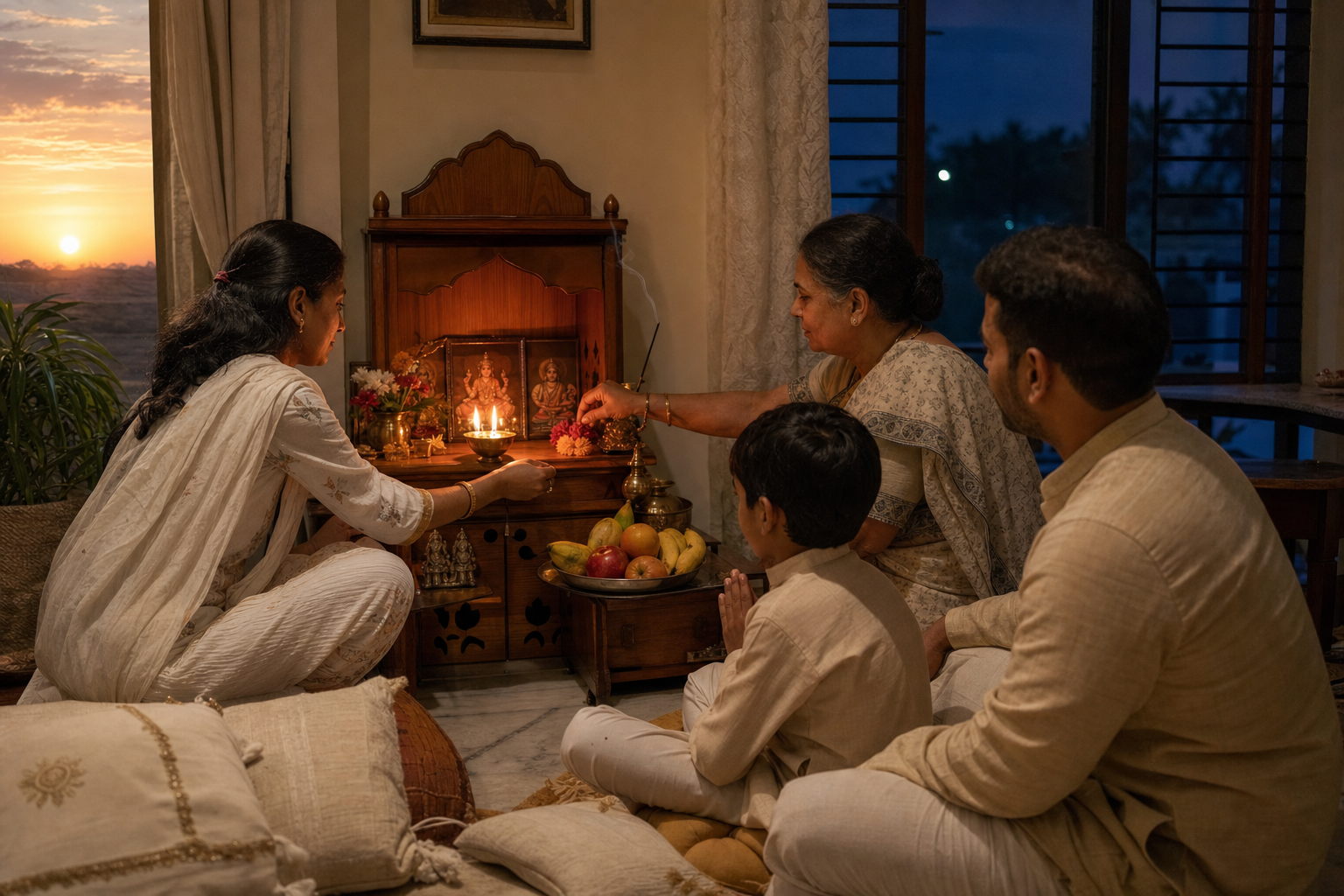
You do not need a major ceremony to observe the opening movement of Krishna Paksha meaningfully. For a Hindu household, a workable practice is to clean the puja space, light a lamp, offer water, and perform japa of the mantra already received or traditionally used in the family. Name Pratipada or Dwitiya in the sankalpa according to the actual time.
Let the practice continue into conduct. Complete one neglected responsibility, simplify one part of your routine, and choose one concrete act of seva, such as annadanam or assistance to someone in your community. The waning fortnight is better used for removing disorder and strengthening discipline than for turning every calendar indication into a prediction.
Other Dharmic traditions can honor the day through their own disciplines without being compressed into a single ritual form. A Buddhist practitioner may emphasize breath awareness and metta. A Jain practitioner may undertake samayika or pratikraman. A Sikh may deepen Nitnem, kirtan, or seva. The shared ground is ethical attention expressed through truthful speech, ahimsa, generosity, remembrance, and service.
Before June 1 arrives, save the local Panchang entry you intend to follow and mark three things: the Pratipada-to-Dwitiya transition, the local avoidance periods, and the selected start window. That small preparation will do more for a clear observance than trying to reconcile conflicting almanacs at the moment your puja or journey is supposed to begin.