

You may understand a harmful pattern perfectly and still repeat it. The difficulty is often not a lack of knowledge. The pattern has acquired momentum: a familiar trigger turns the same thought, the same reaction, and the same consequence until the whole cycle feels inevitable.
Sakatasura Lila gives you a precise way to examine that momentum. A loaded cart stands over Krishna, an unseen hostile presence inhabits it, and one effortless movement overturns the entire structure. Read carefully, the lila shows what karmic bondage looks like, where grace enters, and what disciplined action must do after the hidden burden has been exposed.
Begin with the cart Krishna actually breaks
The Bhagavata Purana places the episode in Gokula during a communal celebration. Yashoda and the women of Vraja are occupied with the festivities. Baby Krishna lies beneath a cart holding utensils and provisions. He cries, stretches his feet, and kicks it. The cart overturns, its contents scatter, and Sakatasura, the asura concealed within it, is destroyed. The cowherds are left astonished by the power disclosed through the apparently helpless child.
It is worth pausing here before turning the scene into an allegory. Within the sacred narrative, Krishna does not merely represent awareness or a therapeutic technique. He acts as Bhagavan, protects Vraja, and removes a real hostile presence. The symbolic reading deepens that devotional meaning; it does not have to replace it.
The Sanskrit word sakata means a cart. An asura, in this setting, is a being whose intention works against divine and cosmic harmony. Lila is divine play: an action that appears spontaneous and effortless yet accomplishes protection, revelation, and restoration. This is why the episode is remembered as shakata-bhanjana, the breaking of the cart.
The crucial detail is concealment. Sakatasura does not approach in an obviously threatening form. He inhabits an ordinary vehicle used for useful household work. That should change the question you ask about your own bondage. Do not ask only what looks sinful, frightening, or chaotic. Ask what appears normal and useful while quietly carrying a motive that no longer serves dharma.
The cart reveals how karmic momentum becomes ordinary
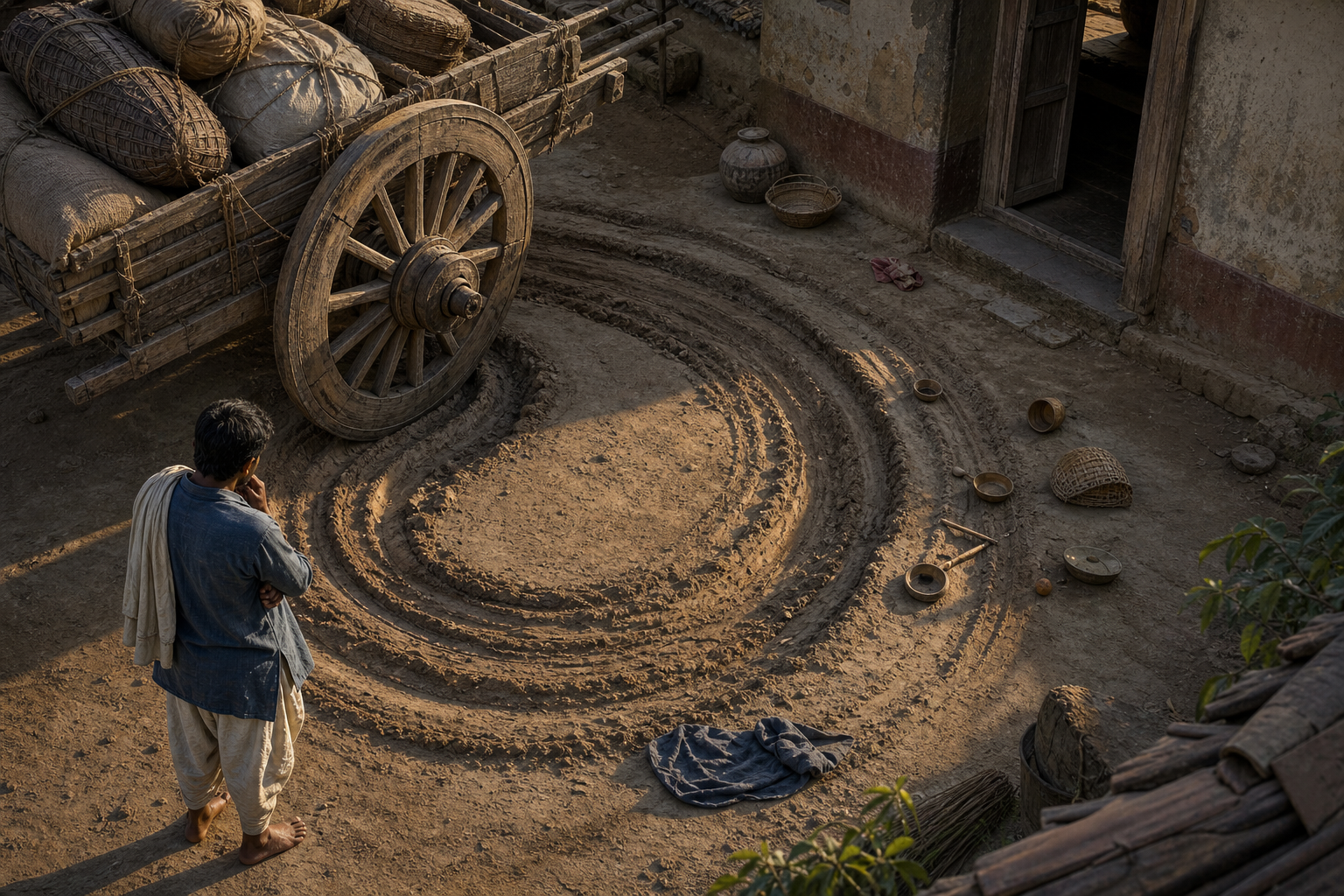
In a symbolic reading, the cart is the structure that carries accumulated momentum through time. Its load resembles inherited tendencies, acquired attachments, unfinished obligations, and emotional residue. Its rotating wheels resemble repeated becoming. Its axle resembles the intention and attention that hold separate actions together as one continuing pattern. Sakatasura resembles the hidden force that benefits whenever the structure keeps moving without examination.
This is a more useful understanding of karma than fatalism. Karma should not become a reason to blame someone for suffering, excuse injustice, or declare that nothing can change. For practical purposes, karma directs your attention to intention, action, repetition, and consequence. Past action conditions the present, but the next intention is also an action. The wheel continues through causes; change the causes, and its movement changes.
A karmic pattern usually survives because it provides an immediate payoff. Anger can provide the sensation of strength. Pride can protect an insecure self-image. Craving promises relief. Avoidance postpones discomfort. Control creates a temporary feeling of safety. The later cost may be obvious, but the immediate reward keeps the wheel turning. Sakatasura is therefore not only the visible bad result. He is the concealed logic that makes reloading the cart seem reasonable.
This distinction matters when you examine a recurring problem. A promise to behave better addresses the visible action. It does not necessarily expose the fear, lack, pride, craving, or need for control that recruits the action. If you remove one expression while protecting its hidden payoff, the same burden will find another vehicle.
Key takeaways
- Repetition creates momentum, not destiny. A cycle feels compulsory when its causes remain unexamined and continuously supplied.
- The hidden driver may inhabit a respectable routine. Work, family duty, religious activity, or social approval can carry fear and ego as easily as obviously harmful conduct can.
- Seeing the pattern is an opening, not the completion. Insight exposes the concealed force; restraint and ethical repair keep it from taking another form.
- Liberation begins before every consequence disappears. The decisive change is that a trigger no longer dictates your intention and response.
Krishna’s kick joins grace to disciplined practice

Krishna does not strain against the cart. The contrast is deliberate: the burden is massive, while the divine movement is effortless. For a bhakta, this is not a lesson in perfecting the ego until it becomes strong enough to save itself. It is a lesson in taking shelter of a power that is not limited by the weight the conditioned person experiences.
Hindu philosophical schools preserve different meanings within that devotional center. Advaita Vedanta can read Sakatasura as avidya, the ignorance that makes the self appear confined to body and mind; the overturning then evokes the disclosure of Brahman that dispels error. Vishishtadvaita emphasizes prapatti, surrender to Vishnu’s grace, while still requiring conduct that brings the household and heart into proper order. Dvaita stresses a real distinction between the Lord, the soul, and the hostile being; the fitting response is refuge in Hari joined to faithful observance of dharma.
These accounts should not be flattened into a claim that every school means the same thing. They disagree about the nature of the self, the Lord, ignorance, and liberation. Their practical convergence is narrower and more valuable: bondage cannot be overcome by preserving the very orientation that produced it. Whether the decisive language is knowledge, surrender, refuge, or devotion, the practitioner must stop treating the loaded cart as the final authority.
The Vaishnava progression from shraddha through sadhu-sanga and bhajana-kriya places anartha-nivritti, the removal of unwanted impediments, before mature steadiness, taste, attachment, spiritual emotion, and prema. Shakata-bhanjana speaks directly to this phase. Practice has begun, yet practice now reveals the material that was previously able to hide.
That sequence corrects a common misunderstanding. When prayer, japa, worship, or satsanga exposes envy, pride, fear, or craving, the discovery does not by itself prove that the practice has failed. The cart may be breaking open. But exposure must not be confused with purification. An identified attachment is still an attachment if you continue feeding it, defend its consequences, or expect the language of grace to protect you from accountability.
Use grace and discipline in their proper relation. Grace makes liberation possible and loosens the claim that bondage is absolute. Discipline reorganizes your conduct around that opening. Surrender without truthful action can become passivity; self-effort without surrender can turn spiritual life into another project of pride.
Dharmic traditions share the wheel, not one doctrine
The wheel is a powerful image across the dharmic family because it captures recurrence. Hindu, Buddhist, Jain, and Sikh traditions all ask why beings repeat suffering-producing patterns and how that continuity can be interrupted. They do not, however, give one interchangeable account of the self or the final state. You can recognize the shared civilizational question without erasing the answers that make each path distinct.
In Buddhism, the bhavacakra depicts becoming driven by ignorance, craving, and aversion. Dependent origination directs attention away from a single isolated cause and toward a conditioned sequence: when supporting conditions arise, the next link follows. The practical interruption is insight joined to compassion. You do not merely condemn the final reaction; you observe the chain early enough to stop supplying its next condition.
Jain philosophy speaks of karmic bondage to the jiva and makes a particularly useful distinction between samvara and nirjara. Samvara stops new karmic influx. Nirjara sheds bondage already accumulated. Applied to the cart, one discipline stops adding weight while the other removes the existing load. Ahimsa, aparigraha, tapas, and samayika are therefore not decorative virtues. They address the causes by which violence, possession, passion, and heedlessness keep bondage in motion.
Within Sikh tradition, haumai and maya obscure life in Hukam. Simran, the Guru’s guidance, and seva loosen the ego’s demand to occupy the center of every event. The world and its duties do not have to be abandoned. The change concerns how one moves through them: as the self-enclosed manmukh, or as the Guru-oriented Gurmukh.
The responsible way to use these parallels is to borrow the diagnostic question, not casually blend the disciplines. Ask what powers the wheel, what stops new fuel, and what removes the accumulated burden. Then answer from within a path you are actually prepared to practise, ideally with guidance from its living community and teachers.
Break one cart in the life you are living

Sakatasura Lila takes place amid household objects, family responsibility, and communal celebration. Liberation is not presented as contempt for ordinary life. The lila removes what has occupied an ordinary vehicle and returns the community to safety. Your practice should therefore make conduct clearer, relationships more truthful, and duties less dominated by compulsion.
A practical cart-breaking inventory
- Name one loop in observable language. Avoid labels such as bad person, lazy, or unspiritual. Write the sequence instead: when a particular cue appears, you perform a particular action to obtain a particular immediate result, followed by a particular cost.
- Identify the load. List what the loop carries from the past: fear, pride, resentment, craving, a social expectation, an inherited habit, or an obligation you have never consciously accepted. Do not treat every inherited duty as bondage; ask whether it remains aligned with dharma.
- Find the wheel and axle. The wheel is the recurring cue. The axle is the intention that connects cue to response. If criticism repeatedly produces defensiveness, for example, the concealed intention may be to preserve an image of being faultless. Work at that point, not only at the later argument.
- Expose the hidden payoff. Complete the sentence: this pattern costs me something later, but immediately it gives me a feeling of something. The answer may be control, relief, superiority, belonging, numbness, or protection. A pattern becomes easier to interrupt once its reward is named without euphemism.
- Stop adding weight. Remove the next condition that predictably feeds the loop. Decline the conversation that always becomes gossip. Put distance between a craving and the means of satisfying it. Pause speech when anger is seeking an audience. This is the practical logic of preventing fresh bondage before attempting to clear everything accumulated in the past.
- Use an interruption native to your path. A Vaishnava may turn immediately to remembrance of Krishna or Hari, prayer, worship, surrender, and a dharmic replacement action. A Buddhist may observe the conditioned chain and refuse the next movement of craving or aversion. A Jain may apply samayika, ahimsa, aparigraha, or tapas at the point of influx. A Sikh may return through simran, the Guru’s instruction, seva, and acceptance of Hukam rather than obeying haumai.
- Repair what the cart has already scattered. If the pattern harmed another person, private insight is incomplete. Correct the false statement, fulfil the neglected duty, return what was taken, make an apology without self-justification, or accept a reasonable consequence. Ethical repair prevents spirituality from becoming a hiding place for the same concealed force.
- Review the next recurrence. Do not wait for a dramatic feeling of liberation. Notice the next cue. Record where the sequence slowed, where it resumed, and what condition you supplied. Then adjust that condition. This turns reflection into sadhana rather than self-accusation.
A spiritual interpretation must never be used to excuse abuse or keep someone in danger. Where safety is at risk, immediate protection and appropriate practical help take priority. Krishna’s act protects the vulnerable person beneath the cart; any reading that demands passive submission to harm has reversed the lila’s moral direction.
Signs that the wheel is actually slowing
- You notice the cue before the usual reaction has completed itself.
- You can name the immediate payoff without defending it.
- You choose a dharmic response even when the old response remains emotionally attractive.
- You make restitution instead of using spiritual language to escape consequences.
- Your practice becomes steadier and less dependent on appearing advanced.
- People around you bear less of the cost of your unexamined pattern.
The child form of Krishna adds one final correction. Firm transformation need not be fuelled by self-hatred. In vatsalya rasa, tenderness and divine power are not opposites. You can confront a pattern decisively without constructing a new identity around shame. The burden is real, but it is not the deepest truth about you or the limit of Bhagavan’s power.
Choose one recurring wheel today. Name its load, expose its hidden reward, remove the next source of fuel, and repair one consequence. Then place the next turn under remembrance. The cart that carried yesterday does not have to be allowed to carry tomorrow.