
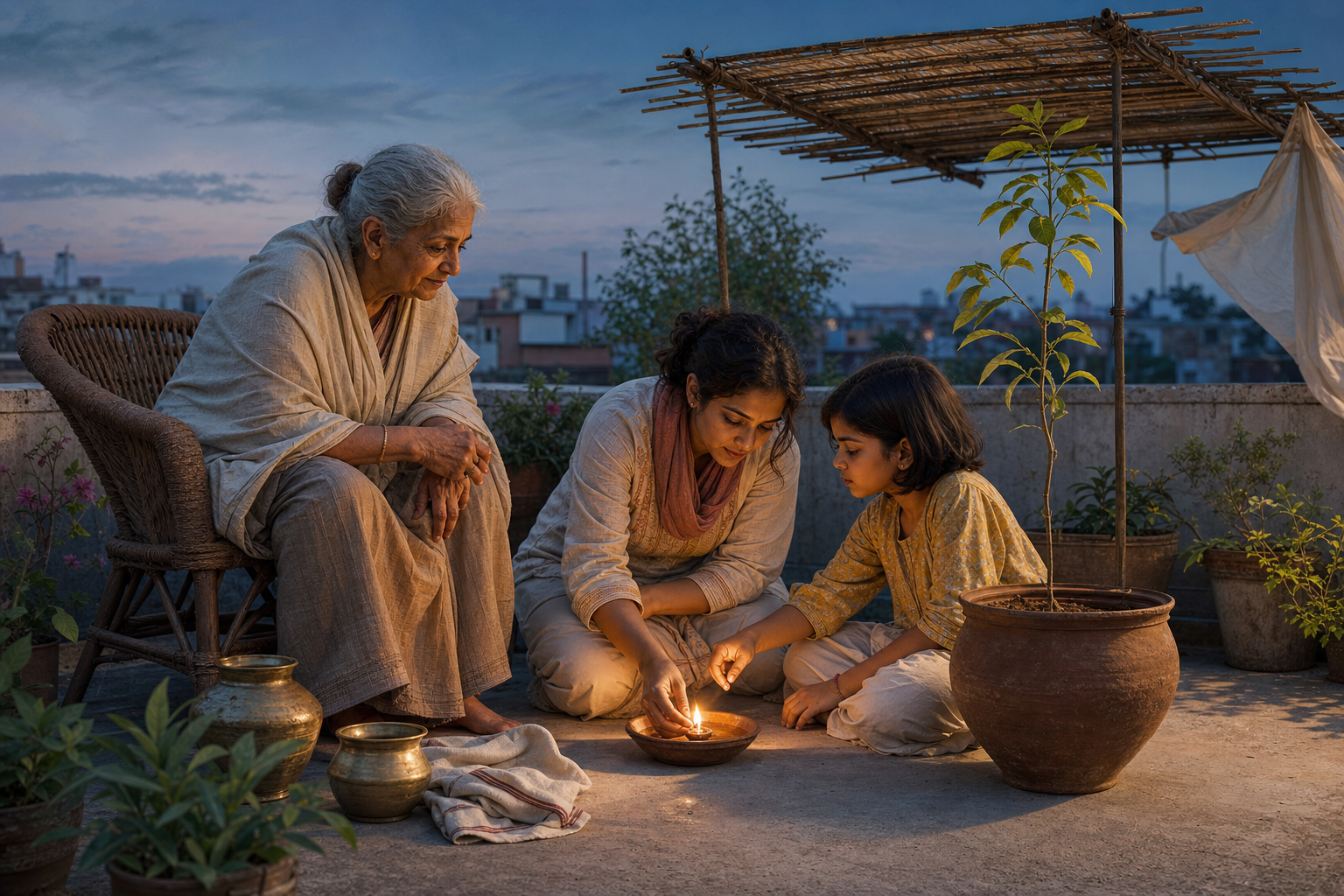
If your children understand English more easily than the language in which their grandparents pray, the obvious response is to translate everything. Translation helps, but it cannot by itself carry the feel of inherited life: where a lamp belongs, how an elder is seated out of the wind, why a sapling is shaded before harsh heat, or what a familiar sound asks everyone to notice.
A shared terrace offers a more complete model. Meaning can move through place, gesture, objects, sound, weather, repetition, and speech at once. If you are trying to pass dharma across a language gap, your first task is not to make a younger relative fluent. It is to give important words a lived setting in which they can be understood, repeated, and eventually claimed.
Place is the first language
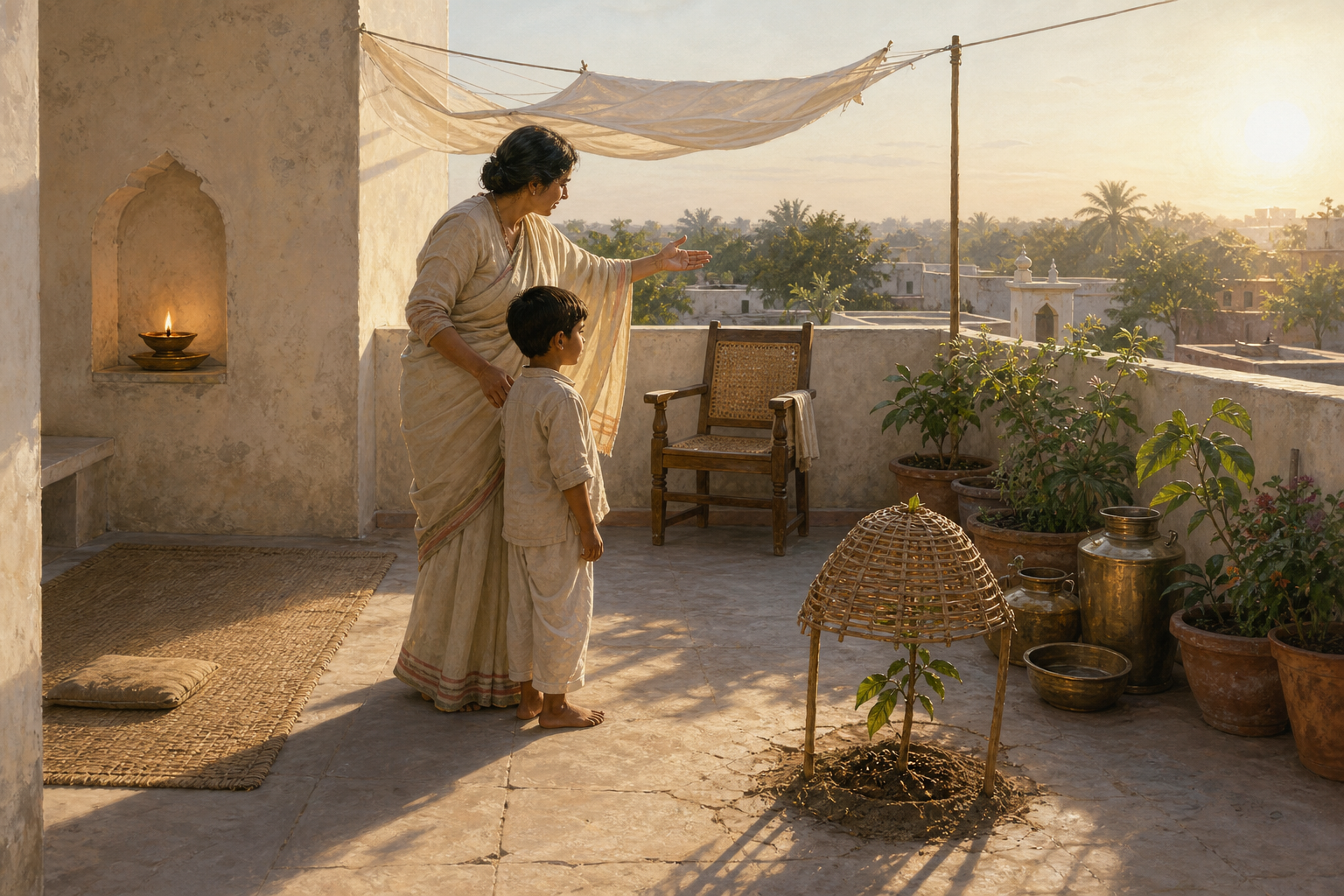
A terrace is neither entirely inside the home nor fully part of the street. It is a threshold where private routines meet the wider neighborhood. Family roles can loosen there: an elder rests instead of directing, a child listens without sitting through a lesson, and a neighbor can join without entering the most private rooms. This is what makes the terrace a liminal space for conversation, observation, and memory.
The rooftop itself is not the essential ingredient. If your home has no terrace, use a balcony, courtyard, veranda, front step, garden corner, or the part of the kitchen where festival work happens. What matters is a recognizable setting where people can return to the same actions without turning every gathering into a formal lesson.
- Choose a place that already belongs to family life. A familiar corner carries memory more naturally than a ceremonial setting created for one occasion.
- Attach the gathering to a cue people can recognize, such as evening light, tea, watering plants, folding clothes, or preparing lamps.
- Give everyone a real role. One person can bring the objects, another arrange them, another explain a remembered custom, and another ask a question.
- Allow silence. Watching an elder perform a practiced action can teach details that disappear when the moment is filled with explanation.
Do not begin by asking a younger person to define dharma. Ask for help with something concrete: placing a diya, tending a plant, spreading a charpai, preparing a garland, or making a comfortable place for an elder. Participation creates an event to which a word can attach. The explanation will then clarify an experience instead of floating above it.
Let action carry the words that are still unfamiliar
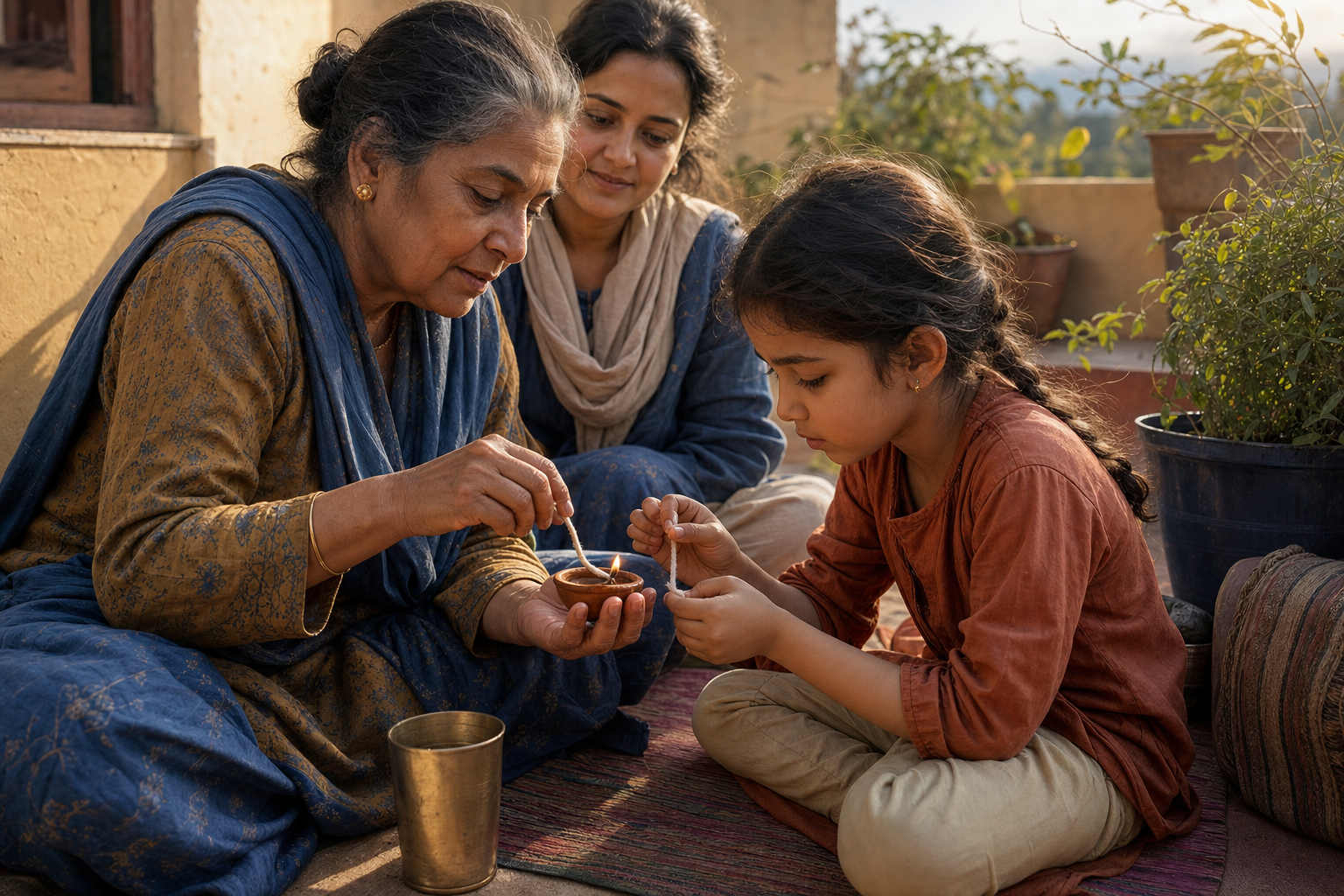
Multilingual families often communicate by moving among languages while also relying on tone, rhythm, gesture, objects, and shared context. That is not failed fluency. It is a practical way of making meaning. A child may not understand every sentence about a ritual, yet still recognize when to become quiet, where to place a lamp, how to offer help, and why the family has gathered.
Use a four-layer pattern whenever you introduce an inherited term:
- Name it. Say one meaningful word in the family’s heritage or liturgical language without immediately burying it under several synonyms.
- Show it. Perform the related action slowly enough for another person to see its sequence and join in.
- Explain it. Give one clear sentence in the language everyone understands best. State the ethical purpose, not only the literal translation.
- Return to it. Use the original word again when the action recurs. Invite recognition, but do not turn the ritual moment into a pronunciation test.
Consider the lighting of a diya at twilight. A grandparent can name the lamp, show how it is placed and lit, explain that the family is marking a transition from daily activity to attentive presence, and let the younger person light the next one. The word now has light, movement, responsibility, and a time of day around it. It is easier to remember because it has somewhere to live.
The same principle applies to sound. A conch at dawn, temple bells, kirtan carried from a nearby gathering, khartals, or rain striking a parapet can signal that the quality of the moment has changed. You do not have to explain every sound immediately. Ask what people noticed before and after it began. That question trains attention, which is itself part of the inheritance.
Correct language with care. If a mistake changes the meaning of a sacred term, explain the distinction after the action. If it is simply an accent difference, do not interrupt participation unless the person asks. A heritage language becomes harder to approach when every attempt is treated as an examination.
Memory grows through return, not through a perfect record
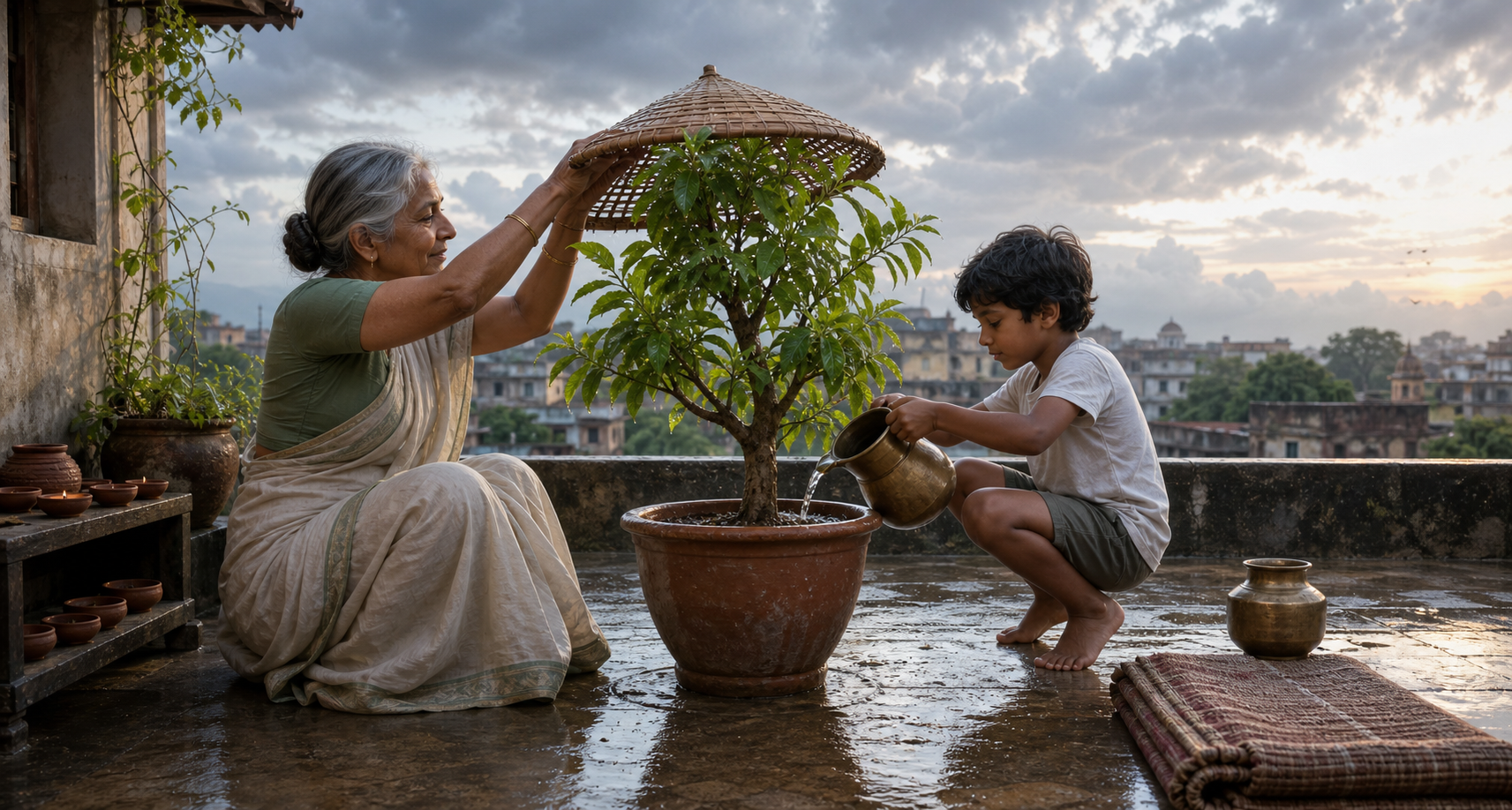
Family memory thickens when the same cues return with a slightly different meaning. A child first sees a tulsi plant as something to water, later understands the discipline of daily care, and eventually remembers the relative who taught that routine. A diya, folded charpai, monsoon breeze, parapet stair, or festival skyline can become part of an ordinary vocabulary of intergenerational memory.
You can preserve this process without trying to archive the entire family at once. Build one small memory record around each recurring object or action:
- Select one anchor: a lamp, plant, garment, garland, cooking tool, prayer object, piece of furniture, or seasonal household task.
- Ask an elder four questions: Who taught you this? When did our family do it? Which detail mattered most? What has changed since then?
- Keep the answer in the form in which it arrives. Preserve code-switching, pauses, regional words, and differing names. With permission, audio is useful when no one can confidently write the original language or script.
- Attach the memory to an action. Arrange the lamps, move the seedlings, prepare the seating, fold the clothes, or invite the neighbor whose presence belongs to the occasion.
- Return to the record when the season, festival, or household duty comes around again. Let the youngest participant retell it in any language before an elder adds what was missed.
The purpose is not to create a museum catalogue. It is to preserve tacit knowledge: where someone sits to avoid the wind, when a plant needs shade, how a garland is tied, or why a particular corner is used at dusk. These small decisions carry habits of care, frugality, hospitality, and ecological attention that abstract definitions of heritage often miss.
Two relatives may remember the same event differently. Record both versions. Do not force every voice into one supposedly authoritative family story. An elder may remember duty, a parent may remember conflict, and a child may remember the weather or a street vendor’s call. Those perspectives can coexist. If a practical detail must be verified, identify that detail separately instead of erasing the rest of the disagreement.
Dharmic pluralism needs precision, not sameness

Hindu, Buddhist, Jain, and Sikh families do not share one theology or one ritual system. Their relationship becomes clearer when ethical kinship is acknowledged without dissolving real distinctions. The terrace can hold several voices because it does not require them to become identical. Ahimsa, anekantavada, karuna, mindfulness, seva, sangat, and respect for multiple approaches to the sacred provide useful openings for conversation, but each term must remain rooted in its own tradition.
| Tradition | Ethical entry point | Question for family dialogue |
|---|---|---|
| Hindu traditions | Ishta and respect for more than one approach to the sacred | Which form or path does our family follow, and how do we show respect when another family follows differently? |
| Buddhist traditions | Karuna and mindful attention | What suffering is present here, and what response would reduce rather than deepen it? |
| Jain traditions | Ahimsa and anekantavada | What harm can we avoid, and what viewpoint might our first judgment have missed? |
| Sikh tradition | Seva and sangat | What service is needed, and how can we perform it within a shared community rather than for recognition? |
These are conversation starters, not complete definitions. Each idea has a deeper scriptural, philosophical, and historical setting. Use a careful sequence when discussing them:
- Name the practice and the tradition from which it comes.
- Ask what discipline, duty, or quality of attention the practice forms in a person.
- Only then compare it with an idea from another tradition, noting both the overlap and the difference.
This sequence avoids two common failures. The first is competition, in which every family memory becomes evidence that one community owns all wisdom. The second is vague universalism, in which distinct teachings are reduced to the claim that every tradition says the same thing. Neither approach teaches a younger person how to listen accurately.
When disagreement arises, replace sweeping claims with precise questions. Ask which ritual, teaching, event, or family experience a person means. Ask whether the disagreement concerns doctrine, custom, language, or conduct. You may not settle a theological dispute on the terrace, but you can prevent it from becoming a caricature of someone else’s path.
Key takeaways
- Do not make fluency a prerequisite for belonging. Give heritage words a place, action, object, and ethical purpose.
- Use a recurring family setting. A balcony, courtyard, kitchen corner, or front step can perform the terrace’s social function.
- Teach in four layers: name the term, show the action, explain its purpose in the strongest shared language, and return to it later.
- Preserve multiple memories instead of manufacturing one flawless family account. Differences reveal how duty, emotion, and place were experienced.
- Compare Dharmic traditions only after naming their practices accurately. Shared values become more meaningful when genuine distinctions remain visible.
At your next family gathering, choose one inherited word and one ordinary action. Put them together in a familiar place, ask an elder how the action was learned, and invite the youngest person to repeat its meaning in their own words. Return to it when the season or occasion comes again. You will have created more than a translation: a small, living chain of language, memory, and dharma.