
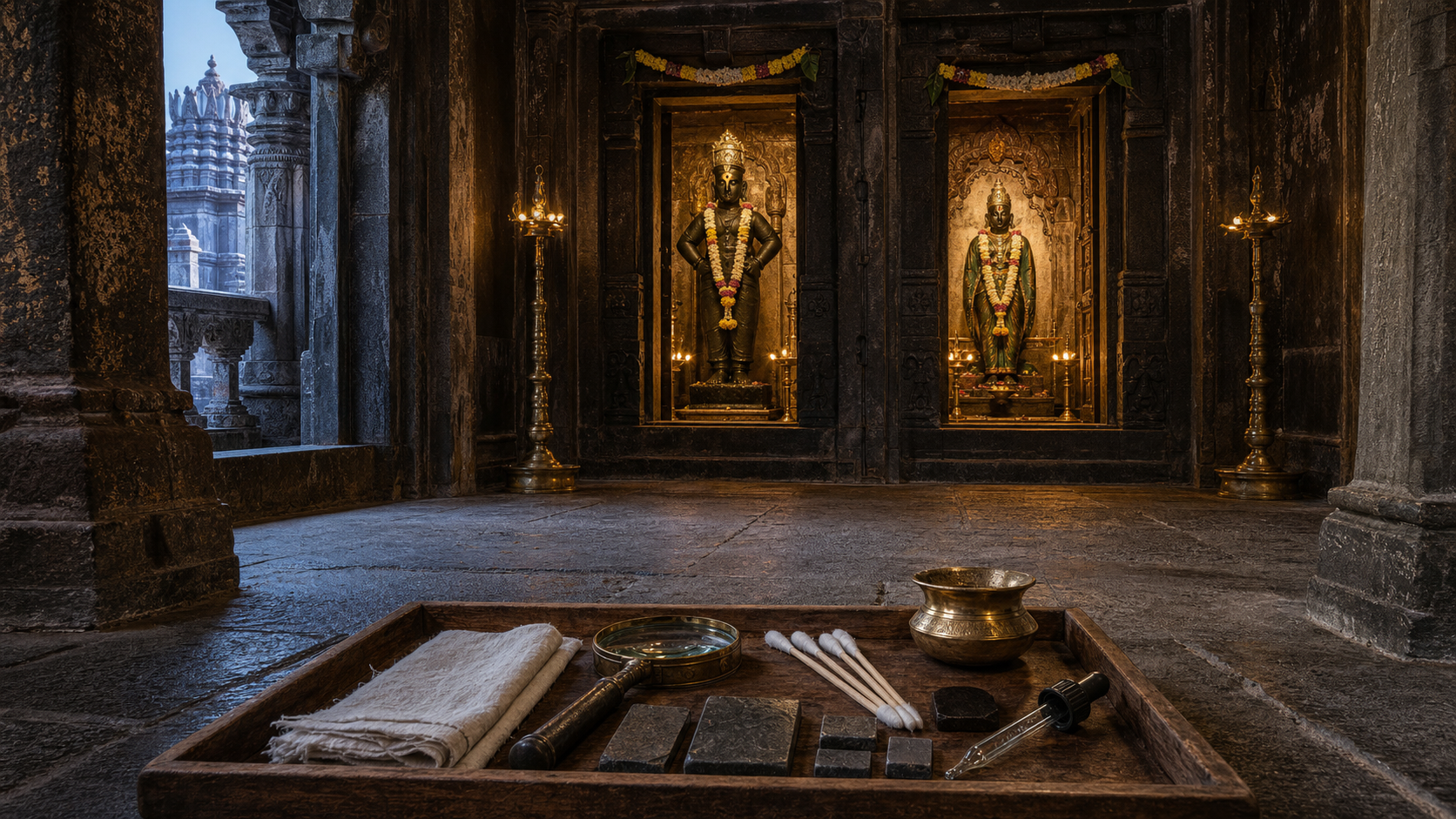
If you have heard that a chemical coating may be applied to the Shri Vitthal-Rukmini murtis, do not begin by choosing between devotion and science. Begin with a narrower question: what documented condition requires treatment, and what evidence shows that the proposed treatment will remain safe under actual worship?
That question protects both the murtis and the credibility of the conservation process. At Pandharpur, success cannot mean merely keeping a stone surface intact. It must also mean preserving darshan, abhishekam, shringar, customary touch, inherited appearance and the confidence of the Warkari community.
A coating is not the same thing as conservation
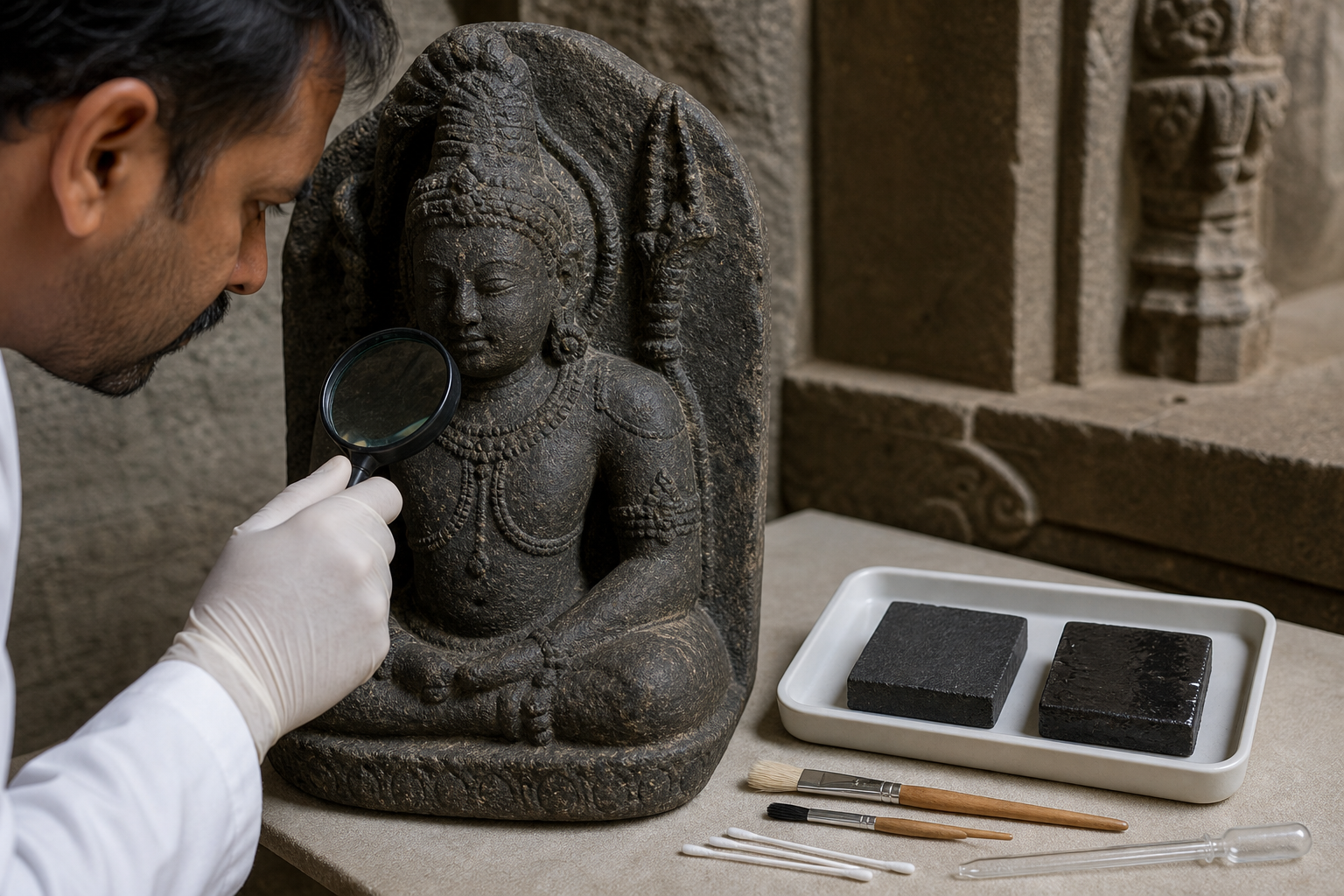
The Maharashtra Mandir Mahasangh and Warkari organizations have opposed the proposed coating and warned that harm to the murtis could lead to court action and criminal proceedings. That opposition should be understood in its proper context. It is not enough to respond that chemicals are routinely used by conservators. The material, purpose, condition of the substrate and conditions of use determine whether an intervention is appropriate.
Chemical coating is not a useful technical specification. Conservation materials used in other settings can include hydrophobic silanes or siloxanes, acrylic resins, microcrystalline waxes and other polymeric barriers. Those are possible categories, not evidence that any one of them has been selected for Pandharpur. When the proposal drew public opposition, no exact product, application parameters or approval record had been publicly identified.
Three different operations are often blurred together:
- Cleaning removes selected deposits without intentionally leaving a continuous new surface layer.
- Consolidation introduces material into a weak or friable substrate to improve cohesion. It is justified only when actual loss of cohesion has been diagnosed.
- Protective coating leaves a barrier intended to change how the surface responds to moisture, dirt, oils or handling.
Each operation answers a different problem. A map of micro-cracks, deposits and earlier repairs may justify localized cleaning or a micro-repair without justifying a blanket coating. If the specific problem has not been defined, the treatment cannot be evaluated. Applying a coating first and diagnosing its necessity later reverses the proper order of work.
No treatment is also a legitimate conservation option. Preventive care, carefully defined cleaning and localized repair may impose less risk than adding a film across an entire sacred surface. Restraint is not neglect when the proposed cure could be harder to reverse than the deterioration it is meant to address.
Ritual life changes what counts as damage
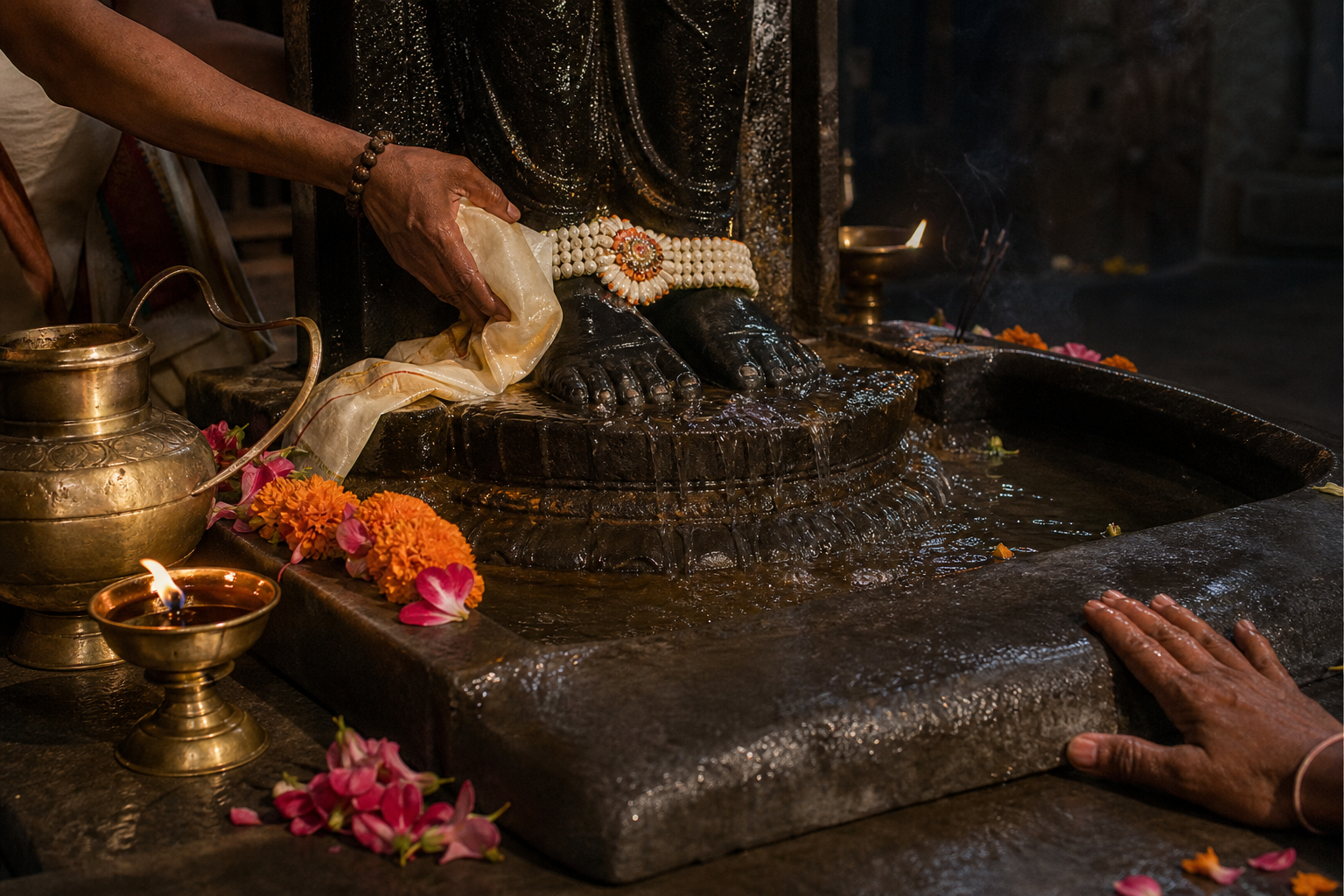
Pandharpur receives lakhs of pilgrims during the Ashadhi Wari and continues to draw devotees throughout the year. The murtis participate in a living cycle of darshan, abhishekam, shringar and tactile devotion. A treatment suitable for a museum object behind glass may therefore fail in the mandir even if it performs well in an ordinary laboratory test.
Panchamrita, water, oil, kumkum, chandana and other ritual materials can wet, stain, soften or adhere to a newly treated surface. Incense smoke and airborne particles may settle differently on a coating than on untreated stone. A film that initially looks clear can deepen the apparent colour, increase gloss or create an artificial sheen. On a familiar dark surface, even a small visual change can alter the form devotees have known through repeated darshan.
Touch, textiles and regular cleaning create a second problem: uneven abrasion. The most frequently contacted areas may lose a coating first while protected recesses retain it. The result can be a patchwork of different colours, gloss levels and textures. Repairing that patchiness may require solvents or mechanical action that place the original surface and its patina at further risk.
Moisture behaviour matters below the visible surface as well. A water-repellent layer can reduce liquid entry, but it can also change evaporation and water-vapour exchange. If moisture or soluble salts remain below the treated zone, crystallization may become concentrated beneath it. An apparently protective skin can then conceal deterioration rather than prevent it.
This is why reversibility cannot be treated as a label printed on a conservation product. The relevant question is whether an aged treatment can be removed or retreated safely after exposure to ritual liquids, pigments, oils, soot and thousands of contacts. Laboratory removability on a clean sample is not enough.
The Venice Charter of 1964, the Nara Document on Authenticity of 1994 and conservation practices associated with the ASI and INTACH point toward minimum intervention, compatibility, respect for authenticity and careful testing. In a living shrine, authenticity includes continuing worship and inherited surface character. Patina is not automatically dirt, and ritual use is not an external nuisance to be engineered away.
Any intervention should pass eight decision gates
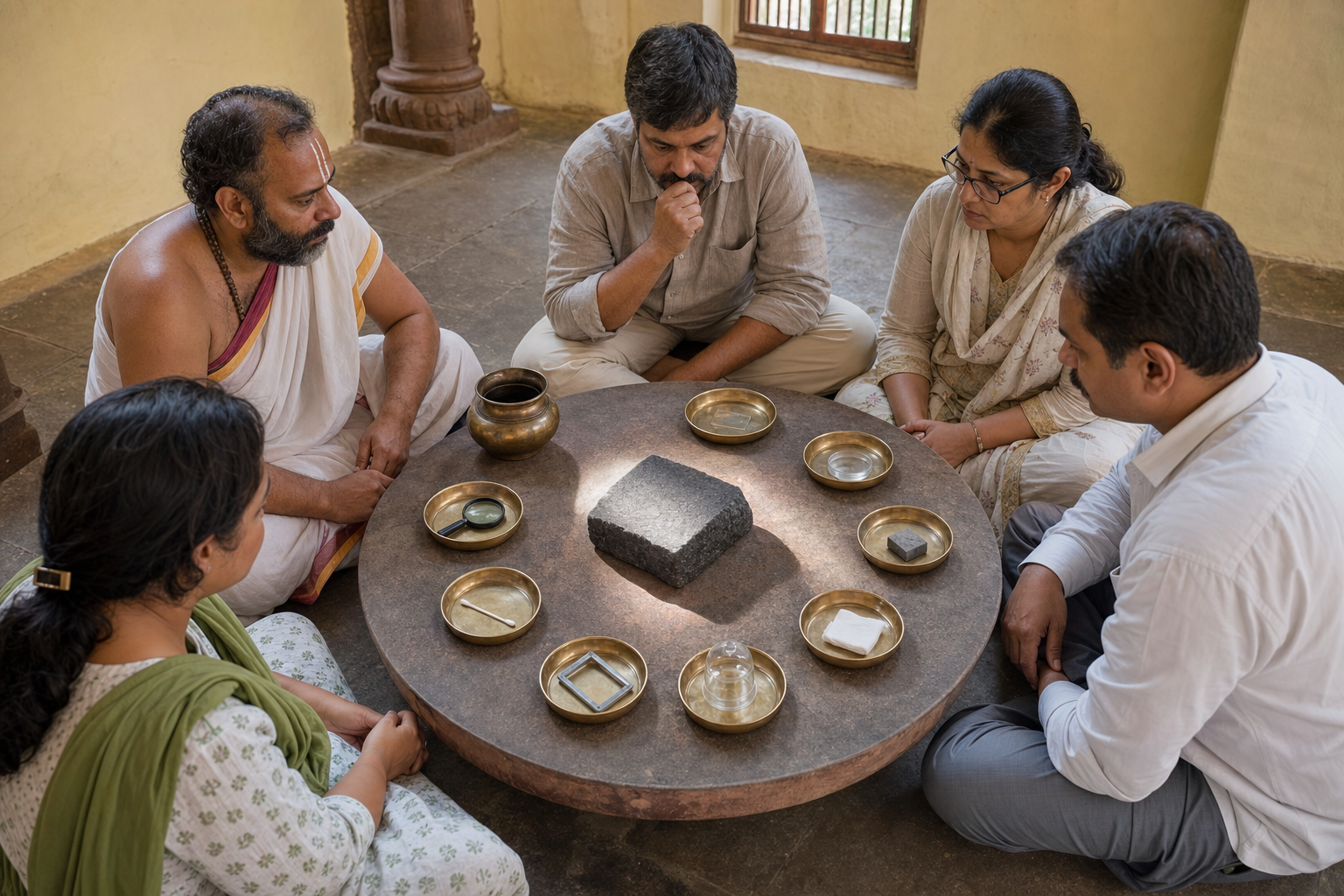
A credible process should be visible before any material reaches the murtis. The following sequence gives devotees, custodians and specialists a practical way to judge it:
- Publish the purpose. State the exact condition being addressed, the proposed material, its application parameters, the expected benefit and the alternatives considered. A general intention to protect the idols is not a diagnosis.
- Constitute an independent multidisciplinary panel. Conservation scientists and material specialists are necessary, but not sufficient. Art historians, archakas, ritual specialists, Warkari representatives, legal experts and relevant heritage authorities must be able to examine the same proposal.
- Create a baseline before treatment. High-resolution photographs, photogrammetry or three-dimensional scanning should record the present form and surface. Condition maps should locate micro-cracking, accretions, wear patterns and previous repairs so that later change can be distinguished from pre-existing variation.
- Characterize the material. Petrographic examination and techniques such as X-ray diffraction can help identify mineral phases and possible incompatibilities. Any micro-sampling must be ethically permissible, tightly limited and justified; the desire for more data does not authorize avoidable removal from a sacred murti.
- Build representative mock-ups. Test pieces should reproduce the relevant substrate and receive the proposed treatment. They must then face panchamrita, water, oil, kumkum, turmeric, chandana, smoke, textiles, repeated touch and the cleaning methods expected in the mandir. The original murtis should never be used to discover basic compatibility.
- Set acceptance criteria in advance. Colour, gloss, texture, capillary uptake, vapour behaviour, salt response, abrasion and removability need written pass-or-fail conditions. A limit selected after observers have seen the result is not a meaningful safeguard.
- Require consent and a stoppage mechanism. Only after mock-ups have passed should a localized test on the original even be considered. Its location, method and observations must be recorded, and authorized representatives must be able to halt the work at the first adverse sign.
- Fund monitoring, not only application. A photographic register, scheduled condition checks, a safe cleaning protocol and a response plan for unexpected change should continue after treatment. Annual reporting to the community would make deterioration, success and corrective action visible.
A proposal that enters this sequence at gate seven is not ready. A small test patch may sound cautious, but it is still an intervention on the original. Mock-ups, agreed criteria and documented review must come first.
The tests must reproduce worship, not ideal conditions
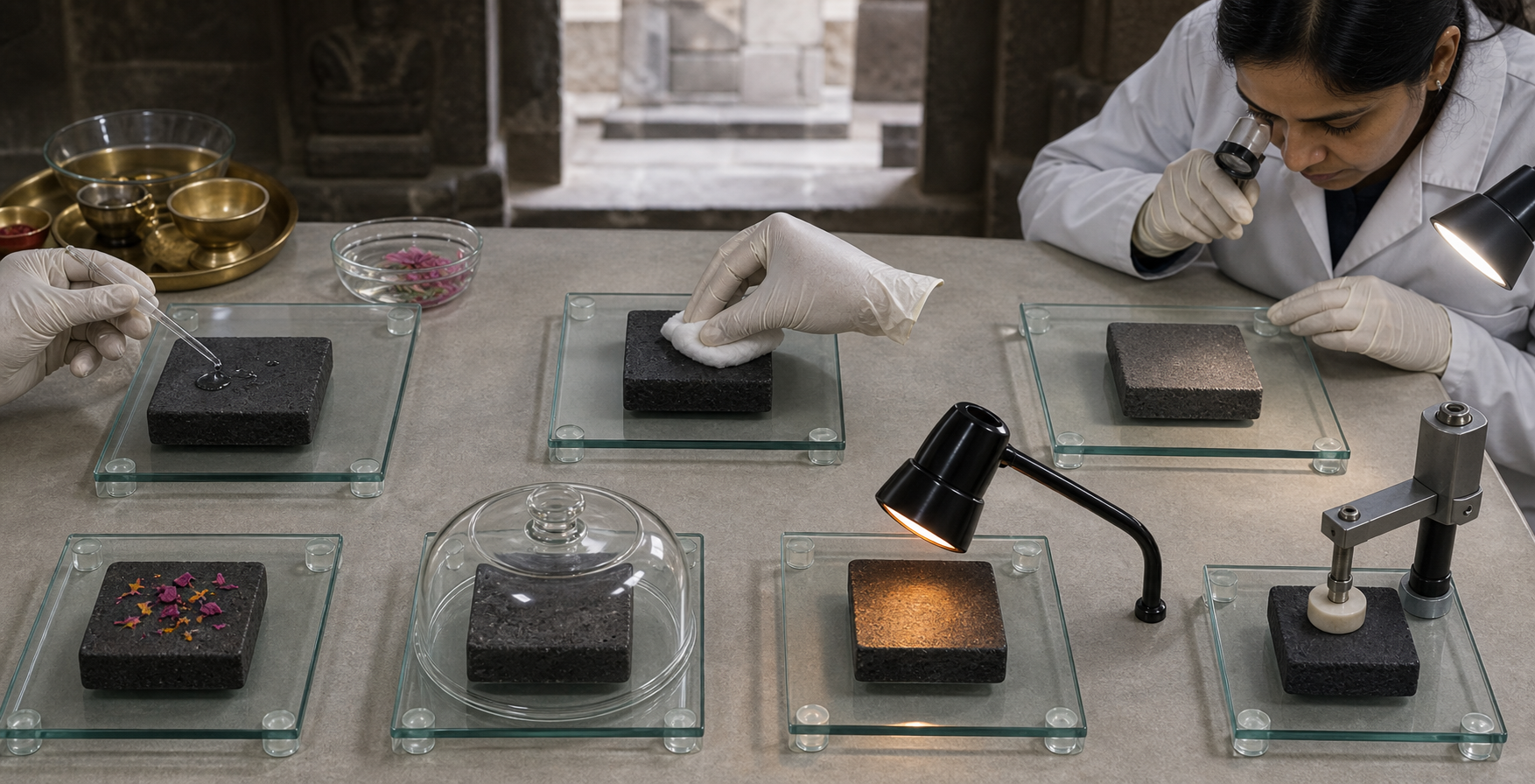
The most useful test programme turns general assurances into observable decisions. Exact numerical limits should be established by qualified specialists and accepted by the review panel before results are known. The community can still insist that every important question has a defined form of evidence and a clear reason to stop.
| Decision question | Evidence required | Reason to stop |
|---|---|---|
| Does the treatment alter darshan? | Colourimetry, including change expressed as ΔE, together with gloss and texture measurements on treated and untreated mock-ups | Colour, sheen or texture exceeds the criterion agreed before testing, or creates a visibly artificial surface |
| Does it manage moisture safely? | Water contact angle, capillary uptake, water-vapour behaviour and salt-crystallization testing | Moisture release is impaired, salts concentrate below the treated layer or the surface responds unevenly |
| Can it tolerate ritual materials? | Repeated exposure to panchamrita, water, oil, kumkum, turmeric and chandana, followed by the proposed cleaning cycle | Tackiness, staining, pigment entrapment, swelling, softening or persistent residue appears |
| Can it tolerate actual handling? | Repeated contact, textile abrasion and wet-and-dry cycles that simulate routine worship and care | The film wears patchily, darkens, becomes glossy in touched areas or attracts visible deposits |
| Can future conservators retreat it? | Removal and retreatment trials on aged mock-ups after ritual exposure | Removal requires action likely to dissolve, abrade, stain or otherwise endanger the original surface and patina |
Visual inspection remains important, but it should not stand alone. A surface can look acceptable immediately after application and still fail after repeated wetting, oil exposure or abrasion. Conversely, a technically impressive increase in water repellency is not a success if it creates shine, traps salts or interferes with customary worship.
Key takeaways
- A chemical coating is an added surface system, not a neutral act of protection.
- No one can give informed approval without the exact material, purpose, application method and risk record.
- Ritual exposure and repeated handling must be tested on mock-ups before any trial on the original murtis.
- Colour, gloss, moisture, salt, abrasion and removability criteria must be fixed before results are available.
- If localized cleaning, micro-repair or preventive care can solve the diagnosed problem, a blanket coating has not earned its additional risk.
A dharmic standard devotees can insist upon
If you contact temple custodians, a Warkari organization or a public authority, do not limit your request to a general demand that chemicals be stopped. Ask questions that require verifiable answers:
- What precise form of deterioration has been documented, and may the condition map be made public?
- Is the proposed work cleaning, consolidation, a protective coating or a combination of these?
- What exact material and application parameters are proposed, and who approved their consideration?
- Who sits on the review panel, and how are archakas and Warkari representatives included in its decisions?
- Which ritual materials, handling patterns and cleaning cycles will the mock-ups reproduce?
- What pre-agreed result will cause the proposal to be rejected or the work to stop?
- How will the treatment be monitored, and when will the community receive the condition records and follow-up findings?
If these answers are absent, the responsible position is a pause. That is not proof that every conservation material is harmful, nor is it an accusation of bad faith. It is recognition that an irreversible or difficult-to-remove intervention should not proceed on trust alone.
The warnings of litigation also make disciplined language important. Potential damage to sacred murtis is serious, but legal allegations should not outrun the evidence. Anyone considering court or criminal action should obtain advice based on the current law, the actual approvals and the documented facts; a conservation checklist is not a substitute for case-specific legal counsel.
The same principle reaches beyond Pandharpur. Jain icons, Buddhist bronzes and Sikh sacred relics also join material inheritance to living maryada. Seva asks custodians to care. Ahimsa asks them to avoid preventable harm. Accountability asks them to show why an intervention is necessary and how it can be stopped.
Your most useful next step is therefore concrete: place these seven questions before the relevant custodians and ask for the answers to be recorded publicly. Until the diagnosis, mock-up results, acceptance limits, consent process and monitoring plan can withstand scrutiny, the prudent sequence is to document, test away from the murtis, consult and wait. Pandharpur deserves conservation that future devotees will not have to undo.