
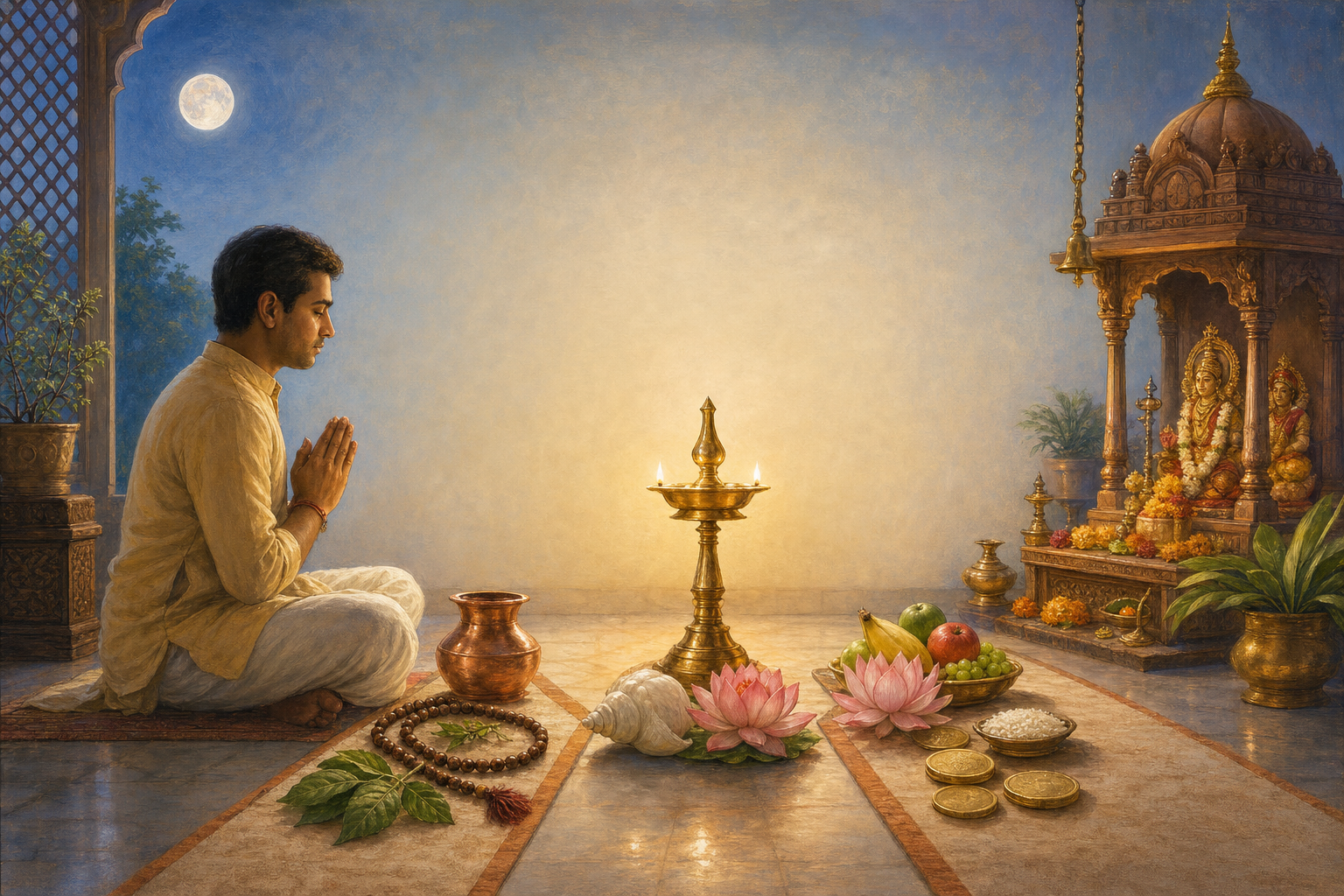
You may be considering a vrat because your conduct feels scattered, your household needs a healthier relationship with prosperity, or your devotion has become occasional. The common mistake is to begin by choosing the strictest fast. Begin instead with the change you need to cultivate and the discipline you can honestly sustain.
Dharmaprapti Vrat and Lakshminarayan Vrat offer two clear frameworks. One concentrates a complete lunar month on attaining and living Dharma. The other places prosperity, work, and household resources under the joint guidance of Lakshmi and Narayana. Both include worship, restraint, charity, and self-examination, but they organize those elements around different needs.
Choose the fruit of the vow before choosing the fast
A vrat is larger than a food restriction. Upavasa may be part of it, but so are sankalpa, puja, japa, svadhyaya, dana, seva, and disciplined conduct. If the menu changes while speech, consumption, and treatment of other people remain untouched, the most important part of the vow has been missed.
| Your present need | Suitable starting point | Characteristic commitment | Central question |
|---|---|---|---|
| You need ethical clarity, steadier conduct, or a sustained spiritual reset | Dharmaprapti Vrat, also called Dharmavapti Vrat | One complete lunar month of regular devotion, restraint, study, and service | How will I bring Dharma into thought, speech, work, and relationships? |
| You want prosperity without separating wealth from responsibility | Lakshminarayan Vrat | A lineage-based recurring cycle, such as a monthly observance or a promised series of Thursdays | How will I earn, use, preserve, and share resources under Dharma? |
| Your family already maintains a vrata tradition | The inherited observance, with its established deity, calendar, and method | The cycle received through your parampara | What must be preserved, and what may be adapted for health or daily duty? |
Dharmaprapti is the clearer choice when the immediate problem is inconsistency: reactive speech, distracted attention, avoidable consumption, or a gap between your stated values and daily conduct. Its month-long form gives you enough continuity to notice patterns and replace them with repeatable habits. Vishnu, Shiva, an ishta-devata, a kula-devata, or Dharma-devata may preside, depending on the living tradition you follow.
Lakshminarayan Vrat is especially suited to a householder asking how artha can support Dharma. Lakshmi signifies auspicious abundance, capability, and relational harmony; Narayana places those powers within preservation, order, and long-term welfare. The aim is not wealth at any cost. It is prosperity obtained through clean means, governed wisely, and shared with gratitude.
Do not silently substitute Varalakshmi Vrat for Lakshminarayan Vrat. Varalakshmi Vrat centers Mahalakshmi, while Lakshminarayan Vrat deliberately worships Lakshmi and Narayana together. Both are sacred, but their devotional focus is not identical.
If both needs speak to you, choose the one that addresses your present disorder. Avoid stacking several demanding vows in an attempt to make the observance more powerful. A single vow carried steadily to completion is more formative than an elaborate program abandoned after its novelty fades.
Write a sankalpa precise enough to govern an ordinary day
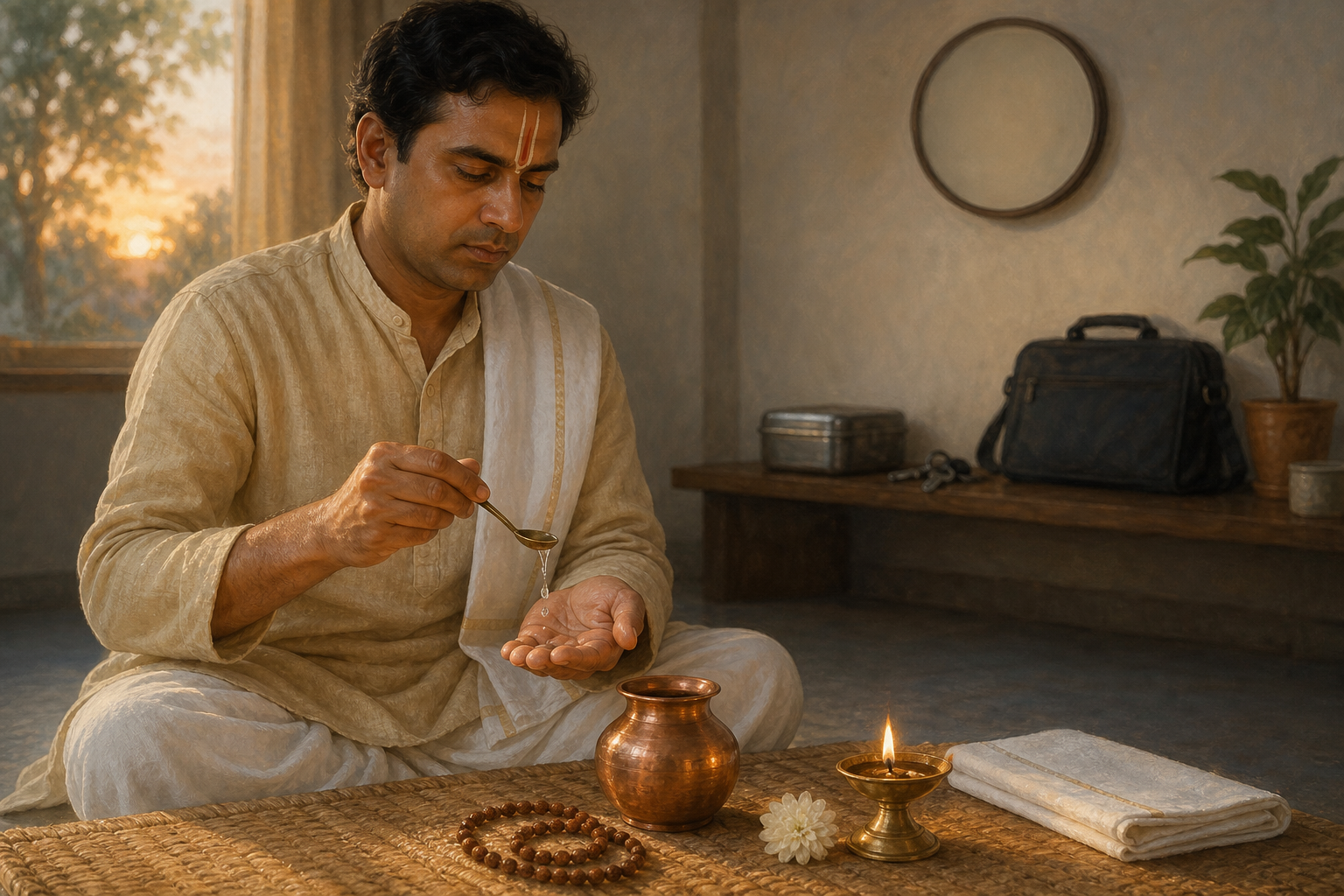
A useful sankalpa defines what you are promising. It should not be a vague wish for success, nor a bargain in which ritual effort is exchanged for a guaranteed result. It is a commitment to place your aspiration inside a disciplined way of living.
- Name the devotional center. Identify the deity or sacred principle before whom the vow is taken. Follow your family tradition where one exists.
- State the cycle. Record the beginning, completion, and relevant tithi or weekday. Dharmaprapti customarily spans a complete lunar month. Lakshminarayan schedules vary and may follow a Shukla Paksha Ekadashi or Dwadashi, a Margashirsha observance, or a series of 11, 16, or 24 Thursdays.
- Choose one sustainable food discipline. State whether you will follow phalahara, ekabhukta, a light sattvic diet, another inherited rule, or a medically necessary adaptation.
- Fix the daily devotional minimum. Name the mantra, recitation, puja, or period of svadhyaya you will maintain even on a busy day.
- Name the ethical restraint. Choose something observable, such as truthful speech, non-injury, reduced reactive conversation, restraint in entertainment, or careful use of time.
- Define dana or seva. Decide how generosity will accompany the vow and how you will conclude it through udyapana, prasada, or service.
A plain-language form can be sufficient: For this stated period, in devotion to this deity, I undertake this food discipline, daily worship, ethical restraint, and service, seeking Dharma and the welfare of all beings. A formal sankalpa may also include your name, lineage, place, and lunar date according to your customary ritual method.
For Dharmaprapti, a concise formula associated with the observance is Om Dharmaya Namah. Dharmaprapti-vrata-siddhyartham, dharma-prapti kamaye. If Sanskrit pronunciation or ritual grammar is unfamiliar, receive the form from an acharya or knowledgeable elder rather than treating an online transliteration as a substitute for instruction.
For Lakshminarayan worship, Om Namo Narayanaya and Om Shreem Mahalakshmyai Namah provide a concise devotional center. Your request for prosperity should remain ethically framed: ask for the resources, discrimination, and steadiness needed to fulfill duty, support the household, serve others, and advance spiritually. A demand for a particular financial outcome turns the sankalpa away from its deeper purpose.
Use the local Panchang rather than assuming that a calendar date alone settles the observance. Tithi boundaries, parana windows, and preferred timings can vary by place. Family custom may also favor a particular weekday, lunar month, or auxiliary observance. Confirm these details before beginning so that uncertainty does not disrupt the vow halfway through.
Build a devotional rhythm that survives work and family duties
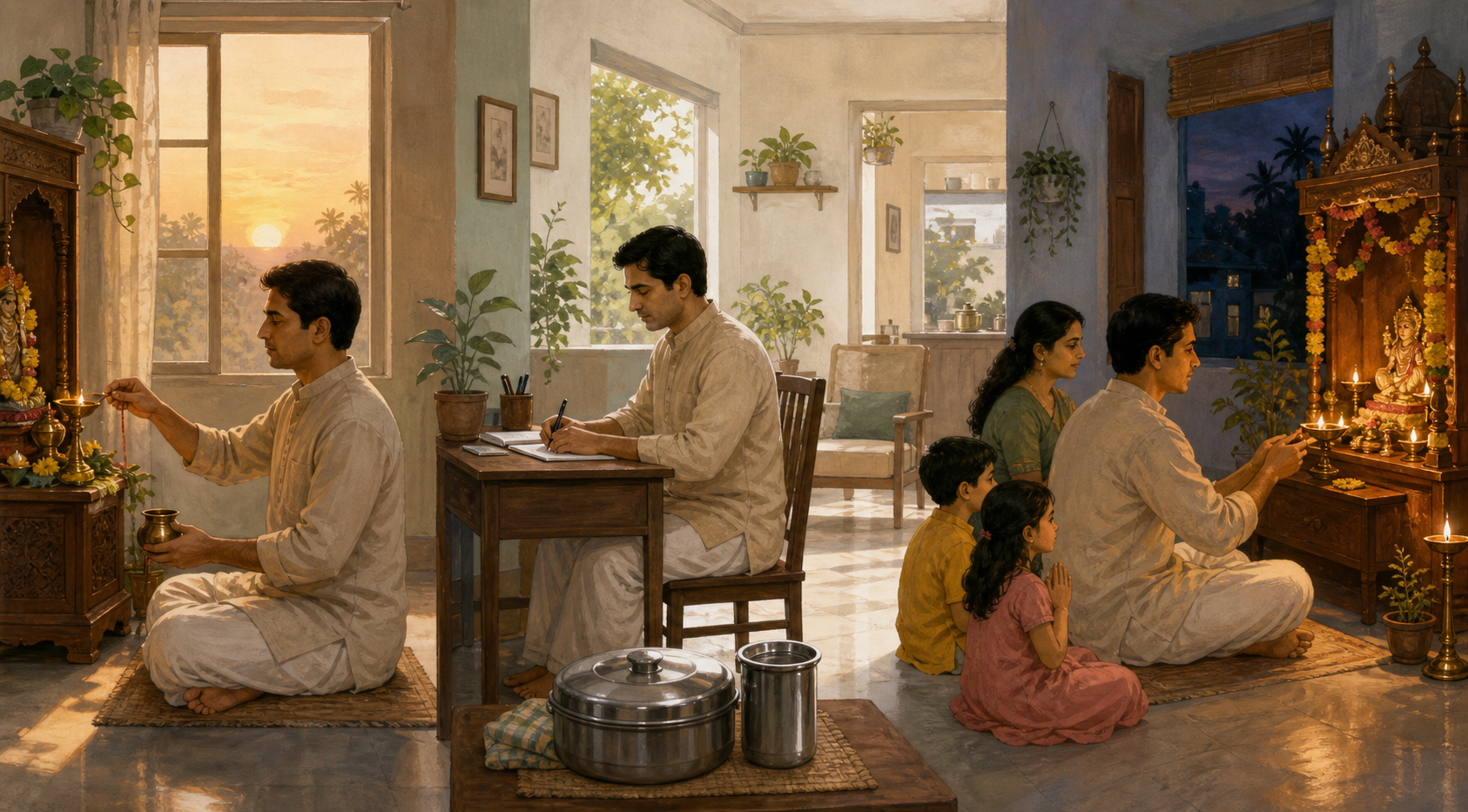
The best daily structure is not the longest one. It is the one you can perform with attention throughout the promised cycle. Prepare the altar, reading, food plan, and charity commitment before the first day. That removes repeated decisions and preserves attention for the practice itself.
A month-long Dharmaprapti cadence
- Morning purification: Bathe, approach a clean worship space, light a lamp, and recollect the sankalpa. Offer water, a simple flower or permitted leaf, and sattvic naivedya according to the deity and your tradition. Tulasi may accompany Vishnu worship; bilva may accompany Shiva worship where customary.
- Focused recitation: Keep one dependable practice, such as a chosen mantra, Vishnu Sahasranama, a suitable hymn, or selected Bhagavad Gita passages. Surya-arghya at sunrise may be included where it belongs to your practice.
- Daytime niyama: Carry the vow into work through ahimsa, satya, restraint in consumption, careful speech, and responsible use of attention. Limiting social media or reactive exchanges can make the discipline concrete rather than merely aspirational.
- Svadhyaya with application: Read a manageable passage on Dharma, then identify one action it requires from you that day. The point is not to accumulate pages but to close the distance between sacred learning and conduct.
- Evening accounting: Light the lamp again, perform brief japa or arati, and examine the day. Where were you truthful? Where did impatience cause injury? What needs repair tomorrow? Share prasada respectfully within the household.
Keep the devotional minimum stable. Constantly changing mantras, texts, and altar arrangements can create the feeling of intensity while weakening regularity. If the day becomes unusually demanding, perform the promised minimum with full attention and return to the fuller routine when normal duties resume.
A recurring Lakshminarayan cadence
Lakshminarayan worship may be performed in the morning, or during an evening or pradosha period where that accords with lineage. Some households perform the main puja in the morning and return for evening deepa and kirtana. Consistency with your promised cycle matters more than copying another region’s schedule.
- Prepare the altar: Place a murti or image of Lakshmi-Narayana on a clean asana. Where feasible, the worship space may face east or northeast. A kalasha with water, grains, a coin, leaves, and coconut may be installed when your tradition uses it.
- Offer appropriately: Tulasi is associated with Narayana; lotus or rose may be offered to Lakshmi. A lamp, incense, sandalwood, kumkum, seasonal fruit, or a milk preparation may accompany the worship according to availability and custom.
- Follow the puja form you know: A concise observance can include invocation, flowers, dhoopa, deepa, naivedya, mantra-japa, stuti, and pranama. A household trained in Panchopachara or Shodashopachara should retain its received sequence rather than improvising a hybrid ritual.
- Recite within capacity: Vishnu Sahasranama or Vishnu Ashtottara may be paired with Sri Lakshmi Ashtottara Sata Namavali. When time is constrained, keep the core mantras and quiet contemplation rather than rushing a long recitation.
- Distribute prasada: Include family members, guests, or neighbors where appropriate. This turns the household’s prayer for abundance into an immediate act of sharing.
If the vow is aligned with Ekadashi, grains are traditionally avoided and parana is made on Dwadashi within the interval shown by the local Panchang. If it follows a Thursday series, keep track of each promised observance and plan the concluding udyapana before the final one arrives. Anchor days such as Ekadashi or Pradosha may also enrich a Dharmaprapti month, but they are optional unless your parampara makes them part of the vow.
The real discipline protects health, duty, and integrity
Choose a sustainable food rule
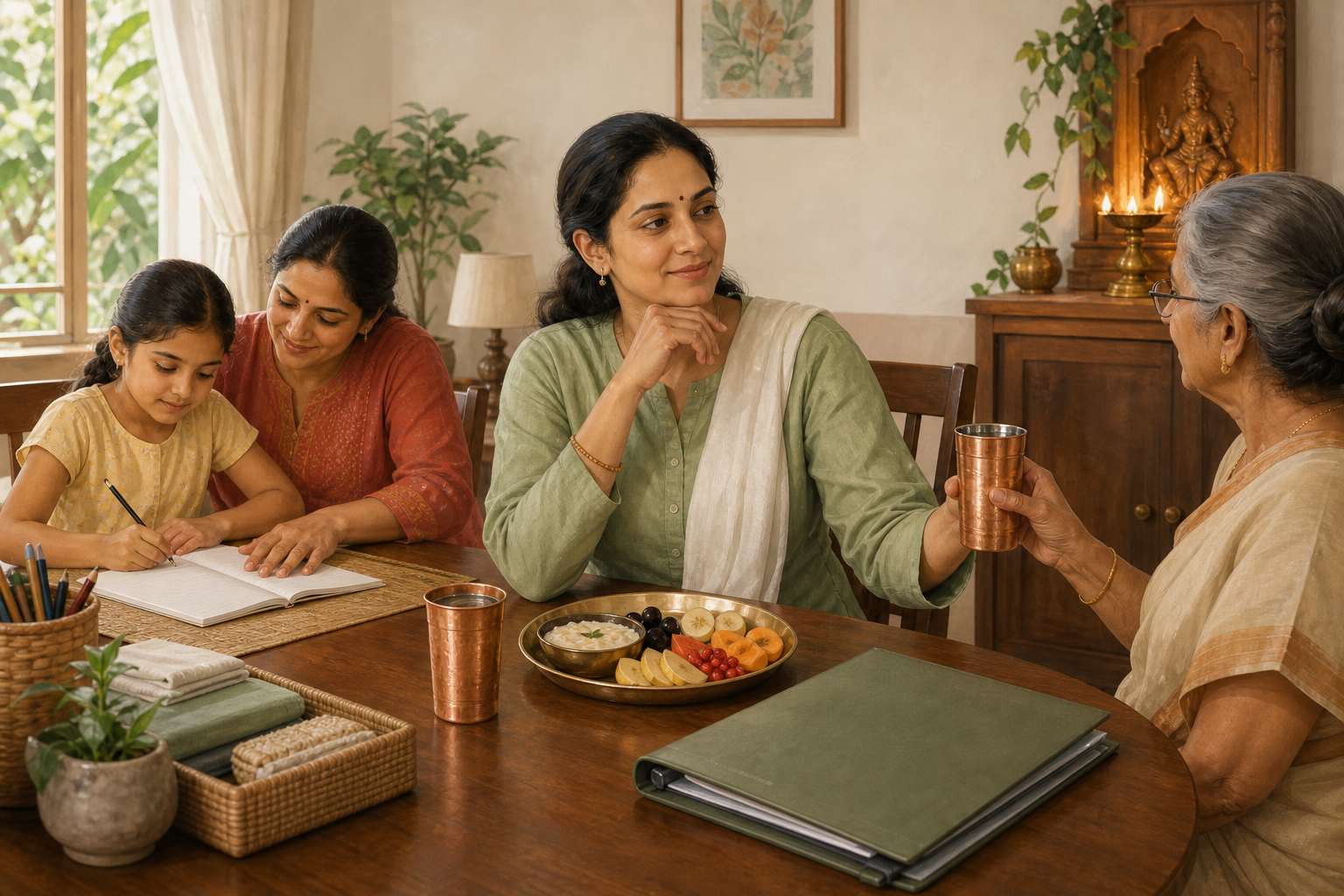
Severity is not the measure of sincerity. The food discipline should sharpen attention without making you incapable of fulfilling legitimate duties. Climate, age, work, health, medication, and family responsibilities all affect what is responsible.
- Light sattvic food: A simple diet or laghu-sattvika ahara is the gentlest option and may be the most workable when daily duties cannot be reduced.
- Ekabhukta: One meal can create a clear boundary while preserving a substantial eating interval.
- Phalahara: Fruit, milk, nuts, or customary vrat preparations may be used where suitable. Regional foods can include sabudana, sama rice or barnyard millet, and kuttu preparations.
- Jala-upavasa: A water-only observance demands greater caution and should not be assumed appropriate merely because it is stricter.
- Nirjala: A waterless fast is exceptional and is not suitable for most practitioners. It should never be adopted casually or used to compete with another devotee’s austerity.
Hydration and electrolyte needs do not disappear during a religious observance. Children, pregnant people, older adults, anyone taking medication, and anyone with a health condition should use a gentle form and obtain appropriate medical guidance. A dietary fast is not a substitute for treatment. If you become unwell, stop the fast and seek appropriate care; worship, japa, charity, and disciplined speech can continue without putting the body at risk.
If food restriction is unsuitable, take a manovrata: reduce reactive speech, avoid needless digital stimulation, maintain daily svadhyaya, and enlarge seva. This is not an inferior escape from the vow. It directs restraint toward the habits that may actually be obstructing Dharma.
Make prosperity answer to Dharma
Lakshminarayan Vrat becomes practical when you examine the means and use of prosperity. On every observance day, bring one real decision into the prayer: a work choice, purchase, debt, use of time, family obligation, or act of giving. Ask whether the means are honest, whether another being bears avoidable harm, whether the choice supports long-term welfare, and what can be shared without neglecting your dependants.
Dharmaprapti applies the same test more broadly. A vow to truthfulness means correcting a misleading statement, not merely admiring satya during puja. A vow to ahimsa means noticing harsh speech and careless treatment of people, animals, and the environment. Restraint means deciding what you will decline before desire or anger makes the decision for you.
Dana and seva give these principles visible form. You may offer food respectfully, support education or healthcare, care for animals, participate in environmental cleaning, help a temple or trustworthy local charity, or give time to someone who needs practical assistance. Choose an act within your means, perform it without display, and treat the recipient with dignity. Generosity is not an ornamental addition after the puja; it is where the vow leaves the altar and enters society.
Repair a lapse and complete the vow properly
A missed recitation, broken food rule, or lapse in conduct should lead to truth, not concealment or despair. Acknowledge what happened, make a modest prayaschitta such as additional japa or a small act of charity, and resume the observance. If your lineage gives a specific remedy, follow it. Do not invent a severe punishment, and do not abandon the remaining cycle because one day was imperfect.
Completion matters because it turns a temporary discipline into a conscious transition. At the end of Dharmaprapti Vrat, perform a concluding puja, offer suitable naivedya, share prasada, and accompany gratitude with dana or community feeding. A series-based Lakshminarayan Vrat may conclude with udyapana, annadana, vastra-dana, or support for a temple or local charity. Follow the scale appropriate to your means; debt and display are contrary to the ethical purpose of the observance.
Before closing, select one practice that will continue after the formal vow: measured speech, a fixed weekly japa, regular dana, evening deepa, or a recurring household review of resources and responsibilities. The lasting fruit is not that you endured a demanding interval. It is that Dharma became easier to remember when ordinary life resumed.
Key takeaways for choosing and keeping your vrat
- Choose Dharmaprapti when you need a sustained month of ethical clarification, devotional regularity, and disciplined conduct.
- Choose Lakshminarayan when your central concern is to place livelihood, household prosperity, and the use of resources under Dharma.
- Confirm the tithi, timing, deity, and ritual form through your local Panchang and living family or sampradaya tradition.
- Write a bounded sankalpa covering the cycle, food discipline, daily worship, ethical restraint, seva, and method of completion.
- Use the gentlest fasting form that remains meaningful and medically responsible. Nirjala is exceptional, not a default measure of devotion.
- When a lapse occurs, acknowledge it, make a proportionate repair, and resume. Conclude through gratitude, prasada, and generosity.
Before selecting an auspicious date, write those six elements on one page and show them to a knowledgeable elder or acharya. If the plan changes eating or hydration in a medically significant way, review that part with an appropriate healthcare professional. Then begin with a promise small enough to keep and substantial enough to change how you live.
References
- DharmaRenaissance Blog — Dharmaprapti Vrat (Dharmavapti): The Month-Long Sacred Fast to Attain Dharma and Fulfil Life Goals
- DharmaRenaissance Blog — Unlocking Lakshminarayan Vrat: Puranic Roots, Ritual Science, Dates, Vidhi, and Benefits