
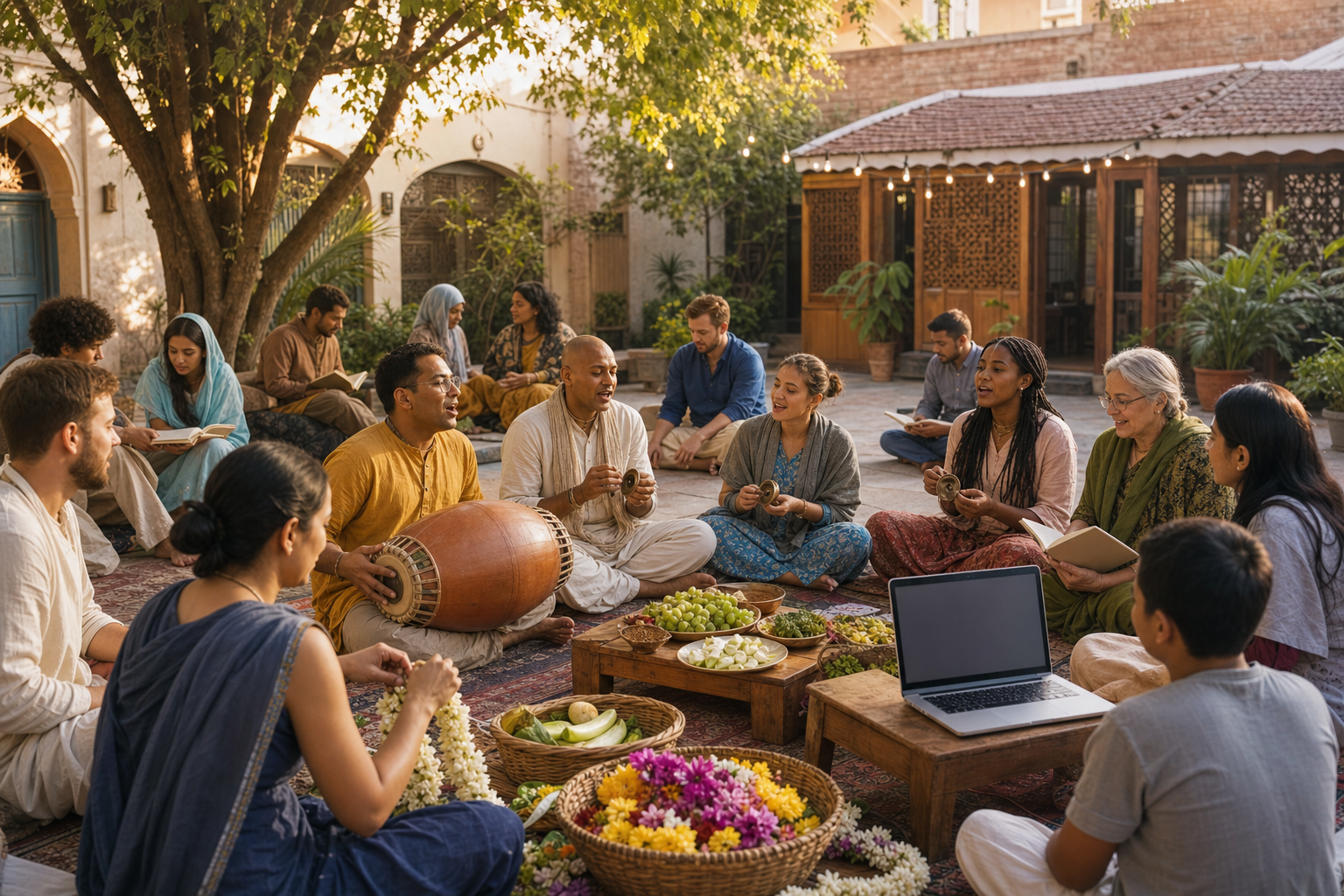
Contemporary Krishna bhakti is global not because a single practice has been reproduced unchanged, but because a recognizable devotional grammar now appears in strikingly different settings. The source accounts move from public chanting in London and festival worship in Zurich and Rishikesh to an online teaching, a village household, and a Western operatic stage.
Together, they show what travels across borders and media: sacred names, attentive hearing, service, scriptural orientation, hospitality, and relationship with Krishna. They also reveal the harder question facing any living tradition: how can bhakti become accessible in a new environment without being reduced to entertainment, cultural display, or vague spirituality?
Key takeaways
- Global Krishna bhakti operates at several scales, from private household discipline to festivals, street kirtan, online study, and major artistic productions.
- The Hare Krishna mantra provides a shared center, but the wider devotional ecosystem also includes scripture, deity worship, prasadam, satsanga, daily conduct, and seva.
- Adaptation is strongest when a new language, venue, or medium expands access while preserving theological meaning and disciplined practice.
- Participation can begin through music or hospitality, but lasting transmission depends on teachers, families, organizers, institutions, and opportunities for continued learning.
Sacred sound connects settings that otherwise have little in common
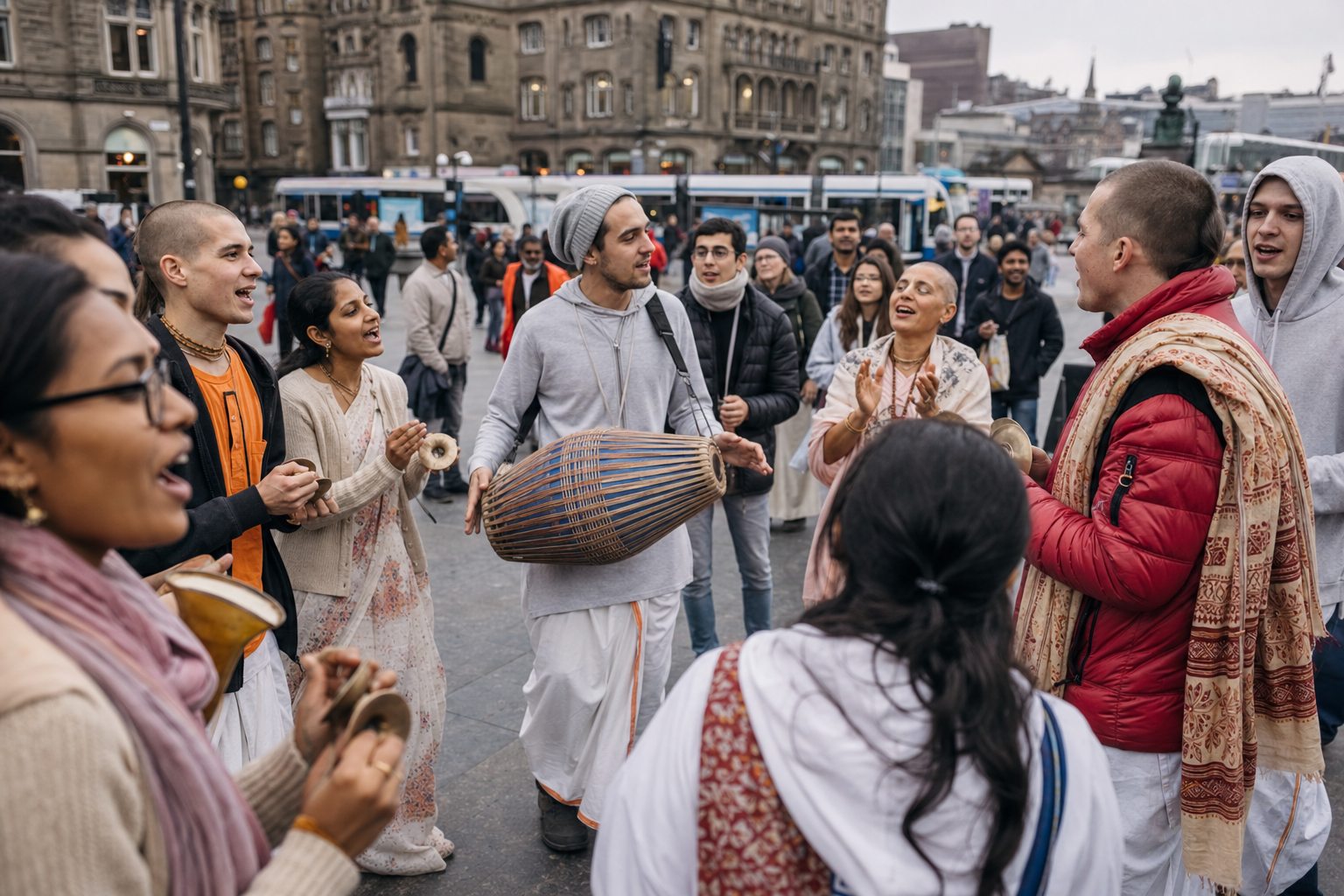
The clearest connection among the sources is sacred sound. The accounts from London, Zurich, and Rishikesh all present congregational chanting as more than musical accompaniment. Kirtan organizes attention, enables immediate participation, and gives a gathering a shared devotional center. Repetition and call-and-response allow a newcomer to listen before gradually joining, while experienced practitioners encounter the same divine names as an established discipline.
The three public settings nevertheless give chanting different functions. The London article reports a public gathering on 20 June 2026 and interprets it against the city’s longer Hare Krishna history. There, kirtan interrupts the anonymity of metropolitan life and makes bhakti audible to commuters, visitors, devotees, and observers. The Zurich account places the Mahamantra within Snan Yatra, where chanting accompanies the ceremonial bathing and honoring of Jagannath, Balabhadra, Subhadra, and Sudarshana. At the fifth Rishikesh Kirtan Festival, as described by its source, sustained chanting, dancing, service, and prasadam form the event itself, with the Ganges and the town’s pilgrimage culture supplying a distinct sacred setting.
These differences matter. Public chanting is not a portable soundtrack applied identically everywhere. In a street, it creates an open invitation; in a deity festival, it supports a ritual sequence; at a dedicated kirtan gathering, it becomes an extended communal practice. The stable element is remembrance through the divine names. The social form, duration, visual environment, and relationship to ritual change with the setting.
The sources also broaden the meaning of devotional listening beyond congregational singing. The announcement concerning Bhurijana Dasa’s live session points toward shravana, or attentive hearing, through a digital platform. That article explicitly notes that the underlying announcement does not establish the lecture’s subject or detailed arguments. Its responsible significance is therefore narrower but still important: an online session can connect geographically separated listeners with a teacher and a culture of sustained scriptural study, provided it is approached as more than disposable digital content.
Bhakti becomes durable through an ecosystem of practice

Kirtan is the most publicly recognizable practice in these reports, but none of the accounts presents sound as an isolated technique. Bhurijana Dasa’s teaching context connects hearing with texts such as the Bhagavad Gita and Srimad Bhagavatam. The Zurich festival joins mantra with abhishekam, offerings, darshan, cleanliness, and coordinated service. The Rishikesh account joins chanting with dancing, volunteer work, hospitality, and prasadam. The recurring pattern is a devotional ecosystem in which sound focuses consciousness, teaching supplies understanding, ritual directs attention, and service turns intention into conduct.
The household narrative makes that ecosystem visible at its smallest and perhaps most consequential scale. According to the account of a wife’s influence on her husband, she met an ISKCON devotee from her village in 2008 and moved from customary participation in religious functions toward deliberate Krishna-centered practice. Her husband did not adopt the same commitment immediately. The reported change occurred gradually through proximity to her chanting, food practices, association, ethical discipline, and steadiness.
This domestic story qualifies any picture of globalization built only from crowds and prominent events. A festival may introduce the mantra, but a household tests whether devotion can shape time, eating, speech, relationships, and responsibility. It also shows that transmission does not always move through formal authorities alone. Teachers and institutions provide teachings and structure, while spouses, parents, relatives, and friends make a spiritual path credible through repeated conduct. In this narrative, persuasion rests less on argument than on observed transformation.
Institutional continuity remains essential. Several of the source articles identify A. C. Bhaktivedanta Swami Prabhupada, who founded ISKCON in 1966, as the figure whose global teaching mission placed public chanting, scripture, prasadam, temple worship, and devotional community within a reproducible program. Yet the sources also show that an institution lives through differentiated forms of service: a teacher interprets scripture, trained worshippers conduct ritual, volunteers organize a festival, householders establish daily habits, and artists translate sacred material for unfamiliar audiences.
Translation can widen access without erasing difference

Global bhakti necessarily involves translation, but translation here means more than replacing Sanskrit words with another language. It includes adapting schedules, venues, musical presentation, food service, teaching formats, and expectations of public participation. The Zurich article, for example, observes that a celebration in Switzerland cannot duplicate one in Puri in every practical detail. Local rules, language, venue conditions, safety, and hospitality shape the event, even as deity service and the festival’s devotional logic remain central.
The British examples demonstrate two notably different kinds of cultural translation. The London source places contemporary public chanting within a history that includes the Radha-Krishna Temple’s association with George Harrison and a 1969 recording released through Apple Records. The account of Sir John Tavener’s Krishna, by contrast, follows bhakti into contemporary Western classical music. That source reports that devotee and writer Ranchor Prime helped Tavener shape a libretto after the composer needed new Sanskrit guidance. It describes the composition, completed in 2005 and premiered posthumously at Grange Park Opera in 2026, as Tavener’s attempt to approach Krishna’s sacred narratives through Sanskrit and English, choral writing, ritual pacing, and contemplative scenes.
A street kirtan and an opera should not be treated as interchangeable forms. Kirtan invites the assembly to produce sacred sound together; an opera generally asks an audience to receive an interpreted work. Tavener reportedly called Krishna a mystic pantomime, indicating that contemplation rather than conventional dramatic momentum shaped the project. Its value within this synthesis lies in demonstrating that Krishna bhakti can enter an artistic institution far removed from a temple or sankirtana procession. Its corresponding risk is that sacred narrative may be encountered chiefly as aesthetic material.
The same tension appears in every medium. A livestream can extend satsanga or become another fragment in an algorithmic feed. Public kirtan can invite participation or be consumed as spectacle. A diaspora festival can transmit theological memory or be treated only as ethnic display. Cross-cultural art can encourage disciplined attention or detach compelling imagery from the tradition that gives it meaning. The sources collectively suggest that authenticity is not secured by refusing adaptation. It is strengthened when organizers and interpreters preserve the devotional center, explain what participants are encountering, and create a path from first contact to deeper practice.
A global movement is sustained between gatherings
The reports present accessibility as one of contemporary bhakti’s defining strengths. A person may first encounter Krishna through a melody in a London street, the bathing of Jagannath in Zurich, an extended kirtan beside the Ganges, a live scriptural session, a spouse’s example, or a work of sacred theatre. Each doorway engages a different combination of body, intellect, emotion, relationship, and place.
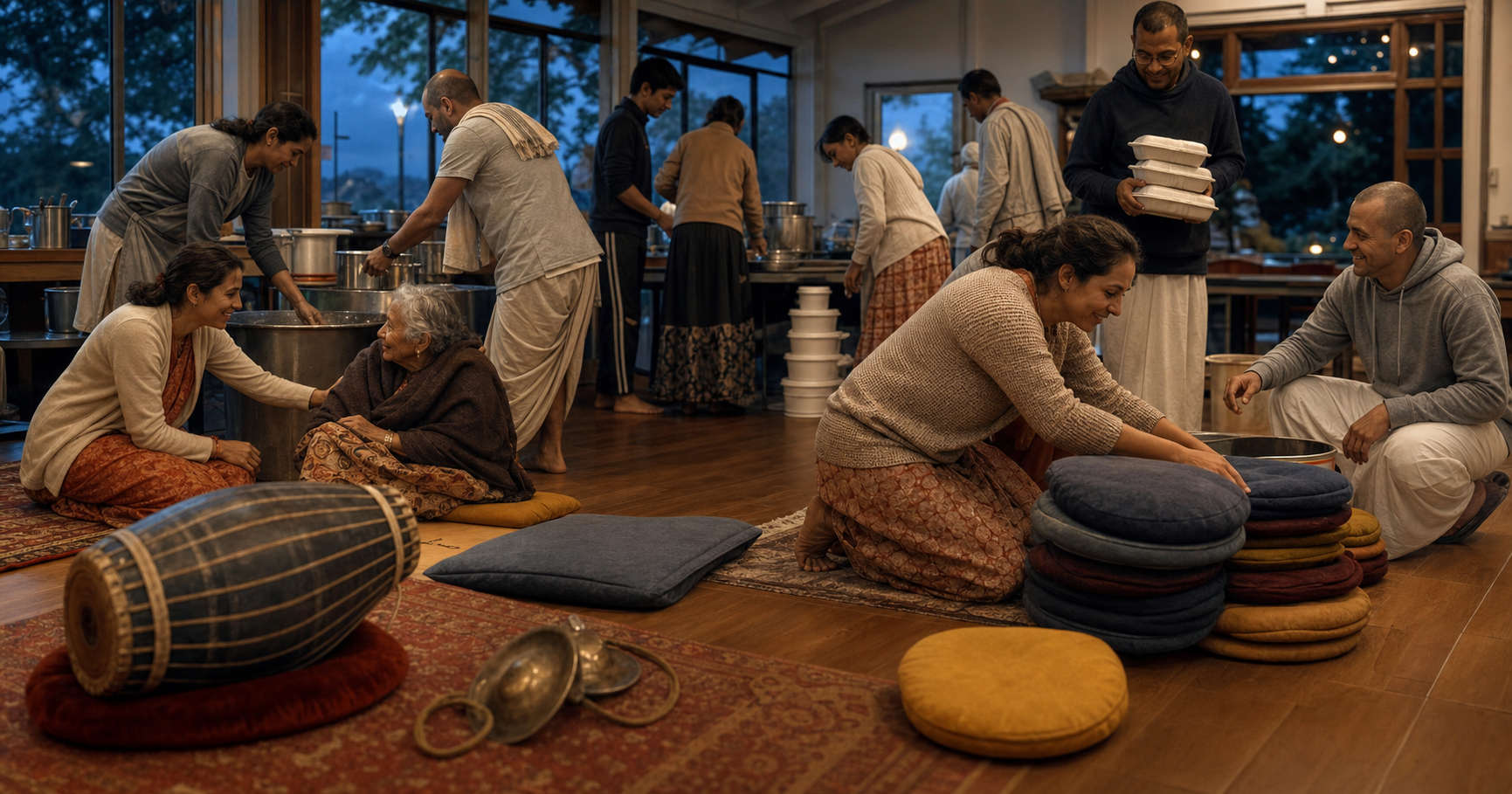
Accessibility, however, is only the beginning. Public events require careful service; digital hearing benefits from note-taking, reflection, and return to scripture; household enthusiasm needs stable habits; artistic translation needs theological literacy and humility. Even the apparently administrative work mentioned in the festival accounts – coordinating worship, musicians, movement, food, and hospitality – becomes part of seva when it protects the gathering’s devotional purpose.
The sources also frame openness without requiring religious traditions to become indistinct. Krishna bhakti remains specifically Vaishnava in theology and practice, even when sacred sound, service, self-restraint, and hospitality are appreciated across Hindu, Buddhist, Jain, or Sikh communities. This approach offers a useful model of dharmic coexistence: participation need not require immediate expertise, and mutual respect need not depend on erasing genuine differences.
The next phase of global Krishna bhakti will therefore depend less on visibility alone than on the quality of the passage from encounter to formation. Streets, stages, festivals, homes, and screens can all open the door. Teachers, communities, disciplined practice, and thoughtful service will determine whether those openings mature into enduring devotional life.
References
- DharmaRenaissance Blog – Bhurijana Dasa Live: A Powerful Gateway to Bhakti, Study, and Dharmic Unity
- DharmaRenaissance Blog – London Joins the Hare Krishna Mantra: Powerful Lessons in Bhakti and Unity
- DharmaRenaissance Blog – Snan Yatra 2026 in Zurich: ISKCON, Jagannath Devotion and the Power of Kirtan
- Dandavats – Sir John Tavener’s Powerful Krishna Vision: Devotion, Opera, and Sacred Song
- Dandavats – How a Wife’s Quiet Devotion Sparked a Powerful Journey into Krishna Bhakti
- Dandavats – Rishikesh Kirtan Fest: A Powerful Celebration of Bhakti, Seva, and Sacred Unity