

Debates about decolonizing yoga often turn on a deceptively simple question: may texts such as the Bhagavad Gītā and Patañjali’s Yoga Sūtra be identified as Hindu when the modern English category of Hinduism took shape much later than the traditions themselves? The answer affects more than terminology. It determines whether Hindu communities are recognized as inheritors and interpreters of yoga or treated merely as one influence among many.
A useful approach must hold several truths together. Modern classifications have histories; Hindu traditions possess continuity that predates those classifications; and yoga developed through exchanges among multiple Indic traditions. Decolonization becomes meaningful when it can acknowledge all three without turning complexity into cultural amnesia.
Key takeaways
- The relatively recent standardization of the English word Hinduism does not establish that the traditions now described by it were created in the same period.
- The Hindu identity of a text can be assessed through concepts, interpretive lineages, ritual and devotional use, and reception history—not through terminology alone.
- Recognizing Buddhist, Jain, Śramaṇa, and other contributions to Indic contemplative culture need not require detaching yoga from Hindu history.
- A credible decolonial method should apply historical scrutiny consistently while allowing living communities to describe their inheritance in their own intellectual vocabulary.
The dispute confuses a category with what it describes

The DharmaRenaissance essay underlying this discussion distinguishes the history of a name from the history of its referents. It accepts that colonial institutions helped standardize modern religious categories, but disputes the inference that Hindu traditions therefore began with colonial classification. Vedic, epic, Purāṇic, philosophical, devotional, ritual, and regional formations existed before the modern English category gathered them under a common label.
This distinction matters because identities do not have to be timeless, uniform, or exclusive to be historically meaningful. The source describes Hindu, Sanātana Dharma, Vaidika, Āstika, Śaiva, Vaiṣṇava, Śākta, Smārta, Vedānta, Sāṅkhya, and Yoga as overlapping identifiers rather than compartments with fixed borders. On this account, Hindu identity names a layered civilizational field, not a claim that every community within it has always used one designation or held one doctrine.
The Bhagavad Gītā illustrates how reception history can clarify that field. The essay locates the Gītā within the Mahābhārata and emphasizes its treatment of dharma, ātman, karma, yajña, bhakti, jñāna, yoga, and moksha. It also points to interpretations by figures including Ādi Śaṅkara, Rāmānuja, Madhva, Abhinavagupta, Śrīdhara Svāmin, Bal Gangadhar Tilak, Mahatma Gandhi, and Sri Aurobindo. Their disagreements do not weaken the text’s Hindu reception; they show how extensively different Hindu philosophical, devotional, and public traditions have engaged it.
The same reasoning applies to the Yoga Sūtra without making it identical to every practice now called yoga. As characterized by the source, Patañjali’s concise text examines citta-vṛtti-nirodha, kleśa, samādhi, abhyāsa, vairāgya, īśvara-praṇidhāna, and liberation. Its place within Sāṅkhya-Yoga and its interpretation through Hindu philosophical and ascetic traditions make a Hindu identification historically intelligible, even though the text also belongs to a wider landscape of contemplative debate.
Yoga emerged through exchange, not isolated ownership
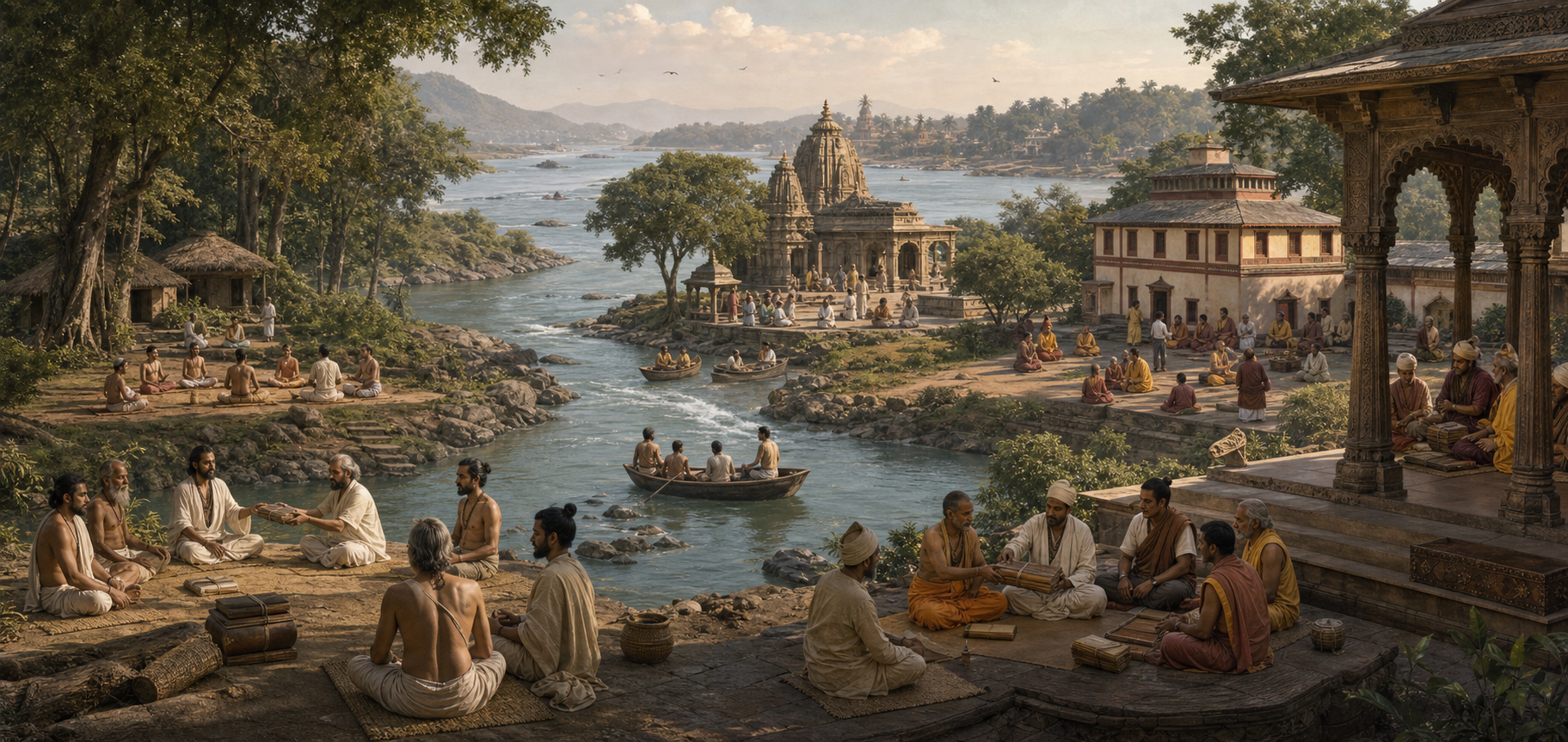
Affirming Hindu inheritance does not require presenting yoga as the product of a sealed tradition. The source rejects a simple genealogy in which Buddhist, Jain, or ascetic systems appear only as external predecessors from whom yoga was derived. It instead portrays an Indic intellectual ecology in which Vedic, Upanishadic, Śramaṇa, Buddhist, Jain, Sāṅkhya, Vedānta, Śaiva, Śākta, and Tantric streams debated, borrowed, contested, and transformed ideas and disciplines.
This ecological model separates participation from dispossession. Buddhist and Jain parallels in meditation, restraint, renunciation, and liberation can be studied seriously without using them to invalidate the Hindu reception of Patañjali. Conversely, calling a text Hindu should not be used to absorb every Indic contemplative tradition into Hinduism or erase their distinct scriptures, metaphysical commitments, institutions, and ritual cultures.
The result is a more precise account of Dharmic relationship. Hinduism, Buddhism, Jainism, and Sikhism remain distinguishable traditions, while concepts such as dharma, karma, rebirth, disciplined conduct, liberation, meditation, ethical responsibility, and guru-paramparā have circulated through their shared civilizational environment in different forms. Similarity does not establish sameness, and difference does not require hostility.
That balance also reframes the question of ownership. The relevant inquiry is not which modern community can claim exclusive possession of every yogic practice. It is which communities preserved, interpreted, contested, embodied, and transmitted particular texts and disciplines—and how their relationships changed across contexts. Such an inquiry can recognize multiple participants while still naming Hindu continuity where the record described by the source supports it.
A decolonial test for scholarship on yoga
The essay draws on critiques associated with Edward Said, Gayatri Spivak, and Walter Mignolo to argue that classification is connected to authority. Its concern is not historical investigation itself, but the power to decide which indigenous identities are legitimate, which vocabularies count as theory, and which communities are treated only as objects of study. This is a position advanced by the source, not a comprehensive survey of scholarship on yoga.
From that argument, four tests for decolonial integrity follow. The first is historical symmetry: if modern categories such as Buddhism and Jainism can refer coherently to traditions older than their contemporary academic definitions, Hinduism should be assessed by the same principle. Historicizing a category should reveal its development rather than selectively dissolve the tradition it names.
The second is receptional depth. A text cannot be adequately situated by examining its composition or vocabulary alone. Commentaries, sampradāyas, oral teaching, ritual use, devotional interpretation, philosophical dispute, and lived memory help show how communities made the text meaningful. In the case of the Gītā, the source argues that removing Hindu reception from view would obscure a central part of the text’s historical life.
The third is epistemic plurality. Sanskrit categories and indigenous forms of interpretation should be considered sources of knowledge, not merely cultural data awaiting approval by an external theoretical framework. This does not exempt traditional claims from evidence or criticism. It broadens the field of evidence and asks scholars to explain why one vocabulary is granted analytical authority over another.
The fourth is clear attribution. Shared Indic development should be described at the appropriate level: a practice may belong to a broad ascetic environment, receive a distinctive formulation in one school, and later be transmitted by several lineages. Naming each layer is more informative than choosing between exclusive ownership and an originless, universally available yoga.
What responsible teaching and practice would look like

For yoga education, the practical consequence is contextualization rather than compulsory belief. A course can identify the Yoga Sūtra’s place in Hindu intellectual history, explain its Sāṅkhya-Yoga framework, acknowledge Buddhist and Jain parallels, and distinguish Patañjali’s aims from other forms of yoga. These statements can coexist because they answer different historical questions.
The Gītā likewise should not be presented as a collection of detachable techniques. Its teachings on karma yoga, bhakti yoga, jñāna yoga, svadharma, lokasaṅgraha, and surrender to Śrī Krishna belong to a narrative, theological, and ethical setting. Students need not adopt a particular interpretation, but they should be told that Hindu communities and thinkers have transmitted the work through diverse lineages rather than encountering it as an unclaimed philosophical poem.
Institutions can also distinguish between critical inquiry and identity denial. Questions about the dating, compilation, interpretation, or transformation of a tradition are ordinary scholarly questions. A different problem arises when Hindu testimony is presumed compromised merely because it is internal, while externally supplied categories are treated as neutral. The source identifies this asymmetry as a continuation of the hierarchy that decolonial scholarship is meant to examine.
At the same time, Hindu recognition should not become a shortcut around the plural history of yoga. Responsible attribution leaves room for disagreement within Hindu traditions and for the independent voices of Buddhist, Jain, Sikh, and other communities. It resists both erasures: removing Hinduism from texts and practices it has long preserved, and flattening every Indic tradition into a single Hindu identity.
The next stage of this debate should therefore move beyond the choice between colonial taxonomy and civilizational essentialism. Scholarship and yoga education can instead evaluate names historically, listen to living lineages, disclose exchanges among traditions, and identify the limits of every claim. Decolonization will have substance when Hindu identity can be stated without excluding Indic plurality—and plurality can be honored without making Hindu inheritance disappear.