
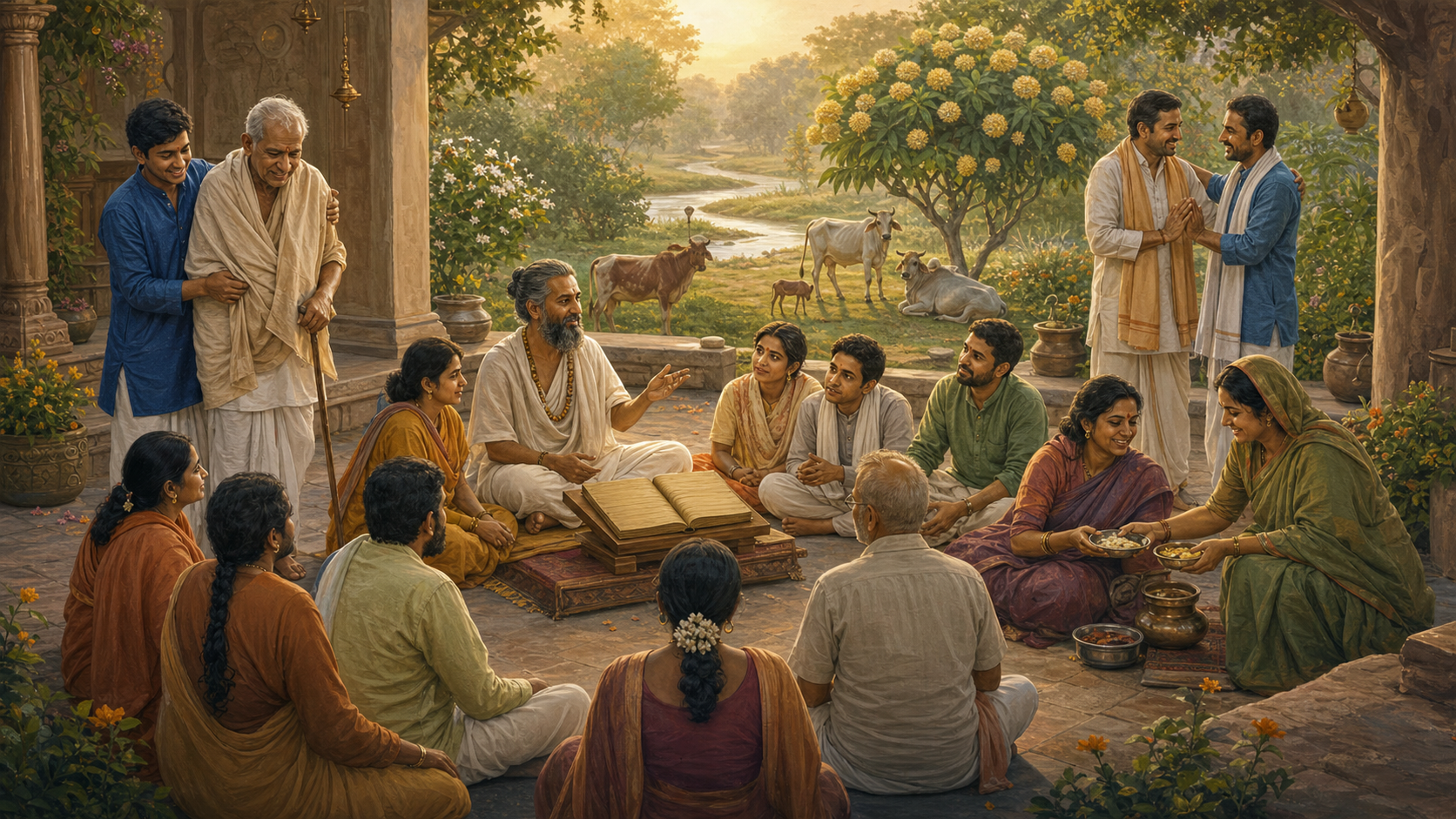
The Bhagavata tradition remains living when sacred narrative moves beyond admiration and begins to shape attention, judgment and conduct. Read together, the two source articles show how that movement occurs: through disciplined hearing, interpretive guidance, repeated remembrance and the testing of teachings in ordinary relationships.
One article examines a Srimad-Bhagavatam class and the culture of transmission surrounding it; the other interprets Balarama’s encounter with Pralamba in Vrindavan. Their combined value lies in revealing two sides of one pedagogy: the community learns how to receive scripture, while the narrative gives it something morally and spiritually demanding to receive.
A scripture carried through hearing and example
The article on Srutakirti Prabhu’s class presents the Srimad-Bhagavatam, also known as the Bhagavata Purana, as a work encompassing theology, cosmology, ethics, devotion, sacred history and spiritual psychology. Yet its central claim is practical rather than encyclopedic: scriptural knowledge is incomplete unless it refines perception, humility, devotion and behavior.
That claim helps explain why oral commentary matters. According to the class article, Dharmic knowledge has been preserved not through books alone but through recitation, attentive listening, commentary, ethical discipline and guidance. A class therefore does more than transmit information about a verse. It places the text in conversation with memory, duty, conflict, grief, work and the resistance of the ego to correction.
The article identifies śravaṇam, attentive devotional hearing, as a principal practice of bhakti. Hearing in this sense is not passive exposure or the collection of agreeable ideas. It asks the listener to concentrate, inquire and remain open to transformation. Repeated engagement with familiar teachings is accordingly understood as refinement rather than redundancy: the words may remain the same while the hearer’s capacity to understand and embody them changes.
Personal example strengthens this form of transmission. The source notes that Srutakirti Prabhu is remembered in ISKCON circles for his long association with A.C. Bhaktivedanta Swami Prabhupada and for recollections arising from that service. It presents such testimony as valuable because small details of speech, discipline, service and daily consistency can demonstrate what abstract principles look like when lived. The teacher’s remembered conduct does not replace scripture; it supplies a practical lens through which scripture can be understood.
Vrindavan’s play as an education in moral vision

The article on Balarama and Pralamba supplies a narrative case study for this pedagogy. It reports that Pralamba enters the company of Krishna, Balarama and the cowherd boys while disguised as one of them. During a team game in which losers carry winners, he takes Balarama on his shoulders and attempts to move him away from the group. His assumed form eventually gives way to a threatening appearance, and Balarama kills him with a decisive blow.
The source interprets the episode through contrasts: pastoral openness and concealed violence, childhood play and calculated deception, trusting fellowship and an intruder’s manipulation. It also emphasizes that Krishna recognizes the danger while Balarama becomes the central protector who ends it. Within the article’s theological reading, Balarama’s strength is ordered toward the defense of dharma and the preservation of the community in which affection and devotion can flourish.
This is not merely a lesson to distrust appearances. The story’s setting remains a community of shared play, labor and affection; Pralamba’s intrusion does not redefine that world. The more precise lesson is that trust and discernment must coexist. Openness without judgment can be exploited, but vigilance without trust can destroy the very fellowship it seeks to protect.
The narrative also shows why the Bhagavata’s literary form matters. A proposition such as “discern harmful intent” can remain remote. A disguised participant entering a game, separating one member from the group and revealing his purpose turns the proposition into a memorable pattern. The story trains moral imagination by asking readers to recognize deception, distinguish protective strength from aggression and see how a community can confront danger without making fear its governing principle.
Receptive hearing and alert discernment belong together

Placed side by side, the articles correct two possible misunderstandings of devotional life. The class article warns against learning that becomes pride, prestige or verbal mastery. The Pralamba article warns against innocence that lacks the wisdom to identify manipulation. A mature practitioner must therefore be teachable without becoming uncritical, and discerning without becoming cynical.
This balance also clarifies the role of authority. The class article describes the guru–shishya relationship as a channel for knowledge, example, correction and responsibility, healthy when the student brings humility and the teacher brings integrity. Its stated aim is awakening rather than dependency. The Pralamba narrative adds a communal dimension: someone who adopts the appearance of belonging does not thereby share a community’s purposes. Character and intention matter alongside outward identity.
The synthesis suggests that humility is not the suspension of judgment. It is freedom from the assumption that personal preference is the final measure of truth. Discernment, in turn, is not suspicion directed at everyone. It is the disciplined ability to compare conduct with dharmic purpose. Hearing makes correction possible; discernment protects the conditions under which sincere hearing can continue.
These disciplines operate inwardly as well as socially. Pralamba can be read, as the source proposes, as symbolic language for concealed hostility and false familiarity. Without reducing the narrative to psychology, the same pattern can prompt self-examination: spiritual language may conceal ambition, defensiveness or the desire for status. The Bhagavatam-class article makes a closely related point when it asks whether religious life is surrendering the ego or quietly strengthening it.
Character is the test of living transmission
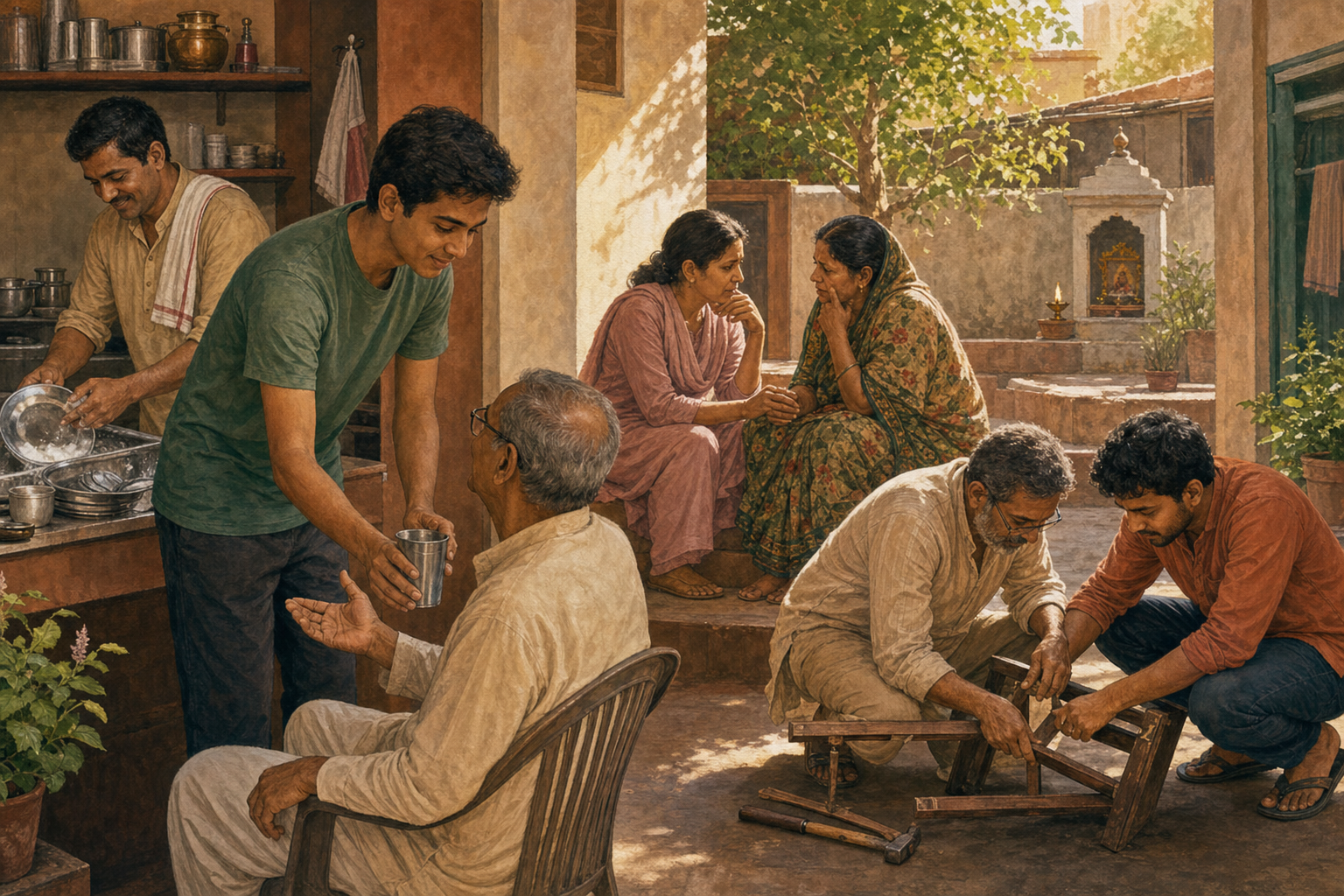
Both sources ultimately direct attention from performance to formation. In the class article, the fruits of study include a softened heart, clearer discrimination, humility, compassion and steadier service. In the Balarama article, spiritual strength protects rather than dominates, exposes deception without glorifying suspicion and restores the possibility of joyful community. These are complementary measures of whether teaching has entered life.
This standard also preserves the difference between devotion and mere religious display. Fluency with scripture may be impressive, but the class article argues that learning used for pride or sectarianism has missed its purpose. Likewise, fascination with Balarama’s victory may remain superficial if the reader notices only force and overlooks restraint, responsibility and the protection of trust.
The tradition described by the sources is therefore neither exclusively textual nor merely experiential. Text gives experience a framework and a vocabulary; teachers and communities interpret that framework; narrative lodges it in memory; conduct reveals whether it has been understood. Each element checks the others. Experience without guidance can become self-confirming, while commentary without ethical fruit can become an exercise in display.
The class article also places this process within a wider Dharmic horizon, observing that Hindu, Buddhist, Jain and Sikh traditions all give importance, in their distinct ways, to disciplined listening, reflection and ethical transformation. Its point is not that their teachings are interchangeable. Rather, serious commitment to the Bhagavata should deepen maturity in one’s own path and respect for sincere seekers, not produce hostility as a substitute for conviction.
Key takeaways
- The Bhagavata becomes a living scripture through hearing, commentary, remembrance and application, not through textual possession alone.
- The Balarama–Pralamba episode joins trust with vigilance: a healthy devotional community remains open without ignoring concealed harm.
- Humility and discernment are complementary disciplines. One permits correction; the other tests appearance against conduct and dharmic purpose.
- Protective strength is distinguished from domination by its aim, restraint and responsibility toward the vulnerable and the community.
- The most reliable evidence of scriptural learning is transformed character: clearer judgment, steadier service, less ego and greater compassion.
The future vitality of the Bhagavata tradition will depend on preserving this complete movement from sacred sound to moral attention and from remembered narrative to responsible action. When classes, stories and communities continue to form people capable of both devotion and discernment, an ancient text remains an active source of spiritual education.
References
- DharmaRenaissance Blog — A Powerful Srimad-Bhagavatam Class with Srutakirti Prabhu on Living Bhakti
- DharmaRenaissance Blog — Balarama and Pralamba: Powerful Lessons from Vrindavan’s Divine Cowherd Play