Uchchaihshravas is easily diminished when treated as merely a spectacular horse in a cosmic tale. Its significance emerges from the relationship among four elements: its birth during the Samudra Manthan, its radiant whiteness, its association with Indra and its later representation with seven heads.
Read together, these elements present a sustained reflection on power. The celestial stallion embodies extraordinary energy, but the surrounding symbolism repeatedly subjects that energy to purity, responsibility and expanded awareness.
A celestial treasure shaped by the cosmic churning
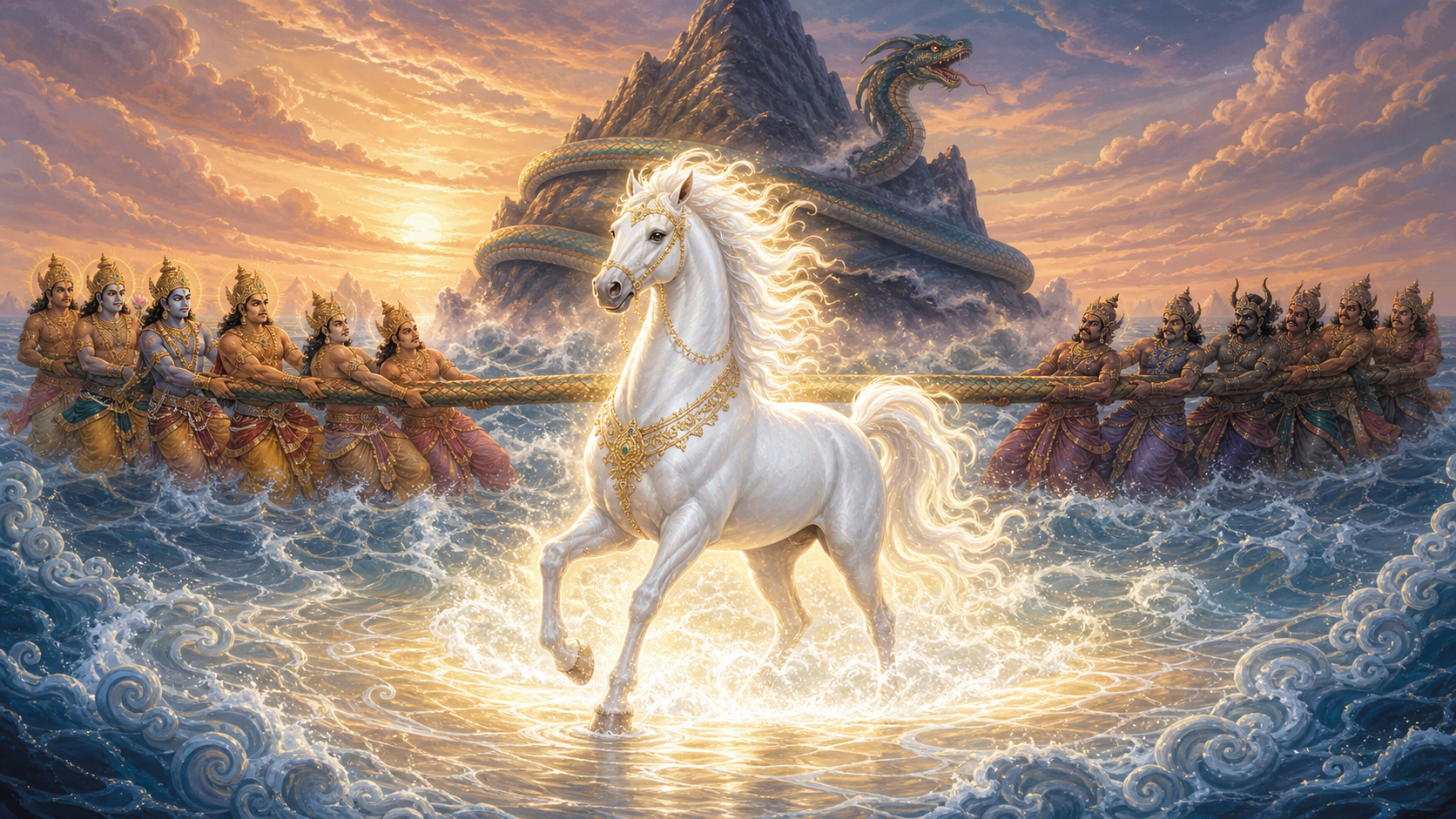
The DharmaRenaissance account places Uchchaihshravas among the luminous beings and treasures produced during the Samudra Manthan. In this Puranic narrative, devas and asuras temporarily cooperate to churn the Kshira Sagara in search of amrita. Mount Mandara serves as the churning rod, Vasuki as the rope, and Vishnu sustains the undertaking through divine intervention.
This origin is essential to the horse’s meaning. The churning produces neither an uncomplicated reward nor a single sacred object. The same process brings forth abundance and danger, including the halahala poison that Shiva consumes for the welfare of living beings. Uchchaihshravas therefore belongs to a narrative in which valuable powers emerge through friction, cooperation, endurance and divine assistance.
The horse’s identity also carries interpretive possibilities. The source reports several common understandings of the name Uchchaihshravas, including “high-eared,” “loud-neighing” and “of exalted fame.” These alternatives need not be forced into one definitive translation. Within the symbolic portrait, they respectively suggest alert receptivity, vigorous presence and a reputation elevated beyond the ordinary.
The Bhagavata Purana and Vishnu Purana are among the textual traditions in which the source locates the figure. Yet its larger significance comes not from appearance alone but from narrative position: Uchchaihshravas is a refined power drawn out of cosmic depths. The episode consequently establishes a pattern that governs the rest of the image. Force becomes sacred when it emerges within an order larger than itself.
Whiteness and kingship discipline the image of power
The stallion’s dazzling white appearance is more than a description of beauty. In the source’s interpretation, whiteness connects Uchchaihshravas with sattva, luminosity, clarity and auspiciousness. It suggests energy cleansed of confusion and selfish aggression: movement directed by an intelligible purpose rather than speed pursued for its own sake.
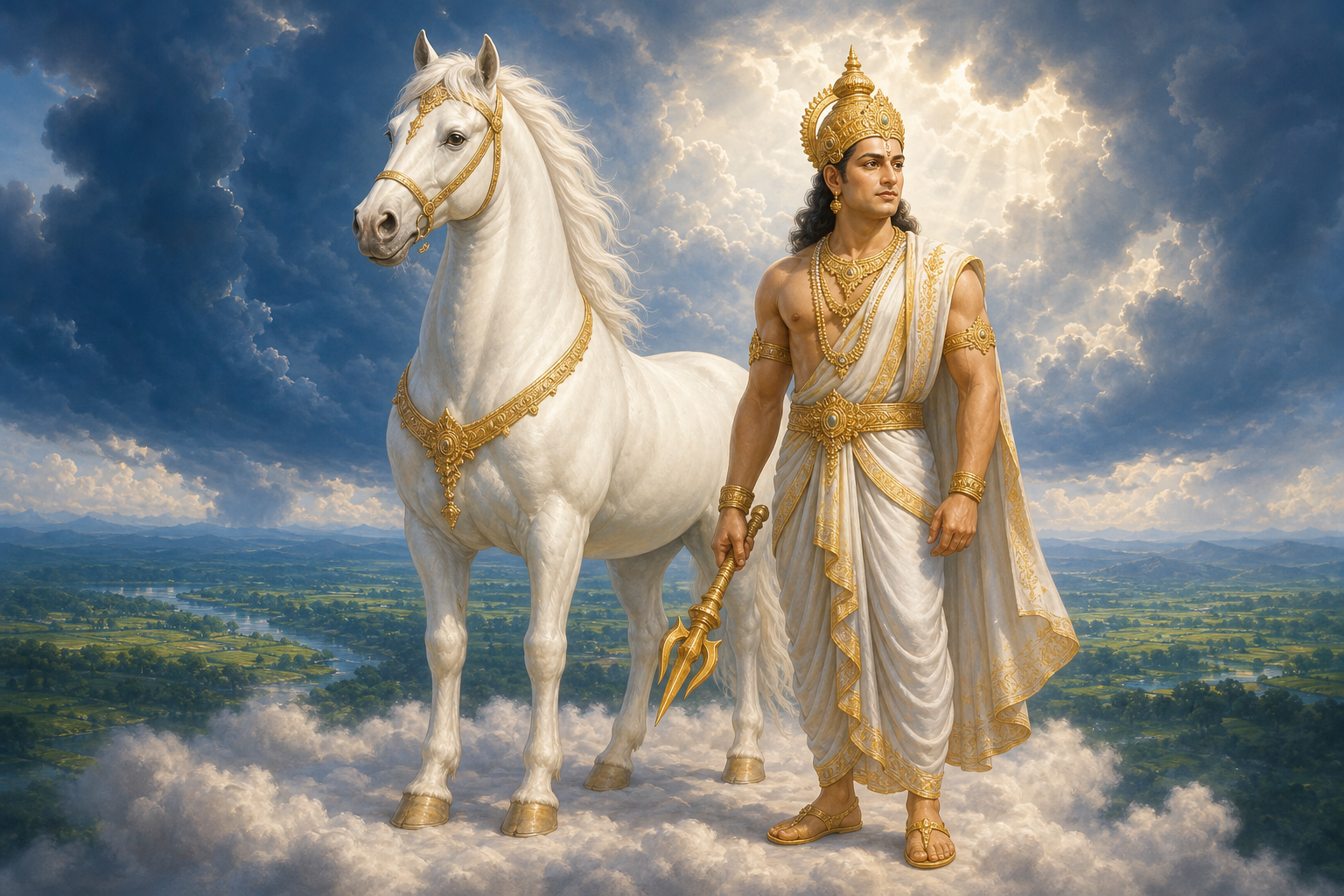
That distinction becomes sharper through the horse’s association with Indra, king of the devas. The relationship joins equine vitality to sovereignty, but it does not amount to a simple celebration of domination. As the source frames Hindu kingship, authority carries an obligation to protect life, preserve balance and uphold order. The celestial horse thus represents royal capacity placed under a moral and cosmic demand.
Broader Indic associations of the horse reinforce this reading. The account connects equine imagery with vitality, prana, nobility, sacrifice and movement. It also points to the Ashvamedha as a context of sovereignty and ritual authority, while the horses of Surya’s chariot connect motion with light, time and cosmic rhythm. Uchchaihshravas gathers these themes without becoming reducible to any one of them.
The resulting image contains an important tension. A horse naturally evokes kinetic strength, while whiteness and royal duty impose direction upon that strength. Uchchaihshravas is consequently not a symbol of passive purity. It is active power made transparent to dharma.
Seven heads belong to interpretation, not a single fixed description
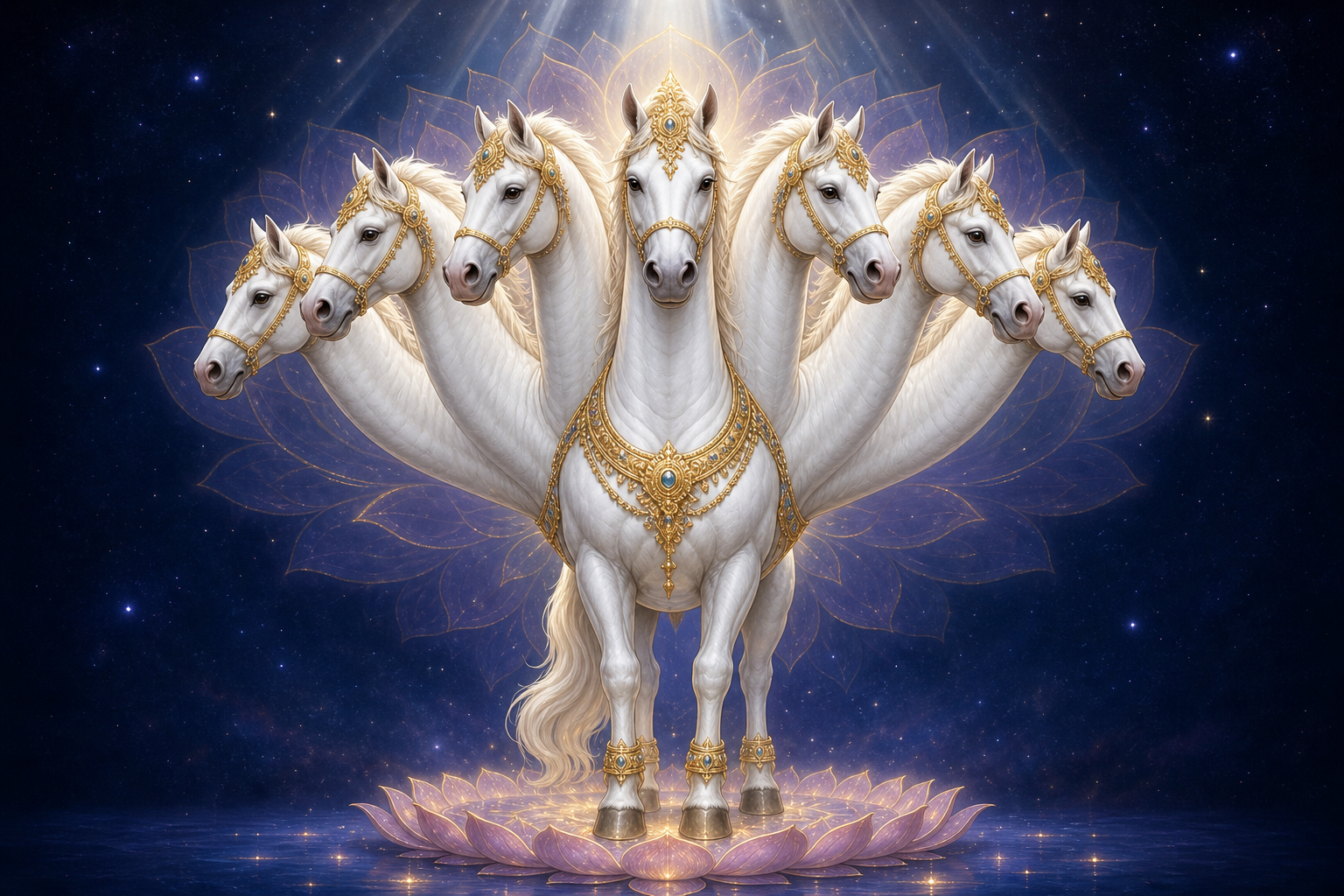
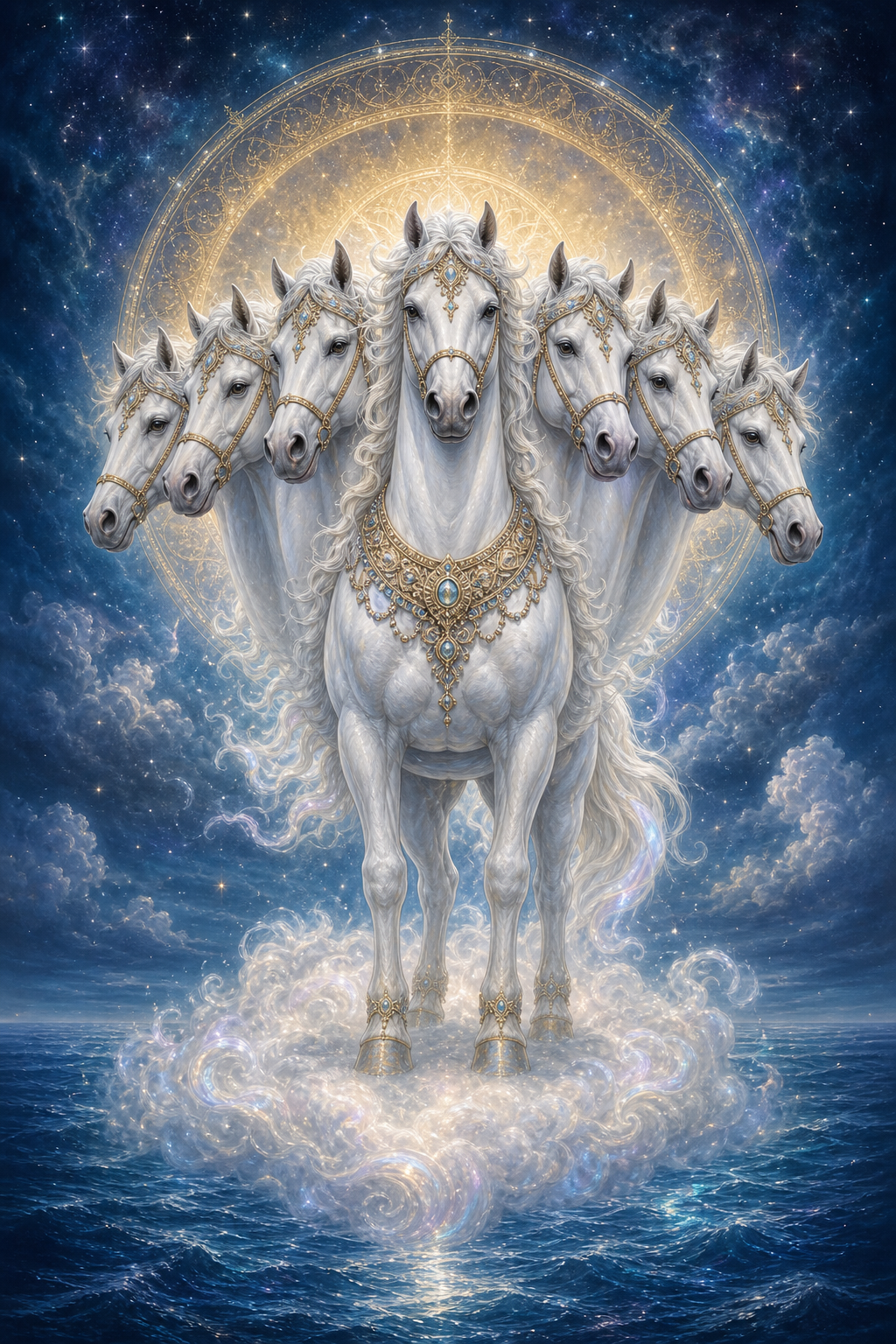
The seven-headed form is among the most memorable representations of Uchchaihshravas, but it requires interpretive care. The source explicitly notes that scriptural references do not always supply the same visual detail. The multiheaded image is therefore best approached as an iconographic and devotional elaboration rather than imposed as a uniform description across every textual appearance.
Within Hindu symbolic vocabulary, seven can indicate completeness expressed through ordered multiplicity. The source proposes several possible resonances: seven worlds, meters of Vedic recitation, flames, rivers, the horses of Surya’s chariot and channels of awakened awareness. These are interpretive correspondences, not evidence that the image must encode one exclusive scheme.
The most coherent insight lies in the relation between the heads and the single body. Multiple heads can suggest perception extending in several directions, while the unified body prevents that multiplicity from becoming fragmentation. The icon thereby transforms the ordinary symbolism of momentum. Speed alone may rush forward without seeing consequences; expanded perception allows movement to answer a wider field of reality.
This also illustrates how Hindu iconography can operate as visual theology. Number, color, anatomy and motion carry ideas rather than functioning merely as ornament. In the seven-headed white horse, whiteness qualifies power, several heads enlarge awareness, and one body integrates the whole. The image is meaningful precisely because its parts interpret one another.
From cosmic image to a discipline of inner integration
The Samudra Manthan allows Uchchaihshravas to be read psychologically without stripping the figure of its sacred setting. The ocean can represent hidden depth, while churning evokes the demanding process through which latent possibilities become visible. Because poison as well as treasure emerges, inner cultivation cannot be confused with the pursuit of pleasant experiences alone.
Within this contemplative reading, the horse’s speed becomes focused attention, strength becomes service, beauty becomes refinement and nobility becomes responsibility. These are not separate lessons attached arbitrarily to the animal. They follow from the way its origin, color, royal relationship and iconographic development constrain the meaning of its power.
The source also interprets the horse through pranic elevation. Equine movement depends upon breath, rhythm, muscular force and alert responsiveness; transferred into a celestial image, those qualities can suggest life-energy directed toward higher awareness. The seven heads then represent not seven competing selves but differentiated perception coordinated by one purpose.
This integration supplies the symbol’s ethical edge. Knowledge across many domains is not wisdom if the knower remains inwardly divided. Ambition is not purity merely because its goal appears impressive. Uchchaihshravas asks whether perception is broad enough to guide action, whether purpose is clear enough to unify capacity and whether strength has accepted responsibility for its effects.
Key takeaways
- Uchchaihshravas derives much of its meaning from the Samudra Manthan, where treasure and danger arise through the same demanding cosmic process.
- Its whiteness signifies clarified and disciplined energy rather than power without restraint.
- Its association with Indra connects exceptional vitality to the obligations of sovereignty and cosmic order.
- The seven-headed form should be read as an iconographic interpretation whose possible meanings include completeness, widened perception and unity within multiplicity.
- As an image of inner life, the stallion presents spiritual maturity as the integration of energy, awareness and ethical purpose.
Future readings of Uchchaihshravas can remain attentive to differences among textual description, artistic development and contemplative interpretation. Preserving those distinctions will allow the celestial horse to inspire reflection without turning a layered tradition into a single rigid formula.