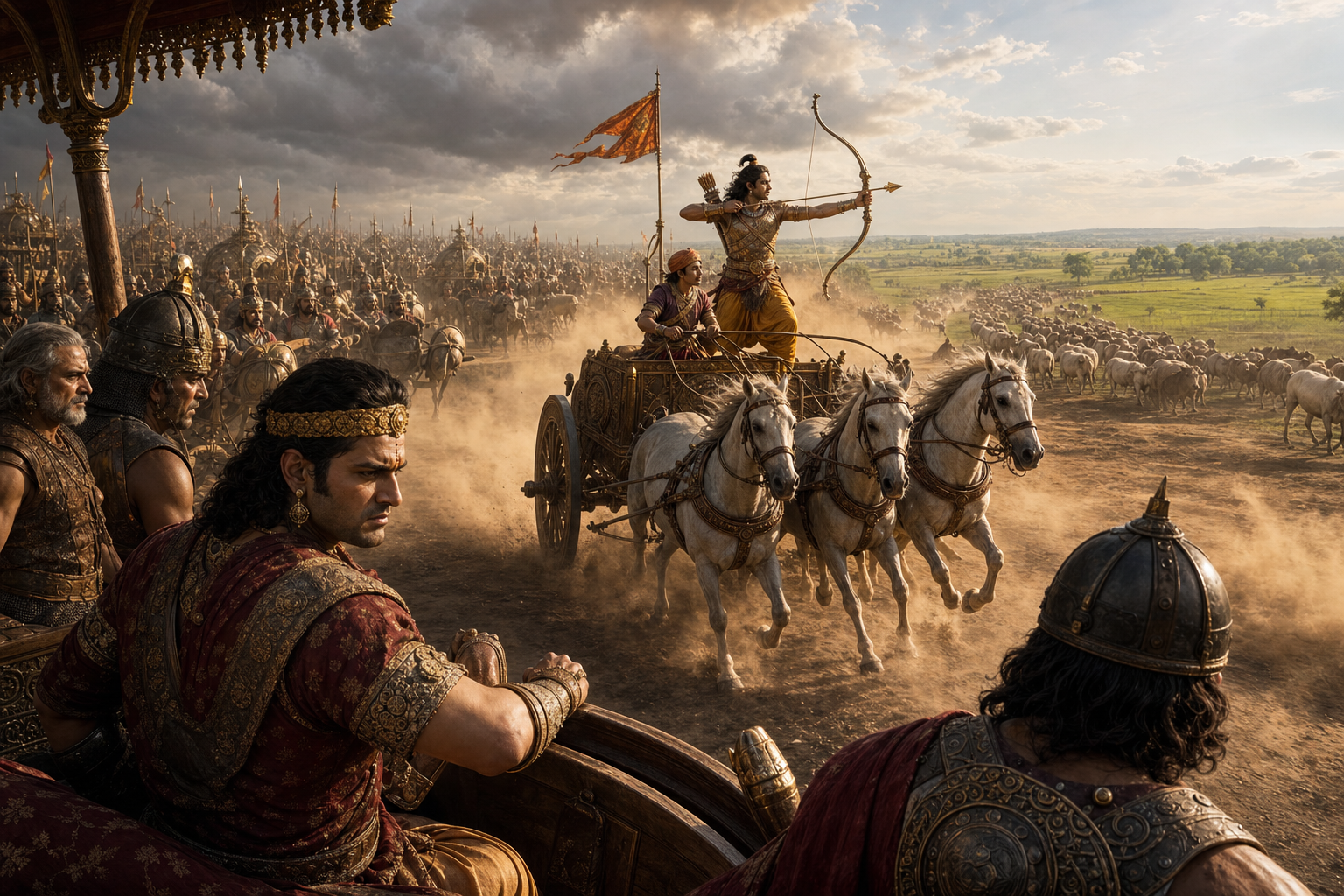
At Virata, the most consequential defeat was not the Kuru army’s retreat. It was Duryodhana’s failure to recognize that the assumptions behind his policy toward the Pandavas had collapsed.
The supplied DharmaRenaissance account presents the cattle raid, Arjuna’s response and the dispute over the completed exile as parts of one political test. Read together, they explain why the episode matters beyond its battlefield drama: Virata gave Duryodhana actionable evidence about Pandava strength, Kuru vulnerability and the shrinking space for a negotiated settlement.
A cattle raid designed as a political trap
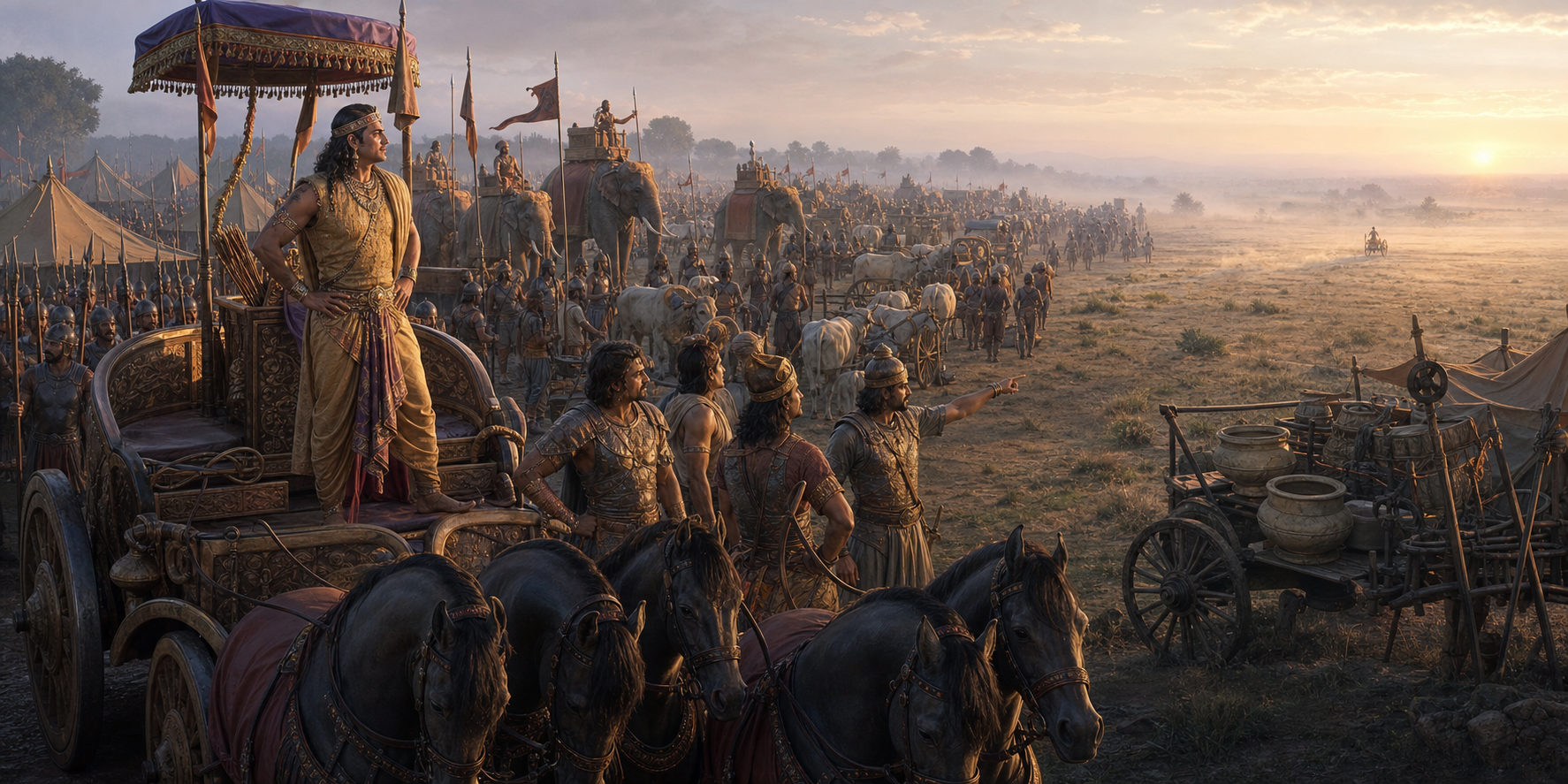
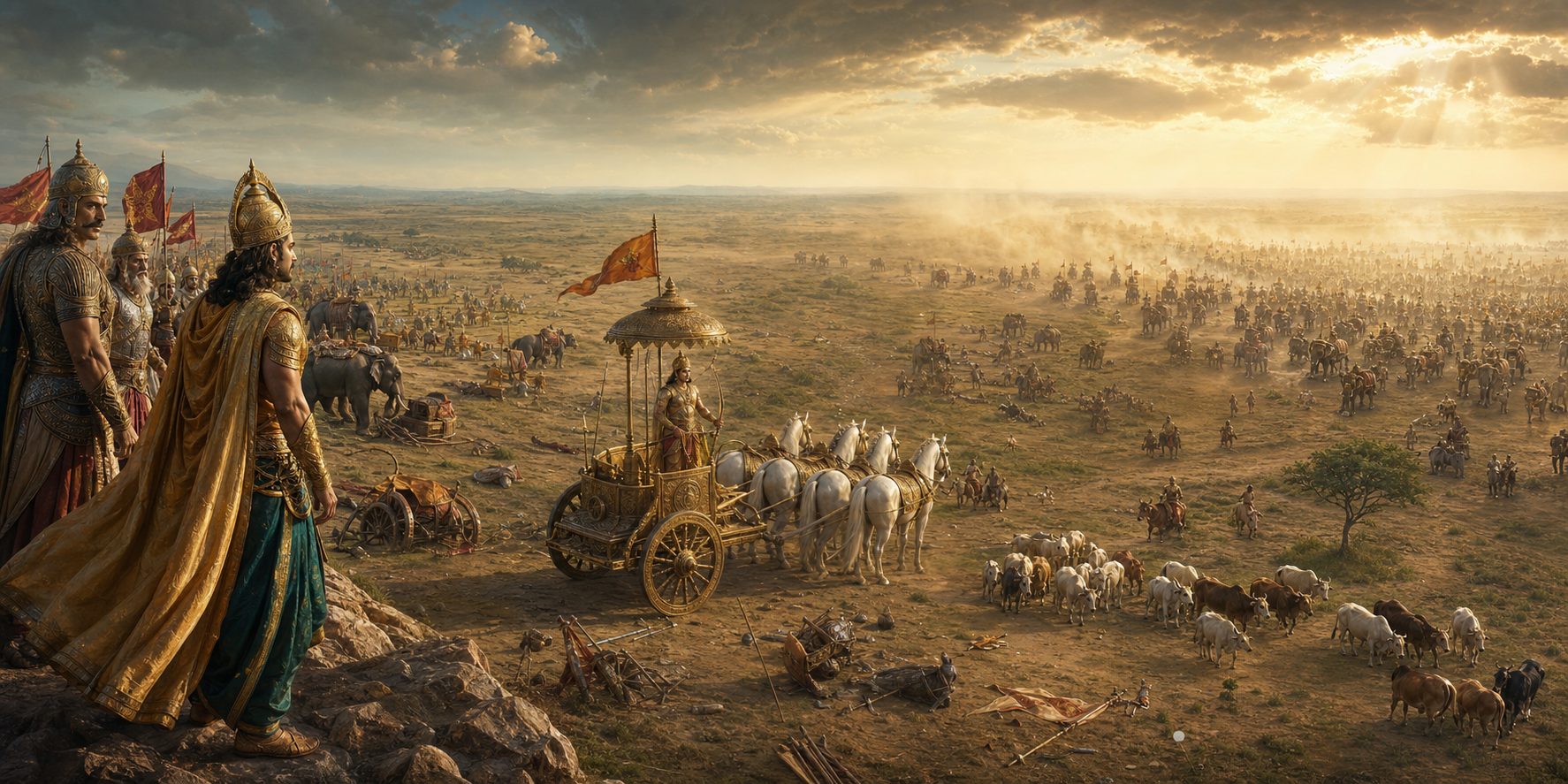
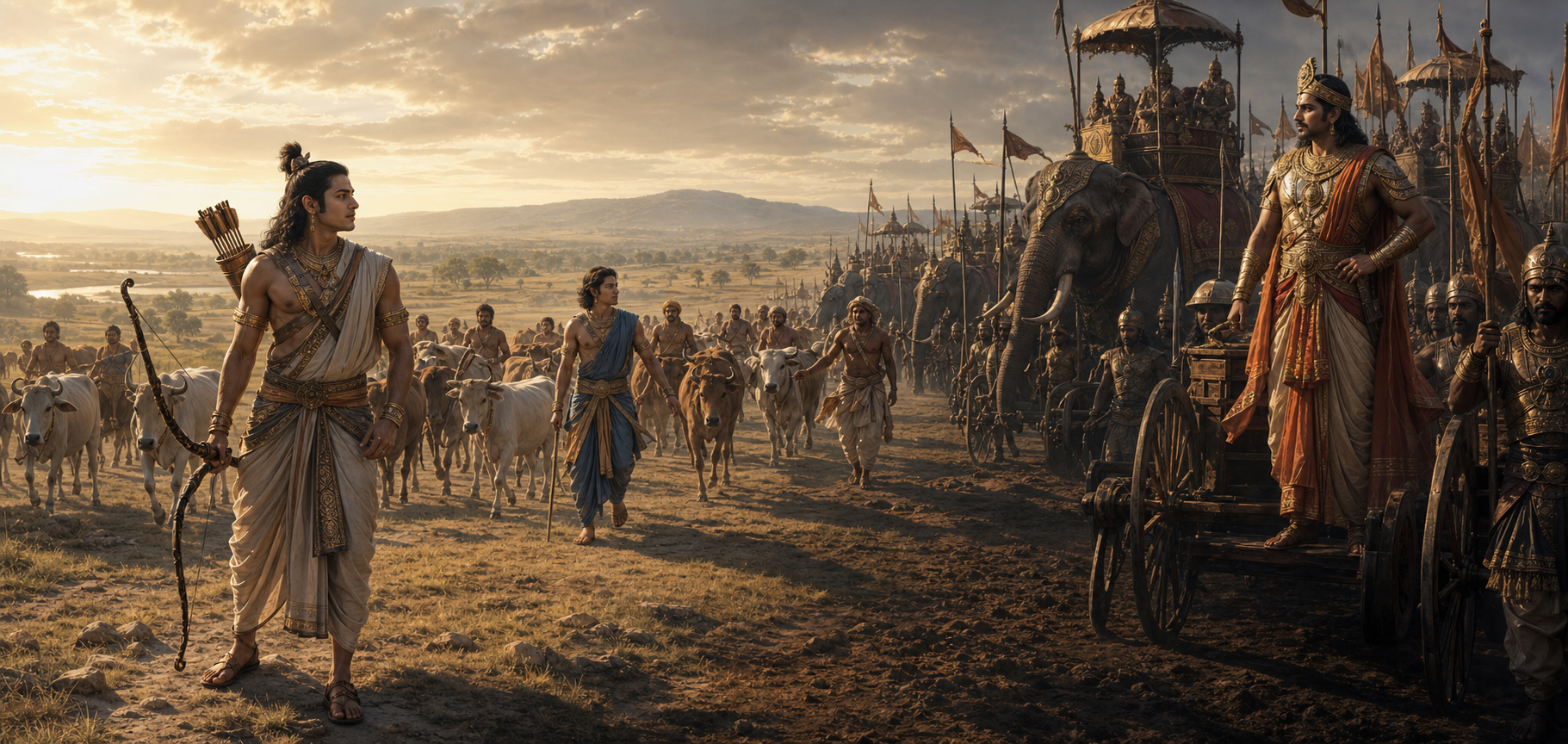
According to the source account, the confrontation occurred near the end of the Pandavas’ thirteenth year of exile, while they were living under assumed identities in King Virata’s Matsya kingdom. The Kauravas suspected that their rivals were concealed there and joined a raid on Virata’s herds. The operation therefore had two objectives: taking economically and politically important cattle, and forcing Matsya’s hidden defenders to reveal themselves before the period of concealment could be accepted as complete.
This made the raid strategically more ambitious than an ordinary seizure of wealth. If the Pandavas appeared too early, Duryodhana could argue that the terms governing their exile had been broken. If no capable defender appeared, Matsya would lose royal property and prestige. The plan sought to convert uncertainty about the Pandavas’ location into leverage over their future.
Yet the design also contained a serious risk. By assembling prominent Kuru warriors for a coercive test, Duryodhana created an unusually clear measure of the Pandavas’ remaining military capacity. A failed raid would not simply leave the cattle unrecovered; it would disclose that exile and disguise had not neutralized his opponents.
Arjuna turned concealment into controlled force
The source reports that Arjuna, then concealed as Brihannala, accompanied Prince Uttara and recovered his weapons from the shami tree. He subsequently confronted a Kuru force containing Bhishma, Drona, Kripa, Karna, Ashwatthama and Duryodhana. The importance of the encounter lies partly in that concentration of ability: Arjuna was not tested against an insignificant detachment but against several leading figures who would later shape the war at Kurukshetra.
Arjuna defeated the Kuru host and protected Virata’s cattle, according to the article. It also notes that several traditional retellings emphasize his restrained use of celestial weapons and his ability to subdue the opposing army without turning the engagement into indiscriminate killing. Because this detail is presented as a feature of traditional retellings, it is best understood as an interpretive emphasis rather than a claim that every version narrates the action identically.
That emphasis changes the meaning of the victory. Arjuna’s strength was joined to timing, purpose and proportion. He had accepted an inconspicuous role during the incognito period, but concealment did not become passivity when protection of Matsya required action. Nor did restored martial power become an excuse for limitless destruction. The episode thus contrasts disciplined capacity with Duryodhana’s attempt to use force as an instrument of dispossession.
The battle exposed three weaknesses in Duryodhana’s position
First, Virata challenged the expectation that prolonged hardship had broken the Pandavas. The source interprets Arjuna’s performance as evidence that exile had not erased their martial competence or inner cohesion. Their political relationships could be rebuilt, while their claim could no longer be postponed on the assumption that they had become powerless.
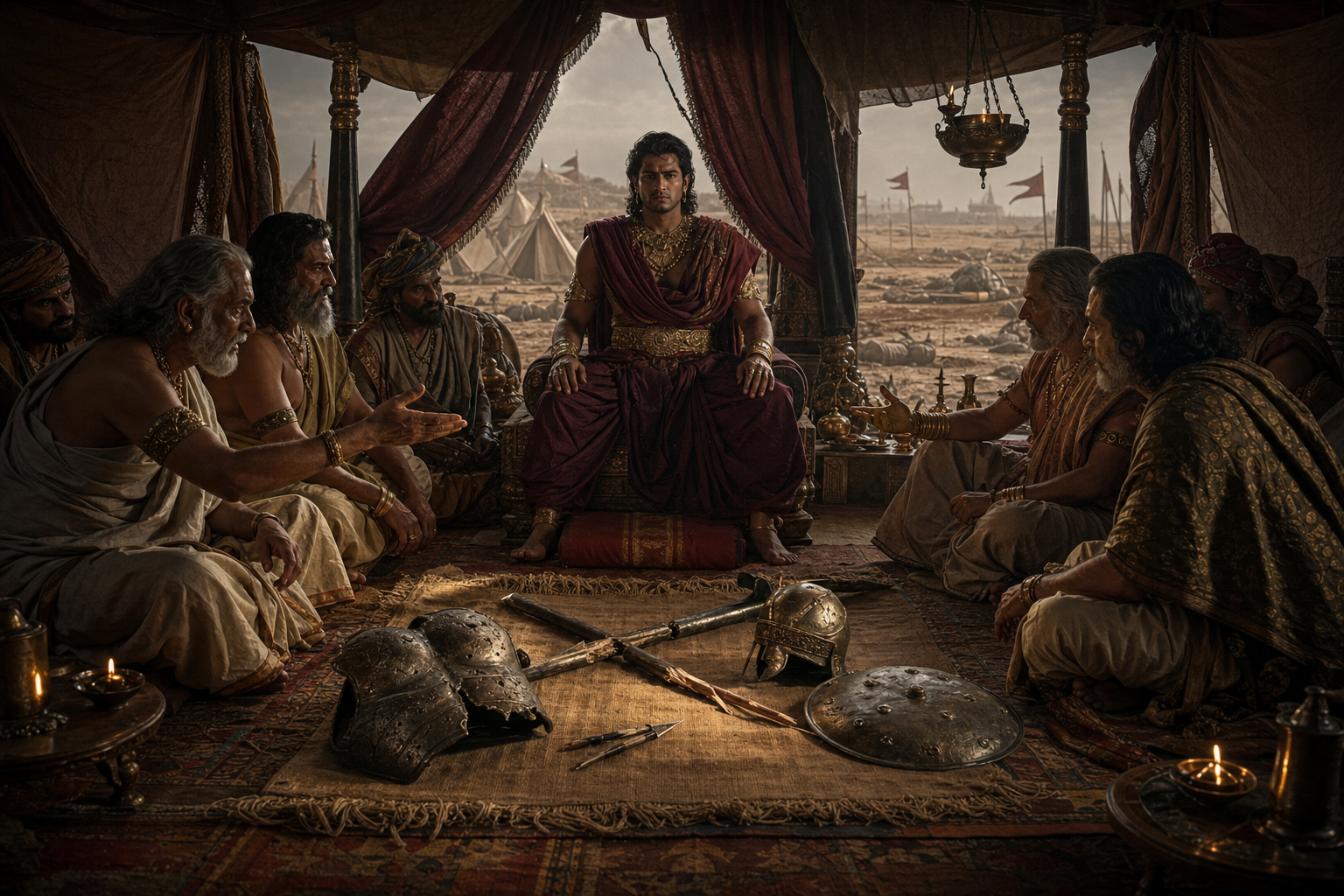
Second, the result separated possession of institutions from moral and strategic security. Duryodhana could draw upon the Kuru throne, its army and renowned commanders, but those resources did not guarantee victory or establish the justice of his position. Bhishma and Drona were attached to the Kuru order, yet the article portrays their judgment as more morally alert than Duryodhana’s. Their presence therefore revealed an uncomfortable distinction between serving an institution and endorsing every purpose for which its power was used.
Third, the encounter weakened confidence in a future military solution. A prudent assessment would have asked what Arjuna’s success implied about confronting all five Pandava brothers with renewed alliances. The source argues that Virata should have prompted reconsideration of war and made reconciliation more attractive. It did not prove every detail of a future conflict, but it supplied enough evidence to make complacency irrational.
Why defeat produced resentment instead of revision
The article’s central explanation is not that Duryodhana lacked information. Bhishma, Drona and Vidura offered counsel, while even Dhritarashtra sometimes perceived the danger in his son’s direction. The failure occurred between receiving knowledge and allowing it to govern desire. Duryodhana could observe a setback, but his commitment to dispossessing the Pandavas determined what the setback was permitted to mean.
Virata threatened a sustaining political narrative: that humiliation, delay and exclusion would eventually erase the Pandavas as serious claimants. Once Arjuna’s victory contradicted that narrative, Duryodhana treated the event as an injury to pride rather than corrective evidence. Persistence then appeared as strength even when it preserved a failing strategy.
The source assigns supporting but not absolving roles to Duryodhana’s allies. Shakuni transformed grievance into schemes, but Duryodhana repeatedly chose advice that served his existing wishes. Karna’s loyalty gave him emotional and political reinforcement, yet Karna’s reverse against Arjuna should also have encouraged caution. Instead, personal rivalry helped displace strategic realism.
The disagreement over whether the incognito year had ended reveals the same pattern in procedural form. The account contrasts Duryodhana’s search for a technical basis to invalidate the Pandavas’ return with Bhishma’s understanding of time and obligation, which supported completion of the exile. The question was therefore larger than calendar calculation: it concerned whether procedure would clarify duty or be used to defer an unwelcome claim indefinitely.
This is why the episode functions as a study of discernment. Duryodhana is not depicted in the source as devoid of courage, ambition, administrative confidence or loyalty. His tragedy is the subordination of those capacities to envy and entitlement. Ability could help him pursue a course of action, but it could not make that course just or wise.
Key takeaways
- The raid combined economic coercion with an attempt to expose the Pandavas before their incognito period could be accepted as complete.
- Arjuna’s victory demonstrated retained Pandava strength while, in the traditional emphasis noted by the source, restraint showed that power could remain governed by purpose.
- The presence of eminent Kuru commanders did not eliminate the distinction between institutional strength, strategic judgment and moral legitimacy.
- Duryodhana’s decisive weakness was not lack of warning but a refusal to let contrary evidence revise an identity-defining ambition.
- The exile dispute shows how procedural arguments can become tools for postponing substantive justice rather than resolving it.
Virata consequently remains relevant wherever leaders must interpret unwelcome evidence. Its forward-looking challenge is not merely to gather capable advisers or accurate signals, but to preserve enough discernment for those signals to change policy before rivalry makes correction impossible.