Guru Hargobind Sahib’s legacy is best understood not as a choice between contemplation and action, but as an effort to hold them together under moral discipline. Miri-Piri gave this relationship a durable form: spiritual authority was to guide engagement with worldly power, while temporal responsibility was to protect dignity, justice, and freedom.
The source supplied for this synthesis approaches that legacy through several connected dimensions: succession after martyrdom, the symbolism of two swords, the institutional role of the Akal Takht, the restraint expected of armed power, and the shared liberation remembered at Gwalior. Read together, these dimensions reveal Miri-Piri as an integrated ethic rather than a historical slogan.
Continuity through a moment of crisis
The source article reports that Guru Hargobind Sahib was born in 1595 at Guru Ki Wadali near Amritsar to Guru Arjan Sahib and Mata Ganga Ji. It places his childhood within a community already shaped by kirtan, scriptural learning, seva, sangat, langar, and the institutions developed under the earlier Sikh Gurus.
That inherited foundation matters because the sixth Guru’s martial bearing can otherwise be misread as a departure from the Sikh path. According to the source, the decisive historical pressure was the martyrdom of Guru Arjan Sahib under Mughal authority in 1606. Guru Hargobind Sahib reportedly assumed the Guruship at about eleven years of age, inheriting both a devotional tradition and a community newly confronted by the dangers of political coercion.
His response, as the article presents it, was neither retreat nor indiscriminate retaliation. Naam simran, humility, service, and compassion remained foundational, but they were joined to organized readiness. The resulting continuity is essential to the meaning of Miri-Piri: spiritual formation did not end when public danger began. It became the source of the courage, restraint, and solidarity needed to meet that danger.
This interpretation also changes how grief is understood. The memory of Guru Arjan Sahib’s death could have produced a politics centered on vengeance. The supplied account instead portrays Guru Hargobind Sahib as converting inherited suffering into the capacity to guide and protect a community. Grief became a reason to assume responsibility without allowing hostility to become the community’s governing principle.
What the two swords require of each other
The most recognizable expression of Miri-Piri is Guru Hargobind Sahib’s wearing of two swords. The source identifies Piri with spiritual authority and Miri with temporal responsibility. Their conjunction does not make religion and power interchangeable. It makes each answerable to an ethical purpose.
Piri locates authority in remembrance of the Divine, moral refinement, humility, and service. Miri concerns the worldly field in which communities face questions of security, judgment, institutions, and protection. Within this framework, Piri disciplines the motives and limits of power; Miri prevents devotion from becoming indifferent to avoidable suffering.
The balance is demanding because either side can be distorted in isolation. Temporal strength detached from conscience can turn protection into control. Spiritual aspiration detached from public duty can leave vulnerable people without defenders. Miri-Piri therefore describes more than two parallel roles. It establishes a relationship in which inward discipline must shape outward conduct, and outward conduct must demonstrate whether spiritual commitments are socially meaningful.
The source relates this balance to a wider Dharmic conversation about ahimsa, compassion, self-restraint, and the ethical use of force. Its argument is that non-harm should not be confused with passivity. Preventing aggression may sometimes require protective action, but such action remains bound by necessity, conscience, and proportional restraint. In this reading, courage is not the abandonment of compassion; it is compassion made capable of defending others.
The Akal Takht made the principle institutional
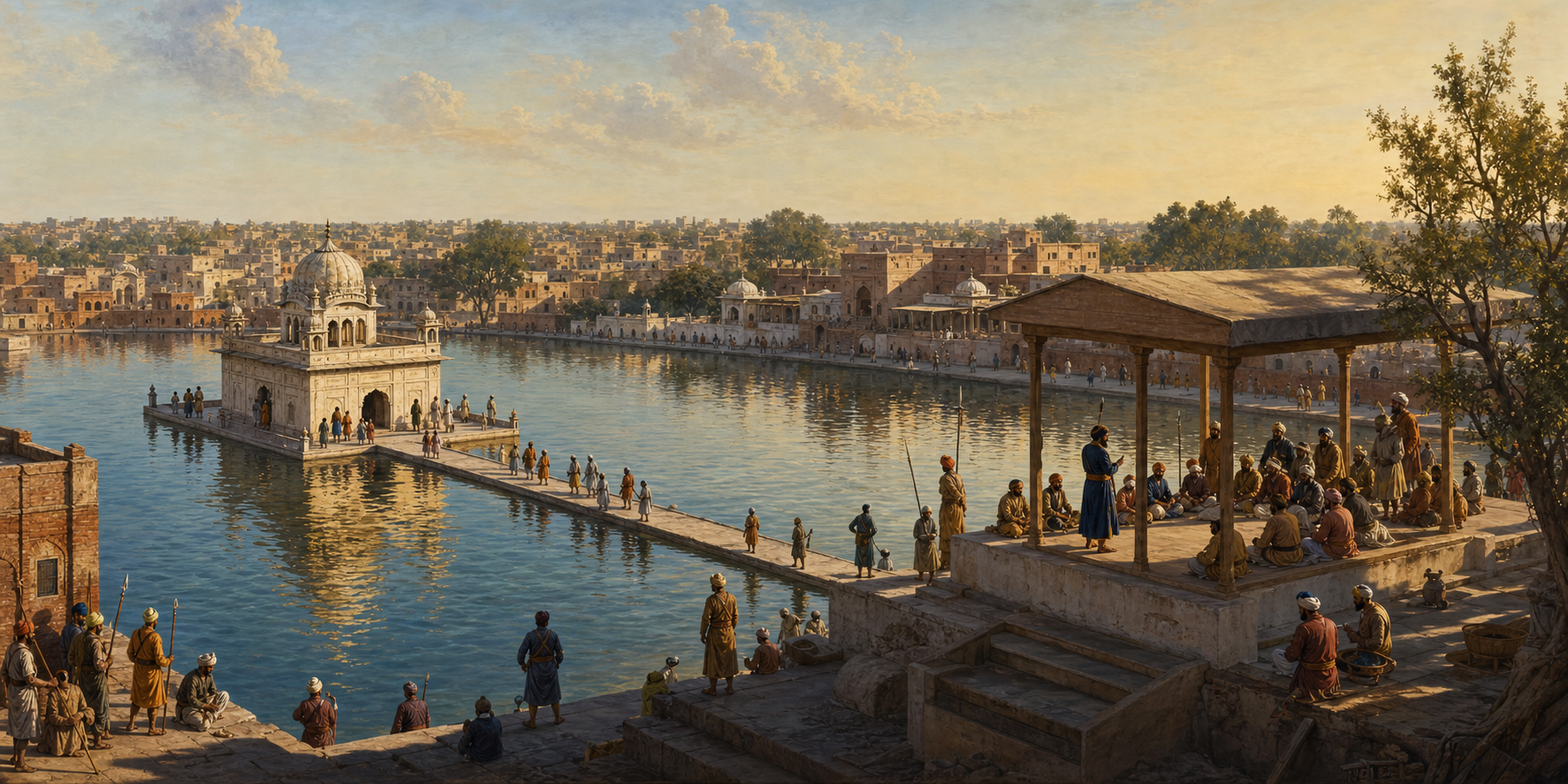
Miri-Piri acquired an institutional expression through the Akal Takht. The source places it opposite Harmandir Sahib in Amritsar and interprets that relationship as a visible dialogue between devotion and public responsibility. Harmandir Sahib represented humility, worship, and openness to the Divine, while the Akal Takht became associated with justice, counsel, collective authority, and governance.
The spatial relationship conveys a significant idea: a community may need both a sacred center that forms conscience and a public seat from which conscience addresses worldly affairs. Neither setting cancels the other. Spiritual practice supplies the orientation, while deliberation and institutions translate that orientation into decisions affecting communal life.
According to the article, Guru Hargobind Sahib received petitions, advised the community, encouraged discipline, and supported training in horsemanship, archery, and the responsible use of arms. These practices formed what the source calls a new grammar of sovereignty. Authority was not presented merely as imperial display or personal status; it was tied to service, protection, and accountability.
This institutional dimension distinguishes Miri-Piri from a purely private ideal. Personal virtue is indispensable, but a community facing injustice also needs forums for counsel, shared standards, preparation, and coordinated action. The Akal Takht represented the movement from individual conviction to collective responsibility without severing public authority from its spiritual foundation.
Martial readiness, restraint, and shared liberation
The source describes Guru Hargobind Sahib’s martial program as defensive, ethically governed, and responsive to changing political conditions. It notes conflicts during the reign of Shah Jahan but cautions against reducing his legacy to battles. The central development was the formation of a disciplined community able to preserve its faith and protect human dignity without making conquest, cruelty, or revenge its purpose.
This is the moral logic later associated with the sant-sipahi, or saint-soldier. Saintliness without the capacity to confront injustice may remain ineffective; martial capability without spiritual discipline can become dangerous. The saint-soldier ideal therefore requires a double education: the cultivation of compassion and self-command alongside the courage and skill needed for protection.
The Gwalior Fort tradition gives this ethic a particularly clear narrative form. As reported by the source, Sikh tradition holds that Guru Hargobind Sahib secured the release of fifty-two detained rulers when he was freed, an episode remembered through the title Bandi Chhor and the observance of Bandi Chhor Divas. The article also acknowledges that historians may approach particular dates and details cautiously.
The tradition’s ethical significance does not depend on treating every commemorative detail as uncontested. Its central image is of freedom refused as an exclusively personal privilege. Liberation reaches its moral fulfillment when it is extended to others. In relation to Miri-Piri, the episode shows spiritual stature generating public solidarity: the Guru’s own release becomes an occasion to seek release for those who remain confined.
How to read Miri-Piri in the present
Miri-Piri should not be reduced either to ceremonial symbolism or to a general endorsement of political power. The supplied account supports a stricter reading. Authority is legitimate only when directed toward service and protection; resistance remains ethical only when governed by restraint; and spiritual discipline proves consequential when it produces responsibility toward people beyond the self.
The principle can therefore serve as a test of both religious and civic conduct. It asks whether inward practice cultivates courage rather than withdrawal, whether leadership remains accountable to moral limits, whether protective strength serves those at risk, and whether freedom is pursued as a shared good rather than a private possession.
Key takeaways
- Miri-Piri joins spiritual authority with temporal responsibility while preserving the distinct purpose of each.
- Guru Hargobind Sahib’s martial leadership is presented as a continuation of Sikh devotion, service, and compassion under changed historical conditions.
- The relationship between Harmandir Sahib and the Akal Takht gives institutional form to the dialogue between humility and public duty.
- The Bandi Chhor tradition presents liberation as incomplete when it remains limited to one person’s freedom.
The continuing relevance of Miri-Piri lies in this discipline of integration. It calls for conscience strong enough to enter public life and for power restrained enough to remain the servant of justice. Its future depends less on repeating its symbols than on sustaining the demanding ethical relationship those symbols express.