Shiva’s encounter with Arjuna is often remembered as the contest that precedes the granting of the Pashupatastra. The supplied DharmaRenaissance account, however, presents it as a broader examination of whether exceptional ability has been placed under the discipline of dharma.
The central question is therefore not simply how a renowned archer lost a duel. It is why divine power became available only after Arjuna’s endurance, perception, confidence and capacity for surrender had all been tested.
The test begins with the purpose behind the weapon
DharmaRenaissance situates Arjuna’s quest during the Pandavas’ exile following the dice game, with a future conflict against the Kauravas already foreseeable. The article reports that ordinary military strength appeared inadequate against the formidable warriors aligned with Duryodhana, so Arjuna undertook spiritual preparation for the acquisition of divine weapons.
This setting gives the quest its ethical frame. According to the source, the weapons were sought in response to injustice and for the protection of order, not merely for conquest or personal display. Arjuna’s objective was connected to kshatra dharma, while his tapas was meant to cultivate the self-command required to exercise force responsibly.
The austerities, traditionally associated in the account with the Himalayan region and often with Indrakila, therefore function as more than a price paid for a boon. Bodily endurance, concentration and restraint begin the examination by asking whether the seeker can govern himself before he is permitted to wield a force capable of governing the outcome of battle.
The Kirata disguise exposes a limit in Arjuna’s perception
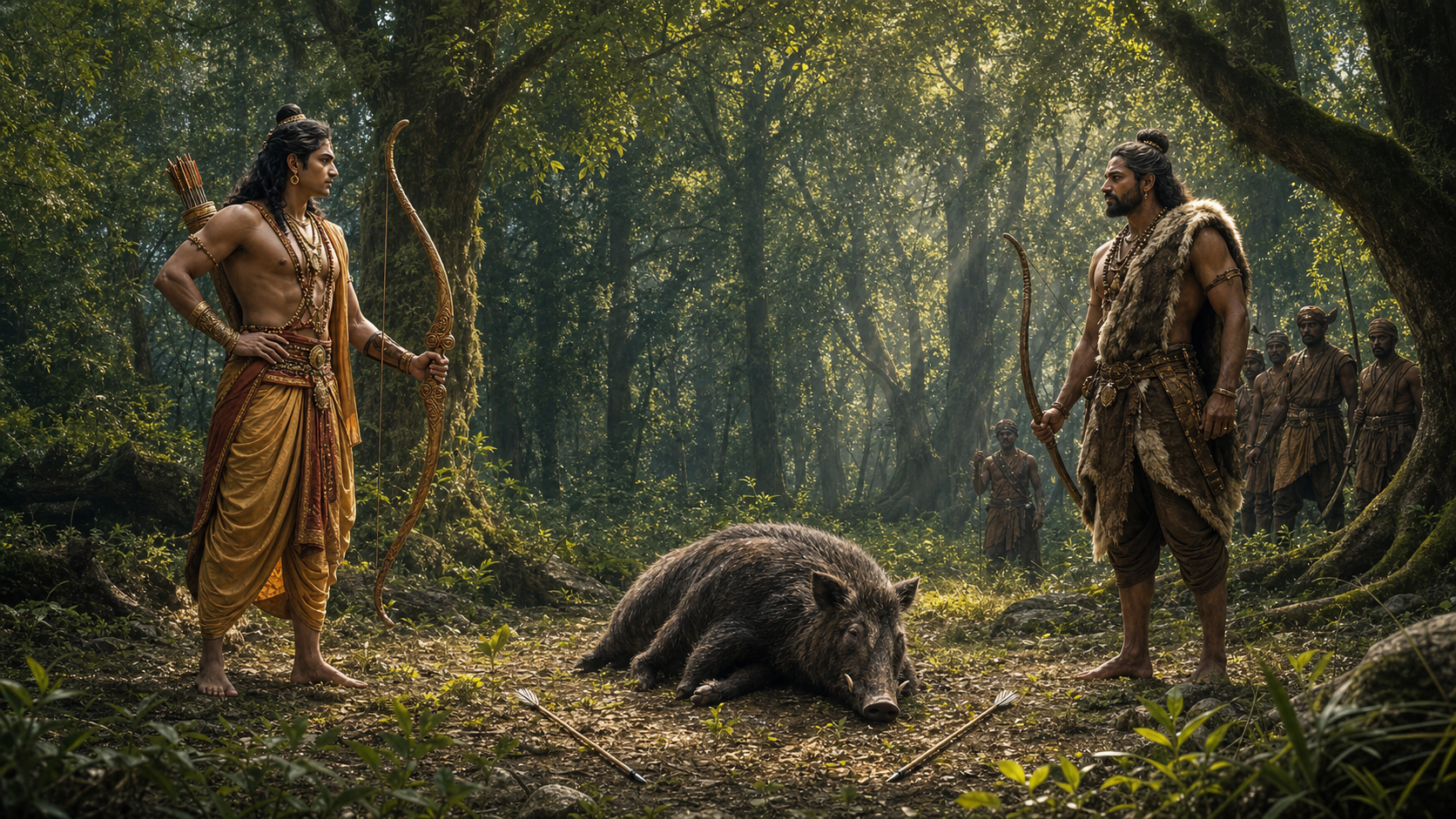
The source recounts that a wild boar charges toward Arjuna and that, in several traditional tellings, it is associated with the demon Muka. Arjuna and a Kirata hunter release arrows at the same moment, after which each claims the kill. A disagreement that appears to concern hunting rights becomes the opening of the divine test.
The hunter is Shiva in disguise, accompanied by Parvati in many tellings cited by the article. The chosen form is significant within the source’s interpretation: Shiva does not meet Arjuna through the signs of courtly rank or immediately recognizable divine splendour. The warrior must respond to someone whose outward identity gives him no obvious reason to defer.
Arjuna initially sees a rival who has challenged his claim and competence. His error is not a lack of courage; he confronts the Kirata directly. The limitation lies in treating the encounter entirely through familiar categories of status, ownership and martial superiority. The disguise consequently tests perception as much as prowess: can Arjuna recognize that truth and authority may arrive in a form his social and professional expectations do not validate?
Defeat removes self-sufficiency without removing courage
DharmaRenaissance reports that Arjuna’s archery cannot overcome the Kirata. Even the Gandiva proves ineffective, his weapons are neutralized, and a subsequent physical struggle also ends in the hunter’s favour. The test does not reveal Arjuna to be unskilled; its force depends on his already established excellence. It reveals that excellence remains finite when treated as sufficient in itself.
The article distinguishes this correction from crude humiliation. Shiva does not destroy Arjuna’s resolve or disqualify him from warrior duty. Instead, the defeat separates courage from the subtler assumption that training, lineage and technical mastery alone can guarantee rightful victory.
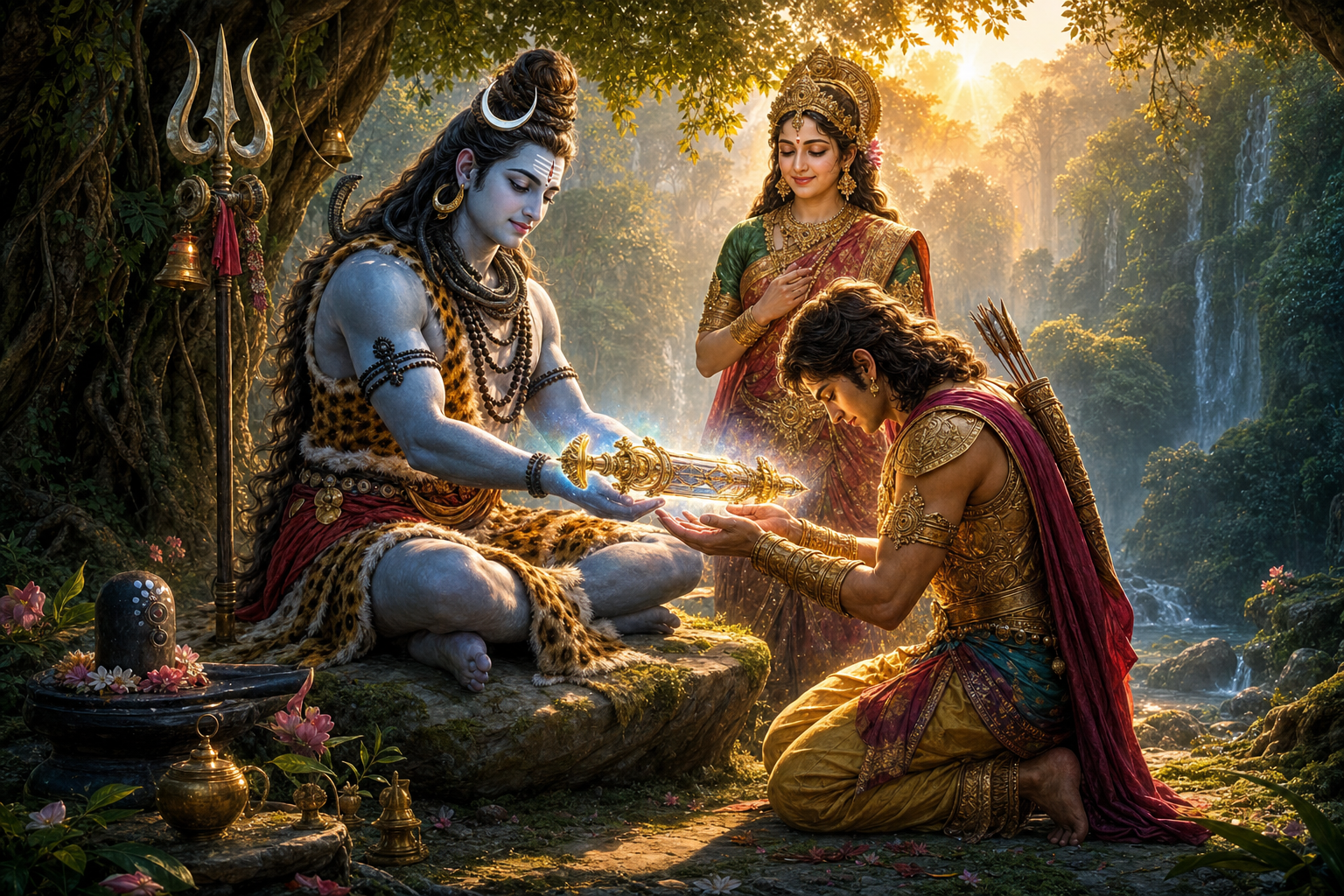
In devotional retellings discussed by the source, Arjuna turns to worship, fashions a linga and offers flowers. When those flowers are seen upon the Kirata, the opponent is recognized as Shiva. That recognition changes the meaning of everything that preceded it: apparent obstruction becomes instruction, defeat becomes grace, and surrender becomes an informed acknowledgement of a reality greater than personal ability.
Key takeaways
- Arjuna’s tapas tests self-governance before the encounter tests martial strength.
- Shiva’s Kirata form examines whether Arjuna can see beyond rank, appearance and professional pride.
- The failed weapons establish the boundary of individual excellence rather than denying its value.
- Recognition and surrender transform the contest from a dispute into divine instruction.
- The Pashupatastra is granted only after Arjuna demonstrates both courage and corrigibility.
The Pashupatastra represents entrusted, not possessed, power
In the source’s account, Shiva grants the Pashupatastra after Arjuna recognizes him and bows. The weapon is described as an exceptionally potent astra associated with Shiva’s destructive capacity, invoked through mantra and requiring spiritual authority, discipline and an understanding of consequences. It is therefore not presented as an ordinary addition to an arsenal.
The order of events supplies the episode’s governing logic: austerity precedes confrontation; confrontation produces failure; failure opens the way to recognition; and recognition makes responsible empowerment possible. The weapon comes last because its recipient must be more than capable of obtaining power. He must be capable of refusing its careless use and subordinating it to dharma.
This reading also sharpens the episode’s connection to Kurukshetra. Arjuna’s preparation is not only an accumulation of superior means for a future war. It is an inner reorientation from acting as an isolated master of force toward serving as an accountable instrument of a moral order. The lasting criterion for power, in this framework, is not whether it can be won, but whether its bearer has become trustworthy enough to receive it.