
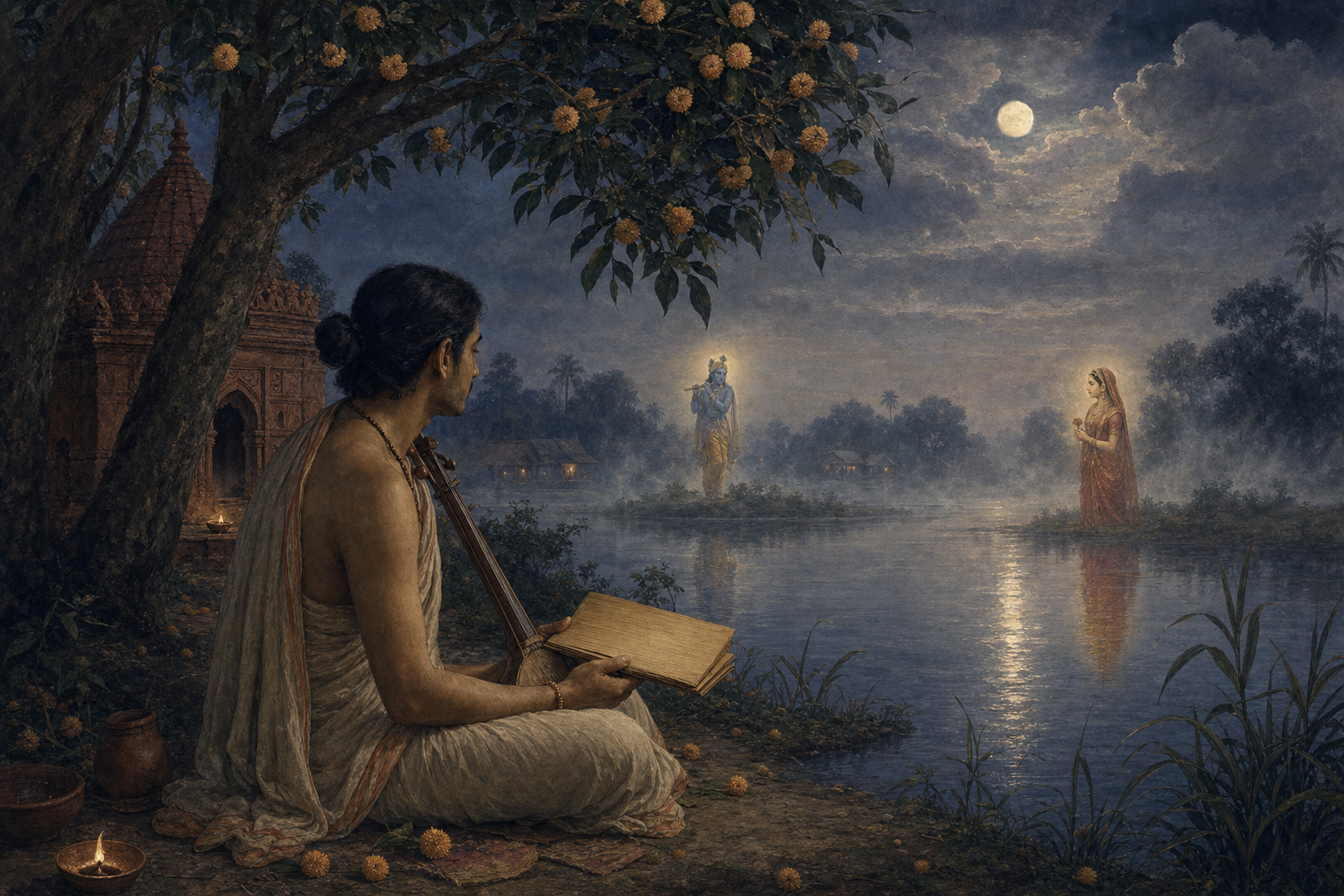
Chandidas stands at a revealing crossroads: between history and devotional memory, Radha’s divine longing and a disputed human love, temple service and vernacular poetry, social hierarchy and spiritual dignity. His importance lies not in any one of these themes alone, but in the way they illuminate one another.
The supplied DharmaRenaissance account does not support a simple, settled biography. Instead, it presents a layered tradition in which uncertain authorship, poetic theology, Bengali religious culture, and the legend of Rami must be considered together. Reading those layers carefully clarifies both the appeal of Chandidas and the limits of what can confidently be claimed about him.
Key takeaways
- The name Chandidas is associated with several poets, so the literary tradition should not automatically be treated as the work of one securely identified person.
- In the poems attributed to Chandidas, Radha’s separation from Krishna turns longing into a form of devotional attention and self-knowledge.
- The remembered relationship with Rami functions as an ethical challenge to caste pride, even though it should be approached as a legend rather than an uncontested biography.
- Chandidas’s reported connections with both Goddess worship and Radha-Krishna devotion reflect the layered religious culture of Bengal rather than an obvious contradiction.
- His significance is also linguistic: Bengali becomes a medium for subtle sacred emotion that can circulate beyond exclusively scholastic settings.
One name, several poets, and a living tradition
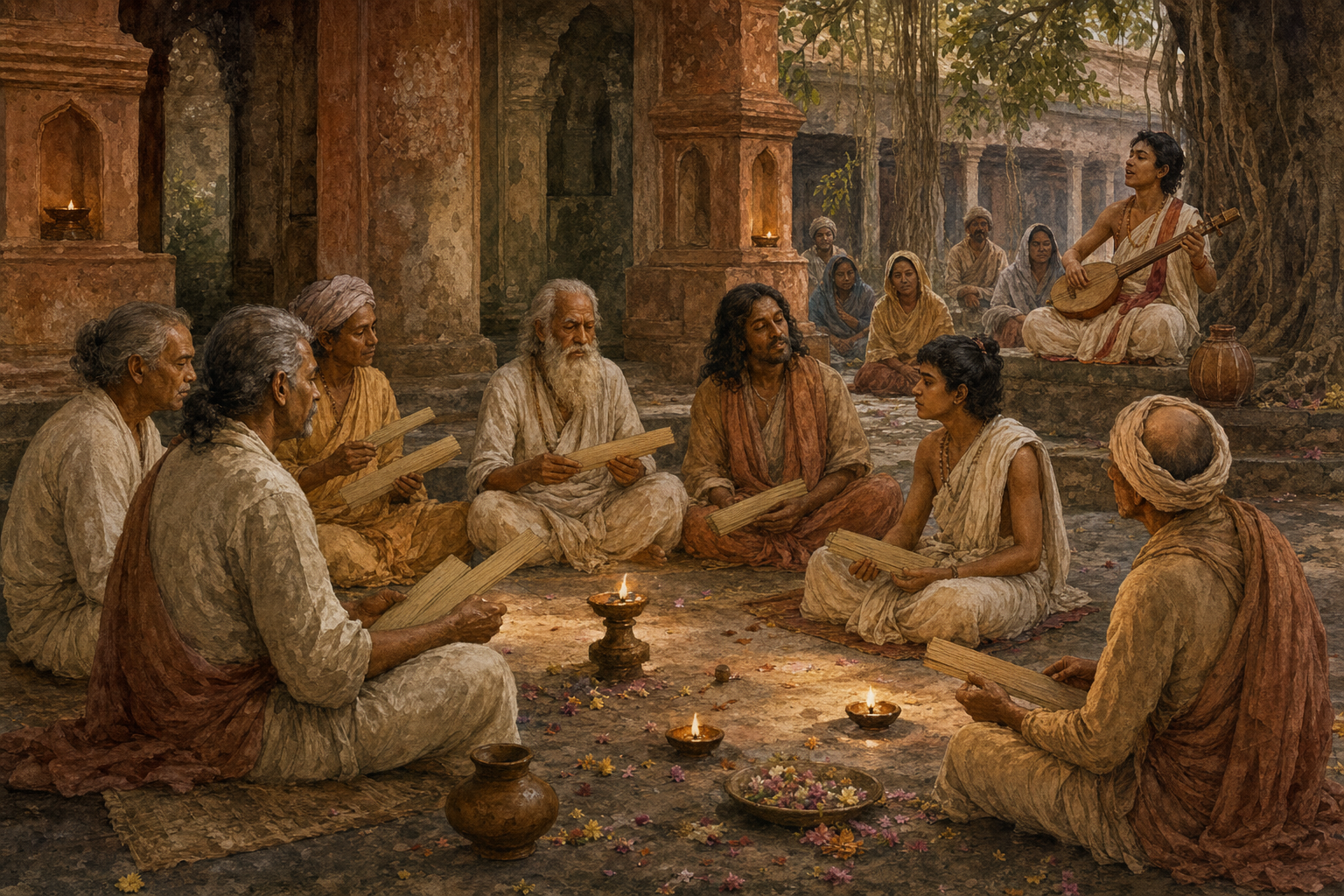
The first difficulty is identifying who Chandidas was. The source reports that Bengali literary history preserves several figures bearing the name, including Baru Chandidas, Dvija Chandidas, and Dina Chandidas. It associates the medieval Srikrishnakirtan principally with Baru Chandidas and gives a commonly proposed period around the fourteenth or early fifteenth century, while emphasizing that the chronology remains uncertain.
Popular tradition adds another portrait: a Brahmin temple priest from Nanur in present-day Birbhum who served Bashuli, a local form of the Goddess associated in the account with Durga or Vishalakshi. These details belong to cultural memory, but the multiplicity of poets makes it unsafe to combine every poem, place, office, and legend into one seamless life.
A responsible reading therefore distinguishes three kinds of claim. There are textual attributions, which concern which poet composed a work; biographical traditions, which connect a Chandidas with particular places and relationships; and devotional memory, which preserves what the name came to signify. The uncertainty surrounding the first two does not make the third meaningless. It shows how Chandidas became a shared cultural figure whose importance exceeded the recoverable facts of any single biography.
Why Radha’s separation becomes spiritual knowledge

The theological centre of the tradition is not a doctrine stated abstractly but an emotional relationship. The source describes poems in which Radha and Krishna embody longing, absence, union, vulnerability, and surrender. Radha’s desire for Krishna gives experiential form to the soul’s search for the Divine, while Krishna’s alternating presence and absence mirrors the changing intensity of spiritual awareness.
The governing devotional idea is viraha, or separation. Ordinarily, separation signifies loss. Within the poetics attributed to Chandidas, however, absence sharpens remembrance until the beloved occupies consciousness with unusual intensity. Radha’s suffering is therefore more than romantic unhappiness: it becomes awareness of a life felt to be incomplete without divine presence.
This does not mean that pain is automatically holy. Its spiritual value lies in what it exposes and transforms. Longing unsettles self-sufficiency, reveals attachment and pride, and demands an honesty that outward religious performance cannot guarantee. The emotions remain recognizably human, but their direction changes. Love becomes less a claim of possession and more a discipline of attention, humility, and receptivity.
That dynamic helps explain the continued intimacy of these songs. Experiences of distance from a beloved, a community, a meaningful life, or the Divine can all make Radha’s voice intelligible. The poetry does not erase grief with easy reassurance; it asks whether longing itself can deepen perception.
Rami and the ethical test of devotional love
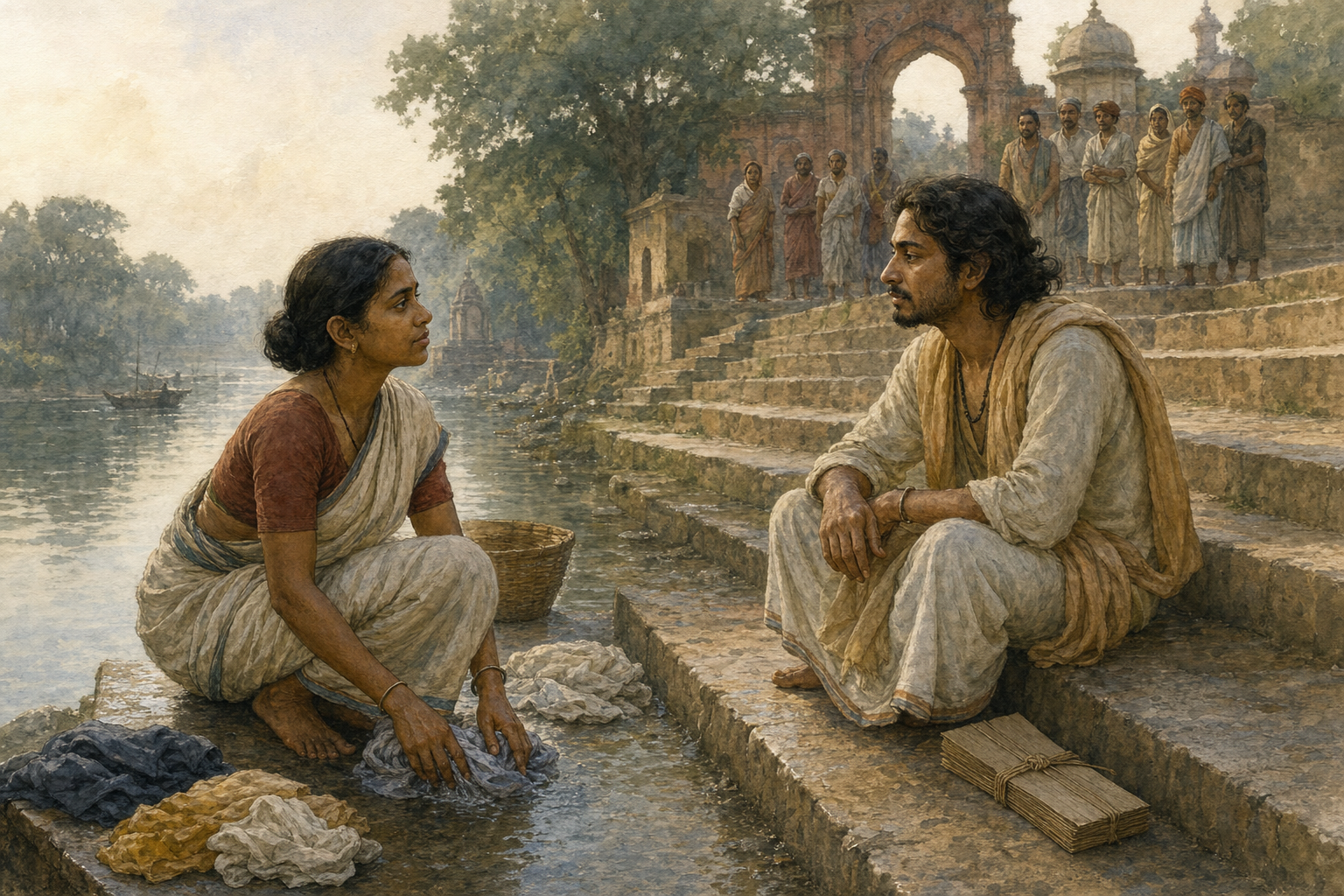
The remembered relationship between Chandidas and Rami, also called Rajakini in the source, places this theology within a social conflict. The account presents him as a Brahmin priest and her as a woman from a washerfolk community. Their affection consequently crossed boundaries involving caste, ritual purity, priestly obligation, and public reputation.
Because the source presents this material as popular tradition, the story should not be treated as an independently established event. Yet a legend can remain historically significant as evidence of what later communities chose to remember. In this case, Bengali memory joined the poet of Radha’s vulnerable love to a human relationship that exposed the moral cost of inherited hierarchy.
The connection is not that human romance and divine devotion are identical. Rather, each tests whether love can survive pride and social calculation. If devotion depends upon sincerity, surrender, and grace, birth-based status cannot by itself determine spiritual worth. Rami consequently becomes more than a supporting character in a scandal: within the remembered narrative, she reveals whether religious respectability has become detached from compassion.
The source also discusses a humanistic saying widely attributed to Chandidas while acknowledging that its textual history is disputed. That caution is important. The saying should neither be used as effortless proof of a modern political programme nor dismissed because its attribution is uncertain. Its lasting reception indicates that readers found an ethic of human dignity compatible with the devotional world attached to Chandidas.
Nor does the legend imply that Dharma means freedom from every obligation. Its sharper proposition is that religious order loses moral credibility when it protects status at the expense of truthfulness and compassion. The tension between discipline and dignity, rather than a simple opposition between tradition and rebellion, gives the story its enduring force.
A Bengali bridge between sacred worlds
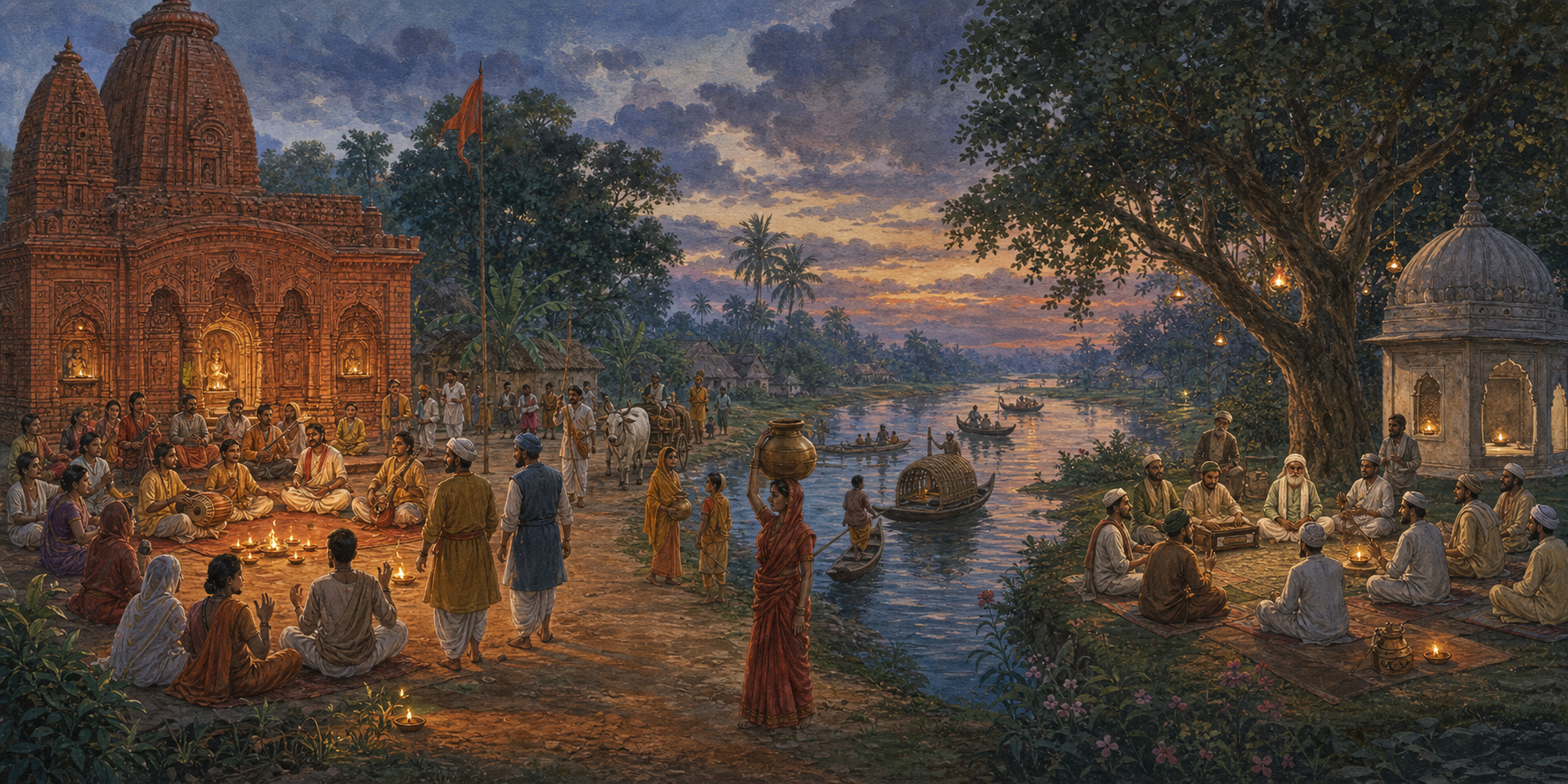
Chandidas’s reported association with Bashuli worship complicates any attempt to place him inside a single religious compartment. The source situates him within a Bengali environment where Shakta, Vaishnava, folk, Tantric, and village traditions could occupy the same sacred landscape. A priest of the Goddess singing the love of Radha and Krishna need not therefore represent an abrupt conversion from one sealed system to another.
This layered setting also changes how the poetry’s social reach is understood. Sanskrit retained its place as a language of sacred learning and philosophical refinement, according to the account, while Bengali verse carried devotional feeling into homes, village paths, courtyards, and musical gatherings. The contrast is not necessarily between learning and ignorance. It is between different modes of transmission: formal exposition and a language that enables emotion to be sung, remembered, and shared.
Vernacular expression was therefore part of the spiritual method, not merely a change of literary packaging. Radha’s voice had to feel immediate for separation to become inward experience. By giving nuanced religious emotion a Bengali form, the poetry associated with Chandidas contributed to the language’s capacity for intimate theological reflection.
The source further presents Chandidas as part of the emotional background to later Vaishnava currents in Bengal associated with Sri Chaitanya. Given the disputed identities and chronology, that relationship is best expressed as continuity rather than a simple, documented line of personal influence. Themes such as longing, surrender, song, and intense attachment to Krishna form the more defensible bridge.
Future engagement with Chandidas will be strongest when textual scholarship and devotional interpretation remain in conversation. Distinguishing among poets, works, and legends can sharpen historical understanding, while attentive reading can preserve the central question carried by the tradition: how love might refine religious life when status, certainty, and pride threaten to harden it.