
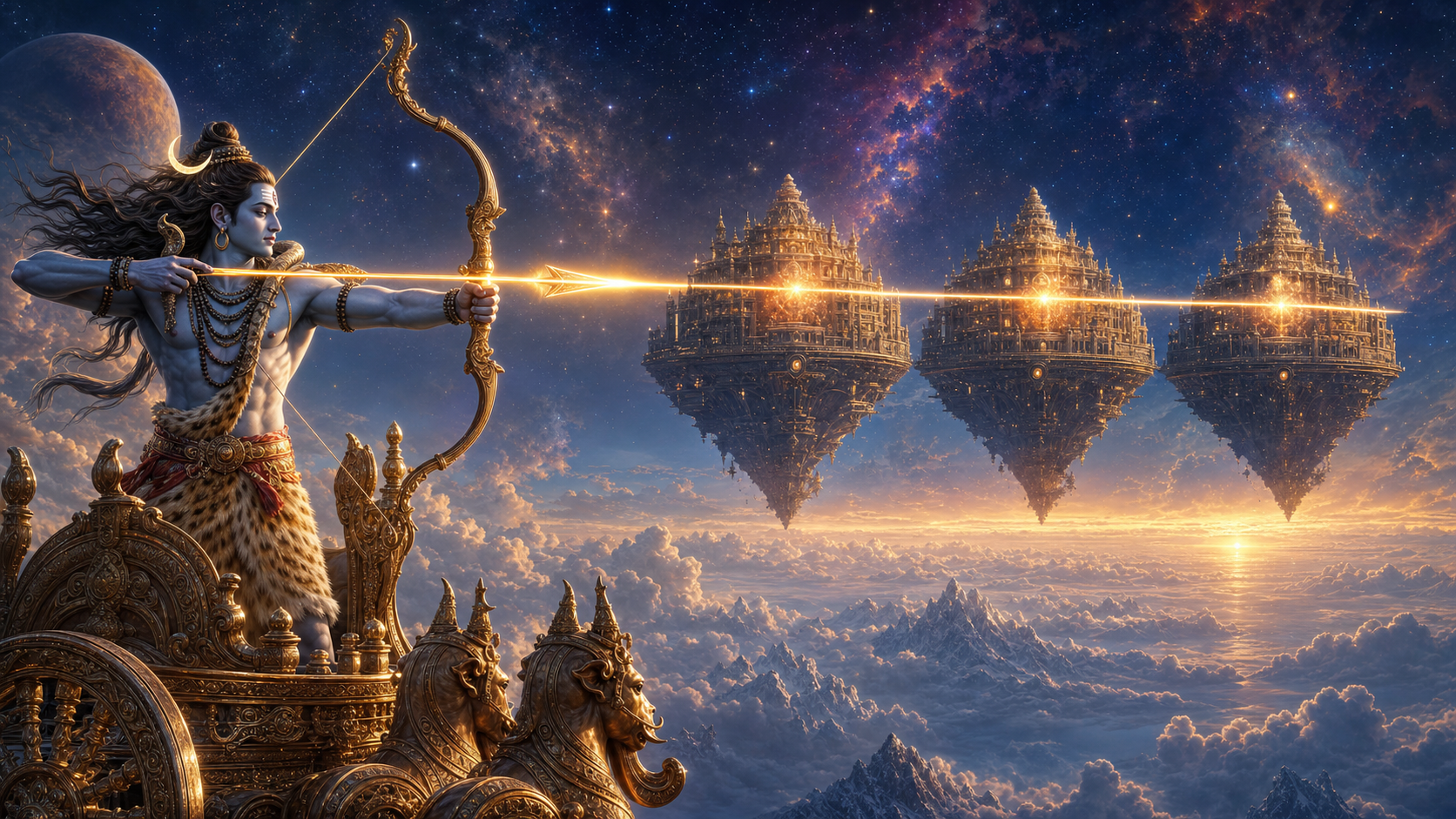
Tripurantaka, the form of Shiva who destroys the three cities, is best understood not as an image of unrestrained violence but as an image of perfectly concentrated action. The episode brings cosmic conflict, ethical responsibility, yogic discipline, and metaphysical insight into a single decisive moment.
Its central question is not simply how Shiva defeats an apparently invincible enemy. It is why the whole cosmos must first become ordered around one purpose – and why three formidable strongholds can be overcome only when they are seen together.
The decisive moment depends on alignment, not greater force
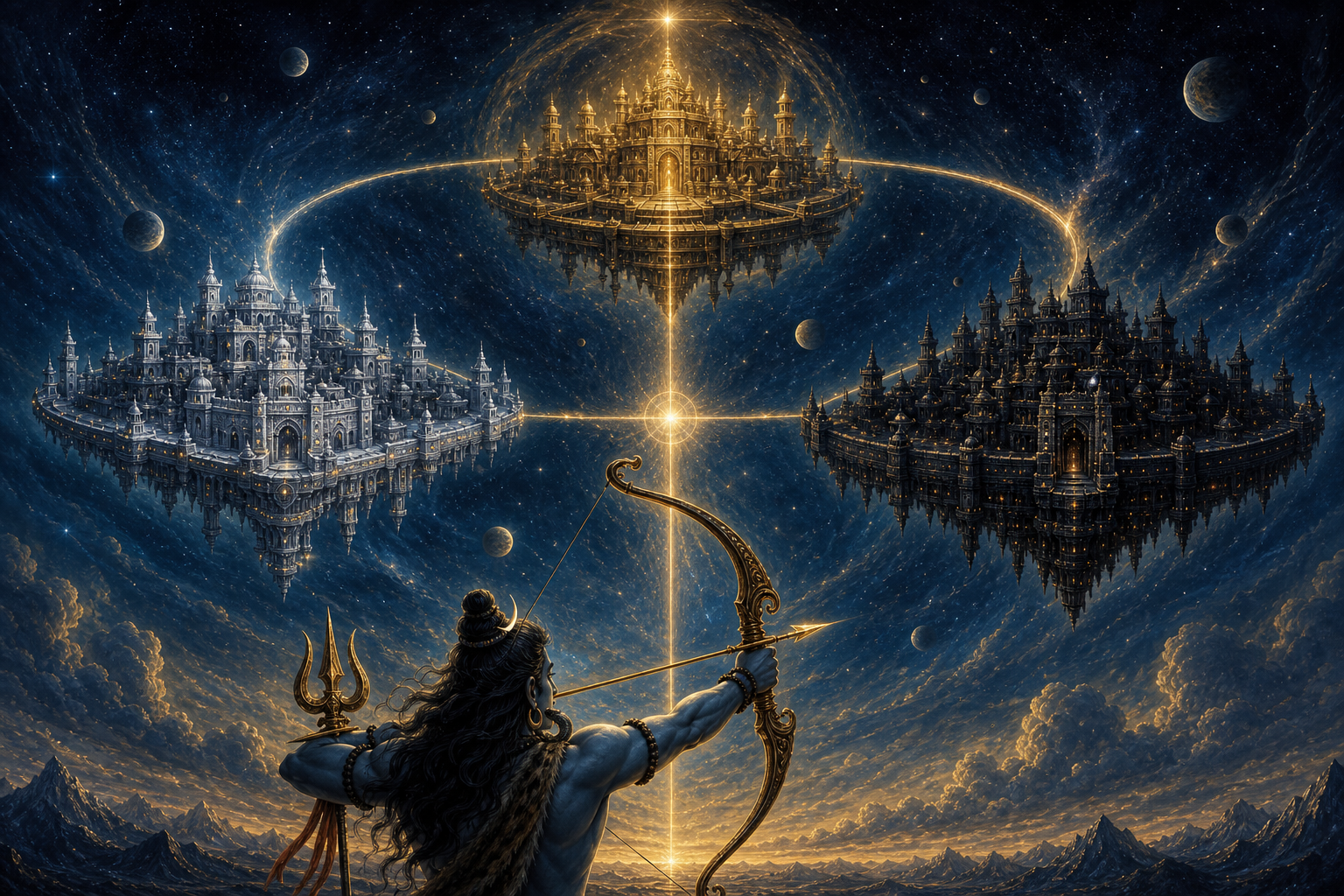
According to the account summarized by DharmaRenaissance Blog, the episode appears in varying forms in the Shiva Purana, the Mahabharata, and related Puranic traditions. Tarakaksha, Vidyunmali, and Kamalaksha, identified as sons of Tarakasura, obtain a boon from Brahma after performing severe austerities. Their three mobile cities can be destroyed only when they align at a rare moment and are struck by one arrow.
This condition changes the meaning of the conflict. The problem cannot be solved by repeatedly attacking each fortress or by applying more force to an isolated target. Victory requires clear perception, patience, and unified action at the exact instant when the apparently separate structures reveal their connection.
The account therefore treats power as morally unfinished. Tapas, discipline, and intelligence can produce extraordinary capacities, but those capacities do not become dharmic merely because they were difficult to acquire. When directed by pride and domination, disciplined power can build stronger forms of captivity. Tripura represents that paradox: achievement has produced splendour and security, yet both have become instruments of disorder.
Shiva’s single arrow answers this fragmentation with integration. The shot is not impulsive. It becomes possible only after the target, the weapon, the vehicle, and the powers assisting the archer have been brought into relation. The rare alignment outside the archer consequently mirrors an alignment within the act itself.
The cosmic weapon makes every power serve one purpose
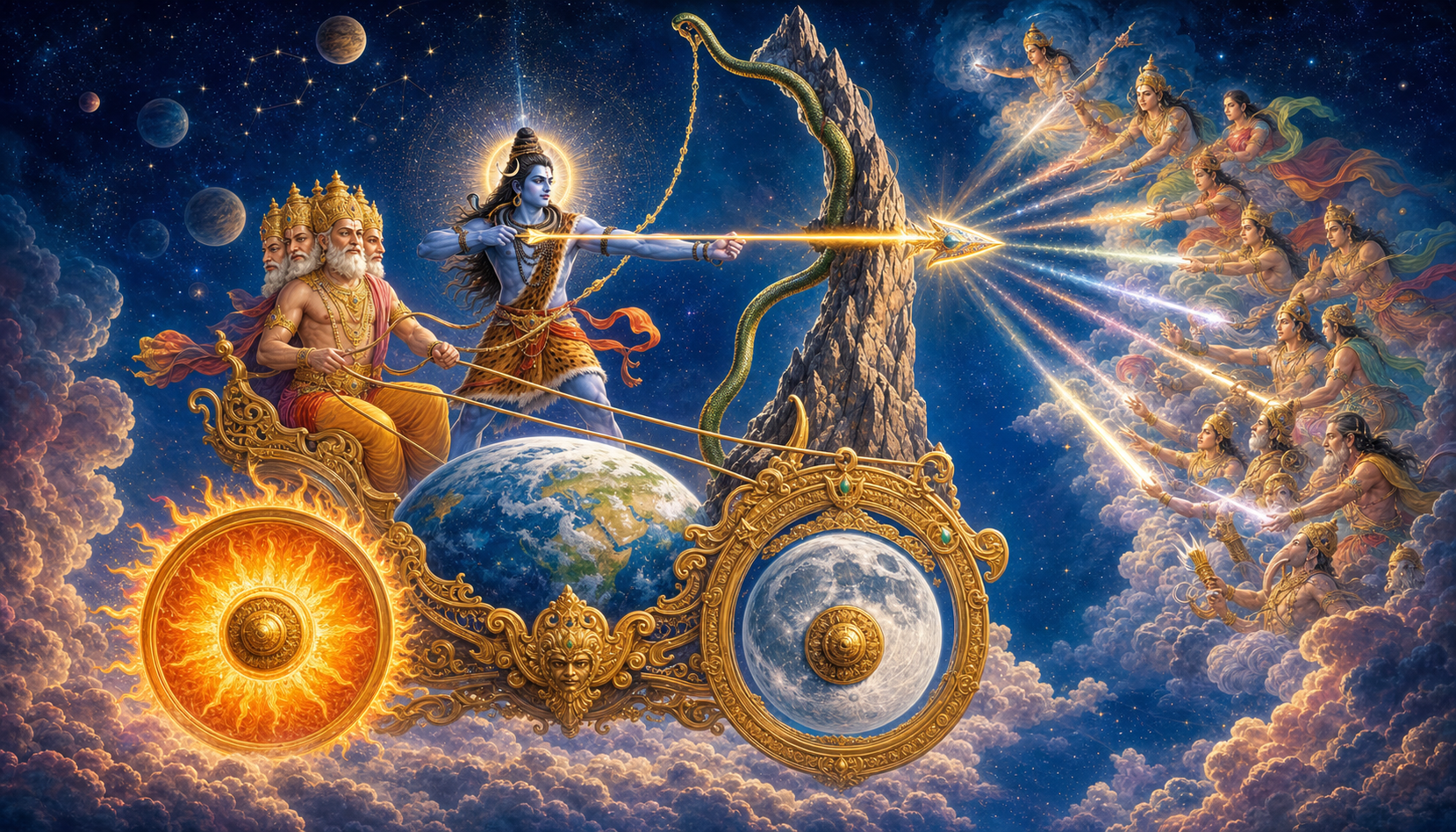
In the version discussed by DharmaRenaissance Blog, Shiva does not confront Tripura with an ordinary chariot and bow. The earth becomes the chariot; the sun and moon become its wheels; Brahma serves as charioteer; Mount Meru becomes the bow; and Vasuki becomes the bowstring. Vishnu is associated with the arrow or its animating force in different tellings, while Agni, Vayu, the Vedas, and other divine powers may also be incorporated into the weapon or vehicle.
These variations need not be treated as competing engineering diagrams of a mythical weapon. Their shared function is theological and symbolic: no partial faculty can restore an order whose disruption spans several realms. Creation, preservation, dissolution, sacred knowledge, elemental energy, and the structure of the world all participate in the response.
The earth as chariot gives embodied existence a constructive role. The world is not discarded so that liberation can occur elsewhere; it becomes the field and vehicle of right action. The sun and moon similarly place complementary modes of awareness under one direction. The source interprets them through such paired qualities as outward clarity and inward reflection, intensity and receptivity, austerity and tenderness. Neither wheel can carry the chariot alone.
Meru and Vasuki express another necessary pairing. Meru supplies an axis firm enough to hold tension, while the serpent supplies stored and responsive energy. Read through a yogic lens, the image does not demand the extinction of power. It depicts power steadied, harnessed, and directed. Energy ceases to be dangerous when it is neither indulged nor suppressed but disciplined by a worthy purpose.
Brahma’s and Vishnu’s participation also prevents the episode from becoming a narrow assertion of sectarian rivalry. Creative intelligence guides the chariot, sustaining intelligence enters the arrow, and Shiva releases the force that ends the hardened imbalance. Destruction here operates within a larger unity of divine functions.
The three fortresses map different forms of bondage
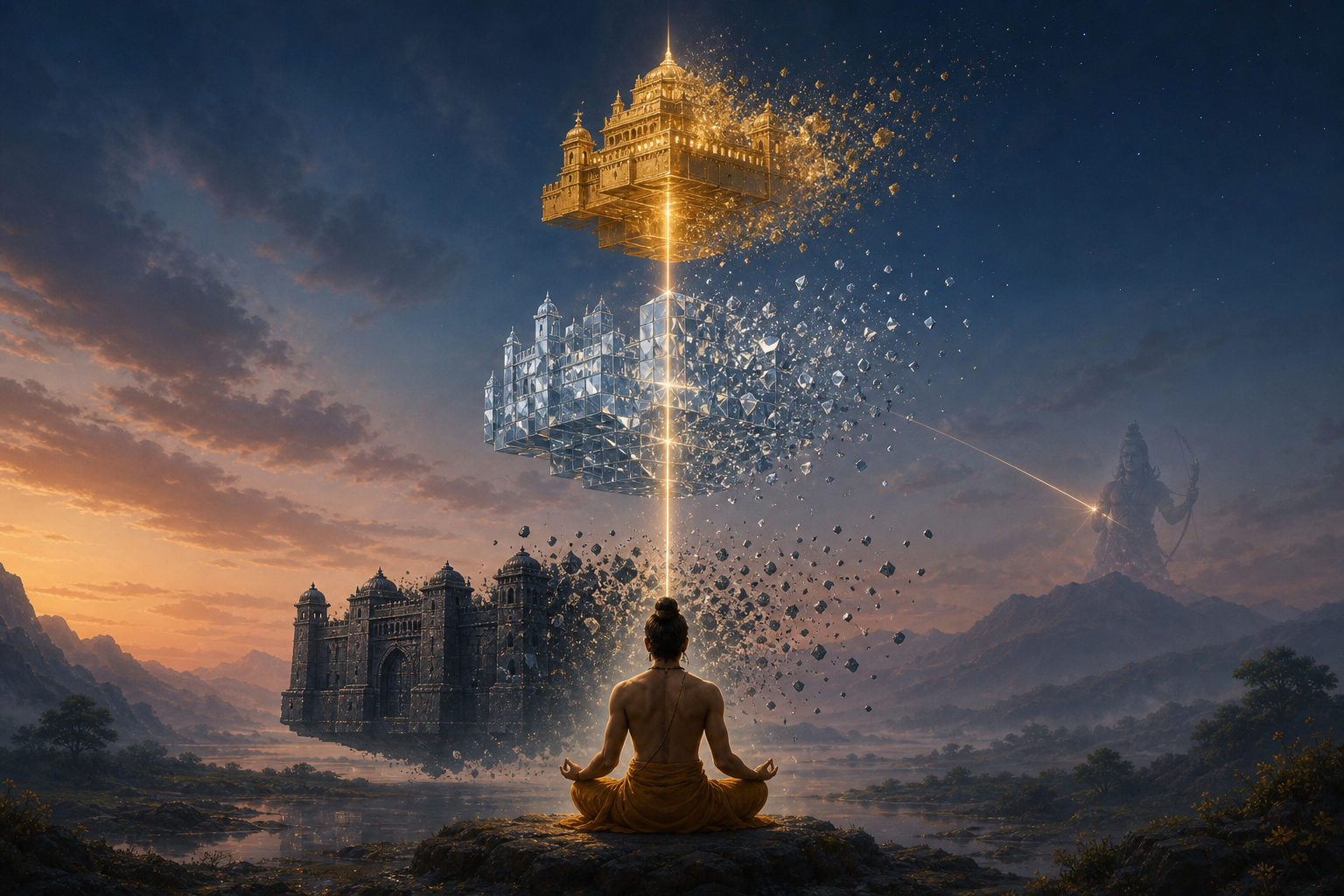
DharmaRenaissance Blog describes the cities as made of gold, silver, and iron and interprets the metals as more than ornamental details. Gold evokes brilliance, attraction, wealth, and refined enjoyment. Silver suggests reflected luminosity and subtle mental experience. Iron conveys hardness, material force, and the density of embodied life. Together, the cities form an enclosure that can be read across several philosophical frameworks.
At the most immediate psychological level, Tripura becomes a model of layered attachment. Material possessions and physical capacity form one defence. Thought, memory, status, and emotional narratives form another. Beneath them lies the more deeply embedded conviction that the separate self is ultimate. These layers appear to move independently, just as the cities move through different regions, which makes their common centre difficult to recognize.
A Shaiva reading connects the three cities with the three malas. The source identifies these as anava mala, the contraction into smallness and separateness; karma mala, bondage through action and consequence; and maya mala, the limiting structure through which reality appears fragmented. On this interpretation, Tripurantaka does not annihilate the person. Shiva burns the limitations through which consciousness mistakes contraction for its complete identity.
The source also relates Tripura to sattva, rajas, and tamas. This comparison adds an important qualification: bondage is not confined to obviously destructive tendencies. Tamas may harden as inertia or ignorance, and rajas may intensify as restless ambition, but even sattva can become a refined enclosure when clarity or virtue is appropriated by ego. The golden city may be more attractive than the iron one while remaining a city nonetheless.
These readings are complementary rather than interchangeable. The metals describe the seductions and densities of experience; the malas explain limitation in specifically Shaiva terms; and the gunas show how the forces of nature can bind when they are treated as possessions of the ego. All three frameworks converge on one insight: liberation requires seeing the full architecture of bondage, not merely attacking its least attractive layer.
Key takeaways
- Tripura represents power and disciplined achievement severed from dharma, not power or discipline as inherently evil.
- The single arrow symbolizes concentrated awareness acting upon several connected forms of limitation at once.
- Shiva’s cosmic chariot presents the world, knowledge, energy, and divine functions as coordinated instruments of restoration.
- The three cities can be read through layered attachment, the three malas, or the three gunas without reducing the episode to only one interpretation.
- Tripurantaka’s destruction is transformative: its object is the fortified structure of bondage and disorder.
Destruction becomes meaningful through restraint
The enduring force of Tripurantaka lies in the discipline surrounding the arrow. Shiva waits for alignment, draws upon a cosmos ordered toward dharma, and acts once. The image therefore places restraint inside power and discernment inside destruction.
For contemporary spiritual reflection, the episode directs attention away from the fantasy of defeating one visible problem while leaving its supporting structures untouched. Its more demanding invitation is to identify how bodily attachment, mental construction, and contracted identity sustain one another – and then to cultivate the steadiness capable of addressing them together.
As long as power can be confused with freedom, Tripurantaka will remain a searching image of responsible transformation: energy gathered without frenzy, complexity integrated without denial, and decisive action governed by a purpose larger than conquest.