

Urmila’s place in the Telugu Ramayana reveals a form of sacrifice that happens away from the forest, battlefield, and royal court. In the account supplied by DharmaRenaissance Blog, her fourteen-year separation from Lakshmana is not an empty interval in the epic but an unseen contribution to the exile itself.
The tradition of Urmila Nidra gives that contribution a memorable form: Lakshmana’s vigilance is made possible by Urmila’s acceptance of sleep. Read symbolically, the episode connects public service with private cost and asks whose endurance sustains the deeds for which others are celebrated.
Urmila changes the moral map of the exile
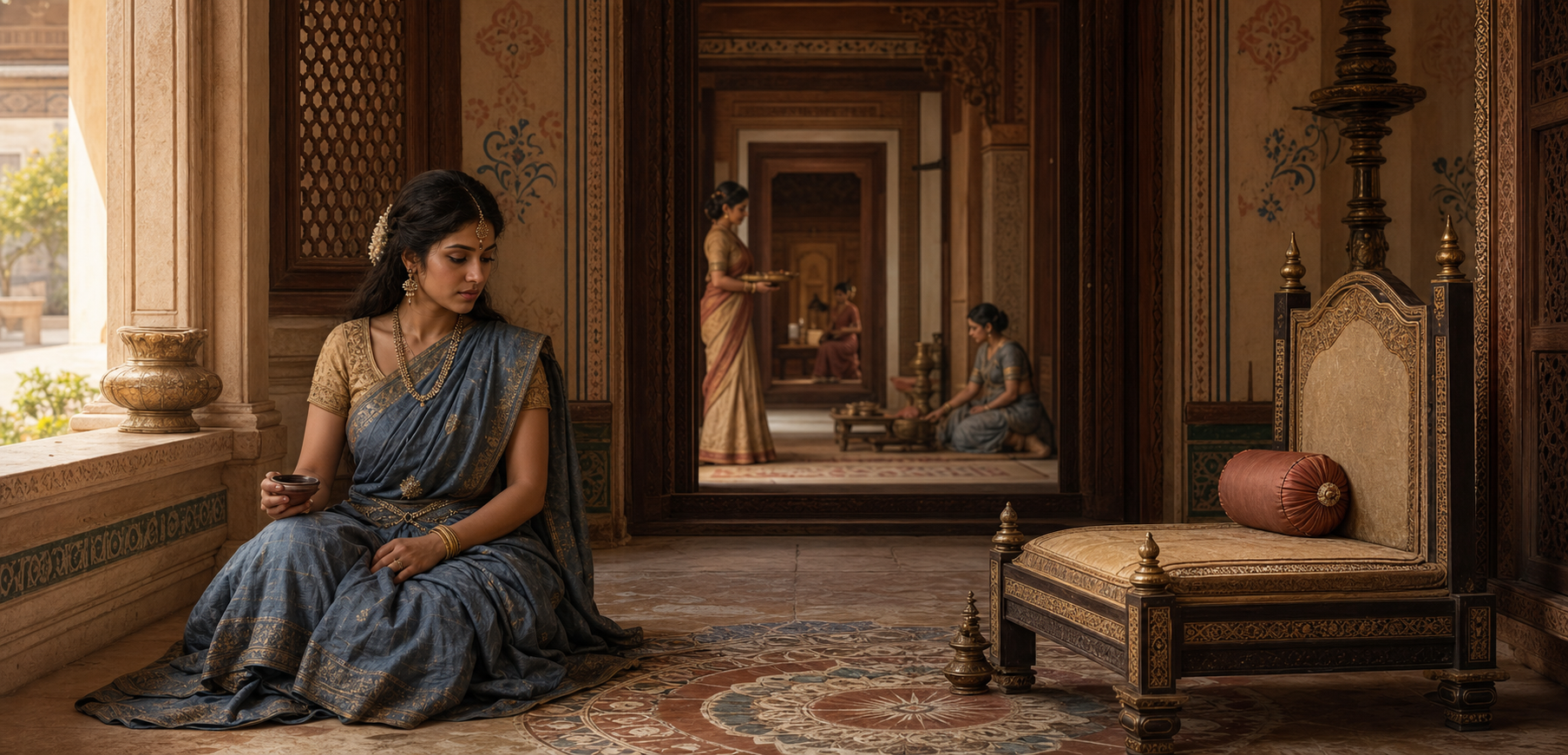
The supplied article identifies the familiar, visible expressions of dharma surrounding Rama’s exile: Sita accompanies Rama, Lakshmana protects and serves them, Bharata renounces the privileges of kingship, and Hanuman later embodies devotion. Urmila’s role differs because it is defined by remaining behind. Her absence from the forest is precisely what makes her ethical position easy to overlook.
According to the article, Urmila is the daughter of King Janaka and Queen Sunayana, the sister of Sita, and the wife of Lakshmana. Her marriage belongs to the larger union between the houses of Janaka and Dasharatha: Sita marries Rama, Urmila marries Lakshmana, Mandavi marries Bharata, and Shrutakirti marries Shatrughna. This family structure matters because exile tests not only individual vows but also the relationships joined by those marriages.
When Lakshmana chooses to accompany Rama and Sita for fourteen years, the decision demonstrates fraternal loyalty while creating a corresponding loss for Urmila. The source interprets her remaining in Ayodhya as disciplined consent rather than passivity. It enables Lakshmana to serve without being divided between the forest and his marriage, while Urmila stays connected to the distressed royal household and its elders.
What the fourteen-year sleep represents

In the Urmila Nidra episode as related by the source, Lakshmana resolves to stay awake throughout the exile so that he can guard Rama and Sita. Nidra Devi, the goddess of sleep, explains that his renunciation requires a balancing bearer. Urmila accepts the sleep relinquished by her husband and sleeps for the same fourteen-year period.
Taken only as a marvel, the story concerns an extraordinary exchange of sleep. Taken as a moral image, it says considerably more. Lakshmana’s alertness has a cost, and that cost does not disappear simply because he possesses heroic resolve. It is transferred into a relationship and carried by someone whose contribution remains outside the main arena of action.
The episode therefore joins two spaces usually treated as opposites. The forest is associated with danger, movement, protection, and eventual war; Urmila’s chamber is associated with stillness and withdrawal. Yet the source’s interpretation makes them interdependent. The visible vow in the forest is sustained by an invisible burden in Ayodhya.
Nidra Devi also introduces the principle of balance. Lakshmana cannot simply abolish a fundamental human need without consequence. The story imagines wakefulness and sleep as obligations that must still be borne somewhere, turning a physical necessity into a language for shared duty.
Agency expressed through consent, restraint, and partnership

Urmila’s story complicates any definition of agency limited to travel, command, combat, or public speech. In the interpretation offered by DharmaRenaissance Blog, she acts by accepting separation, serves by staying, and participates in Lakshmana’s vow without accompanying him physically. Her restraint is purposeful because it protects another person’s ability to fulfil a demanding responsibility.
This reading does not erase Urmila’s loss. On the contrary, it makes that loss essential to understanding Lakshmana’s service. Remembering him only as the ever-watchful brother can isolate his achievement from the marriage that absorbs its private consequences. Urmila Nidra instead presents the couple as partners in dharma: one bears vigilance in the forest, while the other bears the relinquished rest and separation in Ayodhya.
The contrast with Sita is also instructive without turning the two women into rivals. Sita’s solidarity with Rama takes the form of accompanying him; Urmila’s solidarity with Lakshmana takes the form of allowing him to leave. One sacrifice is enacted through presence and the other through absence. The difference broadens the epic’s ethical vocabulary rather than establishing a hierarchy between them.
The same framework gives the episode continuing relevance. Households, communities, and institutions often depend on people who accept loneliness, deferred hopes, caregiving responsibilities, or reduced recognition so that someone else can complete a visible duty. Urmila’s story does not require such burdens to remain unacknowledged. Its force lies in teaching readers to notice the support hidden behind celebrated achievement.
Why the Telugu retelling matters
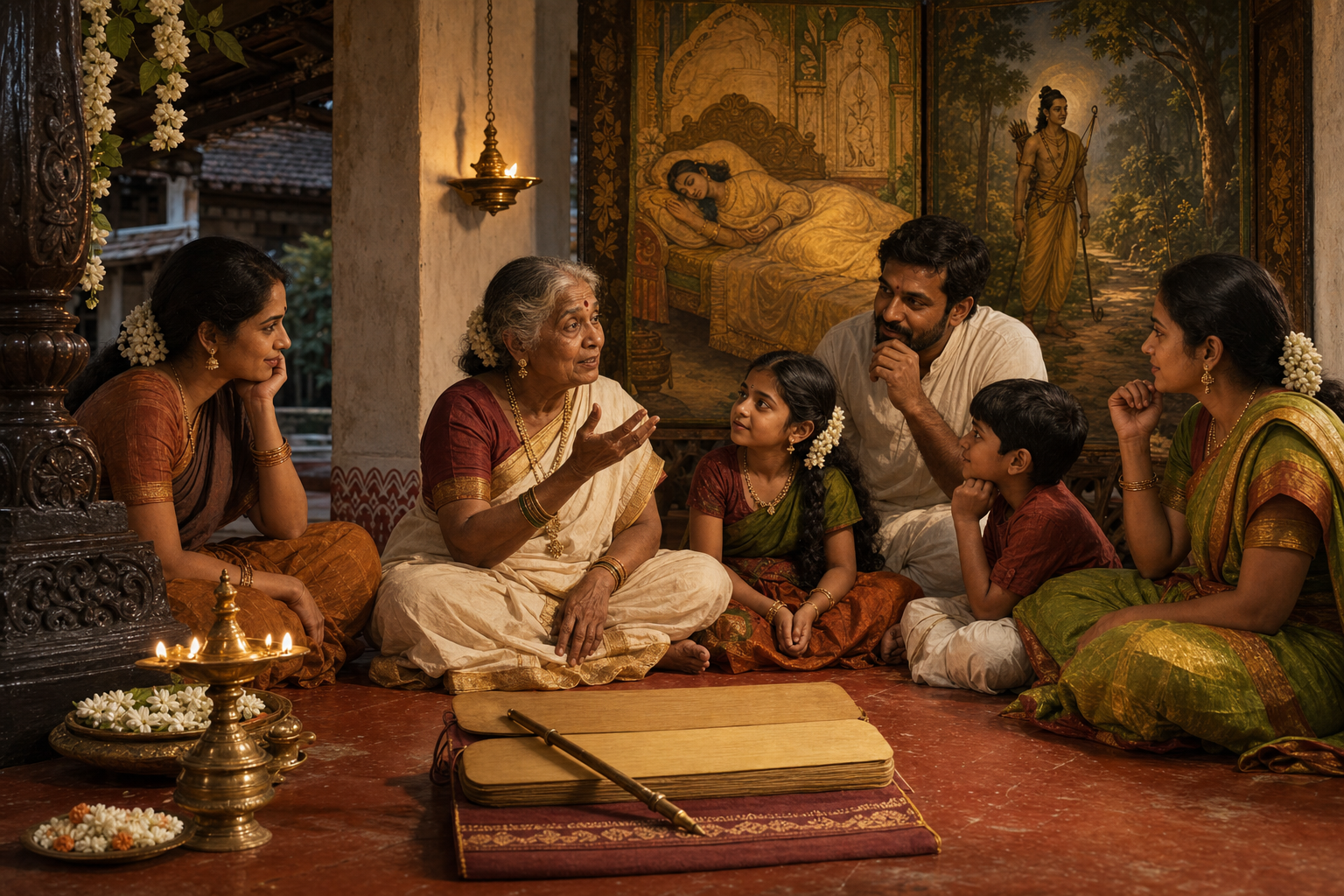
The source situates this interpretation within the Ranganatha Ramayanamu, also called Sri Ranganatha Ramayanamu. It describes the work as an important Telugu Ramayana traditionally associated with Gona Budda Reddy and composed in dwipada, a lyrical couplet form suited to recitation, song, and communal remembrance.
That literary setting helps explain why Urmila can move from the edge of the plot toward the centre of ethical reflection. The supplied article distinguishes the foundational narrative of the Valmiki Ramayana from later Sanskrit, Telugu, Tamil, Kannada, Hindi, Jain, Buddhist, and folk developments. It also cautions that the fourteen-year sleep is not equally central to every version of the Ramayana.
This distinction is crucial. Urmila Nidra need not be presented as a uniform feature of all Ramayana traditions in order to be meaningful within the tradition that preserves it. A regional retelling can explore a question left comparatively open elsewhere: what did Lakshmana’s departure demand of his wife? The answer supplies emotional and relational depth without displacing the better-known actions of Rama, Sita, Lakshmana, Bharata, or Hanuman.
The Telugu telling thus demonstrates how retellings can function as interpretation. By expanding a less visible character, they identify moral consequences concealed within the main narrative. Urmila’s sleep becomes a way to remember that separation reaches beyond those who enter exile and includes those who release them to go.
Key takeaways
- Urmila’s remaining in Ayodhya is interpreted as a chosen contribution to Lakshmana’s service, not as mere inactivity.
- The exchange of sleep makes the hidden cost of Lakshmana’s fourteen-year vigilance visible.
- Sita’s presence in exile and Urmila’s absence from it represent different, non-competing forms of partnership and sacrifice.
- The episode expands agency to include consent, restraint, endurance, and the acceptance of an unseen burden.
- Its place in a Telugu retelling illustrates how regional Ramayana traditions can deepen characters who receive less attention in other narrative layers.
Future readings of the Ramayana can carry this insight beyond Urmila by asking which celebrated vows depend upon support that the main action leaves unseen. Such attention does not diminish visible heroism; it restores the relationships that make heroism possible.