
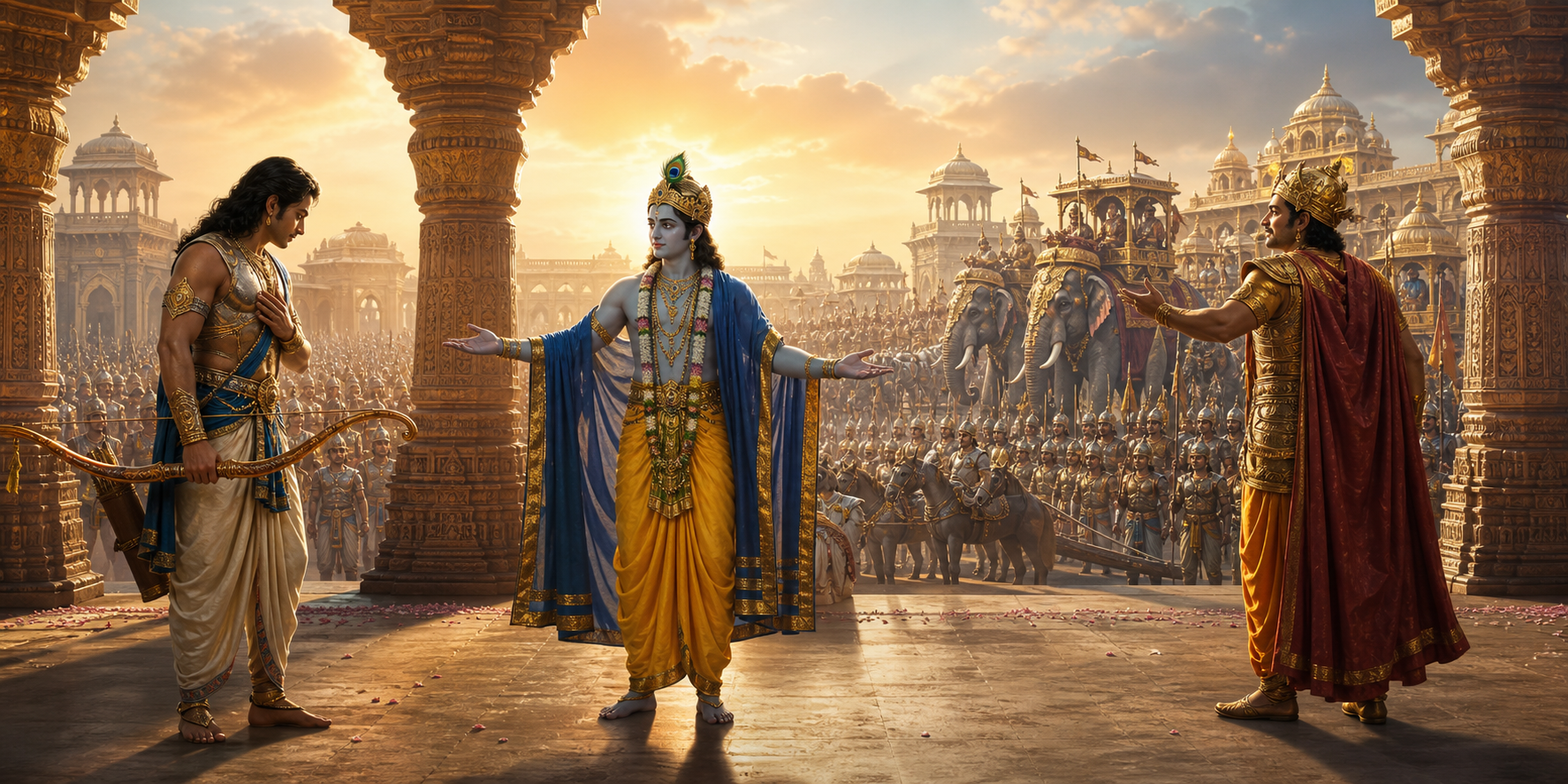
An army can occupy ground, but it cannot decide what a warrior ought to do when duty, fear and consequence collide. The Mahabharata episode examined by DharmaRenaissance Blog places those different forms of strength side by side: Duryodhana and Arjuna seek Krishna’s support at Dwaraka, and Krishna offers either the Narayani Sena or his own unarmed, non-combatant presence. Duryodhana selects the army; Arjuna chooses Krishna.
The significance of that decision does not depend on dismissing material power. It lies in recognizing a hierarchy of value: resources can carry out judgment, but they cannot necessarily supply sound judgment. Read politically, psychologically and spiritually, Arjuna’s choice asks when guidance becomes more consequential than possession.
The choice was not a simple contest of assets
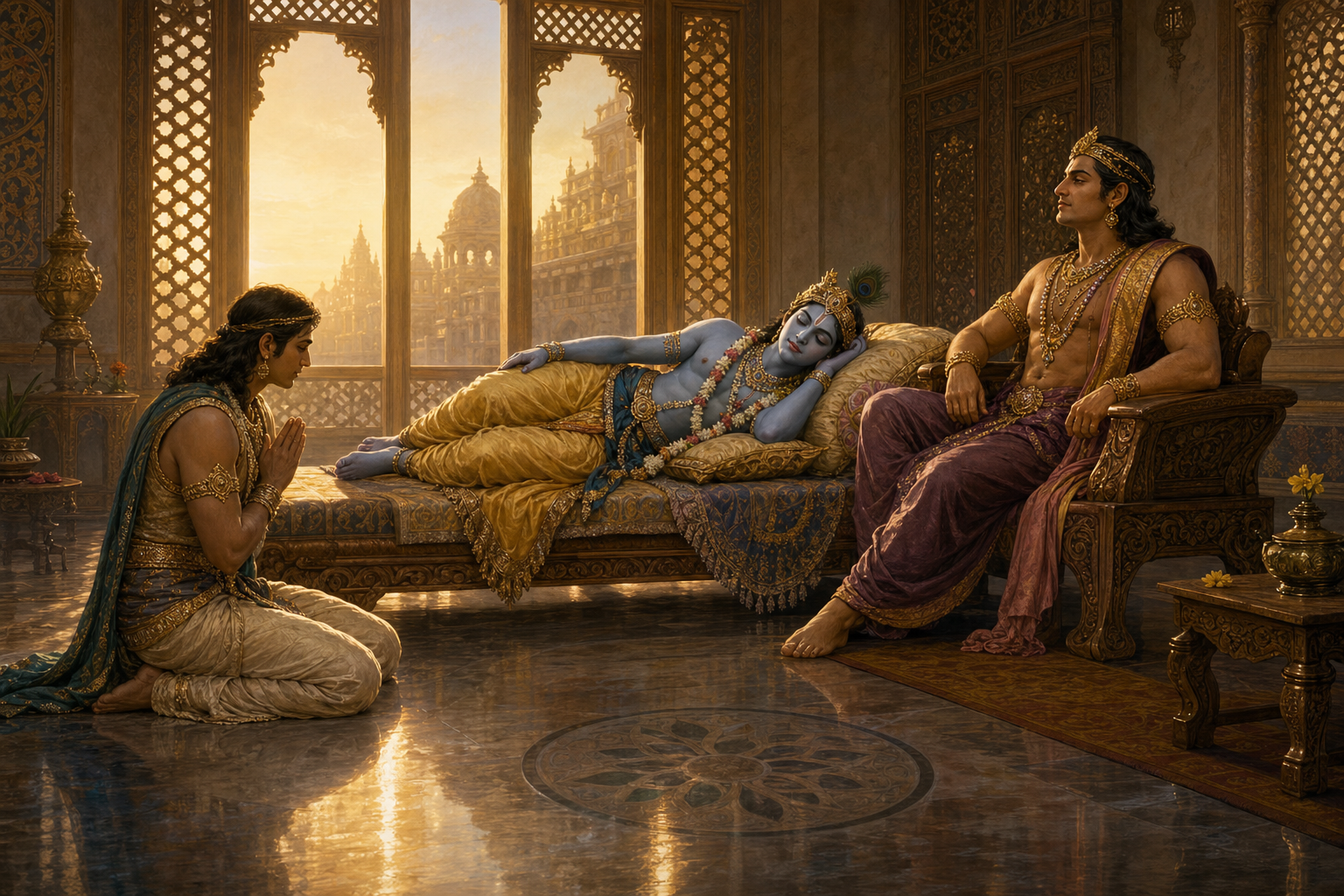
Krishna’s offer was deliberately asymmetrical. The Narayani Sena represented visible, deployable military capacity. Krishna imposed a restriction on his own participation: he would neither wield weapons nor fight. On a conventional battlefield ledger, the army therefore appeared to be the more useful acquisition.
Yet the two options contributed different kinds of value. The army could increase the force available to execute decisions; Krishna could influence the quality, direction and ethical basis of those decisions. Arjuna recognized that the decisive weakness in a conflict may not be insufficient force. It may be confusion about how force should be used.
Arjuna was not choosing withdrawal. As the source account emphasizes, he remained responsible for fighting and would have to exercise his own considerable ability. Choosing Krishna meant determining the conditions under which that ability would operate. The decision joined personal agency to guidance instead of replacing action with dependence.
Duryodhana’s reasoning was practical but incomplete
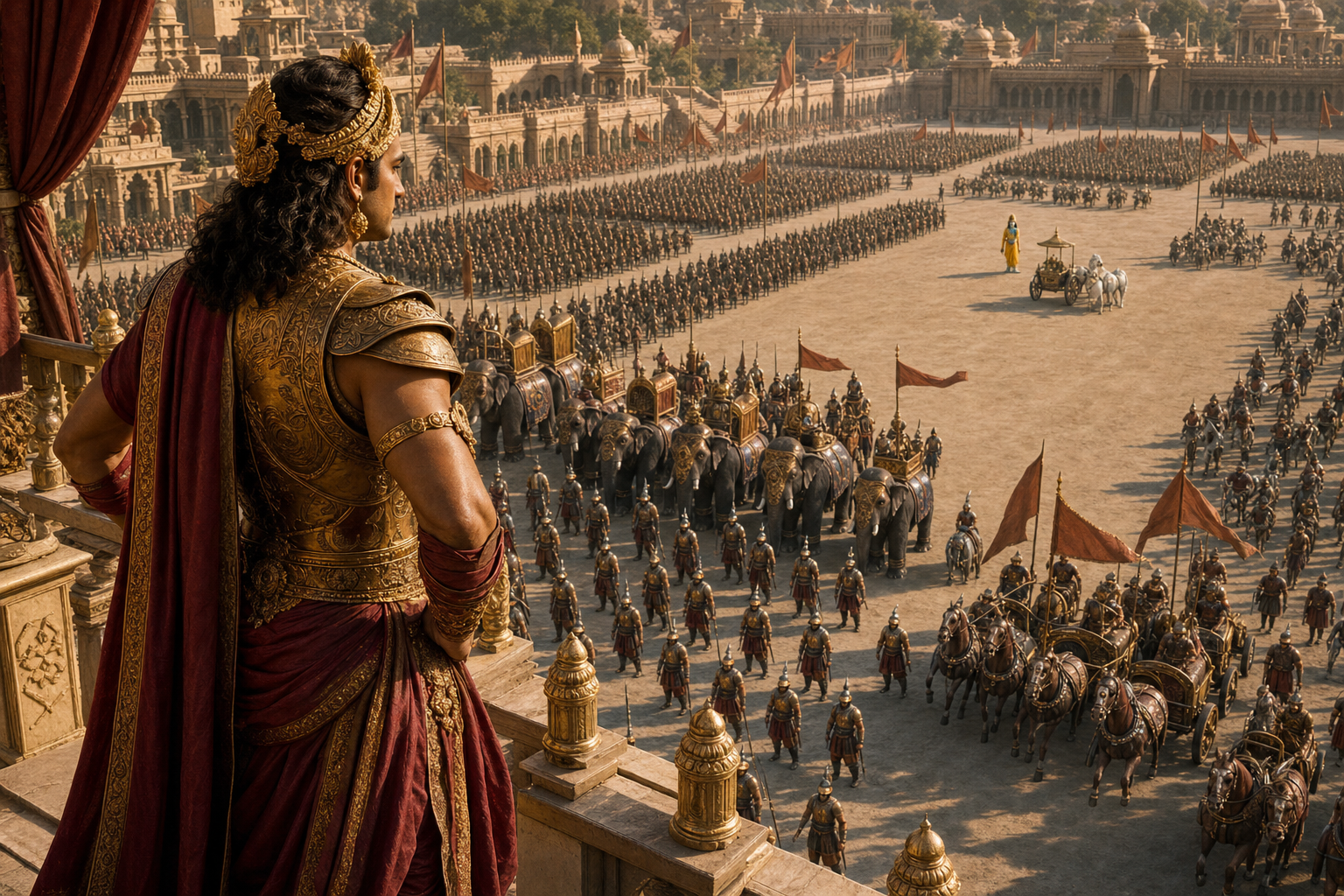
Duryodhana’s selection should not be reduced to foolishness. The source article notes that armies hold territory, fight engagements and provide an immediate tactical advantage. His calculation made sense within a narrow definition of power.
The failure lay in treating that definition as complete. Resources expand what a leader can attempt, but they do not correct a corrupt purpose, steady an unstable mind or make a flawed judgment wise. The source portrays Duryodhana as measuring value externally through numbers, weapons and control. Arjuna, by contrast, considered who could keep action aligned with dharma when certainty failed.
This distinction prevents the episode from becoming a simplistic opposition between power and spirituality. The source does not present power as inherently corrupt, nor does it suggest that renunciation is always superior. The relevant question is whether power remains answerable to an ethical purpose. Duryodhana’s mistake was not that he valued an army; it was that he expected possession of greater force to secure an outcome that judgment and character also shaped.
Choosing the charioteer preserved both guidance and agency
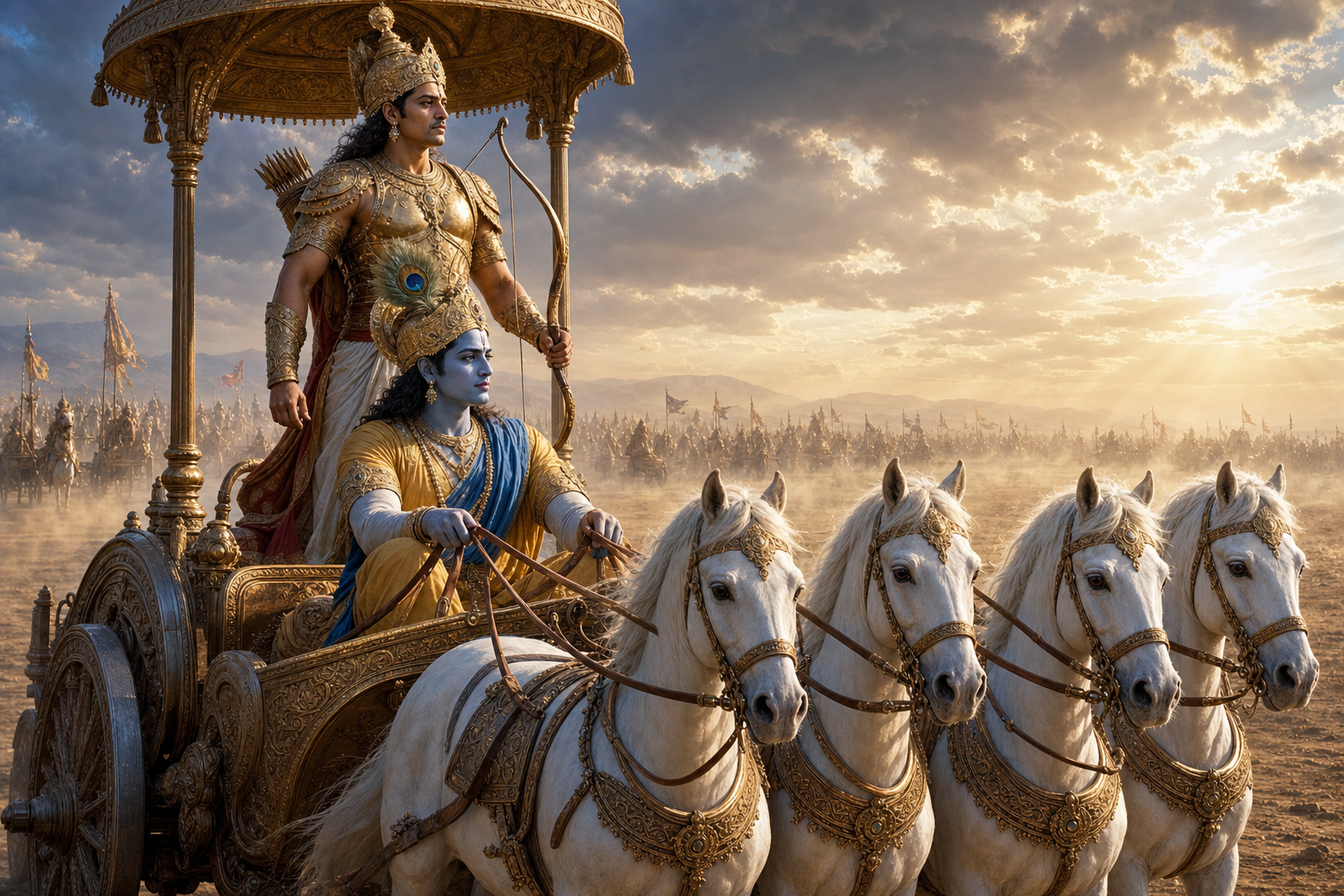
Krishna’s role as charioteer helps explain why an unarmed ally was not an inactive one. As described in the source, a charioteer managed movement, timing, position, advance and retreat while observing the field beyond the warrior’s immediate engagement. The archer retained responsibility for combat, but his ability to act depended partly on the intelligence directing the chariot.
The source also develops the symbolic meaning of this arrangement. The warrior represents the human capacity to act; the horses evoke energy, movement and the senses; the battlefield reflects life’s moral complexity; and the charioteer represents the intelligence that gives direction. Krishna holds the reins rather than the bow. Guidance orders Arjuna’s power without erasing Arjuna’s responsibility.
That relationship also clarifies surrender in a dharmic context. Arjuna does not hand his duty to Krishna or become passive. He accepts that skill alone cannot resolve every crisis and allows a higher standard to govern his will. Such surrender is therefore compatible with disciplined action: it limits ego while leaving the burden of action with the person who must act.
The decision placed wisdom inside the crisis
The DharmaRenaissance account argues that Arjuna’s choice created the intimate setting from which the Bhagavad Gita could emerge. Krishna was not a distant patron or the commander of another formation. He was beside Arjuna when the warrior’s certainty broke down, able to address questions of duty, self-knowledge, attachment, action and liberation within the moment of decision.
This reveals the delayed value of Arjuna’s choice. An army’s usefulness was immediately visible; Krishna’s importance became clearest when the problem could no longer be solved by adding weapons or technical capacity. At that point, the central need was a framework for acting without being ruled by panic, ambition or despair.
The choice also gives devotion an intellectual and ethical dimension. Arjuna’s trust was not presented as attachment to an unknown authority. According to the source, it rested on his knowledge of Krishna’s character and counsel. Bhakti in this episode is therefore compatible with discernment: trust follows recognition of a guide capable of orienting action toward dharma.
Key takeaways for decisions under pressure
Outside the epic setting, the episode offers a useful test for leadership and personal judgment. The apparently stronger option may provide greater capacity while leaving the underlying confusion untouched.
- Identify the real constraint. More resources help only when insufficient capacity is the actual problem; they cannot substitute for clarity of purpose.
- Distinguish execution from direction. Instruments of power can implement a decision, while wise counsel can change whether that decision should be implemented at all.
- Keep expertise open to correction. Arjuna’s martial ability did not make guidance unnecessary; it increased the consequences of using his ability without a sound moral orientation.
- Understand disciplined surrender correctly. Accepting guidance need not mean abandoning agency. It can mean acting while refusing to let ego become the sole authority.
- Evaluate power by its alignment. The relevant measure is not merely how much power is available, but what purpose governs it and what restraints accompany its use.
Arjuna’s choice remains forward-looking because new instruments of power continually appear while the need for judgment does not diminish. The enduring challenge is to place trustworthy guidance close enough to action that it can still redirect power at the decisive moment.