
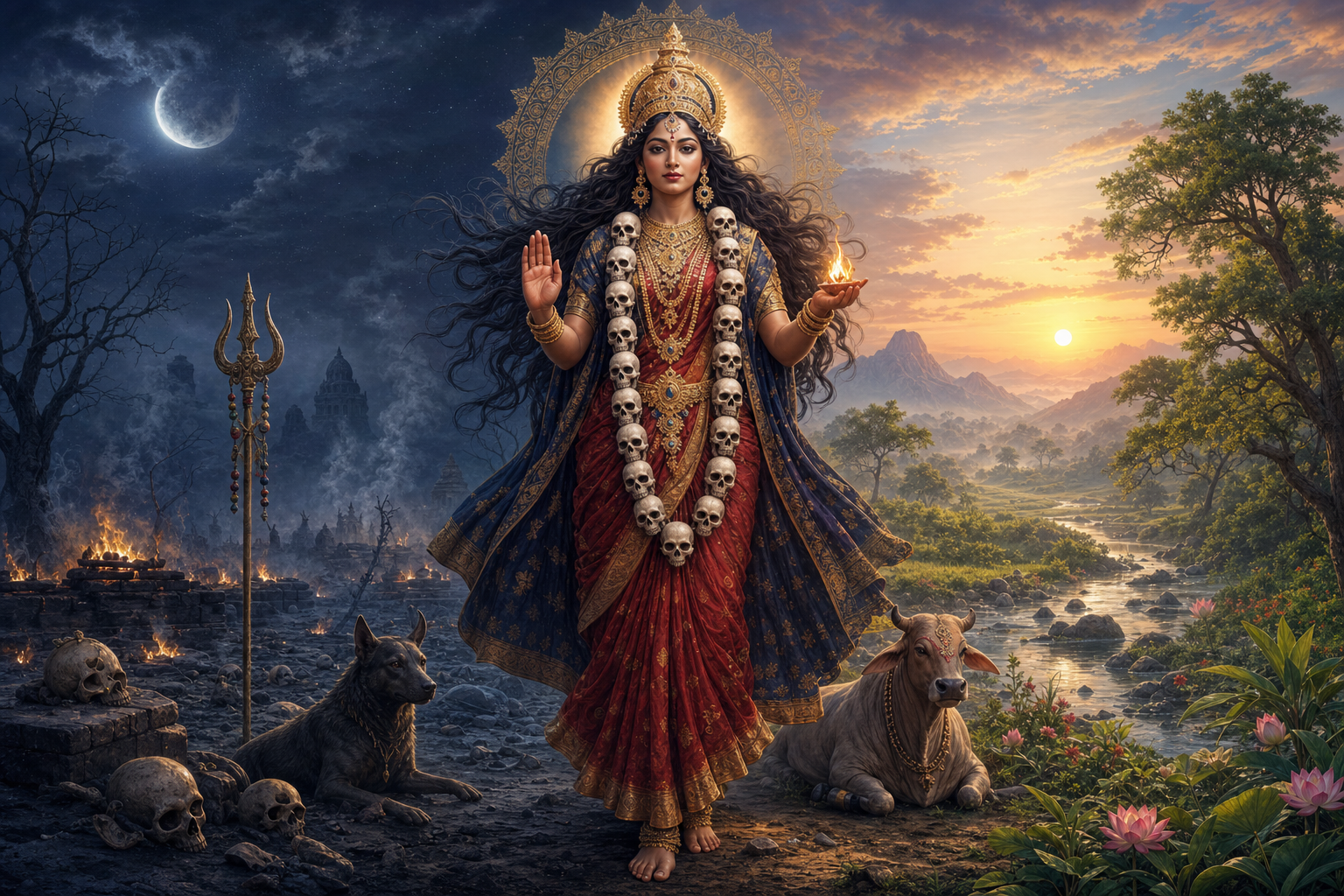
Kapalamalini’s name presents an apparent paradox: the Divine Mother is adorned not with flowers but with skulls. Read within Shakta theology, this is not macabre decoration. It is a visual argument about the breadth of Shakti, encompassing creation and dissolution, refuge and severity, embodied life and the truth of its limits.
The available DharmaRenaissance article is an interpretive source rather than a survey of primary texts. Its central contribution is a symbolic grammar connecting the skull garland, an attributed fox face, liminal settings, fierce protection and liberating insight. Reading these motifs together reveals a coherent theology while also showing where interpretation must remain cautious.
A name that functions as compressed theology
The source explains kapala as skull and malini as one who wears a garland. The resulting name does more than identify an ornament. It establishes the goddess’s relationship to mortality: she does not flee, conceal or succumb to death, but wears its emblem.
A garland ordinarily conveys beauty, honour or devotion. Replacing flowers with skulls relocates beauty from pleasing appearance to uncompromising truth. What ordinary life tries to hide becomes sacred adornment, while what people commonly prize – status, bodily attractiveness, possessions and personal distinction – is placed under the pressure of impermanence.
This inversion supports three connected readings. Existentially, every embodied form passes away. Psychologically, identities built from pride and possession cannot provide permanent security. Theologically, Shakti cannot be confined to the production and preservation of forms; she also governs their dissolution. The image therefore does not make death an ultimate reality. It presents divine power as greater than the conditions that make death frightening.
The skull as mortality, ego and awakened perception

The source associates the skull with bodily impermanence, the cycle of birth and death, the collapse of pride, the conquest of ego and the wisdom that becomes possible when attachment loosens. These meanings operate at different levels, but they converge on a single question: what remains spiritually meaningful when familiar supports of identity can no longer be treated as permanent?
At the most immediate level, the skull is a reminder that bodily distinctions do not last. At a psychological level, it exposes the vulnerability of the constructed self that depends on memory, recognition and control. At a theological level, its place on the goddess’s body reverses the devotee’s ordinary position. Mortality appears overwhelming from within finite life, but it becomes an ornament when viewed from the standpoint of a power that exceeds finite identity.
This is why the symbolism need not be read as nihilistic. The image negates the fantasy of permanence, not the value of life or disciplined action. The source frames the goddess who stands near death as one who can disclose what cannot be reduced to bodily change. The skull thus acts simultaneously as a warning against vanity and an invitation to deeper discernment.
Why fierceness belongs within divine motherhood
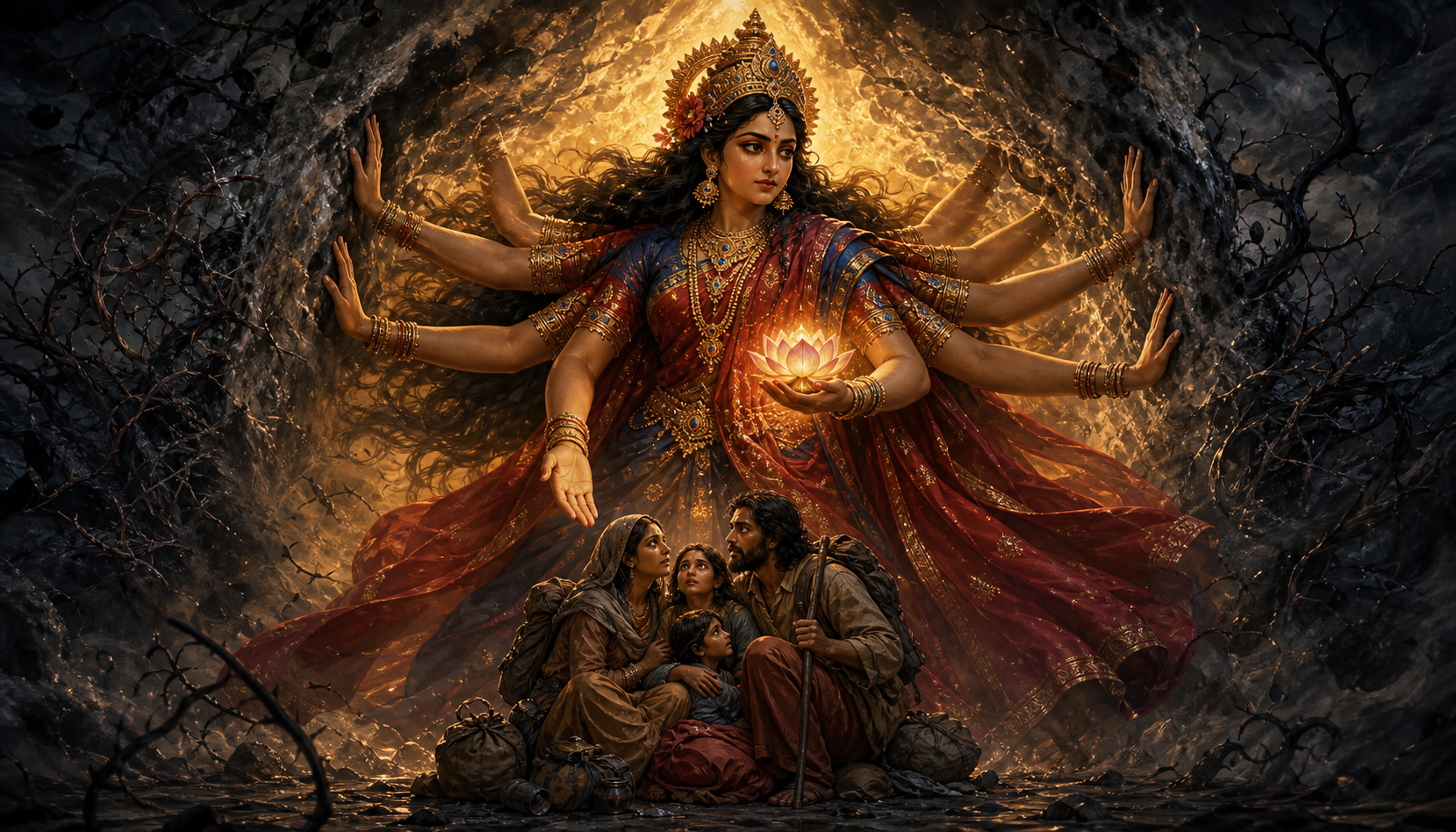
The source situates Kapalamalini within a Shakta understanding of the Divine Feminine as more than one temperament. The Goddess may nourish, teach and protect, but she may also confront, destroy and liberate. Kapalamalini makes the latter functions impossible to overlook. Her severity is directed not toward violence as an end in itself, but toward ignorance, arrogance and false identification.
Seen this way, fierceness does not contradict compassion. Protection sometimes requires the removal of what binds or deceives, and liberation can be experienced as a threat by an ego invested in continuity. Kapalamalini therefore represents a difficult form of grace: she does not reassure the constructed identity but challenges its claim to be the whole person.
The article connects her skull imagery with the broader visual vocabulary associated with fierce forms such as Kali and Chamunda, as well as with Shaiva and Shakta symbolism more generally. That comparison supplies context, but it should not be mistaken for proof that these figures are interchangeable. Shared motifs can express related theological concerns without erasing the identity, setting or history of a particular form.
The source also invokes the kapala, or skull-bowl, in certain Shaiva and Shakta contexts. This comparison illuminates the Tantric reversal through which something conventionally feared or regarded as impure can become an instrument of non-attachment. Yet the article does not establish that Kapalamalini belongs to a particular ritual lineage or practice. The skull-bowl is therefore best treated here as contextual symbolism, not as evidence for a specific rite.
The fox face and the intelligence of the threshold

The article attributes a fox-faced aspect to Kapalamalini and interprets it through qualities associated with wilderness, night, alertness, adaptation and survival at the margins. An animal face in sacred art can communicate a mode of power that ordinary human appearance cannot: instinctive rather than socially rehearsed, elusive rather than easily classified, and at home beyond domesticated space.
This motif reinforces the theology of the skull because both unsettle familiar boundaries. The skull stands between remembered personhood and bodily remains. The fox moves between settlement and wilderness. Kapalamalini consequently appears as a threshold figure, located conceptually where life meets death, social order meets untamed nature, purity meets what society rejects, and a constructed identity meets a less manageable spiritual reality.
The contrast between social polish and primal wisdom requires care. It need not imply that ethical order is spiritually worthless or that instinct is automatically sacred. Its more defensible implication is that ultimate reality cannot be limited to what a community finds comfortable, attractive or controllable. The fox-like quality expresses perception sharpened by the margins, but the available source does not provide textual provenance sufficient to turn every suggested trait into settled doctrine.
Key takeaways for a responsible reading
- Kapalamalini’s name presents the skull garland as a theological statement about Shakti’s sovereignty over formation and dissolution.
- The skull carries several related meanings: bodily impermanence, the limits of social identity, the undoing of ego and the possibility of liberating insight.
- Her fierceness belongs within divine motherhood because Shakta protection can include confronting whatever sustains bondage or delusion.
- The attributed fox face strengthens her liminal character, but its interpretation should remain proportionate to the limited documentation identified by the source.
- Tantric comparisons clarify how fear and impurity can be transformed under discipline; they are not invitations to casual ritual experimentation.
A careful reading separates three layers of evidence: what the article directly reports about the name and attributed form, the wider iconographic traditions it uses for comparison, and the theological meanings it draws from those comparisons. The source itself notes that Kapalamalini is less extensively documented in popular devotional literature than several widely known goddesses and that references may be brief, regional, esoteric or primarily iconographic. Its interpretation is therefore best understood as a reasoned reading of symbols rather than a universally attested biography or doctrine.
Further study can strengthen this picture by identifying named primary texts, regional image catalogues, manuscript contexts and interpretations preserved within situated traditions. Until such evidence is available, Kapalamalini is most responsibly approached as a powerful but source-sensitive expression of Shakti at the boundary between mortality and liberation.