

Tamil Nadu’s reported appeal to the Supreme Court is not simply a contest between cow protection and permission to slaughter. It concerns how far a court may go when enforcing animal-preservation duties, particularly when the governing state law is described as regulatory rather than an absolute prohibition.
Understanding the case requires separating three issues that political argument often merges: alleged slaughter outside authorised facilities, the conditions imposed by Tamil Nadu’s legislation, and the scope of the remedy granted by the Madras High Court. That separation also makes room for Hindu concern for cattle without treating statutory interpretation as a verdict on religious sentiment.
One dispute contains three different legal questions

The supplied DharmaRenaissance Blog report traces the controversy to a public interest litigation concerning alleged plans to slaughter cows and calves in public or non-designated places around Bakrid in Coimbatore. According to the report, the petition sought enforcement of existing restrictions so that slaughter would not occur outside authorised slaughterhouses.
The Madras High Court’s reported direction of May 27, 2026 went further in practical effect. It required the state to ensure that no cow or calf was slaughtered on the eve of Bakrid or on any other day. Tamil Nadu has characterised that direction as an absolute prohibition and reportedly argued that the petitioner had not requested such comprehensive relief.
The first question is therefore about compliance: were unlawful arrangements being made, and were the responsible authorities required to stop them? The second concerns statutory meaning: under what conditions, if any, does Tamil Nadu law permit the slaughter of cattle? The third is institutional: could the High Court convert an enforcement petition into a statewide and continuing prohibition?
These questions can produce different answers. A court could insist on strict enforcement against unauthorised slaughter without concluding that every slaughter covered by the order is prohibited by statute. Conversely, a commitment to animal preservation does not by itself establish that every form of judicial relief is within the scope of the case.
Article 48 guides policy, but the statutes supply the machinery

The High Court’s reasoning, as described by the source, relied on Article 48 of the Constitution. This Directive Principle calls upon the state to organise agriculture and animal husbandry on modern and scientific lines and to take steps toward preserving breeds and prohibiting the slaughter of cows, calves, and other milch and draught cattle.
Directive Principles have substantial constitutional importance, but the source notes that they are not directly enforceable in the same manner as fundamental rights. They can inform the interpretation of legislation and the evaluation of government policy. The central difficulty is whether Article 48 was used to interpret Tamil Nadu’s enacted framework or to supply a prohibition broader than that framework.
The state reportedly relied on the Tamil Nadu Animal Preservation Act, 1958, the Tamil Nadu Urban Local Bodies Act, 1998, the Tamil Nadu Urban Local Bodies Rules, 2023, and applicable food-safety regulations. Its position, as presented in the report, is that these measures regulate slaughter through conditions, certification and location requirements rather than imposing a total ban in every circumstance.
The source describes a certification model under which slaughter may be allowed only if statutory criteria are met. These reportedly include a specified age together with certification that an animal is unfit for work or breeding, or that it is permanently incapacitated by injury, deformity or incurable disease. The report does not reproduce the statutory definitions or every exception, so the precise reach of those provisions should ultimately be determined from the legislation rather than political shorthand.
Terminology matters as well. The reported order refers to cows and calves, while the account of the legislation discusses cattle more generally. Those expressions should not be assumed to have identical statutory meanings without examining the relevant definitions. This is one reason the appeal cannot be resolved merely by choosing between the labels of regulation and prohibition.
Strict enforcement and a blanket ban are not the same policy
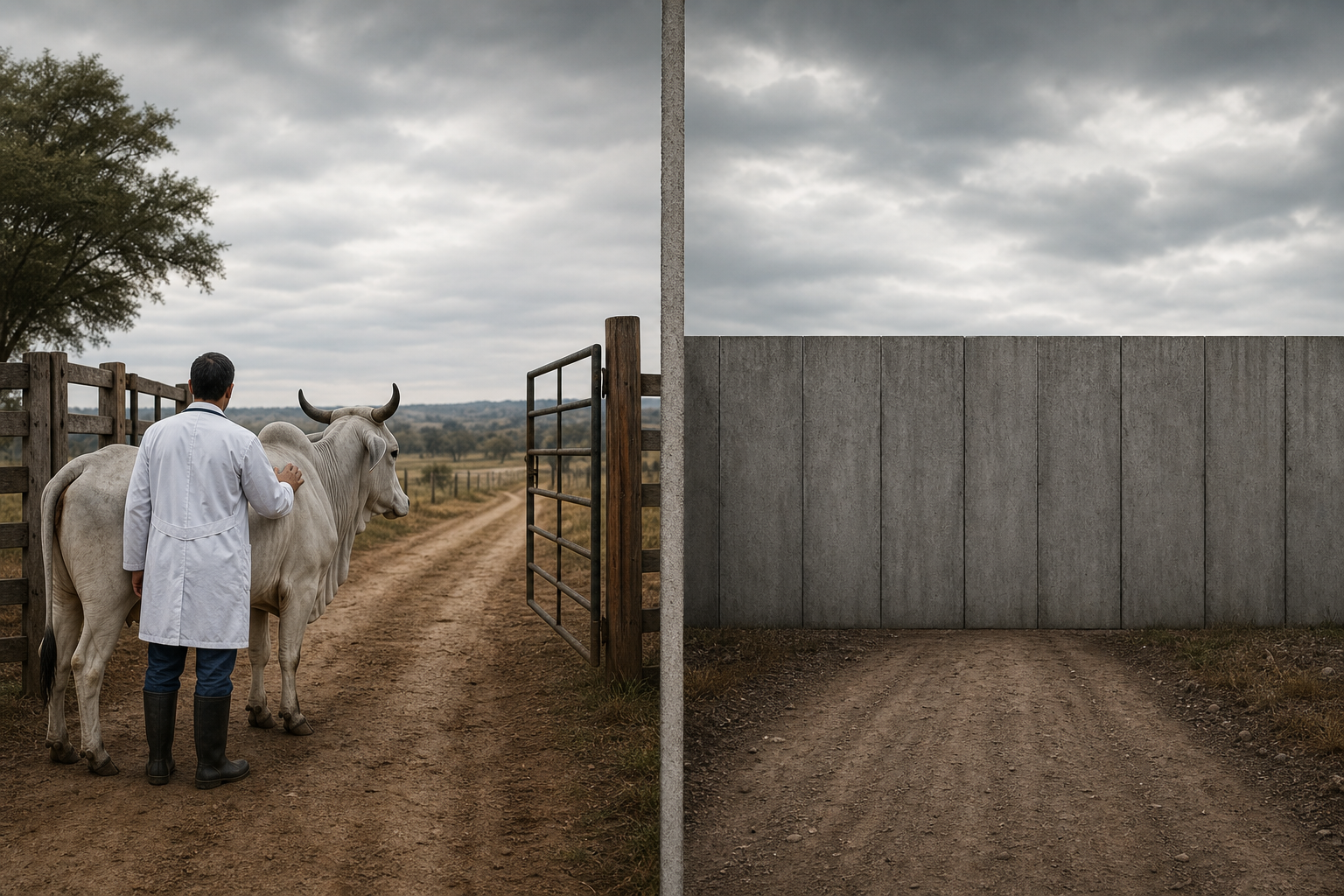
On the facts reported, there is comparatively little ambiguity about slaughter in public or unauthorised places. Even where slaughter is otherwise lawful, the source says it must take place in authorised facilities and comply with veterinary, municipal and food-safety requirements. Public or non-designated slaughter can raise distinct concerns involving hygiene, cruelty, public order and communal sensitivity.
Tamil Nadu’s challenge to the wider order therefore need not be read as a claim that unauthorised slaughter should be tolerated. Its stated legal objection is that the judiciary cannot replace a conditional statutory system with a categorical rule that the legislature did not enact. Critics of the appeal, meanwhile, may view the High Court’s direction as a necessary expression of the preservation duty in Article 48. The legal merits of those positions depend on statutory language and remedial authority, not assumptions about the personal faith or motives of public officials.
The distinction is also important for Hindu public ethics. Reverence for the cow draws upon ideas of ahimsa, gratitude, agrarian continuity and protection of life. Those concerns support serious enforcement against cruelty and illegal killing. They do not require legal analysis to ignore jurisdiction, legislative competence or procedural limits. A dharmic response can defend animals while also insisting on truthfulness, restraint and accurate characterisation of the law.
India’s plural social order adds another dimension. The source identifies minority customs, varied food practices, occupational livelihoods and veterinary realities as interests that coexist with religious concern for cattle. Recognising those interests does not settle the constitutional question, but it explains why a clear rule enacted and administered through lawful institutions is preferable to a dispute conducted through accusations about entire communities.
Key takeaways
- The original reported controversy concerned alleged slaughter outside authorised places; the appeal concerns a substantially broader judicial direction.
- Article 48 gives cow and cattle preservation constitutional weight, but the dispute is whether it can support relief beyond Tamil Nadu’s enacted regulatory scheme.
- The state reportedly accepts regulation through certification, designated facilities and other legal conditions while contesting an across-the-board prohibition.
- Opposition to the High Court’s remedy is not necessarily opposition to cow protection, just as support for preservation does not determine the permissible scope of judicial relief.
- The soundest public discussion distinguishes animal welfare, religious sentiment, statutory interpretation and institutional authority instead of collapsing them into a single political test.
What Supreme Court clarification could accomplish

According to the source, acceptance of Tamil Nadu’s argument could clarify the limits on relief granted in public interest litigation, especially when a direction is said to exceed the petition and the governing statute. Upholding the High Court’s approach could instead give Article 48 a stronger role in interpreting animal-preservation obligations within Tamil Nadu.
The most useful ruling would clarify not only whether the particular direction can stand, but also how constitutional preservation duties interact with statutory exceptions, certification decisions and municipal enforcement. Clear reasoning would help administrators distinguish conduct that must be stopped immediately from conduct that requires evaluation under the legislation.
The controversy also exposes a question of democratic accountability. If Tamil Nadu’s regulatory model is considered inadequate, a durable change would ordinarily require the legislature to define the prohibition, exceptions, enforcement powers and safeguards with precision. Courts remain essential to ensuring that the resulting law is obeyed and constitutionally applied, but the distinction between interpretation and policy creation should remain visible.
Whatever course the litigation takes, authorised-place rules, animal-welfare safeguards and public-order obligations should not disappear beneath the constitutional argument. A clear judicial boundary, matched by consistent administration and measured public language, would allow legal protection and religious concern to reinforce rather than obscure each other.