
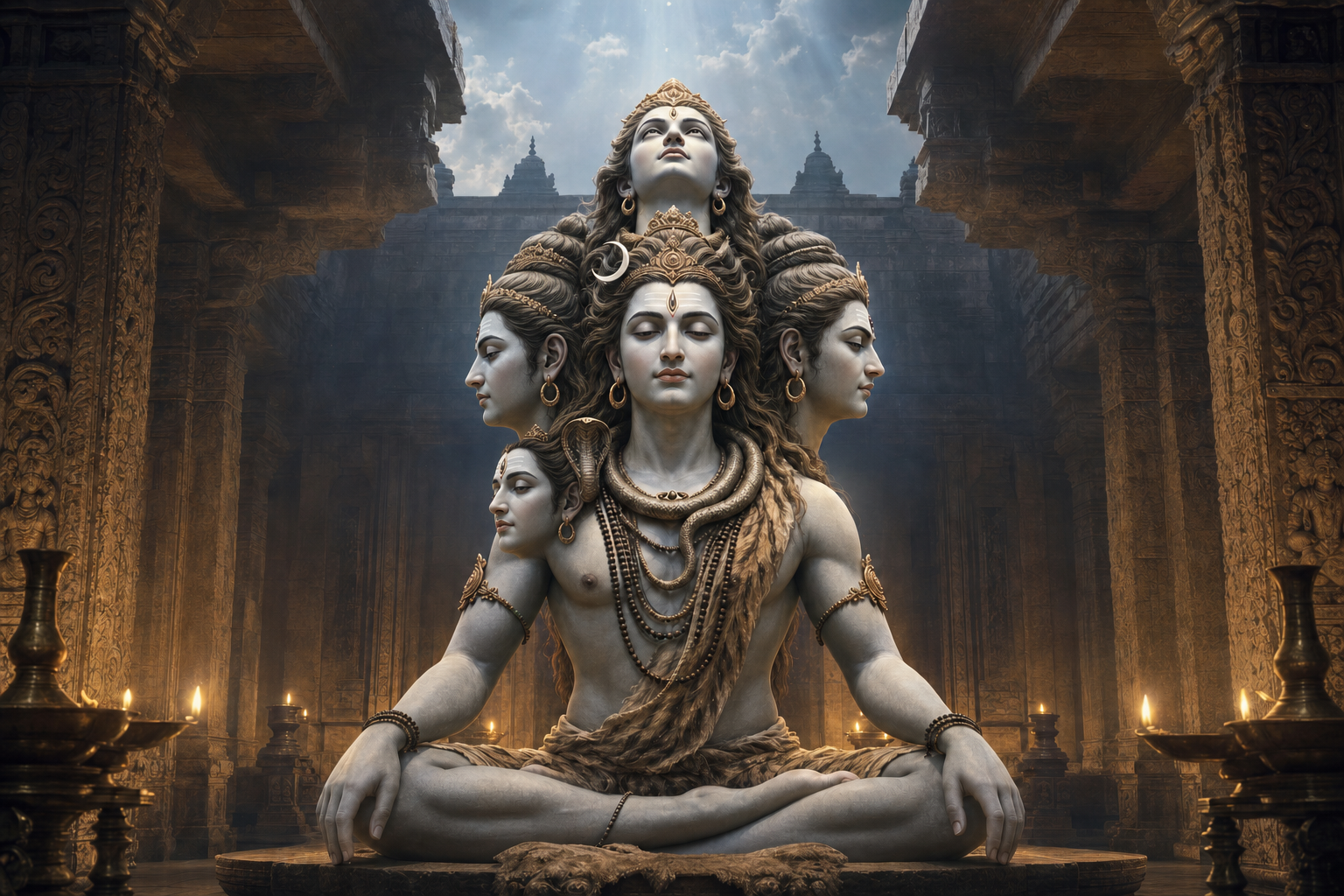
Shiva’s five faces are best understood not as five separate deities, but as a coordinated account of how the divine becomes present in the cosmos, sacred practice, and human consciousness. The supplied DharmaRenaissance article presents Sadyojata, Vamadeva, Aghora, Tatpurusha, and Ishana as the Panchabrahma forms through which Shaiva traditions relate manifestation to liberation.
Read together, the faces provide more than an iconographic key. They connect cosmic activity with temple worship, ethical formation, contemplative discipline, and the recognition of Shiva-consciousness. Their value lies in showing how these levels support one another.
Reading five faces as one theological system
The fivefold form holds unity and differentiation together. Each face expresses a particular orientation of Shiva, while none exists independently of the whole. The DharmaRenaissance account associates the faces with directions, elements, mantras, cosmic functions, and stages of spiritual refinement. Direction in this setting is therefore more than spatial information: it helps order a field of meaning around a single divine center.
This is why the Panchabrahma scheme should not be reduced either to a catalogue of attributes or to the physical appearance of an image. Its theological claim is that creation, continuity, transformation, inward awareness, and liberating knowledge all belong to one supreme reality. Apparent opposites such as form and formlessness, preservation and dissolution, or discipline and grace become aspects of one process rather than rival principles.
The scheme also prevents transcendence from being separated from embodied existence. Sadyojata and Vamadeva affirm manifestation and its sustenance; Aghora addresses the dissolution of what binds; Tatpurusha redirects attention toward the witnessing presence; and Ishana opens the fivefold pattern toward knowledge and liberation. Taken as a whole, the movement begins within life rather than by rejecting it.
The five orientations: distinct but interdependent

The following comparison brings together the principal associations reported in the supplied article. The final column expresses the practical implication developed by that source rather than proposing a rigid or universal correspondence for every Shaiva school.
| Face | Reported orientation | Primary emphasis | Implication for the seeker |
|---|---|---|---|
| Sadyojata | West | Creation and the appearance of form | Embodiment can become a field of dharma, karma, discipline, and realization. |
| Vamadeva | North | Preservation, beauty, nourishment, and sacred order | Spiritual maturity includes compassion, patience, humility, and the protection of what is noble. |
| Aghora | South | Transformative fire and the dissolution of impurity, attachment, ego, and ignorance | Fear, suffering, death, and impermanence must be faced without denial. |
| Tatpurusha | East | Breath, inwardness, yogic discipline, and the inner witness | Conduct, speech, body, breath, and attention become instruments of inner worship. |
| Ishana | Upward | Grace, pure knowledge, transcendence, and liberation | Sacred form is gathered into an awareness that exceeds limitation while embracing the other four faces. |
The comparison reveals a deliberate balance. Sadyojata without Aghora could make manifestation seem permanent; Aghora without Vamadeva could make transformation seem merely destructive. Tatpurusha supplies the inward discipline through which such meanings are assimilated, while Ishana prevents the system from ending in ritual or psychological improvement alone. Liberation remains its horizon.
Cosmic action becomes an inner diagnostic

The source connects Shiva with five acts, commonly termed panchakritya: creation, preservation, dissolution, concealment, and grace. It also cautions, implicitly through its wider presentation, against treating these only as remote events at the scale of the universe. Their pattern is recognizable in ordinary consciousness: thoughts appear, persist, disappear, become obscured, and are clarified.
This inward reading makes the five faces diagnostically useful. Sadyojata asks what is being brought into form. Vamadeva asks what is being maintained and whether it deserves preservation. Aghora asks what must be transformed or relinquished. Tatpurusha asks whether awareness is turned outward in distraction or inward toward the witness. Ishana places every such effort within the possibility of knowledge and grace.
The relationship between the faces and the five acts should nevertheless be handled with care. The supplied article gives clear functional emphases to individual faces, but it does not establish a complete, exclusive one-to-one chart for every tradition. The stronger conclusion is relational: the five faces and five acts illuminate a shared vision in which consciousness manifests, sustains, withdraws, veils, and reveals.
This approach also clarifies Aghora, which the source describes as frequently misunderstood. Its spiritual significance is not a fascination with terror. It represents the condition beyond fear and the transformation of whatever obstructs freedom. Within the full fivefold system, dissolution is compassionate because it makes renewal and recognition possible.
How the map moves through Agamic practice

The five faces become especially meaningful when placed within the practical architecture of the Agamas. According to the DharmaRenaissance account, many Shaiva Agamas organize religious life through four broad dimensions: charya, concerning conduct, service, and devotional discipline; kriya, concerning ritual, consecration, mantra, and temple worship; yoga, concerning meditation, breath, concentration, and inner worship; and jnana, concerning metaphysics and liberating knowledge.
These dimensions should not be read as unrelated departments. Charya gives ethical and devotional shape to life. Kriya trains body and speech through precise sacred action. Yoga internalizes attention and ritual meaning. Jnana brings practice toward insight into Shiva and the soul. The progression explains how the five faces can operate simultaneously as temple symbolism, contemplative supports, and a language of spiritual maturation.
Temple practice makes this integration visible. The source reports that Agamic guidance extends to sacred ground, architectural proportions, the installation of the linga or murti, mantra, daily worship, and festivals. Stone, sound, gesture, flame, water, fragrance, and silence therefore participate in a deliberately ordered sacred environment. The temple is presented not merely as a building but as a ritually awakened embodiment of cosmic principles.
The movement toward the sanctum supplies a spatial counterpart to Tatpurusha’s inwardness and Ishana’s transcendence. Likewise, the source interprets the Shiva linga as holding the unmanifest and manifest together rather than as a merely physical emblem. External worship and inward recognition are not competitors in this account: temple form educates attention, and contemplative awareness discloses the meaning toward which the form points.
The same integration helps explain the reported relationship between Vedic and Agamic currents. The source presents the Vedas as supplying broad revelations concerning cosmic order, mantra, sacrifice, and ultimate reality, while the Agamas give detailed forms to deity-centered worship, initiation, temple practice, and spiritual discipline. Its account treats these currents as complementary influences on Hindu religious life, not as a simple opposition.
Key takeaways
- The Panchabrahma forms express one Shiva through five coordinated orientations rather than dividing the divine into separate powers.
- Sadyojata, Vamadeva, Aghora, Tatpurusha, and Ishana connect cosmic functions with embodied life, ethical refinement, transformation, contemplation, and grace.
- The five acts of creation, preservation, dissolution, concealment, and grace make the symbolism applicable to recurring movements within consciousness.
- The Agamic dimensions of charya, kriya, yoga, and jnana carry the fivefold vision from conduct and temple worship toward inward realization.
Further study of the five faces is most fruitful when iconography, ritual, yoga, and philosophy remain in conversation. That integrated approach preserves the Agamic insight that sacred form is not the endpoint of practice, but a disciplined opening toward recognition.