
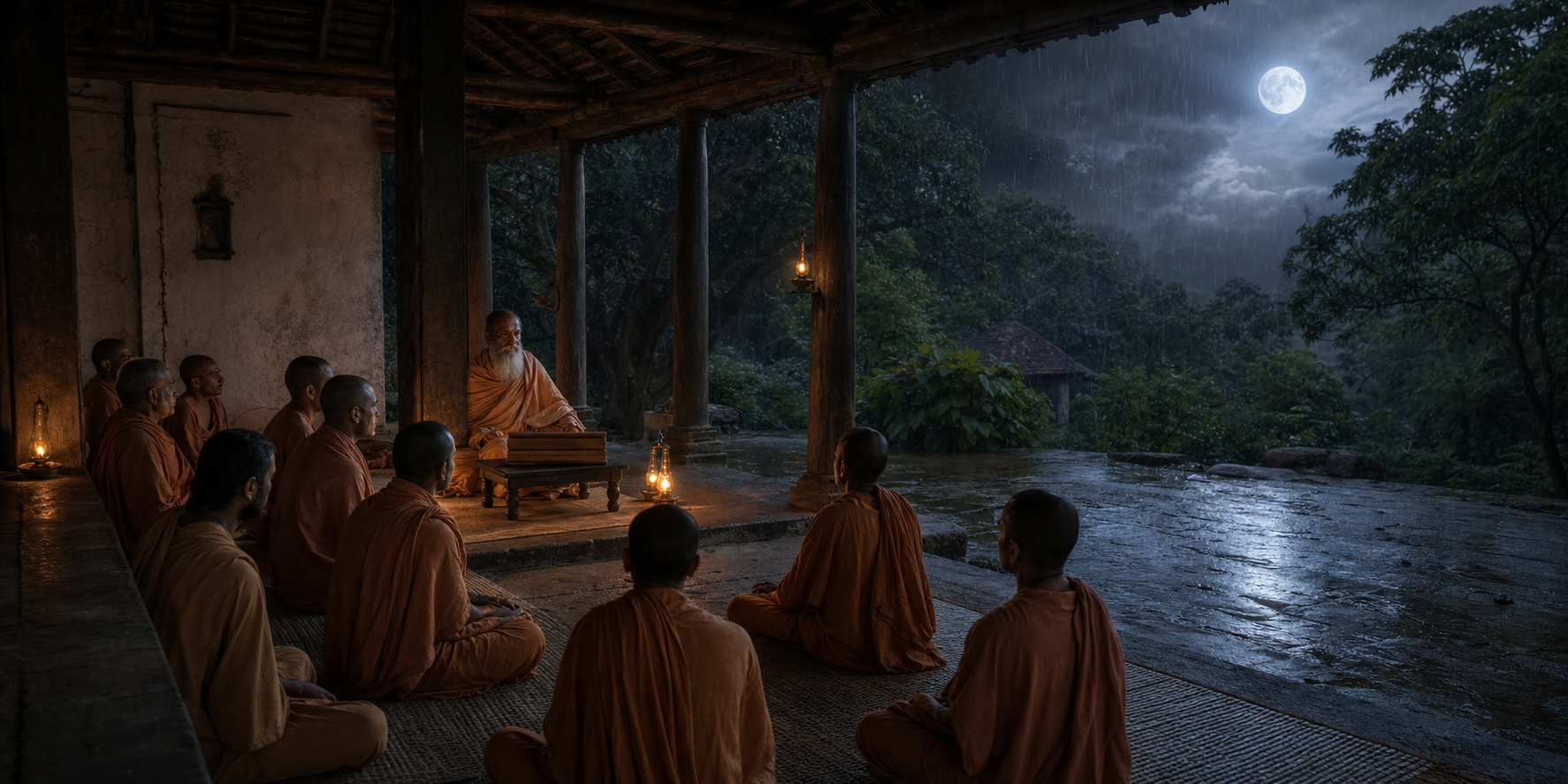
In Hindu monastic life, Ashada Purnima is more than an annual full-moon celebration. It is a threshold at which reverence for the guru, gratitude to Veda Vyasa and the discipline of the rainy-season residence converge.
The DharmaRenaissance Blog account supplied for this article presents the observance, also known as Guru Purnima and Vyasa Purnima, as a change in spiritual rhythm. Reading its ritual, intellectual, ecological and communal dimensions together clarifies why the day matters especially to sannyasis and yatis.
A festival date becomes a monastic threshold
Ashada Purnima falls on the full-moon day of the lunar month of Ashada, which the source places within June or July. In the monastic setting, however, the calendar marker matters because it can initiate a more settled phase of religious life. A renunciate who spends much of the year moving among villages, pilgrimage places and communities may remain in one location as the monsoon begins.
The account notes that Chaturmasya does not begin on an identical date in every lineage. Some traditions start the observance on Ashada Purnima, while others use Ashadha Shukla Ekadashi or another associated tithi. This variation is best understood as a difference in inherited discipline rather than a disagreement about the season’s purpose. The shared movement is from mobility toward restraint, sustained study, worship and intensified sadhana.
The full moon consequently signifies more than celestial fullness. Within the source’s interpretation, it evokes knowledge brought to maturity through parampara. The monastic pause gives practical form to that image: teachings received over time are revisited, tested in conduct and transmitted under more stable conditions.
Guru and Vyasa locate authority beyond personality
The guru-shishya relationship gives Ashada Purnima its personal dimension without reducing it to admiration for a particular religious figure. The source distinguishes a guru from an instructor who merely conveys information. For a sannyasi, the guru provides the discipline and interpretive guidance through which renunciation can become an inward reality rather than a collection of outward signs such as ochre clothing, a danda, a kamandalu or a monastic name.
Its identification as Vyasa Purnima widens that relationship from an individual teacher to the lineage of sacred learning. The article describes Veda Vyasa as traditionally credited with arranging the Vedas, composing or compiling the Mahabharata, authoring the Brahma Sutras and preserving Puranic knowledge. These attributions make Vyasa a symbol not only of learning but also of intellectual service: extensive bodies of teaching are organized so that later generations can approach them.
This connection is particularly important for monastics who study and teach Vedanta, Yoga, Dharma Shastra, Itihasa and Purana. The source portrays these not as an assortment of unrelated texts but as parts of a larger field of inquiry encompassing ritual, metaphysics, liberation, duty and moral difficulty. Honouring Vyasa therefore acknowledges the framework within which monastic teaching becomes possible.
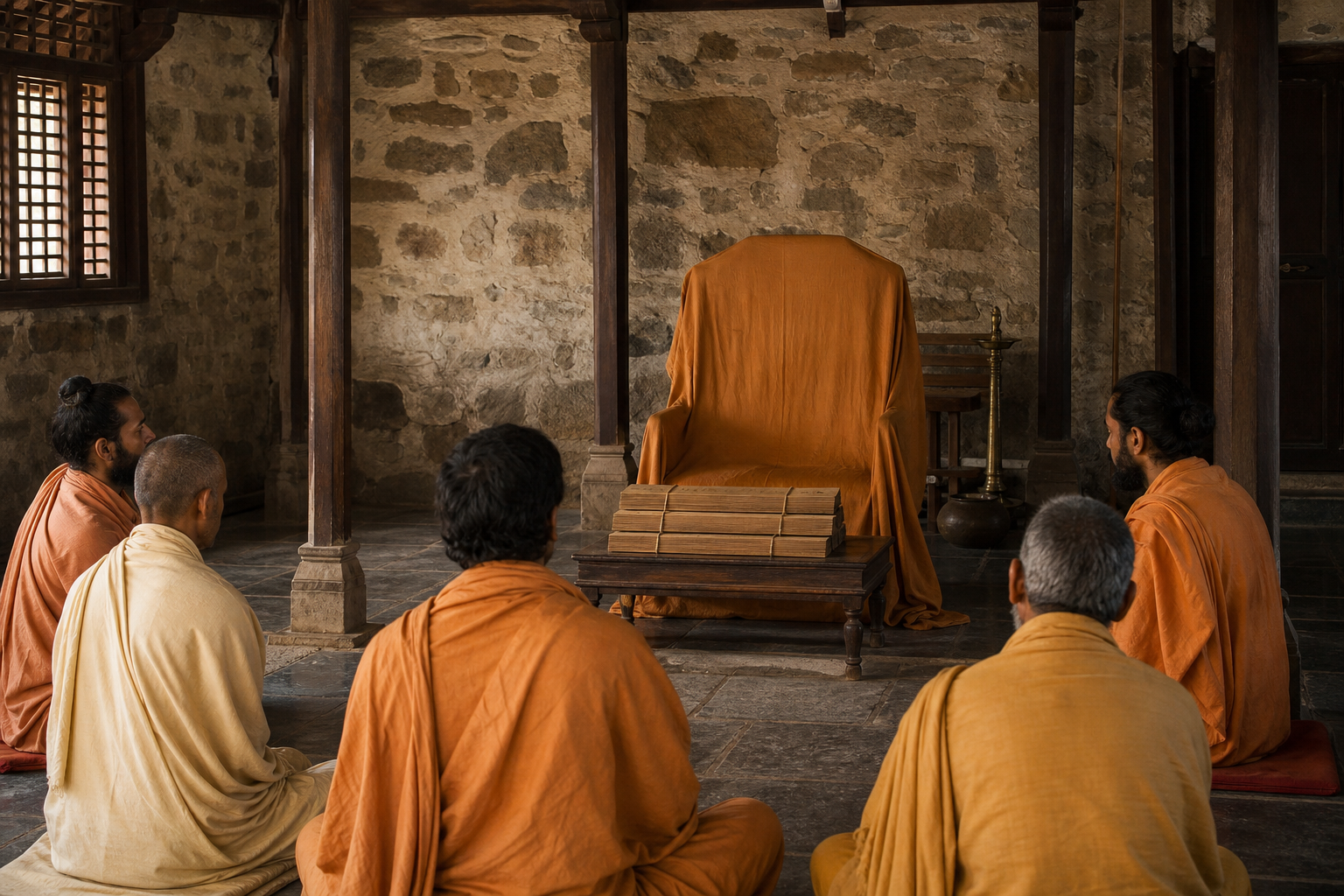
The reported custom of worshipping the symbolic seat of Vyasa before a discourse makes the principle visible. A teacher speaks from within a transmission and does not claim personal ownership of its knowledge. Guru devotion, on this reading, should limit spiritual celebrity rather than reinforce it: authority remains answerable to teaching, lineage and disciplined realization.
Chaturmasya joins restraint, care and public teaching
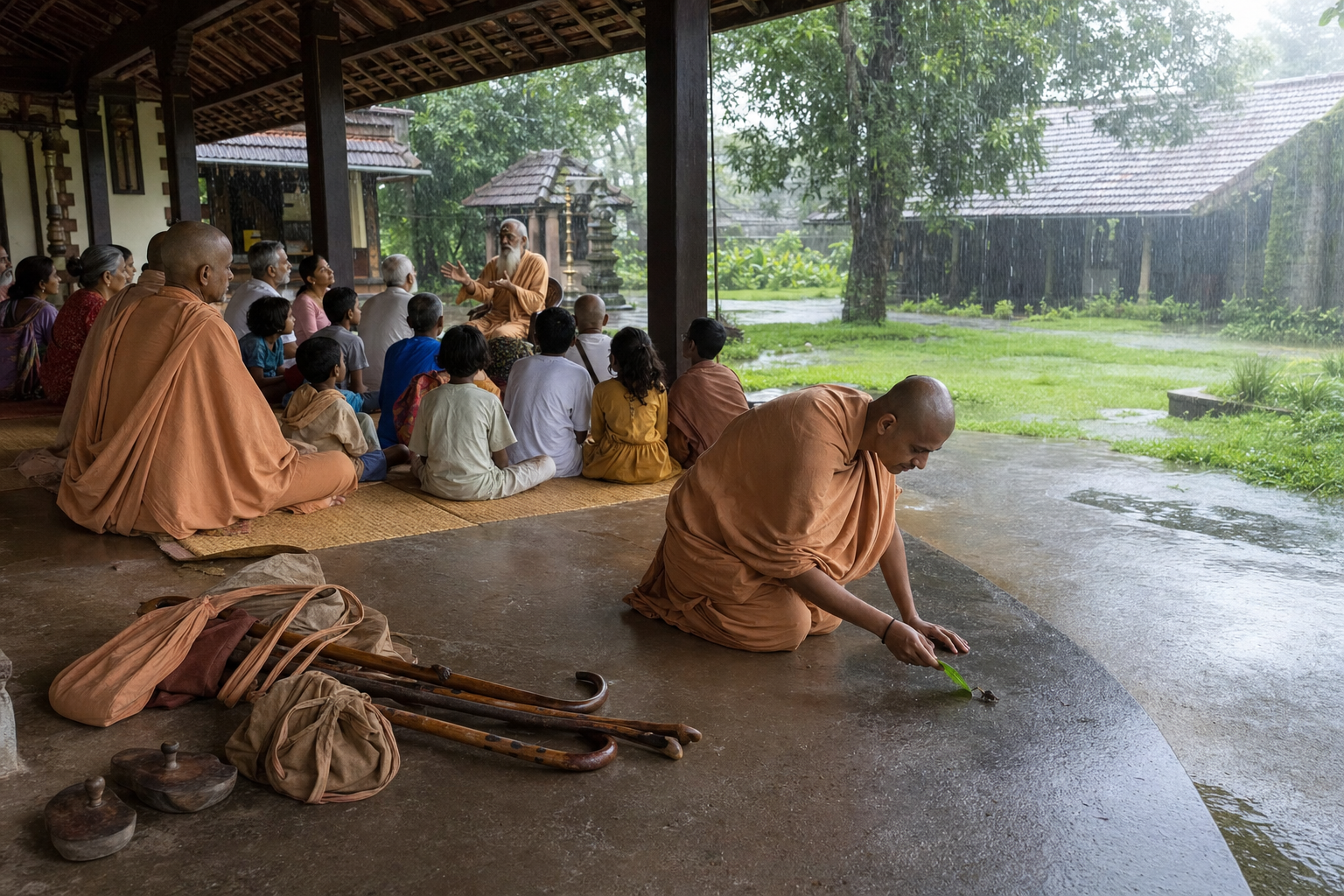
The source gives three mutually reinforcing reasons for the rainy-season settlement. Historically, heavy rain made regular travel difficult. Ecologically, the monsoon brought insects, seedlings and other delicate forms of life into the paths of travellers. Spiritually, reduced movement created conditions for steadier attention. Remaining in one place could thus serve practicality, ahimsa and contemplation at the same time.
Settled residence does not necessarily mean withdrawal from society. The article reports that it can create sustained opportunities for householders and renunciates to meet through teaching, seva, satsanga and reflection on dharma. The same limitation that narrows a monk’s geographical range may deepen local responsibilities. Chaturmasya is therefore both a retreat from dispersion and a season of concentrated engagement.
Reported observances include Guru Puja, Vyasa Puja, sacred recitation, discourses and the taking or renewal of Chaturmasya vows. A renunciate may increase japa and study, keep periods of silence, reduce travel or simplify food. The source mentions lineage-dependent prescriptions involving leafy vegetables, curd, milk or certain pulses during particular months, while emphasizing that details differ among sampradayas. The purpose presented is not competitive austerity but the disciplining of desire and attention.
The account also places Hindu Chaturmasya within a wider dharmic pattern without treating different traditions as interchangeable. It points to Jain rainy-season care for non-violence, the Buddhist vassa and Sikh emphases on the Guru, seva, sangat and remembrance, while noting that Sikh tradition is not monastic in the same way. The comparison identifies a shared respect for restraint and learning while preserving distinct institutions and teachings.
Key takeaways
- Ashada Purnima connects guru reverence and gratitude to Veda Vyasa with a seasonal change in monastic practice.
- Lineages may begin Chaturmasya on different associated tithis, but they broadly direct the rainy season toward restraint, study, worship and sadhana.
- Reduced travel serves practical and ecological concerns while creating time for contemplation and carefulness toward living beings.
- Settled residence can strengthen contact between renunciates and householders through discourse, seva and satsanga rather than functioning as simple isolation.
Keeping the monastic purpose visible

The source’s several strands suggest a useful distinction between the public festival and its monastic function. Ceremonial homage has meaning when it renews fidelity to teaching; dietary limits have meaning when they simplify desire; remaining in one place has meaning when it produces steadiness, care and service. Without those relationships, visible observance can become detached from the discipline it is meant to support.
Future observances can remain intelligible by keeping these connections in view: lineage with accountability, scriptural learning with transformation, restraint with ahimsa, and monastic settlement with community instruction. That framework allows Ashada Purnima to retain its distinctive role as a lived reordering of spiritual priorities.