
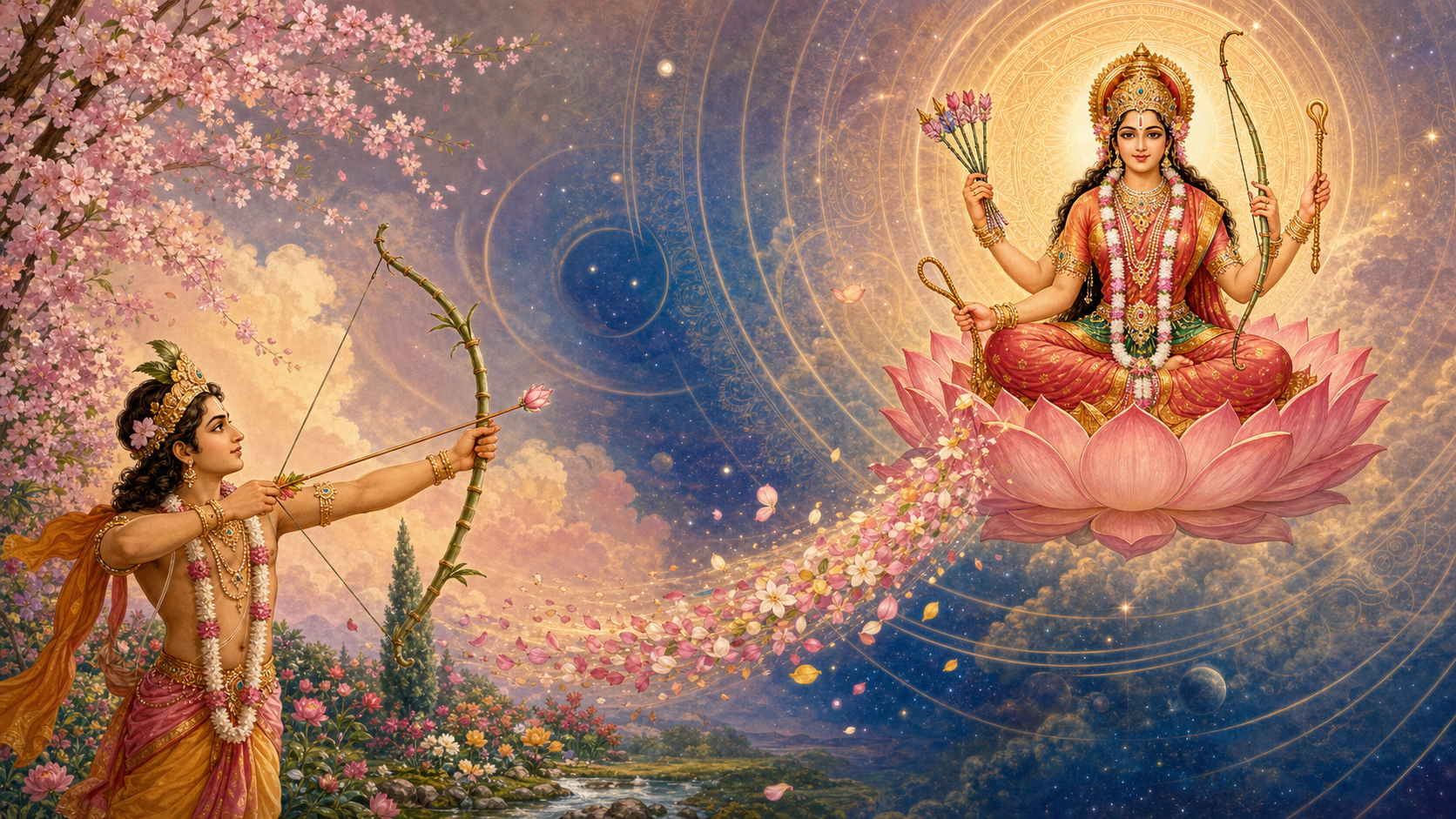
A flower-tipped arrow looks like a contradiction: one part suggests penetration and purpose, while the other evokes beauty, fragrance and fragility. Hindu iconography uses that tension to make the pushpa bana a precise image of forces that act upon consciousness without physical violence.
The motif becomes especially revealing when its appearances with Kamadeva and Lalita Tripura Sundari are read together. Across these settings, the arrow connects embodied desire, sensory perception, cosmic creativity and the devotional experience of being drawn toward the divine.
The paradox of a gentle weapon
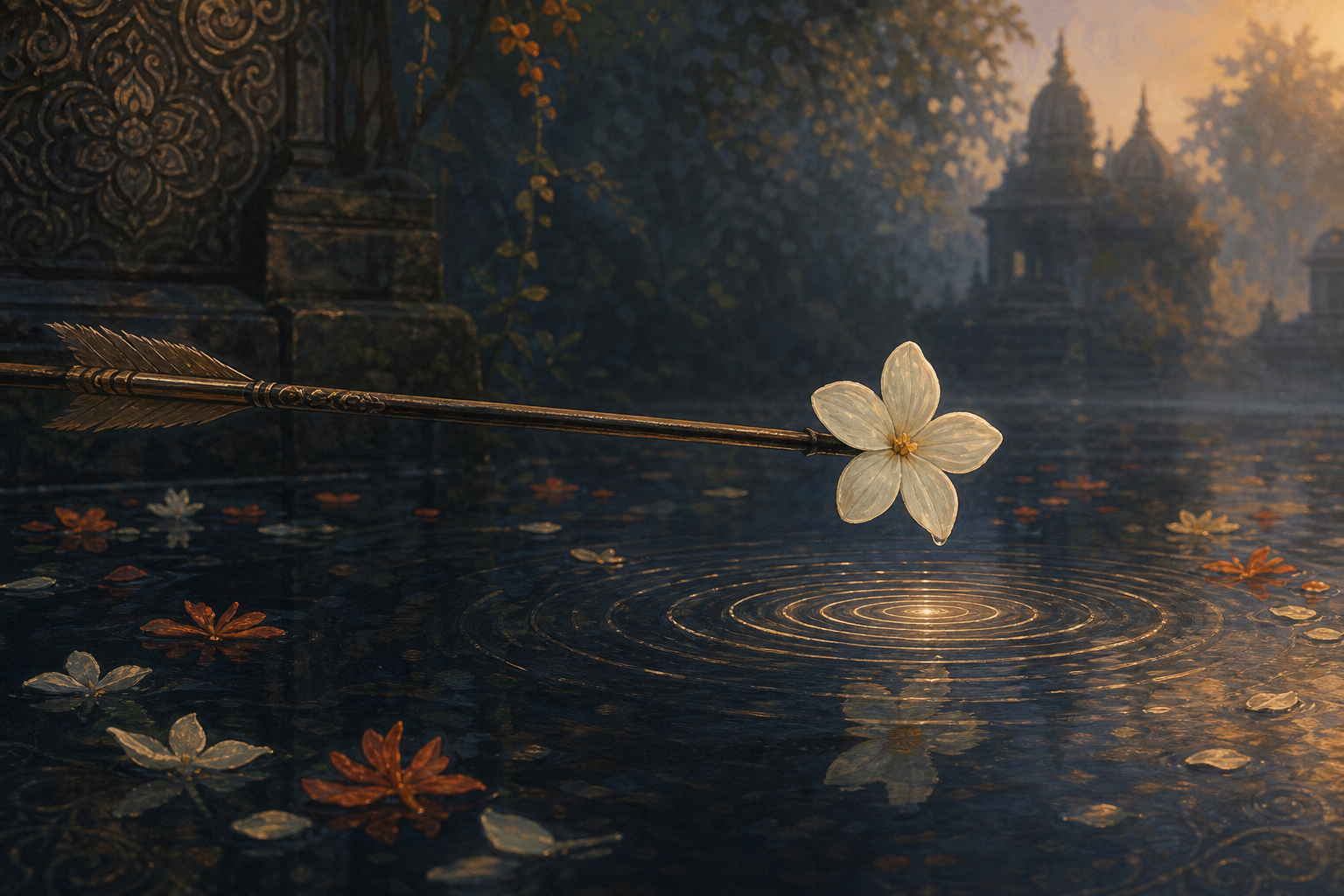
The supplied DharmaRenaissance article explains that the Sanskrit compound joins pushpa, flower, with bana, arrow. Each half contributes a different symbolic quality. An arrow has direction, speed and the capacity to pierce; a flower carries associations of tenderness, scent, beauty, transience and offering.
Calling the pushpa bana an ayudha, or sacred weapon, therefore does not make it a miniature version of a battlefield arm. Its effect belongs to another register. A fragrance, memory, glance or aesthetic impression can enter awareness, change attention and prompt action without applying outward force. The arrow makes that influence visible and directional; the flower identifies the subtle means by which it operates.
This combination also prevents beauty from being treated as passive ornament. In the logic of the image, beauty does something: it reaches a perceiver, awakens a response and may alter the course of the mind. The pushpa bana is gentle in material form but consequential in psychological effect.
Kamadeva and Lalita reveal two scales of attraction
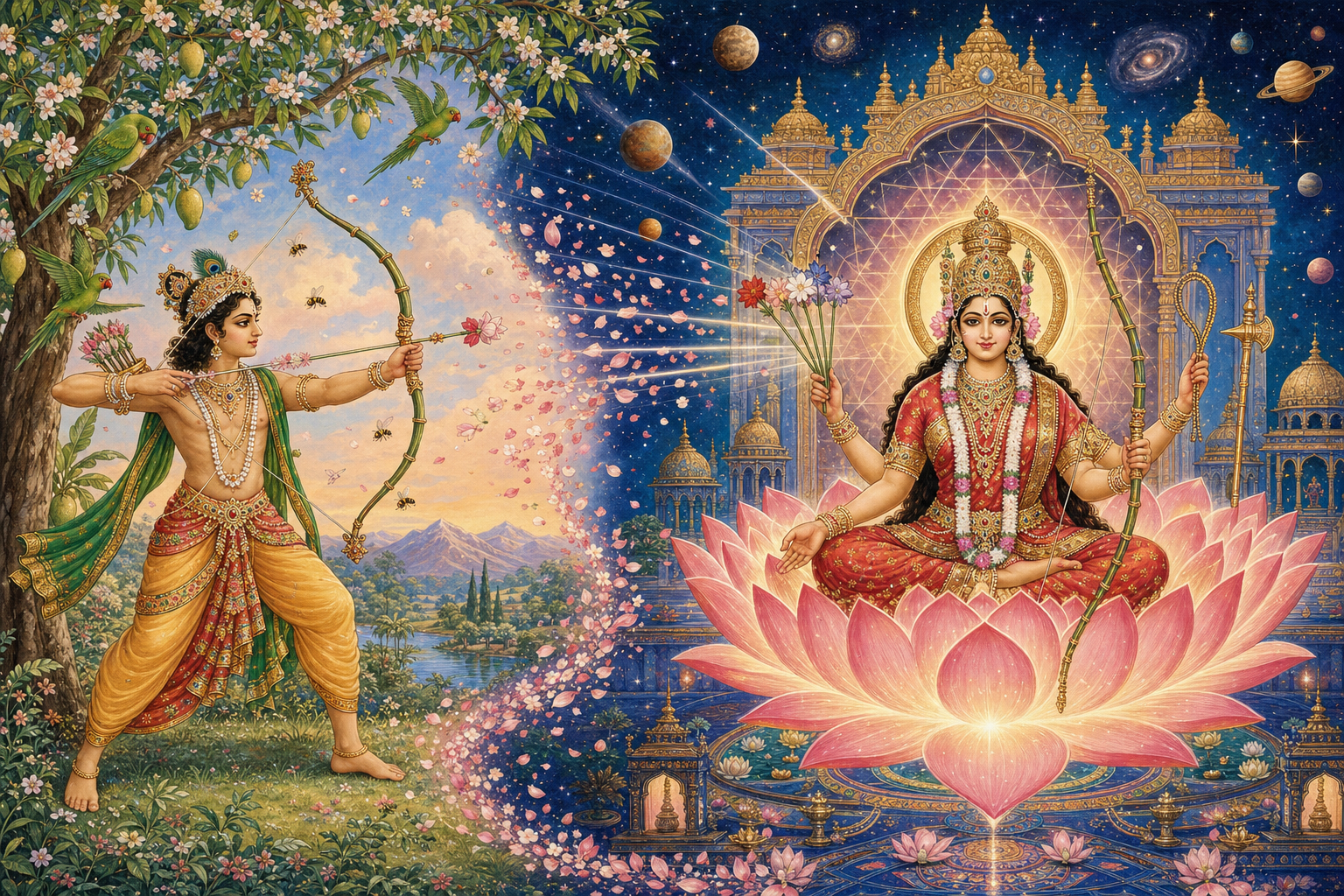
DharmaRenaissance identifies Kamadeva, also called Kama, Manmatha, Madana or Kandarpa, as the deity most closely associated with flower arrows. His iconographic ensemble includes a sugarcane bow, a bowstring of bees and arrows tipped with blossoms. Read as a group, these are not merely charming accessories: sugarcane conveys sweetness and fertility, the bees suggest restless vibration, and the flowers represent the subtle channels through which attraction takes hold.
In this setting, the motif gives visual form to desire as a genuine power within embodied life. The source places that reading within the framework of the four purusharthas: dharma, artha, kama and moksha. Kama is neither automatically rejected nor granted unlimited authority. The flower arrow instead presents desire as something to be recognized, disciplined and brought into accord with dharma.
The same family of attributes acquires a wider metaphysical scope in depictions of Lalita Tripura Sundari. The article reports that she may hold a sugarcane bow and five flower arrows together with a noose and goad. Interpretations cited there associate the bow with the mind and the arrows with the five tanmatras, the subtle potentials of sensory experience.
The comparison clarifies what changes when an attribute passes from one divine context to another. With Kamadeva, the emphasis falls on attraction moving between embodied beings. With Lalita, attraction becomes part of the structure through which perception and manifestation arise. The pushpa bana consequently ranges from the intimate psychology of longing to Shakta accounts of divine creativity and spiritual magnetism.
Five blossoms turn perception into an iconographic map

The source reports traditions of five flower arrows while cautioning that their botanical identities and attributed effects vary by text and region. It names ashoka, mango blossom, jasmine, blue lotus and lotus among commonly cited flowers. That variation matters: a single list should not be mistaken for a universal catalogue when the underlying tradition is poetically and regionally diverse.
The stable feature is not one fixed arrangement of species but a fivefold account of subtle influence. In Kamadeva’s imagery, the arrows can be related to the sensory avenues through which attraction enters experience. In the Lalita interpretation reported by the article, they correspond to subtler sensory potentials. These readings are related without being identical: one describes how desire reaches embodied awareness, while the other situates the senses within a metaphysical order governed by the Goddess.
Flowers are especially suited to this task because their effects cross several modes of perception. Color draws the eye, fragrance arrives invisibly, texture invites touch, and seasonal blossoming can activate expectation or memory. The icon condenses that sensory field into arrows, portraying perception not as neutral reception but as an event capable of moving the mind.
Key takeaways
- The pushpa bana is a weapon of directed influence: it pierces awareness through beauty and attraction rather than injuring a body.
- Kamadeva’s flower arrows portray desire as powerful but capable of being ordered in relation to dharma.
- In Lalita Tripura Sundari’s hands, the motif expands from personal attraction to the divine governance of mind, sensory potential and manifestation.
- The identity of the figure, the accompanying attributes and the surrounding narrative should all be considered before assigning the motif a single meaning.
Shiva’s fire carries desire from rasa toward devotion
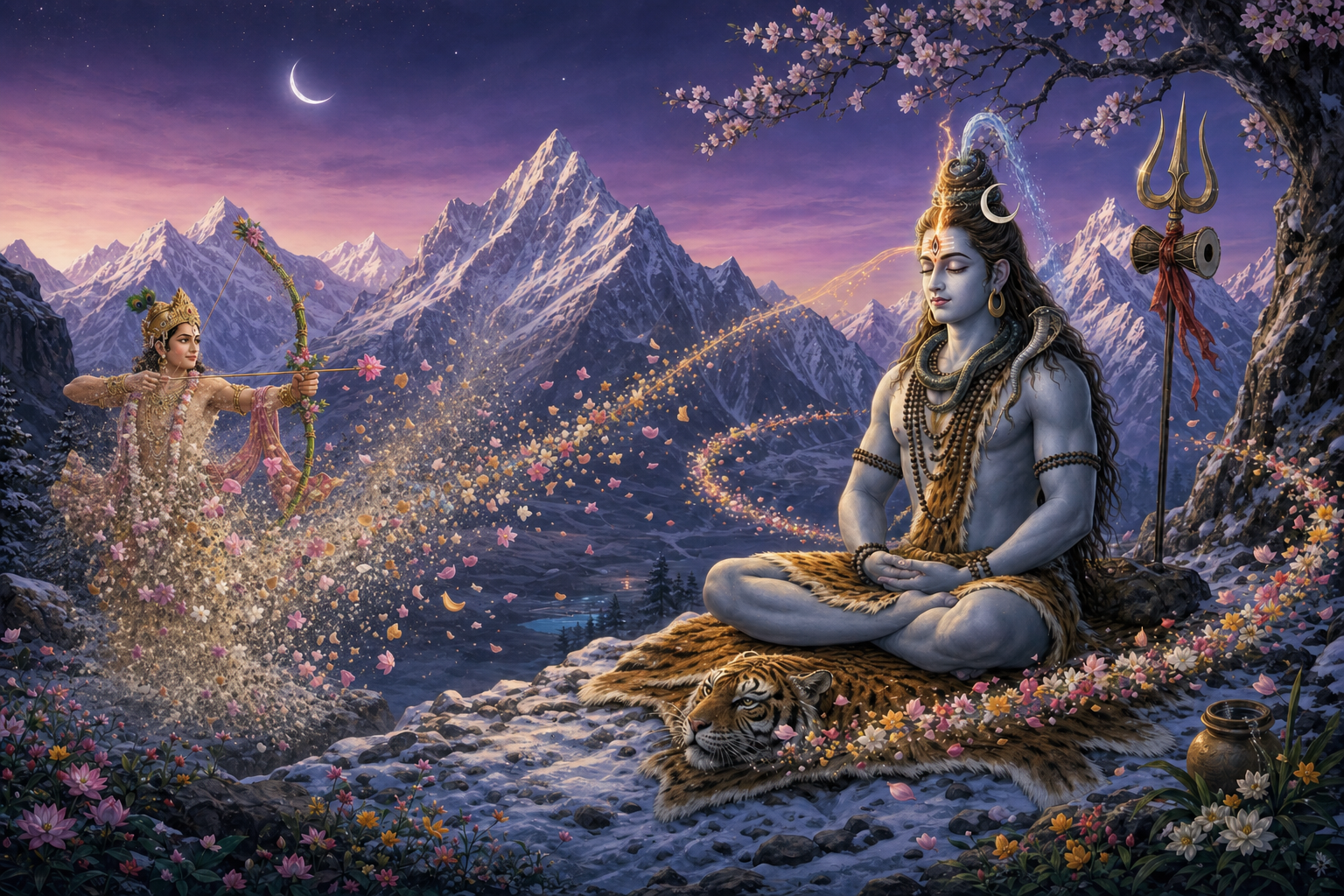
The encounter between Kamadeva and Shiva supplies the motif’s sharpest theological test. As recounted by DharmaRenaissance, the gods need Shiva’s meditation interrupted so that his union with Parvati can produce the power required against adharma. Kamadeva releases his flower arrow, whereupon Shiva opens his third eye and burns him.
Read only as a contest, the episode seems to set desire against ascetic knowledge. The source offers a more integrated interpretation: the fire of jnana exposes and purifies desire without eliminating the world’s need for relationship, fertility and affection. Kamadeva’s subsequent bodiless condition also suits the character of desire itself. Attraction may lack visible form while continuing to shape thought and conduct.
The aesthetic category of shringara rasa provides another bridge. The article associates the flower arrow with the refined experience of love and beauty, then traces how attraction can be redirected toward bhakti. What begins as longing need not remain possession or appetite: affection can become surrender, and the sensation of being pierced can describe an awakening of devotion rather than a wound.
This layered reading is particularly important in temple art, where the source notes that flower arrows may appear among divine couples, attendants, celestial figures and auspicious imagery. The motif should not be isolated as sensual decoration or assigned one rigid definition. Future interpretation is best grounded in a sequence of visual questions: who holds the arrow, what other attributes accompany it, and which theological or narrative setting surrounds the figure. Those relationships reveal whether the image is emphasizing desire, perception, creative power, aesthetic emotion or devotional transformation.