

Sulochana is best approached not as a uniformly developed character in every Ramayana, but as a figure whose importance grows in the wider world of later retellings and cultural memory. Her story brings a difficult question into the household of Lanka: what does righteous loyalty require when a loved one serves an unrighteous cause?
Separating textual location from later interpretation makes that question clearer. It allows readers to appreciate Sulochana’s ethical and symbolic significance without presenting every remembered detail as part of a single, universal narrative.
A character located in layers of Ramayana tradition

The source supplied for this article is a DharmaRenaissance Blog essay, so its particular claims cannot be treated as independently corroborated across publications. What can be synthesised are the textual, ethical, symbolic, and comparative strands within its account, with variant traditions identified as such.
The essay makes an essential distinction: Sulochana is not a major developed character in the most familiar narrative of the Valmiki Ramayana, while her fuller presence belongs to later Ramayana traditions, regional retellings, devotional literature, folk performance, and oral memory. This is not a minor qualification. It prevents a later character biography from being projected backward into every version of the epic.
Within that broader memory, Sulochana is commonly presented as the wife of Indrajit, also called Meghanada, the formidable son of Ravana. The source describes Indrajit as a conqueror of Indra, a master of astras, and one of Lanka’s most dangerous warriors. His ability is central to Sulochana’s significance: she is not paired with an ineffectual man, but with a powerful figure whose courage and loyalty cannot rescue the cause he defends from its moral disorder.
The distinction between textual layers also changes how disagreement should be handled. Details arising in one regional or devotional setting need not invalidate another telling. They may represent different communities using a shared epic world to examine grief, fidelity, conscience, or the consequences of war. “Sulochana in the Ramayana” therefore names a field of reception as much as it names one fixed storyline.
The ethical triangle of love, loyalty, and higher duty

The most productive way to understand Sulochana’s remembered role is through the tension between three loyalties: affection for her husband, membership in Ravana’s royal household, and allegiance to dharma. The DharmaRenaissance account portrays her strength primarily through counsel rather than public rebellion. She can love Indrajit while perceiving the danger of the path he follows.
This makes her more than a conventional emblem of marital devotion. Her loyalty is morally alert. The account implies that support for a spouse does not require approval of every action, just as service to a father or ruler does not automatically become righteous merely because it fulfils a family or political obligation. Particular duties remain accountable to a larger moral order.
Indrajit’s tragedy becomes sharper under this reading. Martial excellence, filial commitment, and personal bravery are genuine strengths, yet they are insufficient when placed at the service of Ravana’s wrongdoing. Sulochana functions as an intimate conscience within that tragedy: she exposes the distance between being devoted to a person and being aligned with dharma.
Her position also complicates any simplistic division between a wholly virtuous camp and an entirely corrupt Lanka. The source places her beside Mandodari and Vibhishana as evidence that moral discernment exists within Ravana’s own family and kingdom. Ravana’s course is destructive not because every person around him shares an identical nature, but because power repeatedly refuses corrective wisdom.
Vision and naga ancestry as interpretive motifs

The account connects Sulochana’s name with Sanskrit senses such as “beautiful-eyed” or “one with auspicious eyes.” It then develops sight as an ethical metaphor: Sulochana sees the moral danger that pride, attachment, and the momentum of war prevent others from acknowledging. This interpretation turns beauty of vision into clarity of judgment.
Some later traditions, according to the source, also associate her with a naga lineage, identifying her in different accounts as a daughter of Shesha or Vasuki. These alternatives should remain alternatives; the available material does not justify combining them into a single definitive genealogy. Their shared interpretive value is nevertheless significant. The essay associates the naga world with hidden knowledge, deep strength, continuity, and cosmic support.
Taken together, the name and the lineage traditions create a coherent symbolic portrait. Both privilege inward perception over spectacle. Indrajit’s power is visible on the battlefield, while Sulochana’s power lies in recognition, restraint, and the capacity to judge what that battlefield power serves. The contrast is not between strength and weakness, but between two different kinds of strength.
This symbolism should not be mistaken for proof that every narrator intended the same allegory. It is better understood as a careful reading of recurring motifs reported by the source. Such a reading respects the devotional depth of the traditions while preserving the difference between inherited narrative detail and modern interpretation.
Women’s counsel and the politics of the household
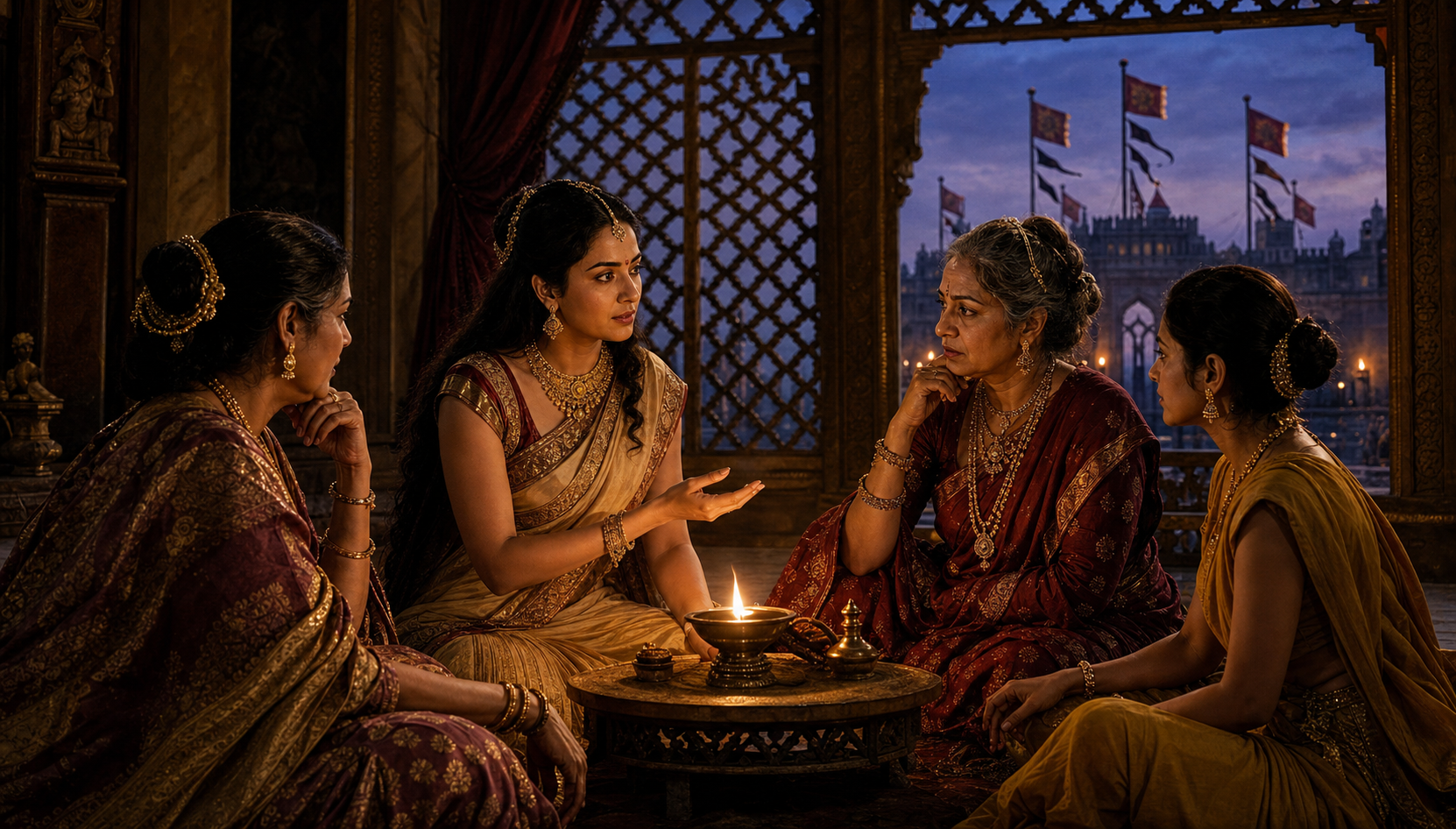
Sulochana becomes clearer when placed within the source’s wider constellation of Ramayana women. It presents Sita through endurance and dignity, Mandodari through political wisdom and grief, Tara through strategic counsel, Shabari through devotion, and Urmila through quiet sacrifice. These figures are not interchangeable, but together they show that epic agency need not be limited to kingship or combat.
Sulochana’s distinctive sphere is ethical intimacy. She stands close enough to Indrajit to expose the private cost of his public allegiance. Her remembered counsel suggests that decisions made in a warrior’s household are connected to the fate of a kingdom: affection can reinforce destructive action, or it can become the setting in which difficult truth is spoken.
Calling this influence “silent” requires care. Narrative marginality is not the same as moral emptiness, but neither should silence itself be romanticised as a virtue. The meaningful element in the source’s portrayal is discernment expressed through restraint and counsel. Her importance rests on what she perceives and represents, not on a general claim that suffering quietly is inherently righteous.
This distinction gives Sulochana contemporary interpretive value without forcing her into a modern biography unsupported by the source. Her story can illuminate a recurring human dilemma: whether fidelity means unconditional agreement, or whether honest warning may be the more demanding form of care. The tradition’s answer, as presented here, is that affection severed from moral judgment becomes attachment, while judgment without compassion loses the relational setting in which counsel can be heard.
Key takeaways
- Sulochana’s developed story belongs principally to later Ramayana traditions and cultural memory rather than to a major character arc in the familiar Valmiki narrative.
- Her central ethical role is to distinguish loving loyalty from moral blindness within Indrajit’s service to Ravana.
- Traditions connecting her name with auspicious vision, and variant accounts linking her to Shesha or Vasuki, support interpretations centred on insight and restrained strength.
- Placed alongside Mandodari, Vibhishana, Tara, Sita, Shabari, and Urmila, she helps reveal the varied forms that counsel and moral agency take around the epic’s public conflicts.
- Her story is most responsibly read by identifying the relevant textual or performance tradition instead of treating every later detail as universally canonical.
Further study can strengthen this portrait by comparing named regional texts, devotional works, and performance traditions individually. That edition-conscious approach would show not only who Sulochana becomes, but also why different communities chose to bring her conscience more fully into view.