
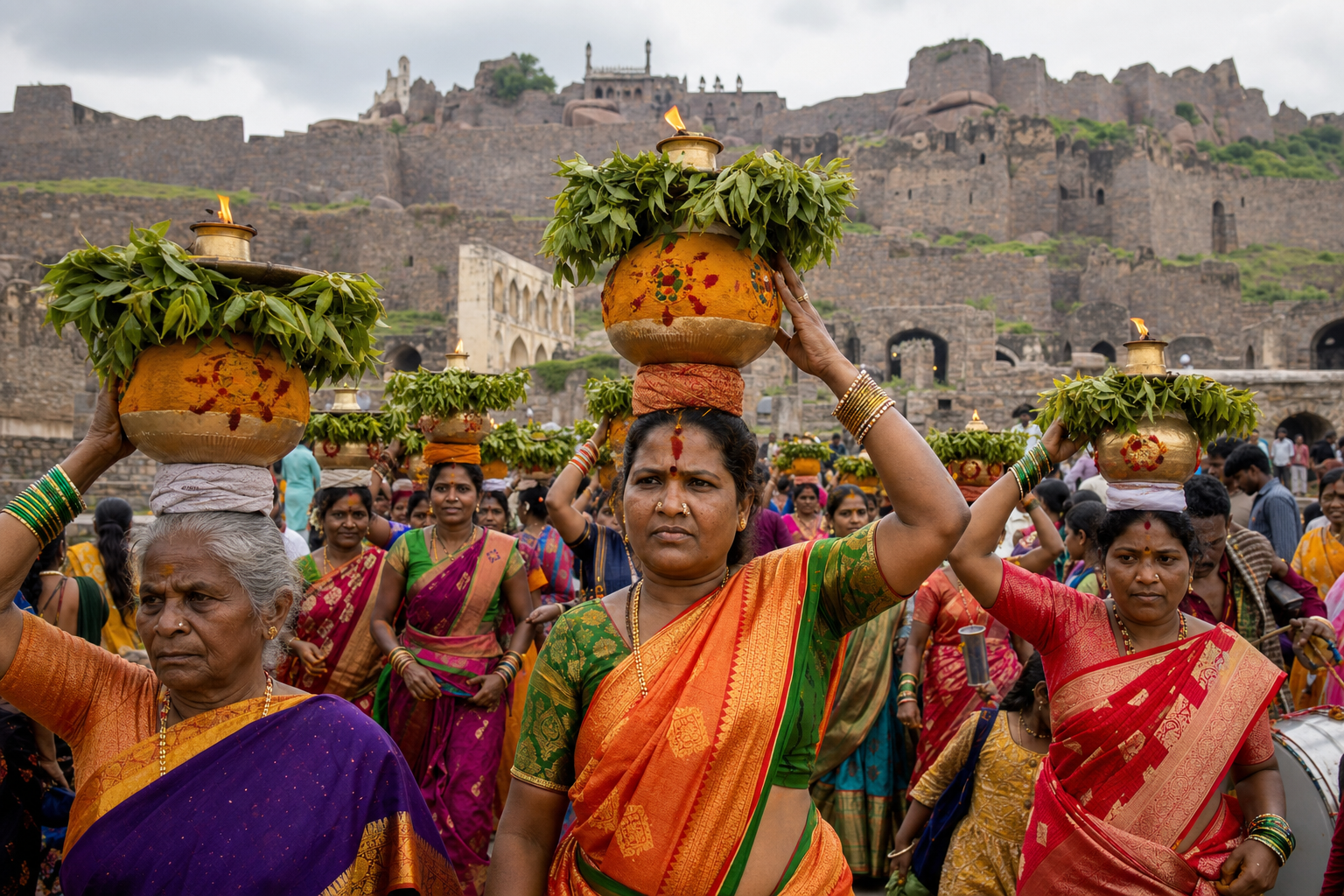
Golkonda Bonalu brings together a household food offering, worship of the Mother Goddess, public processions, Hyderabad’s historic landscape, and the practical work of managing a major gathering. The supplied DharmaRenaissance report presents the festival as both an act of Shakti devotion and a living expression of Telangana’s cultural memory.
This guide connects the report’s ritual, historical, geographic, and civic strands. It explains why Golkonda matters in the festival calendar, how the principal observances relate to one another, and why the evidence for Bonalu’s past is best understood as layered rather than reduced to a single origin account.
Key takeaways
- The source article identifies July 19, 2026, as the opening of the Ashada Bonalu season at the Jagadambika Temple in the Golkonda Fort area.
- Bonam is a prepared meal offered to the goddess, making nourishment and gratitude central to the festival’s theology.
- Women carrying Bonam perform the core offering, while the Ghatam, Pothuraju, Rangam, and Thottelu contribute distinct ritual, processional, or artisanal dimensions.
- The report places nineteenth-century epidemic memory alongside reporting about a 1516 Telugu inscription; these strands illuminate different aspects of the tradition and should not be treated as interchangeable evidence.
- Temple timings, local schedules, and traffic arrangements remain practical details to confirm through official announcements closer to the celebration.
Why a prepared meal stands at the ritual centre
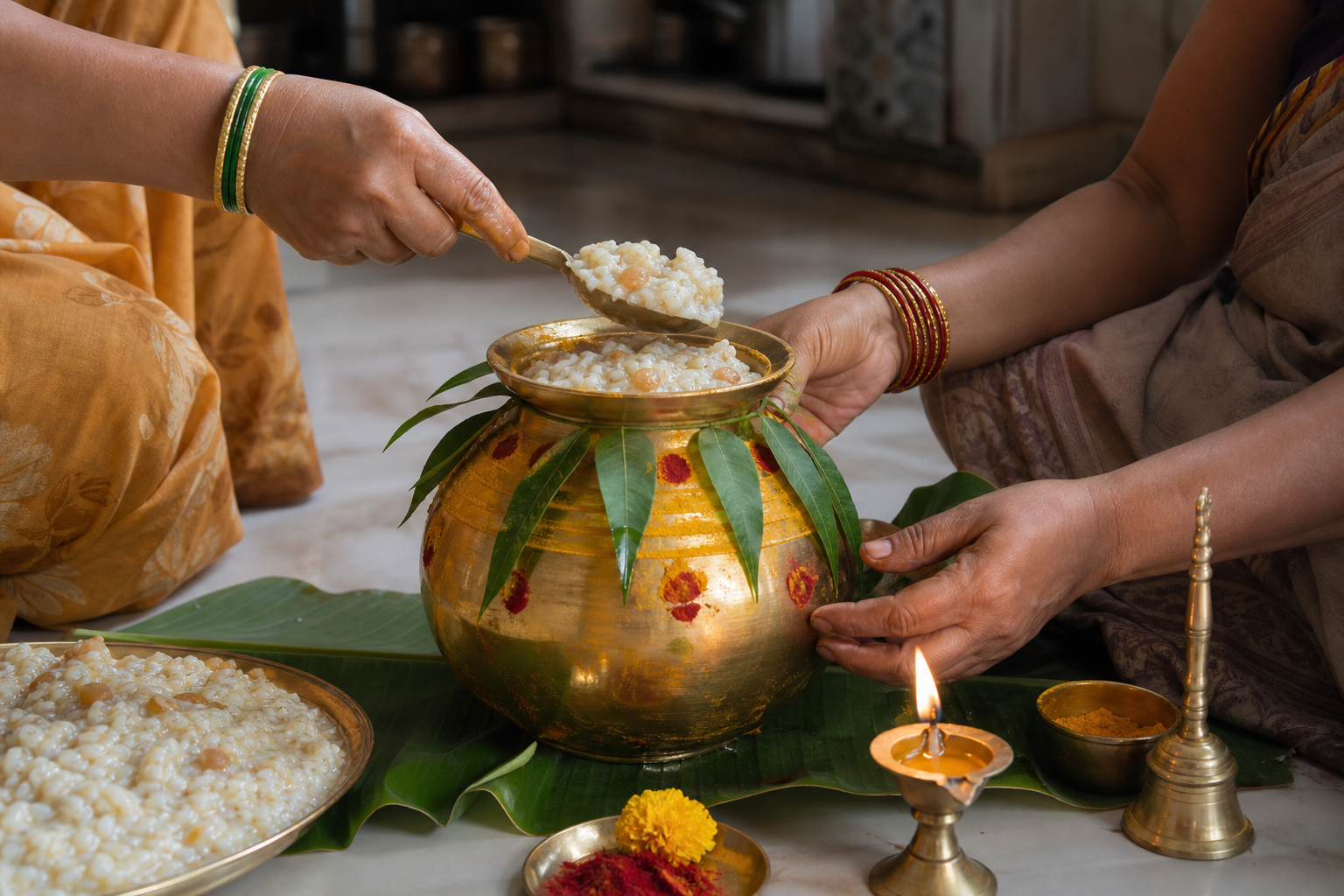
The source connects the word Bonalu with Bonam and, in turn, with Bhojanam, or a meal. It describes women preparing rice with milk and jaggery in a new earthen or brass pot. Turmeric, vermilion, neem leaves, and a lamp complete the offering before it is carried to the goddess.
This sequence joins spaces that are often considered separately. Preparation begins in the household, continues through the public street, and culminates at the temple. Food is therefore more than an accessory to worship: it becomes the medium through which a family expresses gratitude, fulfils a vow, or renews a prayer for protection and well-being.
The report accordingly treats women’s participation as foundational rather than ornamental. Balancing and carrying the decorated vessel requires discipline and care, while the journey transforms domestic labour into a visible sacred act. The theology is enacted through the body: nourishment prepared by human hands is returned to the protective Mother.
Other observances expand this central offering without replacing it. As described by the source, the decorated copper Ghatam represents the goddess in procession; Pothuraju appears as Mahankali’s protective brother and attendant; Rangam provides an oracular setting in some Bonalu observances; and Thottelu introduce an artisanal and visual form of devotion. Together they connect food, embodiment, music, movement, protection, and communal expectation.
Golkonda gives the season a sacred geography
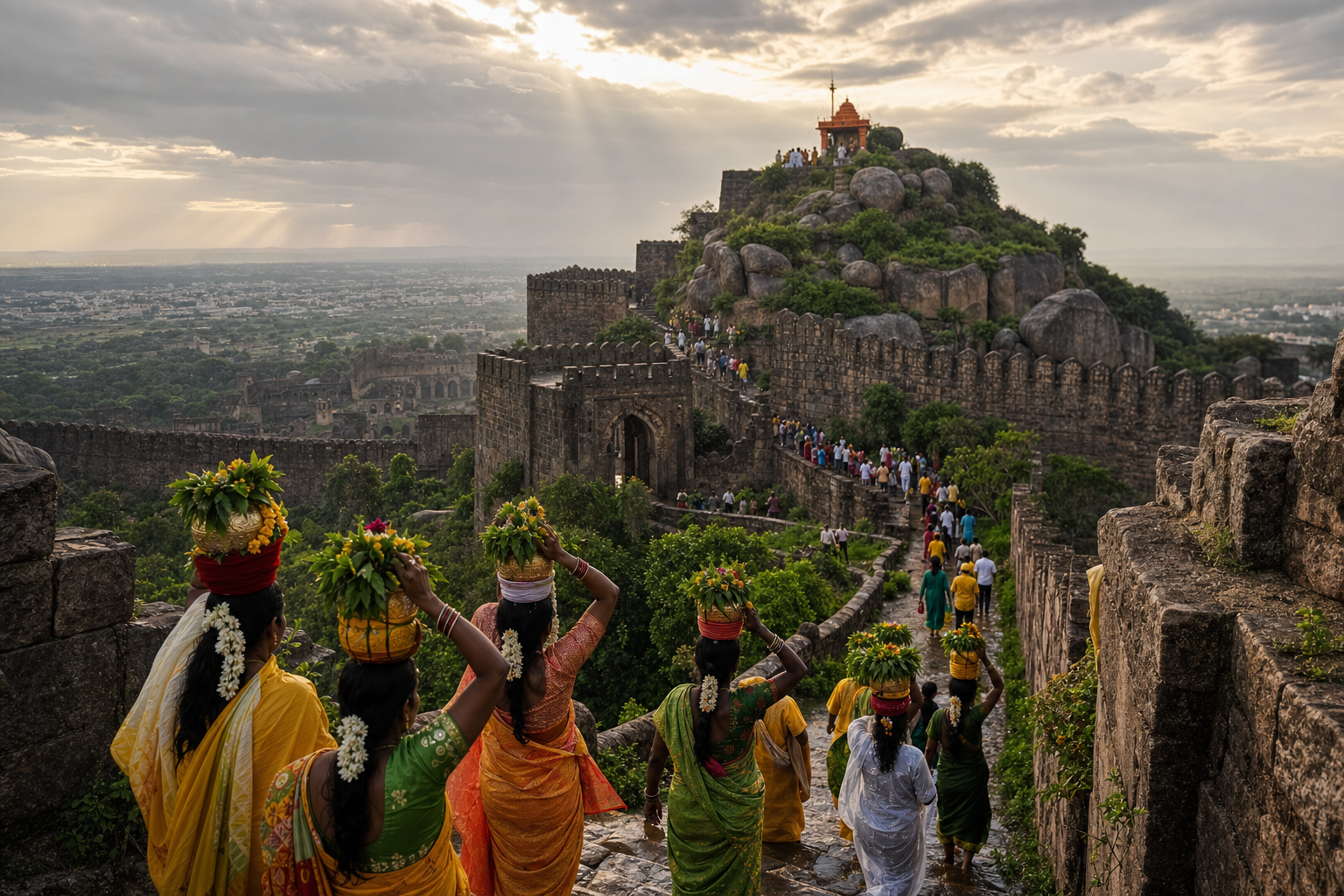
According to the source article, the Jagadambika Temple within the Golkonda Fort landscape formally opens the wider Ashada Bonalu cycle. Celebrations then continue across Hyderabad, Secunderabad, and other parts of Telangana into the first half of Shravana, with devotional attention returning to Golkonda near the season’s close. This movement gives the calendar a circular shape: commencement, offering, procession, thanksgiving, and return.
The report also names the Haribowli Akkanna Madanna Mahankali Temple, Secunderabad Ujjaini Mahakali Temple, and Lal Darwaza Mahankali Temple among the prominent centres that follow in the wider sequence. These are not presented merely as successive venues. Each shrine belongs to a local community, while their shared season connects neighbourhood devotion to a city-wide religious rhythm.
Golkonda adds a further layer because its setting evokes the medieval Deccan, royal power, urban settlement, and Hyderabad’s evolving cultural life. In that environment, the journey to Jagadambika is also an encounter with place. Temple, fort, city, and remembered history overlap, turning geography itself into part of the festival’s meaning.
Bonalu’s history is better read in layers
The source reports a widely remembered connection between Bonalu and epidemic disease in the twin cities during the early nineteenth century. In this account, protection was sought from Goddess Mahakali through a vow, a memory associated especially with the Ujjaini Mahakali tradition in Secunderabad. Such an account explains why health, danger, protection, and thanksgiving remain emotionally powerful themes.
The same article points to epigraphical reporting about a Telugu inscription dated to 1516 that refers to Bonalu-related practices. If read as reported, that evidence suggests that relevant ritual roots may precede the nineteenth-century epidemic narrative. It does not, by itself, establish that every feature of the contemporary festival existed in precisely its present form.
The two strands therefore answer different questions. Epidemic memory explains a durable communal understanding of protection and fulfilled vows; inscriptional evidence may extend the documented horizon of related practice. Temple tradition, public memory, regional worship, and epigraphy can coexist without being compressed into one simple founding story.
A living tradition also requires civic care
Bonalu is transmitted not only through formal explanation but through what the source characterises as a sensory archive: drums, lamps, neem, turmeric, vermilion, jasmine, crowded lanes, decorated vessels, and moving processions. These recurring sights, sounds, and actions allow children, elders, migrants, and returning families to recognise a shared cultural inheritance.
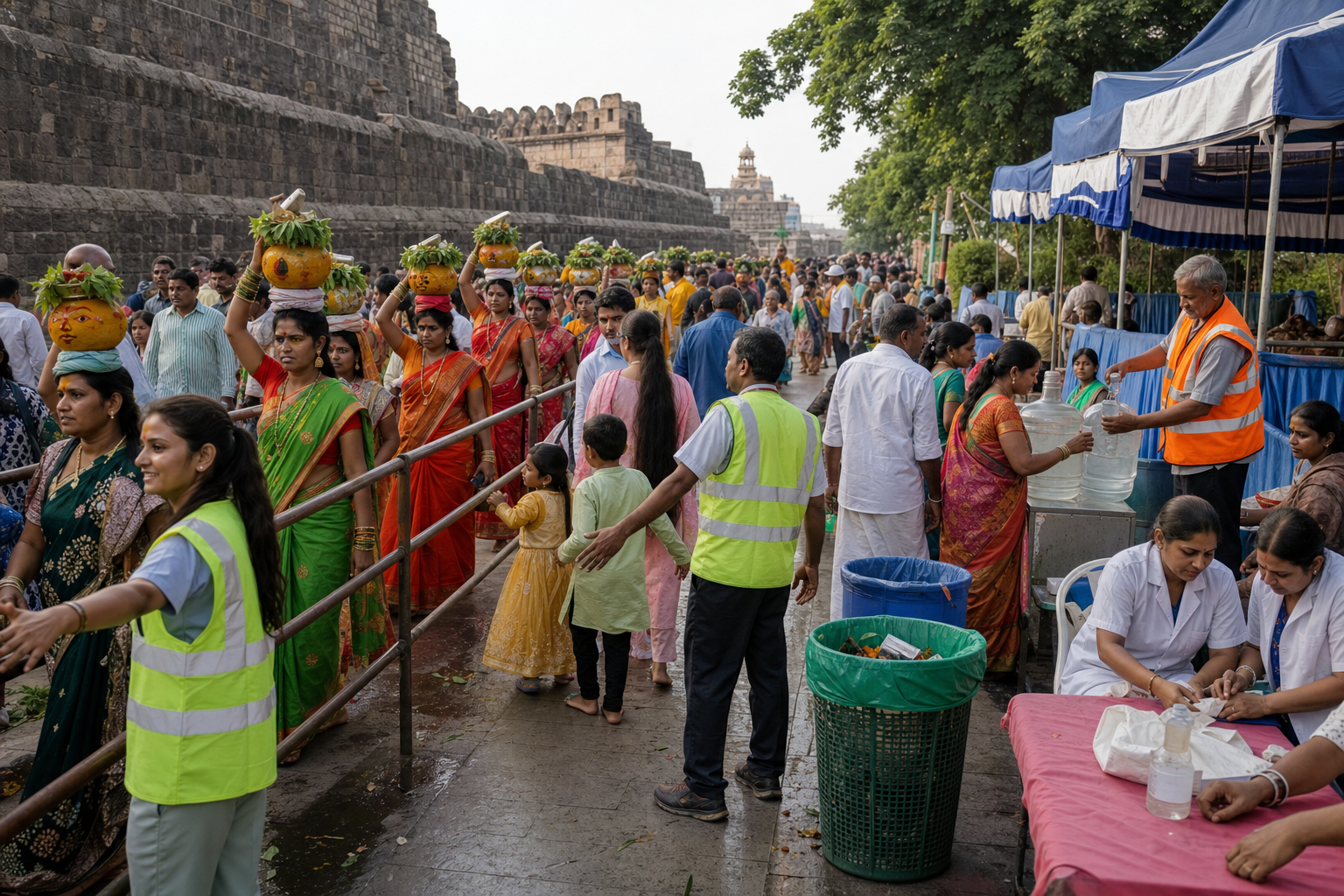
Its public scale also creates practical responsibilities. The report identifies crowd management, sanitation, drinking water, medical assistance, traffic regulation, and coordination among temple committees, civic bodies, police, and volunteers as necessary supports. Administration does not supply the festival’s sacred meaning, but responsible arrangements help devotees participate with dignity and safety.
As the reported July 19 opening approaches, the most useful preparation is both devotional and practical: understand the Bonam as an offering rather than a spectacle, respect the processional roles and historic setting, and consult official temple or civic notices for schedules and access arrangements. That combination can help Golkonda Bonalu remain rooted in reverence while meeting the needs of a living city.