
An Ekadashi date is the result of translating a moving lunar tithi into a local day of observance. The decisive information is therefore not the civil date alone, but the relationship among local sunrise, Dashami, Ekadashi and Dwadashi.
The two source articles approach that relationship through the labels Anandapaksha and Bhooripaksha. Read together, they offer a more useful lesson than either label provides by itself: reliable observance requires a sequence of calendrical checks, followed by a tradition-specific decision about fasting and Parana.
Why a civil date cannot settle Ekadashi
Both the Anandapaksha account and the Bhooripaksha account describe a tithi as a division based on the changing angular relationship between the Sun and Moon, with each tithi corresponding to 12 degrees. Ekadashi is the eleventh tithi in either the waxing or waning fortnight.
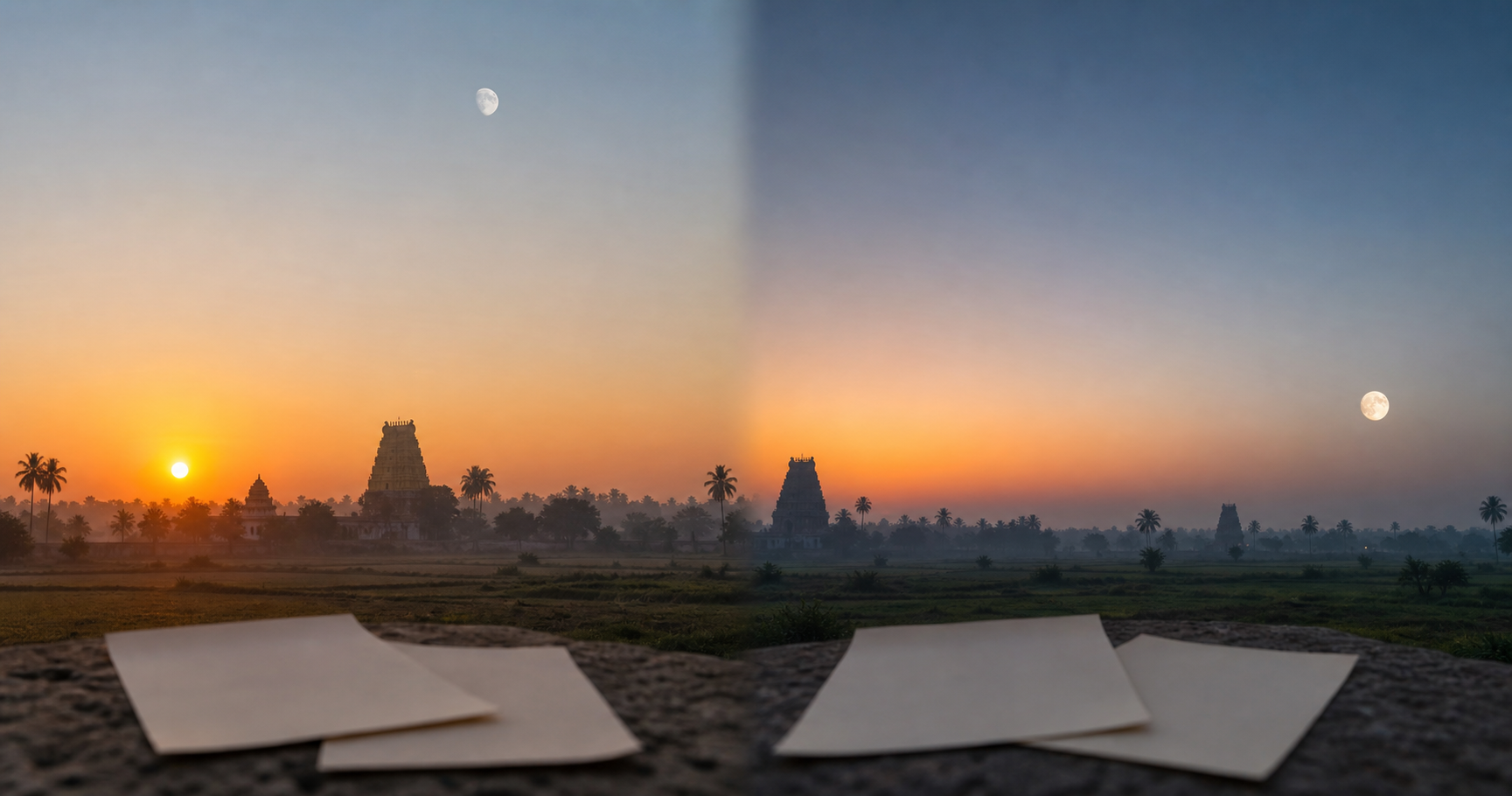
A tithi is not another name for a midnight-to-midnight date. It can begin or end at any hour, and its duration does not have to match a 24-hour civil day. The sources consequently give sunrise a central practical role: the tithi prevailing then generally helps determine the ritual identity of the day, subject to the specialized rules applied to a particular vrata.
This also makes the calculation local. Sunrise varies by place, and a tithi boundary may fall on a different side of sunrise in different locations. The Bhooripaksha article specifically warns that an almanac calculated for one city may not transfer accurately to another. A printed date without its calculation location is therefore incomplete information for a careful observer.
The governing unit is a three-tithi sequence
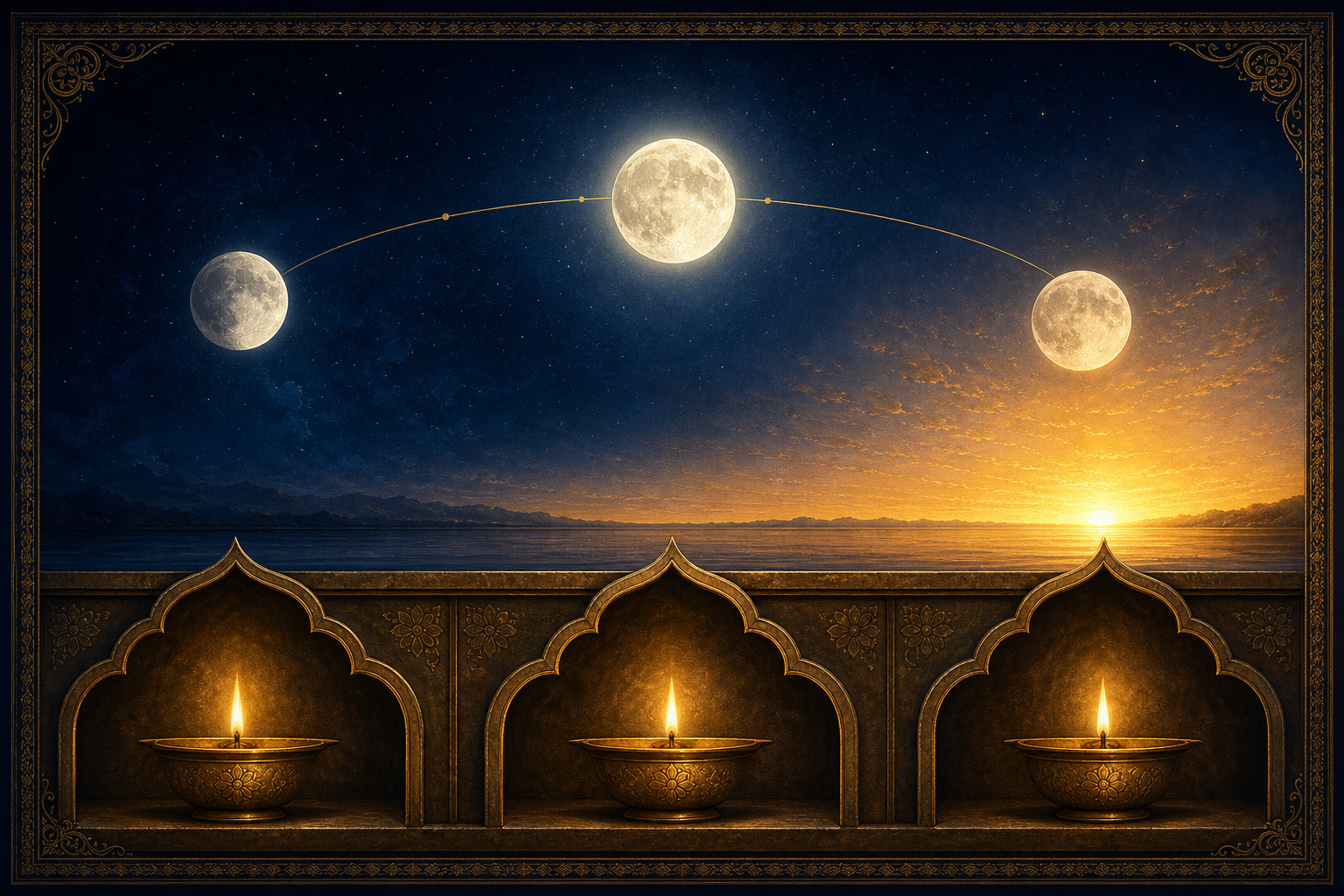
Ekadashi cannot be evaluated in isolation because the vrata is framed by the tithi before it and completed during the tithi after it. The sources describe three connected questions:
| Tithi | Calendrical question | Ritual relevance reported by the sources |
|---|---|---|
| Dashami | Does it remain at a critical boundary used by the applicable tradition? | Some traditions avoid an Ekadashi considered affected by Dashami. |
| Ekadashi | When does the eleventh tithi begin, end and meet local sunrise? | This establishes the principal fasting-day candidate. |
| Dwadashi | Is the twelfth tithi available after the fast, and for how long? | It governs the appropriate Parana, or formal breaking of the fast. |
The ordinary pattern is an Ekadashi suitable for fasting followed by Dwadashi suitable for Parana. Complications arise when the lunar boundaries do not line up neatly with consecutive sunrises. The Bhooripaksha article places this within the wider distinction between an extended tithi, which can occur at two successive sunrises, and a tithi that begins after one sunrise and ends before the next, holding no sunrise at all.
These configurations explain why counting forward from a civil-calendar date is unreliable. The practical decision must preserve the order of the observance: preparation in relation to Dashami, fasting under the accepted Ekadashi condition, and completion while Dwadashi remains ritually usable. The Anandapaksha article particularly emphasizes that Parana is part of the integrity of the vrata, not an optional detail after the principal fast.
What Anandapaksha and Bhooripaksha contribute
The Anandapaksha article presents Anandapaksha as a calendrical classification rather than the name of an additional annual festival. Its focus is an Ekadashi that extends toward, or interacts with, Dwadashi around sunrise. The interpretive concern is whether fasting and the following Parana can remain properly aligned.
The Bhooripaksha article likewise treats Bhooripaksha as a timing category, not a separate festival or sectarian observance. It associates the label with a broader or more substantial presence of Ekadashi in relation to the civil day, then situates that idea among questions of tithi extension, deficiency and sunrise occupancy.
The common ground is more important than forcing the two labels into a simple opposition. Both articles use them to direct attention away from a date printed in isolation and toward the amount and placement of Ekadashi relative to sunrise and adjacent tithis. Anandapaksha places greater emphasis on the Ekadashi-Dwadashi transition, while Bhooripaksha emphasizes the extent of Ekadashi across relevant day boundaries.
Neither supplied article provides a formal computational threshold, a scriptural rule citation or a worked ephemeris from which a universal decision table could be reconstructed. The labels should therefore not be treated as self-sufficient instructions. A Panchang still needs to supply the actual local timings and state which observance rule it has applied.
How to resolve differing Panchang dates
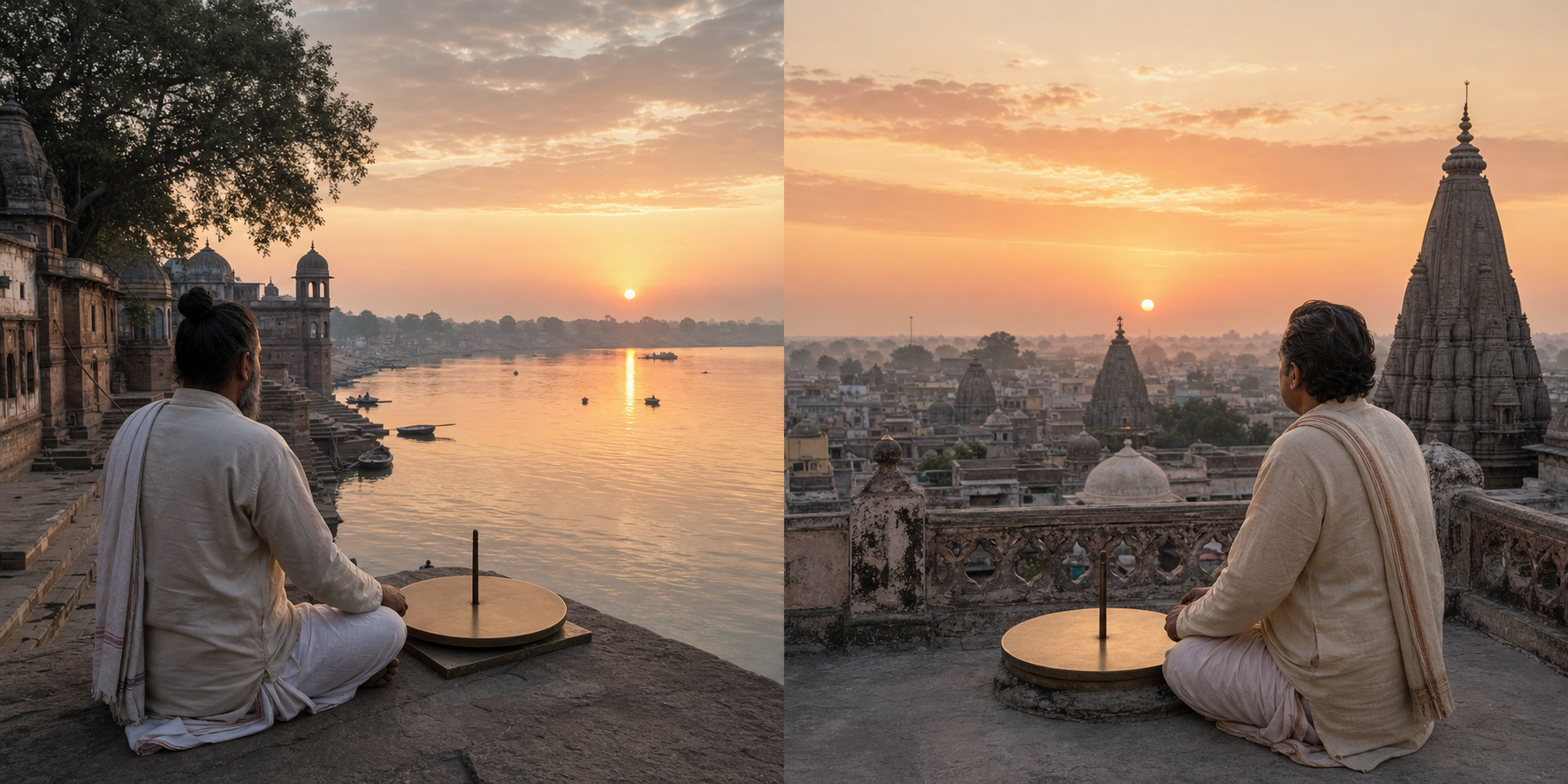
When two calendars mark different fasting dates, the difference does not necessarily mean that one has calculated the Moon incorrectly. The Bhooripaksha article identifies two possible sources of divergence: local sunrise can change how a tithi intersects the day, and different Smarta, Vaishnava or regional systems can apply distinct ritual rules to the same astronomical sequence. The Anandapaksha article also notes variations in the treatment of sunrise, Dashami influence and Dwadashi Parana.
- Confirm that the Panchang is calculated for the observer’s location rather than inherited unchanged from another city.
- Check which sampradaya or rule system the calendar follows; a general festival date and a tradition-specific fasting date may not answer the same question.
- Read the beginning and ending times of Dashami, Ekadashi and Dwadashi across the relevant local sunrises.
- Use the fasting date and Parana window issued under the same rule set instead of combining a fast date from one calendar with a breaking time from another.
- If a label such as Anandapaksha or Bhooripaksha appears without timings or an explanation, seek the underlying local Panchang data or guidance from the community whose practice is being followed.
This method also clarifies what a well-designed Panchang entry should disclose: location, local sunrise, tithi boundaries, observance tradition, selected fasting day and the permitted Parana period. Those fields make the result understandable without requiring every reader to reproduce the astronomical calculation.
Key takeaways
- Ekadashi is determined from a moving lunar tithi, not from a fixed midnight-to-midnight date.
- Local sunrise connects the lunar calculation to the ritual day, so location-specific data matters.
- Dashami, Ekadashi and Dwadashi must be read as one sequence because the fast and its Parana are interdependent.
- Anandapaksha and Bhooripaksha are presented by the sources as calendrical conditions, not additional named festivals.
- A classification label cannot replace actual tithi times, a stated sampradaya rule and a local Parana window.
As digital Panchangs serve increasingly dispersed communities, publishing those underlying inputs alongside the selected date would make Ekadashi guidance more transparent, portable and easier to follow with confidence.
References
- DharmaRenaissance Blog — Anandapaksha Ekadashi: The Powerful Calendar Rule Behind a Sacred Fast
- DharmaRenaissance Blog — Bhooripaksha Ekadashi Explained: Powerful Panchang Wisdom for Accurate Fasting