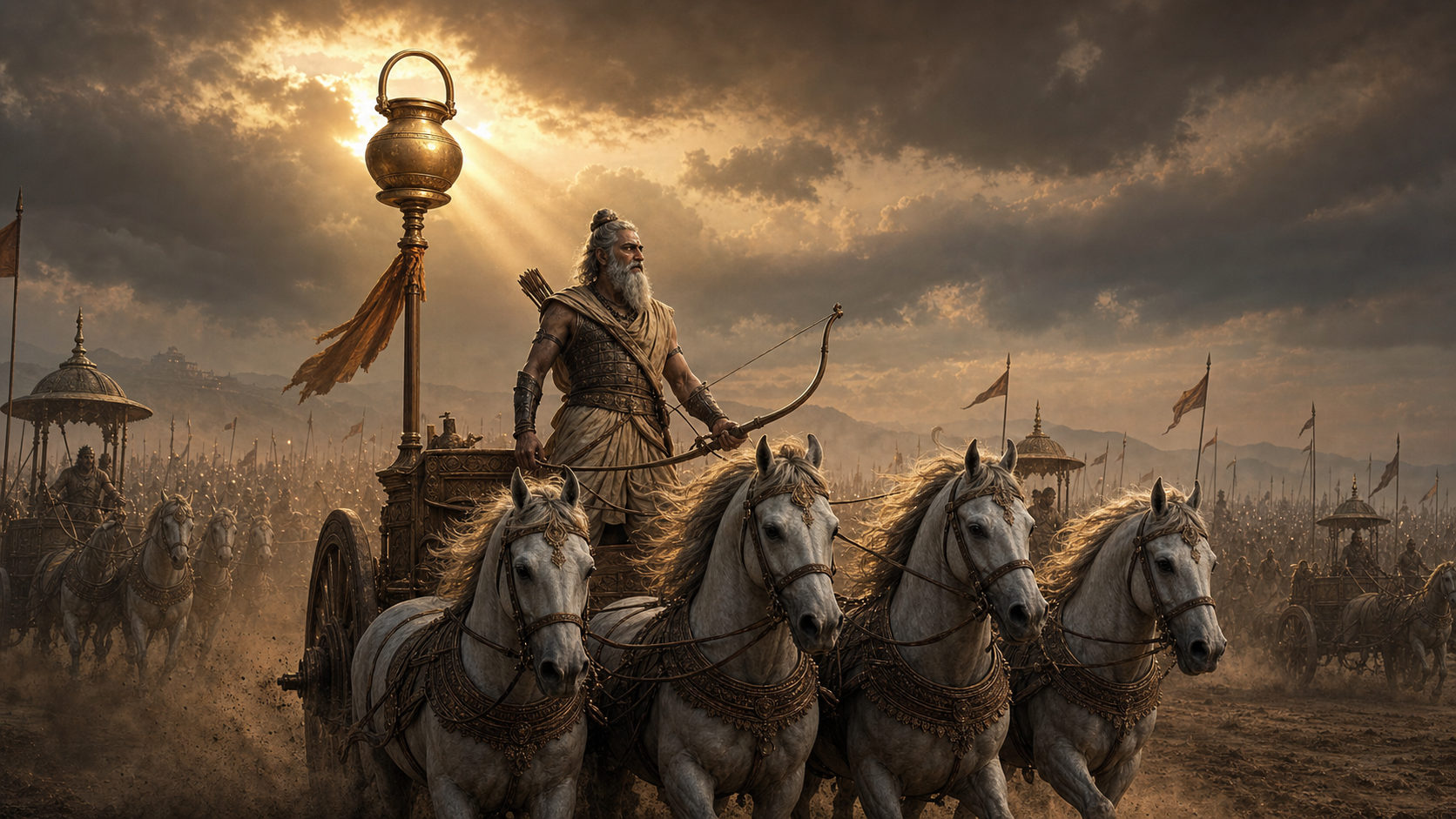
On Drona’s chariot, an ascetic water vessel becomes a public sign in a theatre of war. The supplied DharmaRenaissance article interprets this kamandalu emblem as a concentrated expression of Drona’s unusual position: Brahmin, teacher, weapons master, royal dependent, and battlefield commander.
The emblem is most useful when read on three levels at once: as a practical military standard, as a marker of Drona’s inherited and professional identity, and as an ethical question about knowledge placed in the service of force. That layered reading reveals more than either praise or condemnation of Drona alone can provide.
Key takeaways
- The source presents Drona’s banner as both a battlefield identifier and an outward representation of character.
- The kamandalu evokes learning, austerity, purity, offering, and restraint precisely because it is a vessel rather than a weapon.
- Its presence above a war-chariot expresses the unresolved relationship between sacred knowledge and martial power in Drona’s life.
- The supplied material supports a rich symbolic interpretation, but it does not provide a primary-text passage or compare translations and recensions; the precise textual basis therefore remains outside the available evidence.
A banner doing military and narrative work
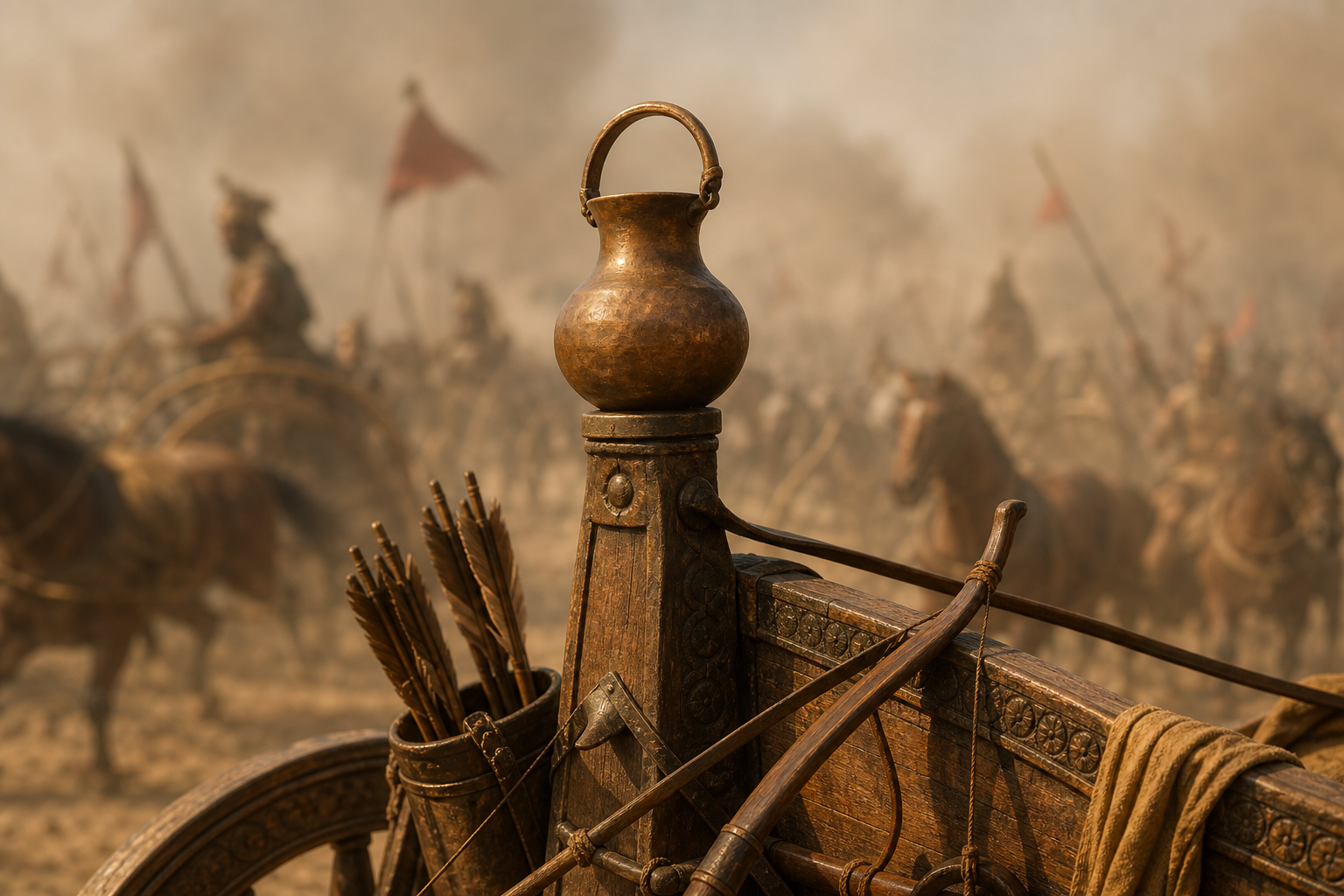
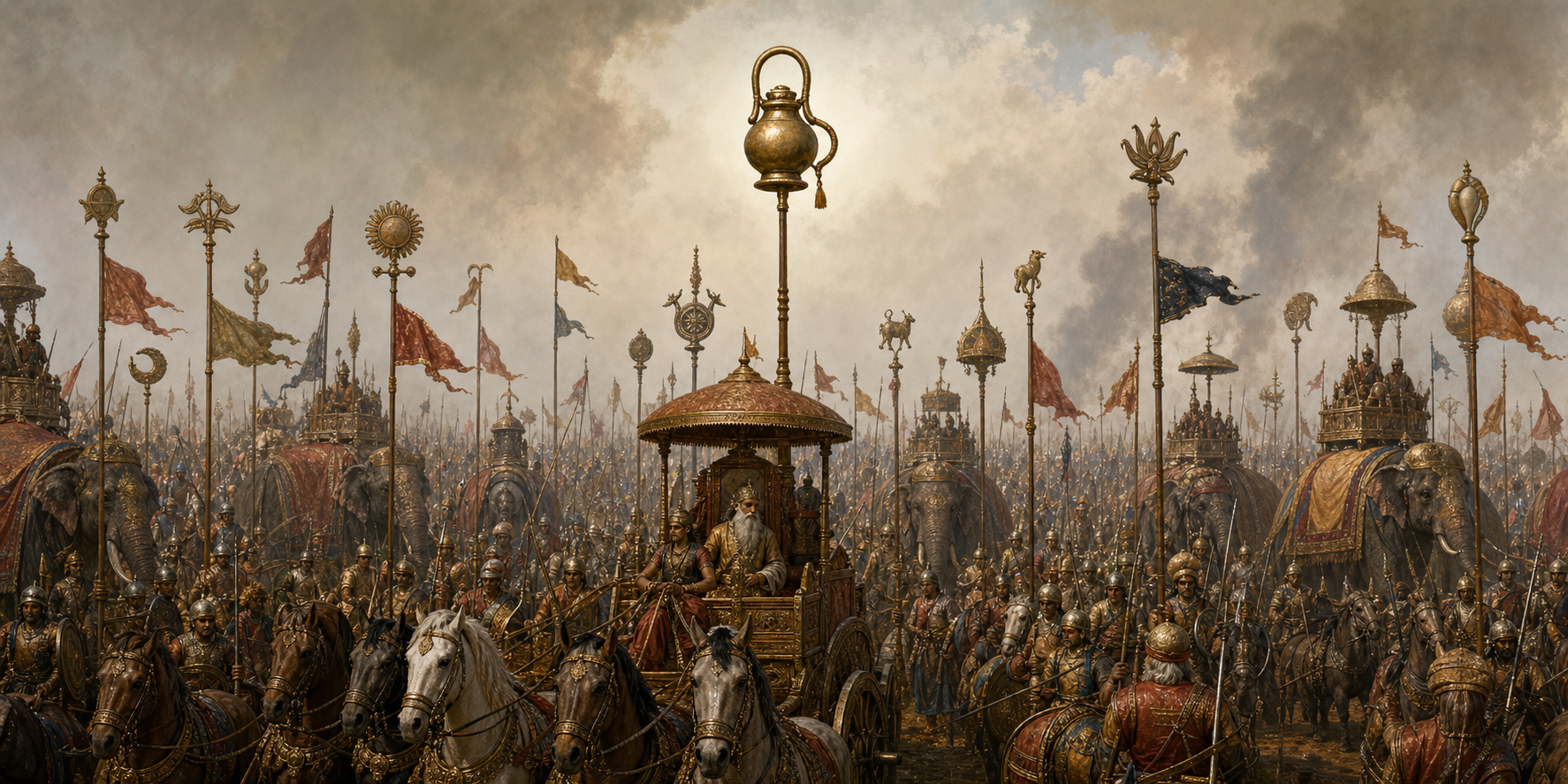
A chariot standard first has a practical function. According to the source article, standards distinguish warriors in a crowded battle, help soldiers locate commanders, support formation, and project psychological force. The kamandalu consequently identifies Drona before it is interpreted: it marks the chariot around which his authority and troops are organized.
The article also treats the Mahabharata’s banners as a visual language. In its comparison, Hanuman on Arjuna’s chariot evokes devotion, strength, memory, and continuity with the Ramayana; Bhishma’s standard communicates ancestral authority; and Karna’s conveys royalty, pride, and heroic defiance. Within that framework, Drona’s vessel distinguishes him from a warrior represented primarily by an animal, weapon, or royal sign. His standard points back to the worlds of the sage and the teacher even as his chariot advances through battle.
This double function matters. If the emblem were treated only as military equipment, its choice would appear incidental. If it were treated only as an allegory, its public and martial setting would disappear. Its force comes from combining the two: an implement associated with disciplined spiritual life becomes the sign by which a commander is recognized amid organized violence.
Why the vessel fits Drona specifically
The source connects the kamandalu with Drona’s Brahmin identity and sage lineage. It identifies him as the son of Bharadvaja and notes that epic tradition associates his unusual birth, as well as his name, with a container. The vessel motif is therefore presented not merely as a general symbol of asceticism but as something that resonates with Drona’s own origin.
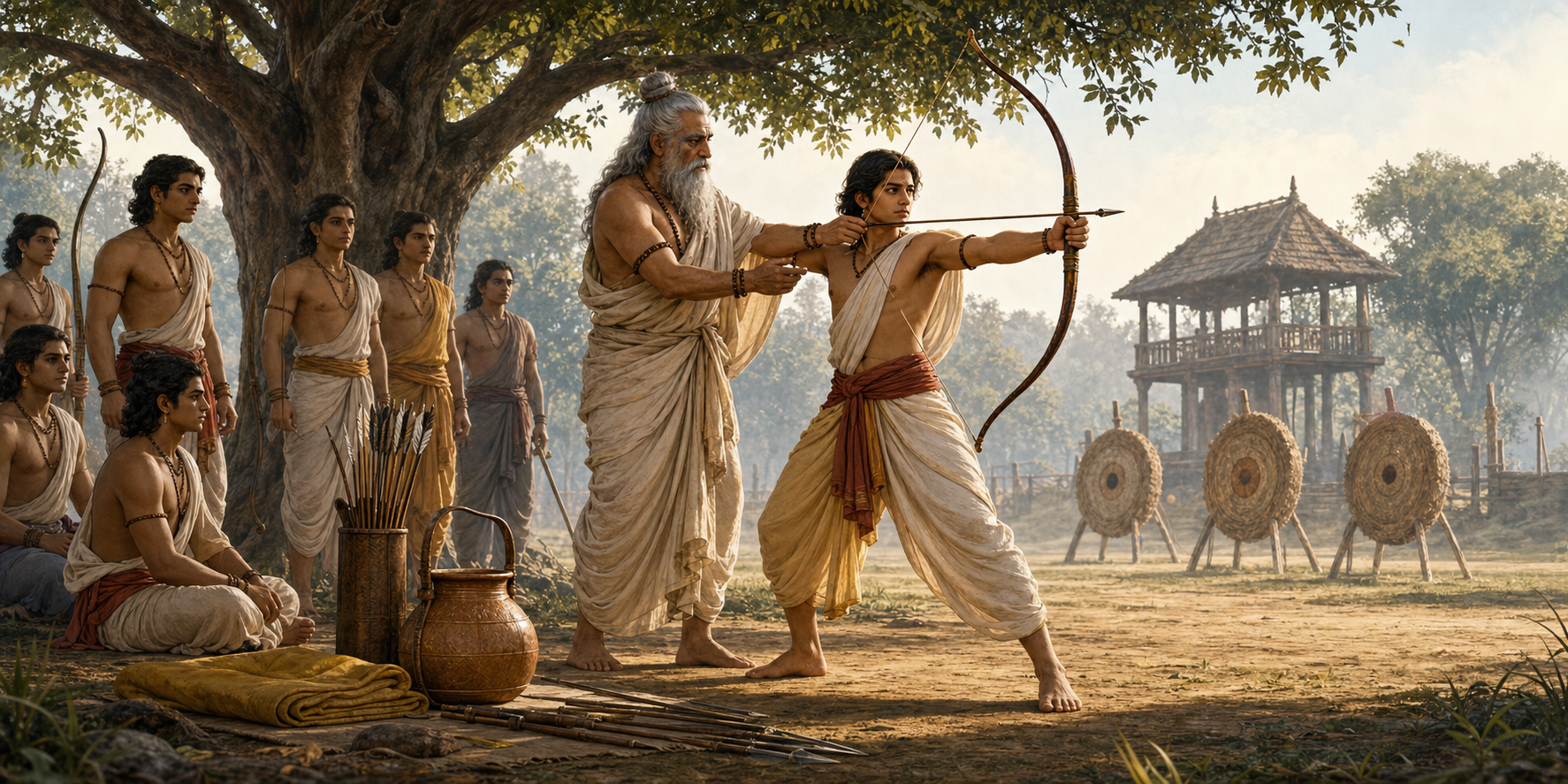
The article gives the vessel an additional intellectual meaning. Drona receives knowledge through discipline, preserves it, and passes it to students. In that sense, he functions as a human receptacle of martial learning. His achievement is undeniable within the source’s account: he trains both Pandavas and Kauravas and develops Arjuna into the outstanding archer of his generation.
Yet a vessel is defined not only by what it holds but also by where its contents are poured. That observation sharpens the emblem’s relevance to teaching. Drona’s expertise does not remain secluded within an ashrama or confined to personal cultivation. It enters a royal institution, is distributed among heirs who later become enemies, and ultimately returns to the battlefield through their competing skills.
The water traditionally held in a kamandalu deepens the contrast. The source associates it with life, purification, offering, and clarity. None of those meanings is intrinsically martial. The banner therefore does not simply announce that Drona possesses sacred learning; it places the imagery of purification over circumstances in which loyalties, motives, and consequences have become morally clouded.
Where sacred learning meets organized force
The source frames this tension through Brahma-tejas and Kshatra-tejas. The former is the radiance of learning, austerity, mantra, teaching, and inward discipline; the latter is associated with courage, protection, statecraft, and rightful force. These powers need not be enemies. In an ordered relationship, wisdom can guide power while power protects the conditions in which wisdom is cultivated.
Drona’s story, as the article interprets it, shows what happens when that relationship loses coherence. He is a Brahmin master of celestial weapons who becomes dependent on royal patronage and eventually commands the Kaurava army. He has affection for the Pandavas and recognizes Arjuna’s greatness, yet he fights on the side opposed to them. The kamandalu remains visible, but its values do not automatically determine the use of the power beneath it.
This is more precise than saying that spirituality and warfare are simply incompatible. The emblem instead raises questions about governance and responsibility. Is technical excellence sufficient education? Can a teacher separate the gift of skill from the purposes it will serve? What happens when knowledge is entangled with livelihood, gratitude, political obligation, status, and personal attachment? Drona’s banner provides no easy answer, but it keeps those questions visible.
The source consequently treats knowledge as morally consequential rather than self-justifying. Instruction can equip opposing causes, and mastery does not guarantee self-mastery. The kamandalu signifies the discipline through which knowledge is acquired while the war-chariot exposes the separate problem of how that knowledge is directed.
An emblem that preserves Drona’s contradictions
Several episodes cited by the source complicate any attempt to turn Drona into either a spotless sage or a simple villain. His humiliation by Drupada and the later use of guru dakshina to have his pupils defeat Drupada show personal injury entering the sphere of teaching. On this reading, the kamandalu’s association with inner clarity is set against a memory of insult that continues to shape action.
The article also points to Ekalavya as a challenge involving hierarchy, access to instruction, social boundaries, and the ethics of excellence. That episode places pressure on the ideal of the teacher as an impartial vessel of knowledge. Drona’s attachment to his son Ashwatthama, his obligations to Hastinapura, and his divided relations with former pupils add further strands of affection and dependence to his public role.
The emblem’s value lies in holding these strands together. It honors Drona’s austerity and learning without declaring every use of his authority pure. It acknowledges his martial responsibility without erasing his identity as a guru. Above all, it redirects attention from the possession of sacred knowledge to the formation of judgment: learning may enlarge a person’s power while leaving pride, grievance, attachment, and institutional loyalty unresolved.
A careful future study would place this interpretation beside the relevant Sanskrit passage, identify its location, and compare how major translations and recensions describe Drona’s standard. Until that textual work is supplied, the kamandalu is best treated as the source article’s illuminating interpretive lens rather than as a complete verdict on Drona. Read that way, the emblem keeps open the Mahabharata’s enduring inquiry into whether wisdom can truly govern the power it makes possible.