
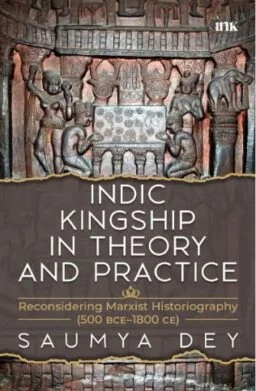
How should Indic kingship be studied when the historian’s framework may determine the answer before the evidence is examined? A Hindu Post item relaying an Indica Today review summary raises this question through a critique of Marxist historiography and its use of class conflict as an overriding explanation.
The supplied excerpt concerns a work attributed to Saumya Dey and covering 500 BCE to 1800 CE. It offers a methodological argument rather than examples from particular kingdoms, so its value lies mainly in the questions it asks about evidence, interpretation, and ideology.
What the source actually establishes
According to the passage carried by Hindu Post, Marxist history is weakened when it compresses events into fixed categories such as exploiter and exploited. The excerpt describes the classical Marxist position as locating the decisive division in control over production and labor, with revolutionary conflict presented as the route to equality.
The criticism is not merely that economic forces receive too much attention. It is that an all-purpose framework may absorb every possible fact without allowing evidence to count against it. That is why the excerpt invokes philosopher Karl Popper and his concept of falsifiability.
Falsifiability is a challenge, not a shortcut
In general terms, falsifiability asks whether a claim identifies evidence that could show it to be wrong. The source presents Popper’s criterion as a way to question theories capable of explaining every outcome after the fact.
Historical interpretation, however, is not identical to laboratory science. Many historical claims concern motives, institutions, or patterns that must be assessed through converging records rather than a single decisive test. Popper’s challenge can encourage intellectual discipline, but it cannot by itself select the best account of Indic kingship. Competing interpretations still need to be compared for evidentiary breadth, explanatory precision, and openness to contrary material.
Why a single binary can obscure kingship
A framework centered exclusively on economic class may overlook other questions relevant to political authority: How was legitimate rule understood? What duties were attached to power? How did law, custom, religious institutions, kinship, and local communities affect governance? These questions do not require ignoring material interests. They require refusing to treat one cause as sufficient in advance.
The excerpt also warns that historical sources are selected and interpreted. Official records may reflect the priorities of those who produced them, while historians bring their own assumptions to the archive. This does not mean that every narrative is equally sound. It means that a persuasive history must disclose its method, distinguish evidence from inference, and test its conclusions against sources that may unsettle them.
A dharmic frame must preserve plurality
A civilizational approach rooted in dharma can widen the inquiry without installing another rigid formula. Hindu, Buddhist, Jain, and Sikh traditions are not interchangeable, yet all sustain serious reflection on disciplined conduct, moral responsibility, community, and the restraint of individual desire or power. Their differences should be studied rather than flattened, even as their shared ethical orientation offers a basis for dharmic solidarity.
For Hindu political thought, rajadharma provides an especially relevant question: by what duties should authority be judged? Comparable questions receive distinct answers across other dharmic paths. Bringing those voices into historical study can recover indigenous categories while avoiding the mistake criticized in the excerpt – forcing every society into a predetermined universal scheme. A confident Hindu civilizational perspective should welcome such comparison because intellectual renewal depends on both rootedness and honest scrutiny.
Key takeaways
- The source challenges Marxist accounts that reduce historical change to a fixed conflict between economic classes.
- It presents Popper’s falsifiability criterion as a test for theories that appear able to explain every possible outcome.
- It emphasizes that records and historians can both carry assumptions, making transparent methods essential.
- The supplied excerpt offers no dynastic case studies, so it supports a methodological invitation rather than a demonstrated history of Indic kingship.
The most productive next step is evidence-led scholarship that places economic conditions beside indigenous ideas of duty, legitimacy, and social order. Such work can strengthen Hindu self-understanding while building a more inclusive conversation among the dharmic traditions of Bharat.
Inspired by this post on Hindu Post.
