
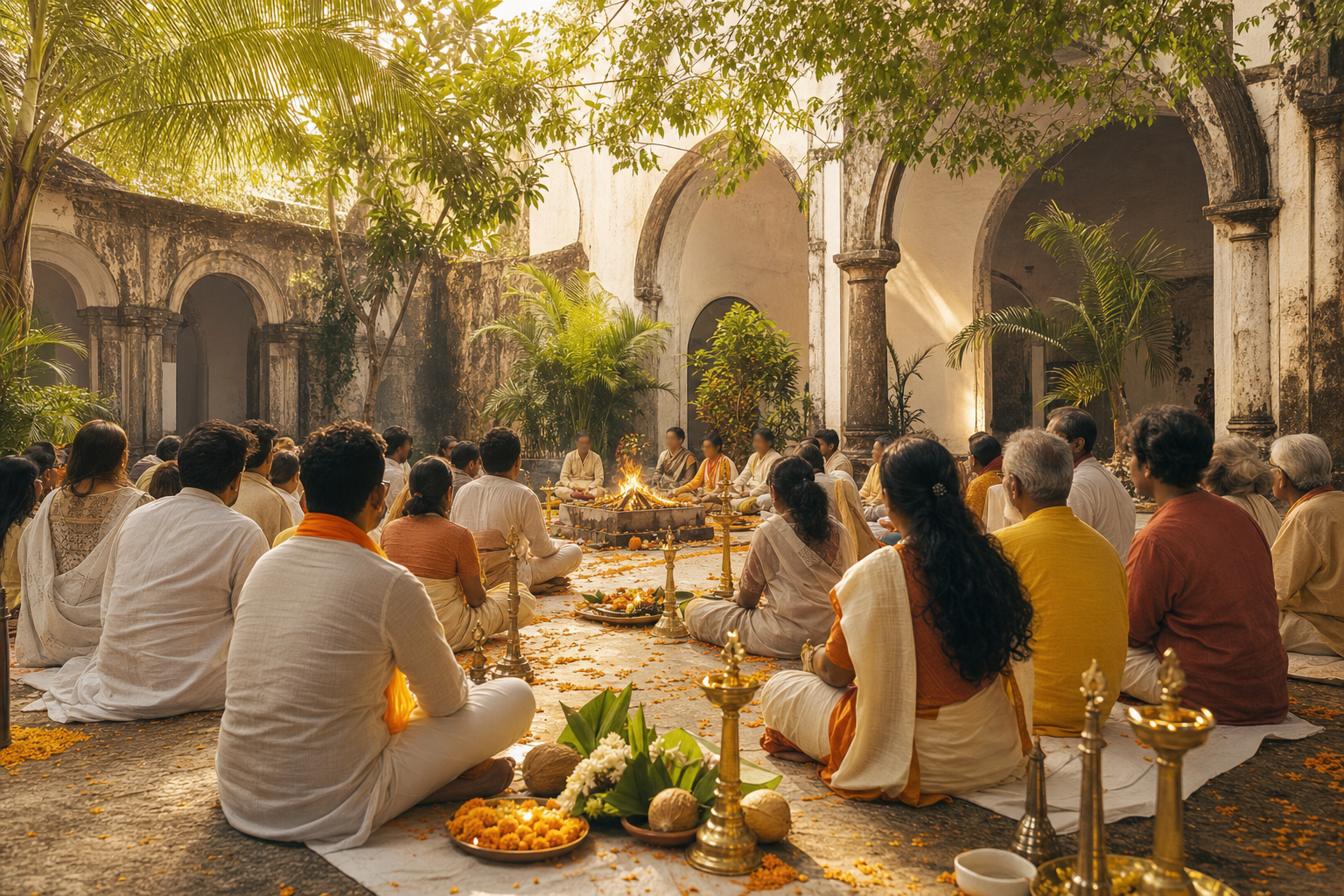
A faith-return ceremony in Old Goa brought 115 individuals into the Hindu fold under the blessings of Jagadguru Narendracharyaji, according to Hindu Jagruti Samiti. The report presents the gathering as one part of a much larger national effort.
The supplied source material is brief and truncated, so the event can be reported only within clear limits. What follows separates the source’s claims from broader analysis of why religious return, voluntary choice and civilizational belonging matter.
What Hindu Jagruti Samiti reports
Hindu Jagruti Samiti describes the Old Goa ceremony as the return of 115 people to their original Hindu faith. Its headline associates the occasion with Jagadguru Narendracharyaji, while the available excerpt says that the ceremony formed part of a nationwide campaign.
The source further claims that more than 1.5 lakh people have returned through this wider campaign. That cumulative figure is the source’s own account; the excerpt provides no supporting records, timeframe or method by which it was calculated.
Key takeaways
- The source reports that 115 individuals participated in a Hindu faith-return ceremony in Old Goa.
- Jagadguru Narendracharyaji is identified as the spiritual figure whose blessings accompanied the occasion.
- The gathering is presented as part of a nationwide campaign that the source says has reached more than 1.5 lakh people.
- The available material does not provide participant testimonies, a date, detailed ceremonial information or independent verification.
Why the language of return carries significance
Describing the ceremony as a return rather than simply a conversion expresses a particular understanding of identity. For supporters of such initiatives, the language suggests reconnection with ancestral memory, inherited customs and a Hindu civilizational home. It places continuity at the center of the story.
Responsible coverage must nevertheless preserve the distinction between an organizer’s description and the personal experiences of participants. Religious affiliation is intimate and consequential. A return has lasting meaning when it reflects informed, voluntary conviction and when those involved are treated as people with agency rather than as numbers in a campaign total.
A wider dharmic understanding of belonging
Hindu traditions contain many sampradayas, teachers and forms of worship while remaining connected through the broad civilizational framework of dharma. That capacity to sustain diversity without demanding uniformity is also relevant to relations among the distinct Hindu, Buddhist, Jain and Sikh traditions.
These paths are not interchangeable, yet they share a cultural landscape shaped by moral responsibility, disciplined spiritual practice, compassion, service and the search for liberation or higher truth. A confident dharmic renaissance can therefore strengthen Hindu continuity while respecting the integrity of neighboring dharmic communities. Unity is most durable when it grows from mutual regard rather than the erasure of differences.
What fuller reporting should establish
A more complete account would need to document when the Goa ceremony occurred, who organized it, what rites were conducted, how participants described their decisions and how the nationwide total was compiled. Those details would help readers assess both the human meaning of the event and the scale claimed for the campaign.
Future coverage should place participant voices and transparent documentation alongside civilizational interpretation. That combination would give the public a clearer understanding of how voluntary religious return is unfolding within contemporary Hindu society.
Inspired by this post on Hindu Jagruti Samiti.
