
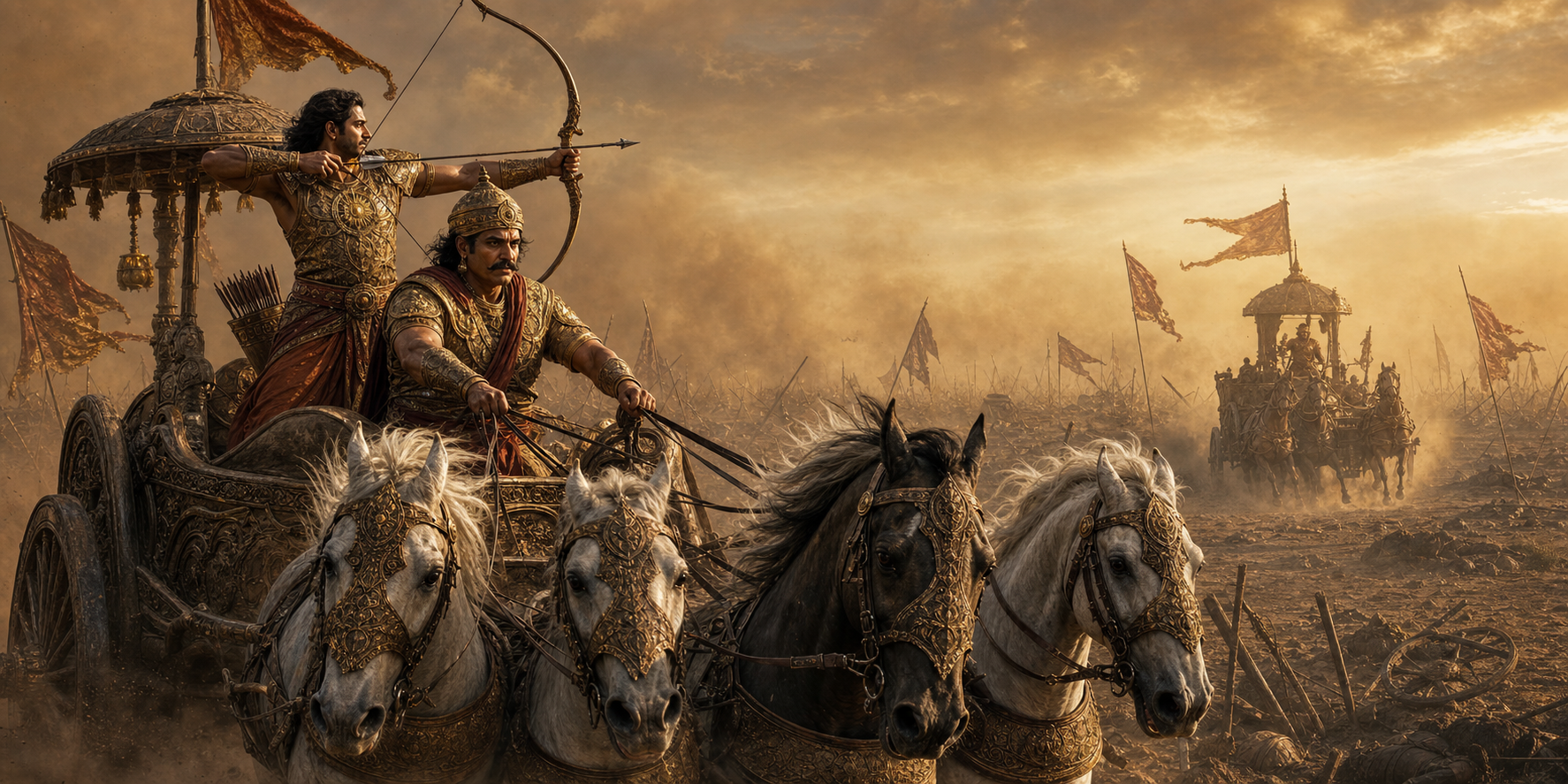
Shalya’s importance in Karna’s final battle lies in a disturbing mismatch: the warrior received an accomplished charioteer but not a dependable ally. The DharmaRenaissance account presents this arrangement as the result of competing promises, family loyalties, and a strategy designed to reach Karna through his most vulnerable point: his need to prove himself against Arjuna.
Seen in that wider frame, Shalya neither personally caused Karna’s death nor stood beside him as a merely passive driver. His counsel added psychological pressure to a warrior already constrained by earlier choices, lost advantages, curses, and the demands of a decisive duel.
A promise placed Shalya on the wrong side of his loyalties

According to the DharmaRenaissance account, Shalya was the king of Madra and the brother of Madri, making him the maternal uncle of Nakula and Sahadeva. His family connections and initial intention both drew him toward the Pandavas: he reportedly set out with an army to assist them.
Duryodhana altered that course through hospitality. The account says he arranged an elaborate welcome for Shalya, who accepted it under the impression that Yudhishthira was responsible. Shalya then promised a boon to his host and learned only afterward that the beneficiary was Duryodhana. Royal honor and fidelity to his word consequently bound him to the Kaurava side.
This background makes Shalya’s later conduct more complex than a simple betrayal. His obligation to Duryodhana conflicted with his affection for the Pandavas, but neither obligation disappeared. The conflict also explains why Yudhishthira reportedly did not demand that Shalya repudiate his promise. Instead, he asked Shalya to act within the situation that had already been created.
The request was conditional and precise: if Shalya became Karna’s charioteer, he should weaken Karna’s confidence and remind him of Arjuna’s superiority. Shalya agreed. Yudhishthira thus converted an unfavorable political commitment into a psychological advantage without asking Shalya to damage the chariot or attack its warrior.
Why the charioteer’s conduct could affect the duel
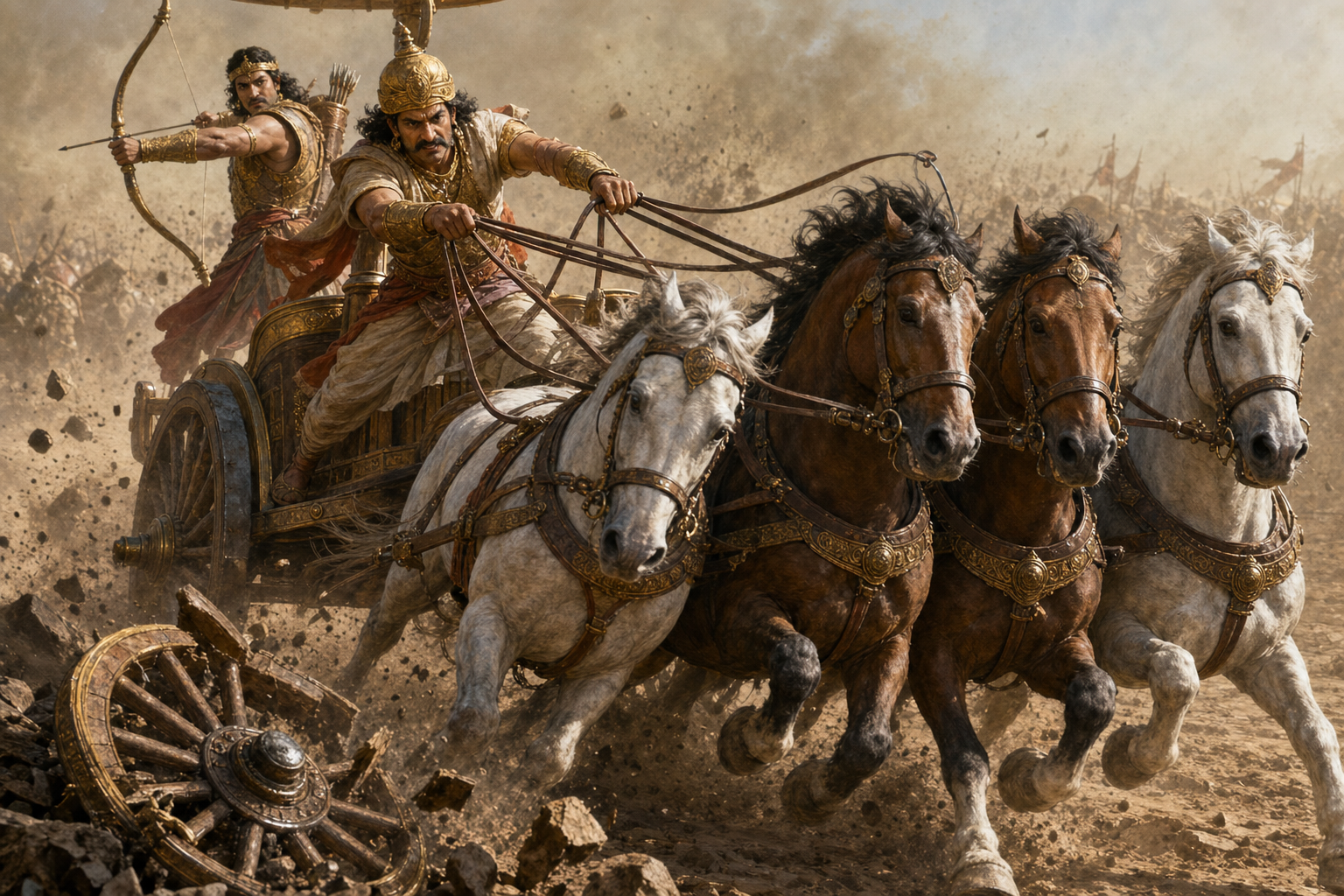
The significance of the plan depends on the charioteer’s responsibilities. As the source explains, a sarathi did more than handle horses. The role included judging terrain, positioning the warrior, watching the opponent’s weapons, managing timing, and advising the fighter under pressure. Technical competence and mental coordination therefore had to work together.
Duryodhana reportedly viewed Shalya’s royal standing and skill with horses as qualities that could help Karna answer the advantage Arjuna possessed in Krishna. On a purely operational level, the choice made sense. Yet the arrangement concealed a serious weakness: Karna and Shalya did not share the unity of purpose that connected Arjuna and Krishna.
The source uses that contrast to illuminate the charioteer’s psychological function. Krishna steadies Arjuna’s attention and reinforces his understanding of the conflict, whereas Shalya challenges Karna’s self-assurance and provokes irritation. One chariot becomes a place of alignment; the other contains an argument at the moment cooperation is most necessary.
This distinction also clarifies why Shalya’s words mattered without becoming supernatural causes. Advice can affect attention, judgment, emotional control, and the relationship between warrior and driver. In a duel requiring exact coordination, conflict inside the chariot becomes part of the battlefield itself.
Shalya intensified Karna’s pressure but did not create it
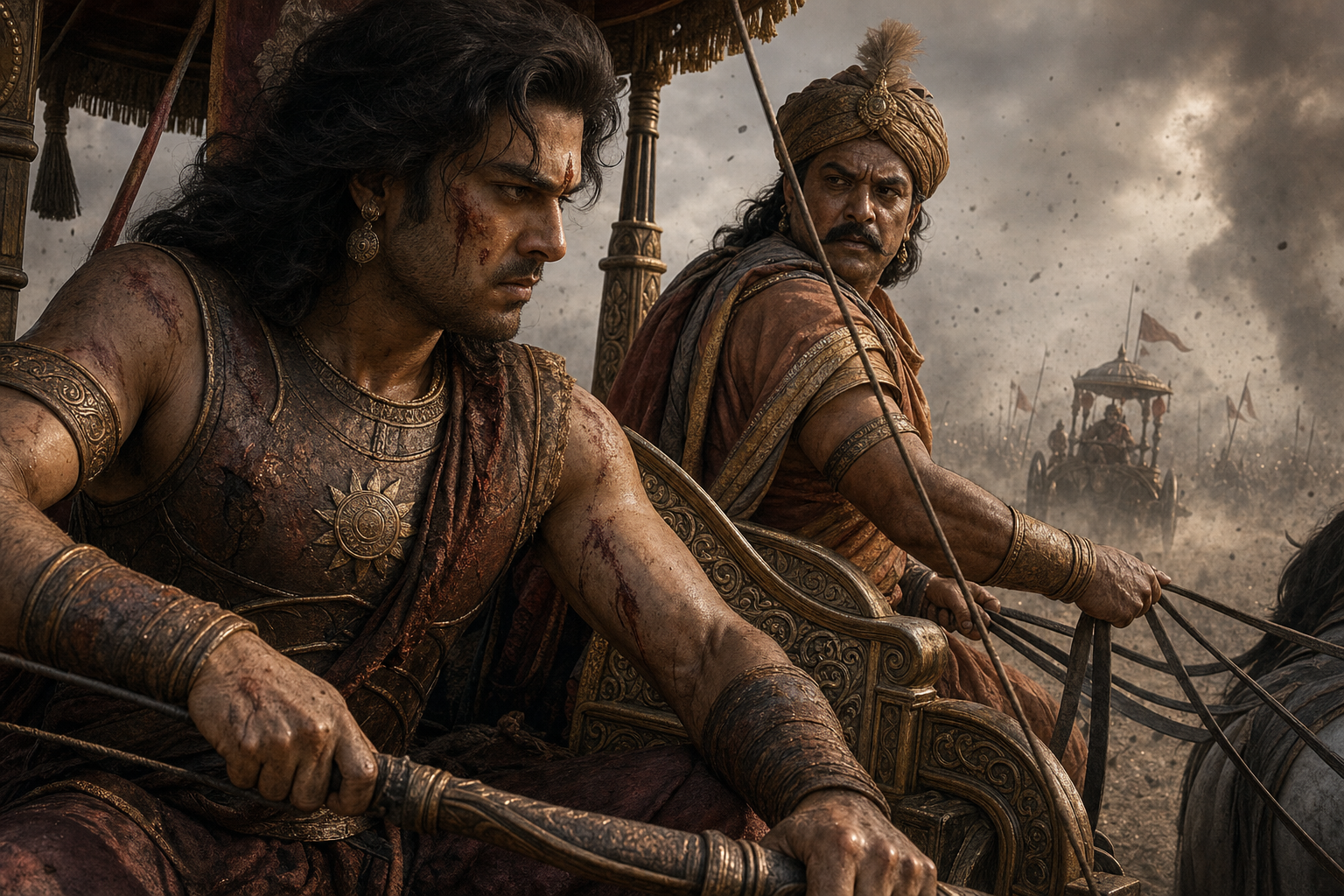
The DharmaRenaissance account reports that Shalya praised Arjuna, compared Karna unfavorably with him, questioned his boasts, and challenged the arrogance within his confidence. These remarks were especially pointed because rivalry with Arjuna touched Karna’s long struggle for recognition.
Karna’s history, as presented by the source, made that pressure unusually potent. He was born to Kunti before her marriage, raised by Adhiratha and Radha, and burdened by contested social standing. His gratitude to Duryodhana produced a sincere loyalty, even though it also kept him attached to a cause the account characterizes as ethically compromised. His generosity and courage coexist with responsibility for choices such as supporting Duryodhana and participating in Draupadi’s humiliation.
Shalya’s counsel therefore struck an existing wound rather than inventing a new weakness. Karna entered the duel carrying rivalry, fatigue, loyalty, pride, and the consequences of earlier decisions. A supportive charioteer might have helped contain those pressures. Shalya instead amplified them.
Even so, the source explicitly resists making Shalya the sole explanation for Karna’s fall. It identifies several other conditions: Parashurama’s curse affecting Karna’s access to divine knowledge at the critical time; the Brahmana’s curse associated with the sinking chariot wheel; Indra’s acquisition of Karna’s kavacha and kundala; and Karna’s earlier use of the Vasavi Shakti against Ghatotkacha. Shalya’s conduct belonged to this accumulated chain of disadvantages and consequences.
The most defensible causal judgment is therefore limited but substantial. Shalya did not determine every event in the duel, erase Karna’s agency, or single-handedly defeat him. He deprived Karna of the stabilizing partnership that a charioteer could have provided and added doubt when composure had exceptional value.
Key takeaways
- Shalya joined Duryodhana because a promise made after accepting hospitality conflicted with his kinship and sympathy toward the Pandavas.
- Yudhishthira reportedly asked for psychological interference, not mechanical sabotage or a physical attack on Karna.
- Shalya’s position mattered because a charioteer combined driving, battlefield judgment, tactical advice, and emotional support.
- His discouraging comparisons targeted Karna’s sensitivity about Arjuna and disrupted unity within the chariot.
- Karna’s fall remained multi-causal, involving earlier losses, curses, strategic decisions, personal choices, and Shalya’s demoralizing counsel.
The episode tests both strategy and dharma
Yudhishthira’s request complicates any portrayal of him as righteous but strategically naive. In the source’s interpretation, he recognized Shalya’s binding promise, accepted the political reality, and found a way to reduce Karna’s effectiveness. The maneuver relied on speech rather than physical treachery, but it still raises the ethical question of whether secretly undermining a warrior through his own charioteer was just.
The account places that question within the war’s reported background: the dice-game deception, Draupadi’s public humiliation, the Pandavas’ exile, failed attempts at peace, and Duryodhana’s refusal of a minimal settlement. That context explains the strategic rationale, though it does not make the moral discomfort vanish. The episode instead portrays dharma as judgment under conflicting obligations rather than a rule that eliminates ambiguity.
Shalya embodies that ambiguity. Keeping his promise to Duryodhana did not erase his relationship with the Pandavas; agreeing to Yudhishthira’s plan did not release him from service on Karna’s chariot. He fulfilled one obligation outwardly while advancing another through counsel. Karna, meanwhile, remained courageous and loyal but accountable for the alliances and actions that brought him to this crisis.
Future readings of the final duel can therefore look beyond the instant of Karna’s death to the divided chariot that preceded it. Shalya’s role shows how, in the epic’s moral world, the outcome of combat may turn not only on weapons but also on whether duty, trust, and speech hold a warrior’s inner world together.