
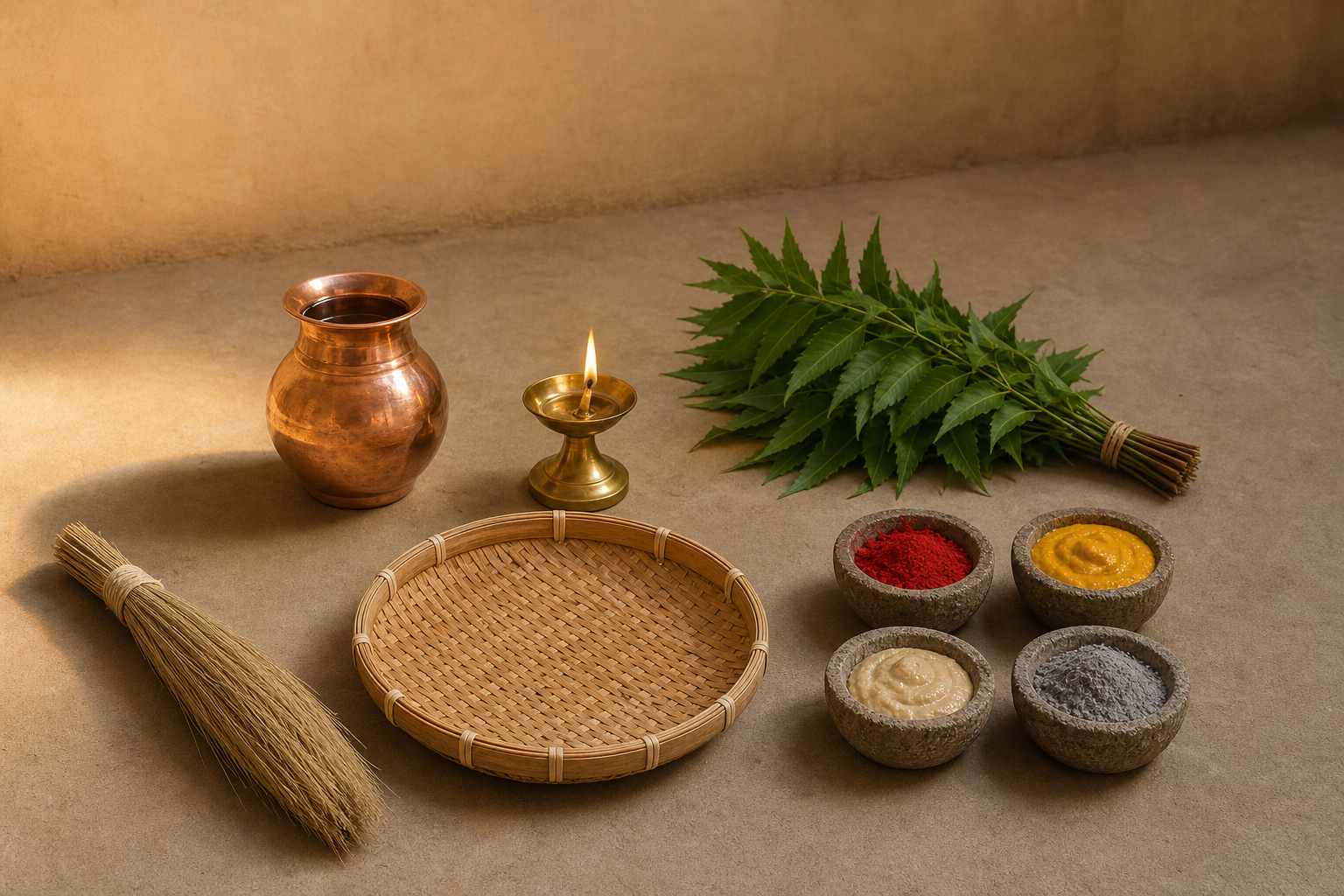
An altar vessel, a red powder, a broom, a leaf, and sacred ash can all carry religious significance, but not because Hindu traditions treat materials as interchangeable. Meaning arises through a relationship among an object’s physical qualities, its ordinary use, the ritual action performed with it, and the deity or lineage that gives it context.
Reading Shitala Mata’s household emblems alongside the substances used for tilak offers a practical way to interpret this sacred vocabulary. It also prevents two opposite errors: dismissing ritual objects as decorative props and assigning every object a fixed, universal definition.
A sacred grammar of material, action, and context
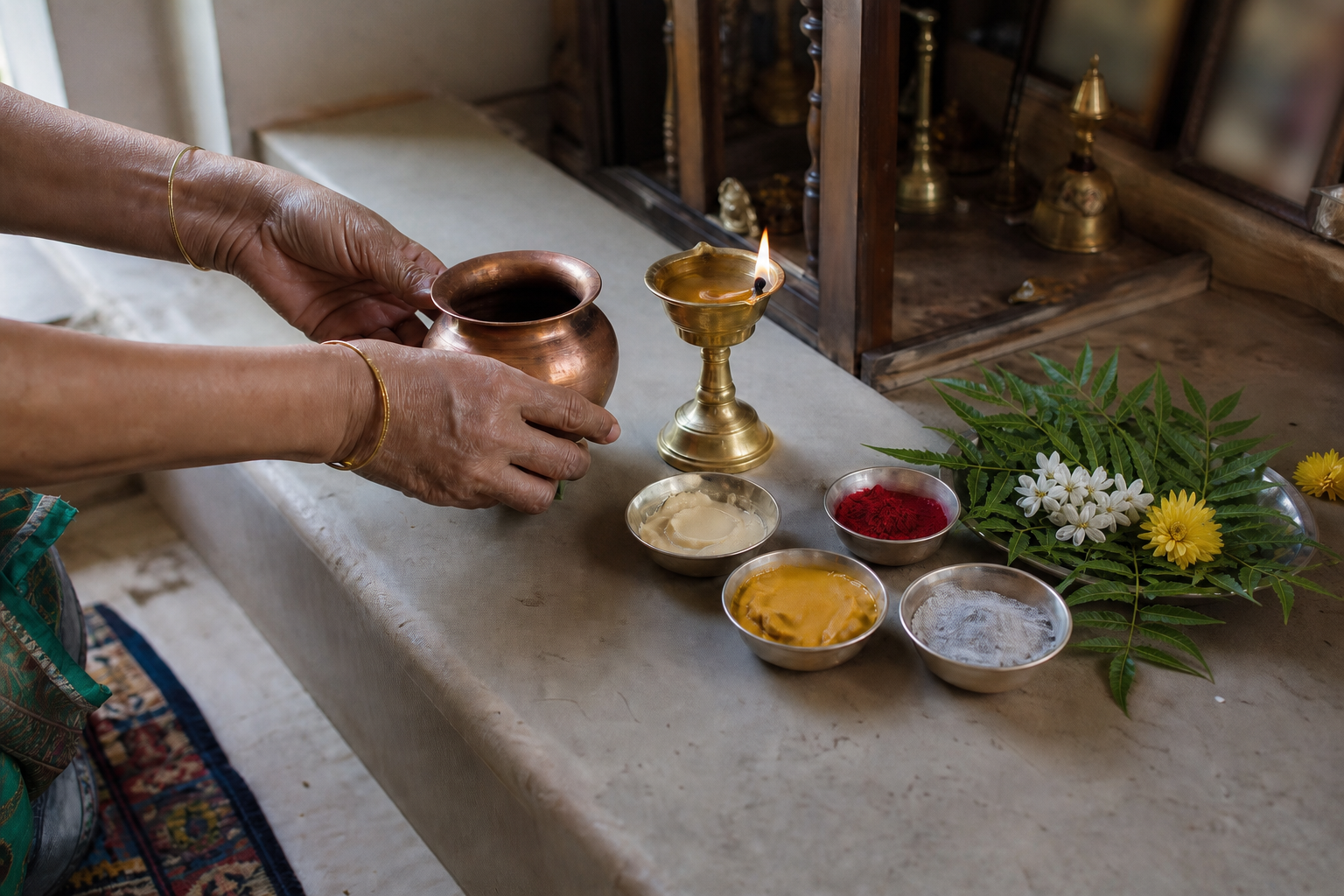
The source on Shitala Mata explains that an iconographic attribute may communicate at several levels. Its familiar function supplies one layer of meaning; ritual practice, regional narratives, and philosophical reflection may supply others. A broom can therefore remain an implement for sweeping while also representing the active removal of disorder.
The source on tilak reaches a compatible conclusion from another direction. It describes tilak not as one substance or design but as a category of sacred marks shaped by sampradaya, region, household custom, temple practice, personal observance, and the deity being worshipped. Colour alone cannot reveal whether a mark is kumkum, turmeric, sandalwood paste, vibhuti, gopi chandan, saffron, or a preparation received in a particular ritual setting.
Taken together, the sources support a relational understanding of sacred material. Physical properties matter: water cools, a broom sweeps, a winnowing tray separates, sandalwood is valued for coolness and fragrance, and ash recalls what has been consumed. Yet none of those properties automatically produces a complete religious meaning. Tradition interprets the property through a particular act, story, deity, or discipline.
Ritual status matters as well. The tilak source notes that kumkum offered in a temple may subsequently be received as prasada. The substance has not ceased to be powder, but its relationship to worship has changed how devotees receive it. Similarly, the Shitala source interprets ordinary tools in the goddess’s hands as emblems that dignify cleaning, caregiving, resource management, and other forms of frequently overlooked work.
Key takeaways
- Sacred meaning comes from material, action, placement, ritual history, and community context together.
- An object’s everyday function often supplies a metaphor, but the metaphor should not be mistaken for a scientific claim.
- Similar colours do not make saffron, kumkum, turmeric, sandalwood, and sacred ash ritually identical.
- Regional and sectarian variations are part of Hindu sacred culture, not defects that must be forced into one universal code.
Shitala Mata’s emblems turn household care into sacred action
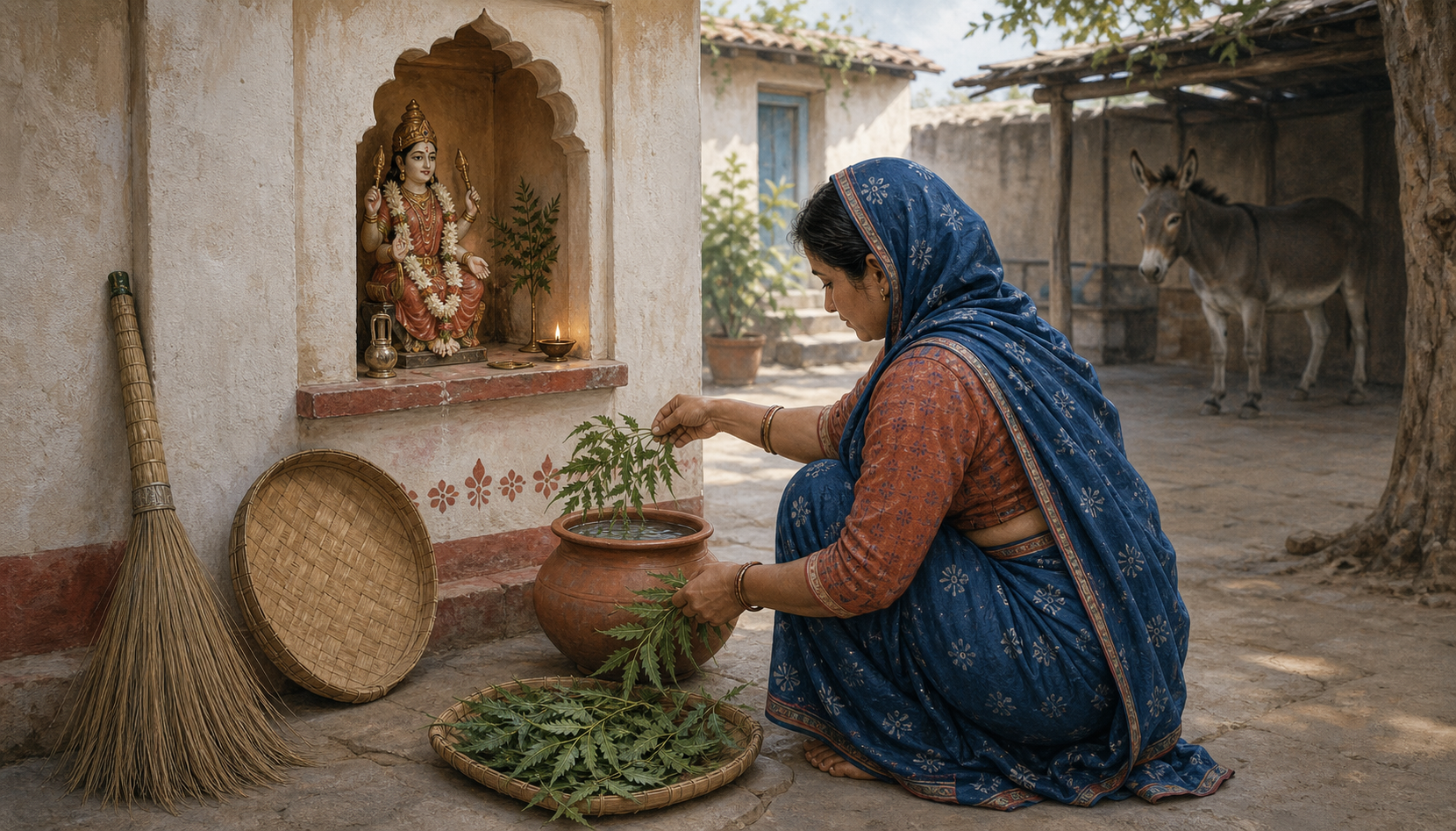
The Shitala Mata source connects the goddess’s name with shita, or coolness, and reports her historical association with protection from smallpox and other eruptive illnesses. In this devotional setting, cooling signifies relief not only from bodily heat but also from fear and social disturbance. Her broom, waterpot, winnowing tray, and associations with neem make that concern visible through objects familiar from courtyards, fields, kitchens, and sickrooms.
Sweeping and winnowing: two images of restoring order
The broom and winnowing tray are especially revealing because they are almost verbs as well as objects. A broom changes a neglected space by gathering and moving unwanted matter. The source consequently reads it as an emblem of cleanliness, disciplined attention, prevention, and the removal of accumulated disorder. On an ethical level, it can also direct attention toward the dignity and safety of the people whose labour maintains clean homes and communities.
A winnowing tray performs a different kind of ordering. It separates usable grain from unwanted material and can move air. The Shitala article therefore associates it with both a cooling current and discernment: the capacity to distinguish what should be preserved from what should be removed. The broom clears; the tray separates. Together they present care as intelligent, repeated work rather than passive hope.
The source explicitly cautions against treating these interpretations as evidence that earlier communities possessed modern germ theory. Clean surroundings may have practical value, but a contemporary public-health reading remains an interpretive extension, not proof of ancient microbiology. That distinction preserves both historical accuracy and the ethical relevance of the symbol.
Water and neem: relief, preservation, and protective purity
The waterpot answers the experience of fever with an image of cooling, hydration, and restoration. Within a wider Hindu ritual vocabulary, water also participates in cleansing, hospitality, and consecration. The vessel adds another dimension: it gathers and preserves a resource that must be held and distributed with care. Healing is pictured not merely as a feeling of compassion but as the organized provision of what sustains life.
The same source places neem within the practical ecology of traditional households and interprets it as a sign of protection and purity. It also notes an important variation: neem may be prominent in popular worship and healing customs even when it is not present in every formal representation of the goddess. Its devotional significance should not be inflated into a clinical claim that the cited material does not establish.
These emblems collectively locate wellbeing in a network of maintained spaces, preserved resources, cultivated plants, careful judgment, and human service. Their sacred force depends precisely on their familiarity. Shitala Mata’s iconography does not require ordinary life to be left behind before care can become religiously meaningful.
Tilak materials show why colour is an unreliable shortcut
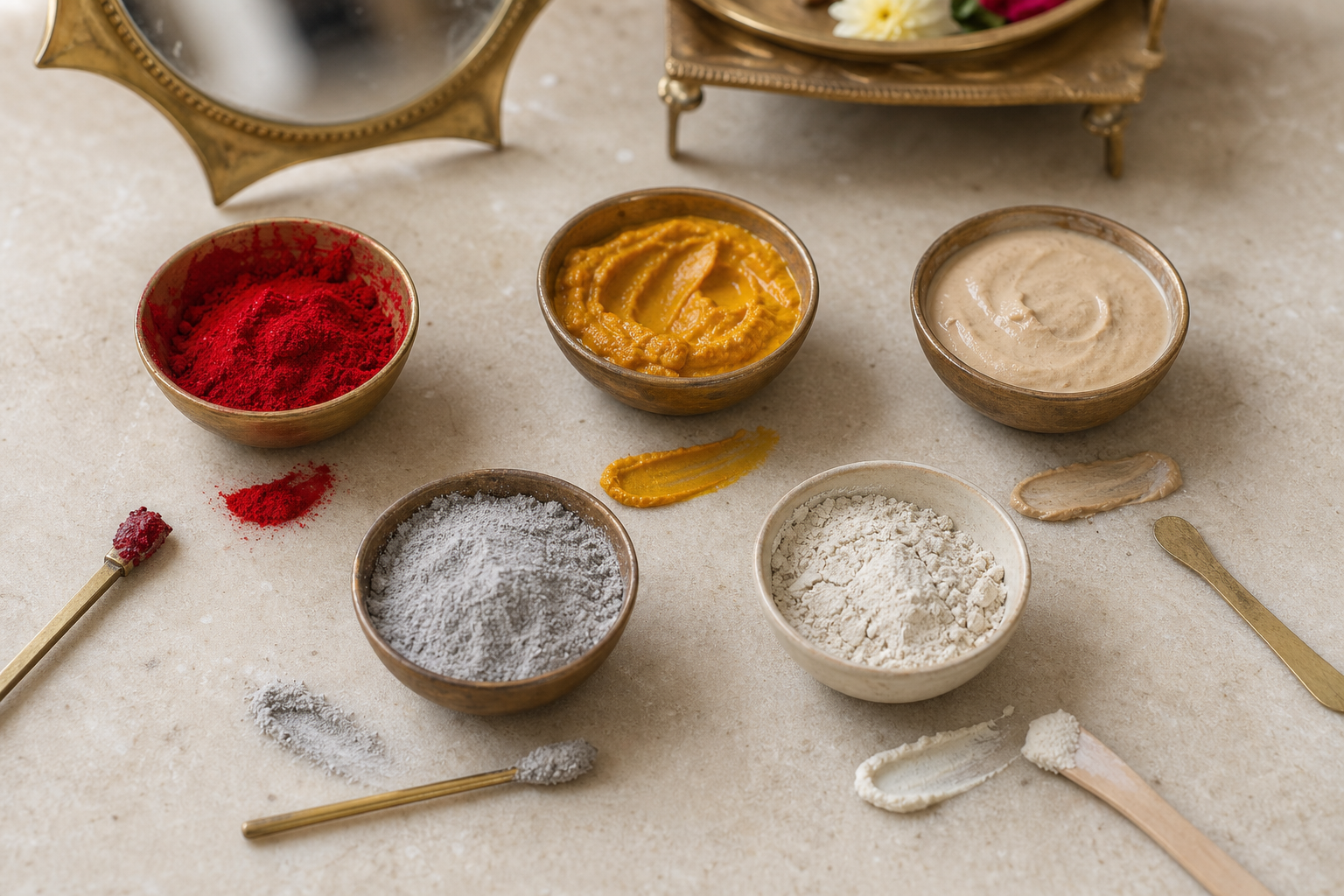
If Shitala Mata’s emblems sacralize actions around the household, tilak brings sacred material directly onto the body. The tilak source associates the forehead, particularly the area between the eyebrows, with the Ajna Chakra, concentration, insight, and spiritual awareness. Applying a mark there can express remembrance, discipline, affiliation, or receipt of a deity’s grace, depending on the tradition.
The substance must still be identified accurately. The source describes traditional kumkum as commonly made by processing turmeric with slaked lime, producing a change from yellow toward red in an alkaline medium. It connects kumkum with auspiciousness, Devi worship, protection, prosperity, and, in several regional customs, married life. Saffron, by contrast, is described as the dried stigmas of the saffron crocus: a valuable botanical ingredient that may appear in special ritual preparations but is not the everyday basis of most tilaks.
Other materials articulate other relationships. The source associates horizontal lines of vibhuti with Shaiva practice, purification, and the transience of the body. It links Vaishnava forms of urdhva pundra made with gopi chandan to surrender before Vishnu or Krishna. Shakta practice may emphasize kumkum, while Smarta households may use sandalwood, turmeric, kumkum, or sacred ash according to the occasion. These are reported patterns rather than rules that erase temple, household, or regional differences.
This precision also clarifies the difference between saffron as a traded spice and bhagwa as a sacred colour. The tilak source argues that the symbolism of saffron or ochre robes does not depend on cloth containing saffron threads. The colour has a ritual and civilizational association with renunciation, discipline, sacrifice, courage, and knowledge. A commodity’s geographic origin and a colour’s inherited symbolism answer different questions.
The larger lesson is not that physical material is unimportant. It is that material identity, visual resemblance, and ritual meaning must not be collapsed into one category. Kumkum is not saffron merely because both can contribute to red or orange visual worlds, just as every forehead mark cannot be assigned the same theology from its colour alone.
Reading sacred materials with precision and proportion
A sound interpretation begins by identifying the object or substance before assigning symbolism. It then asks what the material ordinarily does, what action the ritual performs with it, where it appears, and which community transmits that use. Finally, it checks whether the proposed meaning is widespread, regional, sectarian, temple-specific, or a modern ethical interpretation.
The comparison between Shitala’s attributes and tilak makes the value of this method clear. The goddess’s implements direct attention outward toward spaces, resources, illness, and collective care. Tilak directs attention toward sacred embodiment, remembrance, and lineage. Both nevertheless transform familiar matter through disciplined action: the household implement becomes divine iconography, while powder, paste, clay, or ash becomes a mark of relationship.
Three boundaries protect that interpretation from exaggeration. Regional variation should not be presented as contradiction; a devotional symbol should not be recast as proof of a modern scientific mechanism; and a sacred practice should not be reduced to the trade history of one possible ingredient. Cultural literacy advances when distinctions such as object and action, substance and colour, symbolism and efficacy, or commodity and consecrated offering remain visible.
Future discussion of Hindu ritual culture can become more useful by documenting who uses a material, how it is prepared, what rite gives it status, and where interpretations differ. Such precision allows living traditions to be studied without freezing their plurality or stripping ordinary acts of their sacred depth.
References
- DharmaRenaissance Blog — Shitala Mata’s Sacred Emblems: How Broom, Waterpot, Neem, and Tray Teach Healing
- HinduPost — Priyank Kharge, Kesar and Tilak: The Essential Truth Behind Kumkum