
The alternative-land dispute is narrower than the larger battle over the Dhar Bhojshala complex, but it raises a consequential question: what relief, if any, may be considered for a community whose claimed worship rights at a protected monument have been displaced by a court’s ruling?
A July 11, 2026, DharmaRenaissance report says National Development Volunteers, also known as Rashtriya Vikas Swayamsevak, intends to file a Special Leave Petition challenging the Madhya Pradesh High Court’s observation that the state may consider an application for land for a mosque or prayer space. The distinction between considering an application and ordering an allotment is central to understanding what this proposed litigation would actually test.
The High Court did not allot land for a mosque
According to the report, the Indore Bench of the Madhya Pradesh High Court issued a common judgment on May 15, 2026, in petitions concerning worship, conservation and administration at the Bhojshala-Kamal Maula complex. The bench comprised Justice Vijay Kumar Shukla and Justice Alok Awasthi.
The judgment reportedly held that the disputed area had been a protected monument since March 18, 1904, and that its religious character was that of Bhojshala, with a temple dedicated to Vagdevi, or Saraswati. It quashed the relevant part of an Archaeological Survey of India order dated April 7, 2003, under which Hindu worship had been limited to specified occasions while Friday namaz was permitted at the complex.
The alternative-land language appears in paragraph 211(vii). As described by the report, it allows the Madhya Pradesh government to consider an application from the Muslim side or an appropriately constituted Waqf body for suitable permanent land in Dhar district for a mosque, prayer space and related facilities. The governing phrases are "may consider" and "in accordance with law."
That formulation did not identify a plot, direct an immediate transfer, approve construction or declare that an applicant was automatically entitled to government land. An application would first have to be made, and any state response would remain subject to the applicable legal process. The proposed challenge therefore concerns judicial authorization for possible executive consideration, not a completed allotment.
Key takeaways
- The High Court reportedly recognized the disputed site’s religious character as Bhojshala and a Vagdevi temple while ending the shared-access arrangement created by the relevant portion of the 2003 ASI order.
- The court did not award a particular parcel for a mosque; it said the state may consider a legally submitted application.
- The proposed National Development Volunteers petition would challenge that limited alternative-land observation, while Muslim parties have reportedly challenged the principal ruling on the site’s character and Friday prayers.
- A Special Leave Petition is not an appeal available as of right. Supreme Court review under Article 136 is discretionary, and the precise pleadings and requested relief will determine the scope of any proceedings.
The opposing petitions address different parts of the judgment
The report describes two challenges moving in opposite directions. Muslim parties have reportedly approached the Supreme Court against the High Court’s central conclusions: the identification of the complex as a temple and the termination of Friday namaz there. The proposed National Development Volunteers SLP would leave those conclusions intact while attacking the separate possibility of alternative land.
This difference matters because success for one challenge would not necessarily resolve the other. A review of the monument’s religious character, evidentiary record or former prayer arrangement presents different legal questions from a challenge to the state’s ability to consider compensatory or accommodative relief elsewhere. The Supreme Court could potentially connect the proceedings, as the source notes, but their legal objects would remain distinct.
The announced campaign has used the slogan "No Legal Land for an Illegal Mosque." The report appropriately distinguishes that advocacy language from the judgment itself. The High Court did not use the alternative-land direction to validate a mosque within Bhojshala, nor did it characterize a future mosque on another site as unlawful. The slogan expresses the challengers’ position; it is not a substitute for the order’s actual terms.
The report also says the proposed initiative has the support of Dwarka Shankaracharya Swami Sadanand Saraswati. That support adds religious and public significance to the campaign, but the Supreme Court’s threshold inquiry would remain legal: whether to grant special leave and, if it does, which part of the High Court’s relief requires examination.
The site’s status explains why the remedy is contested
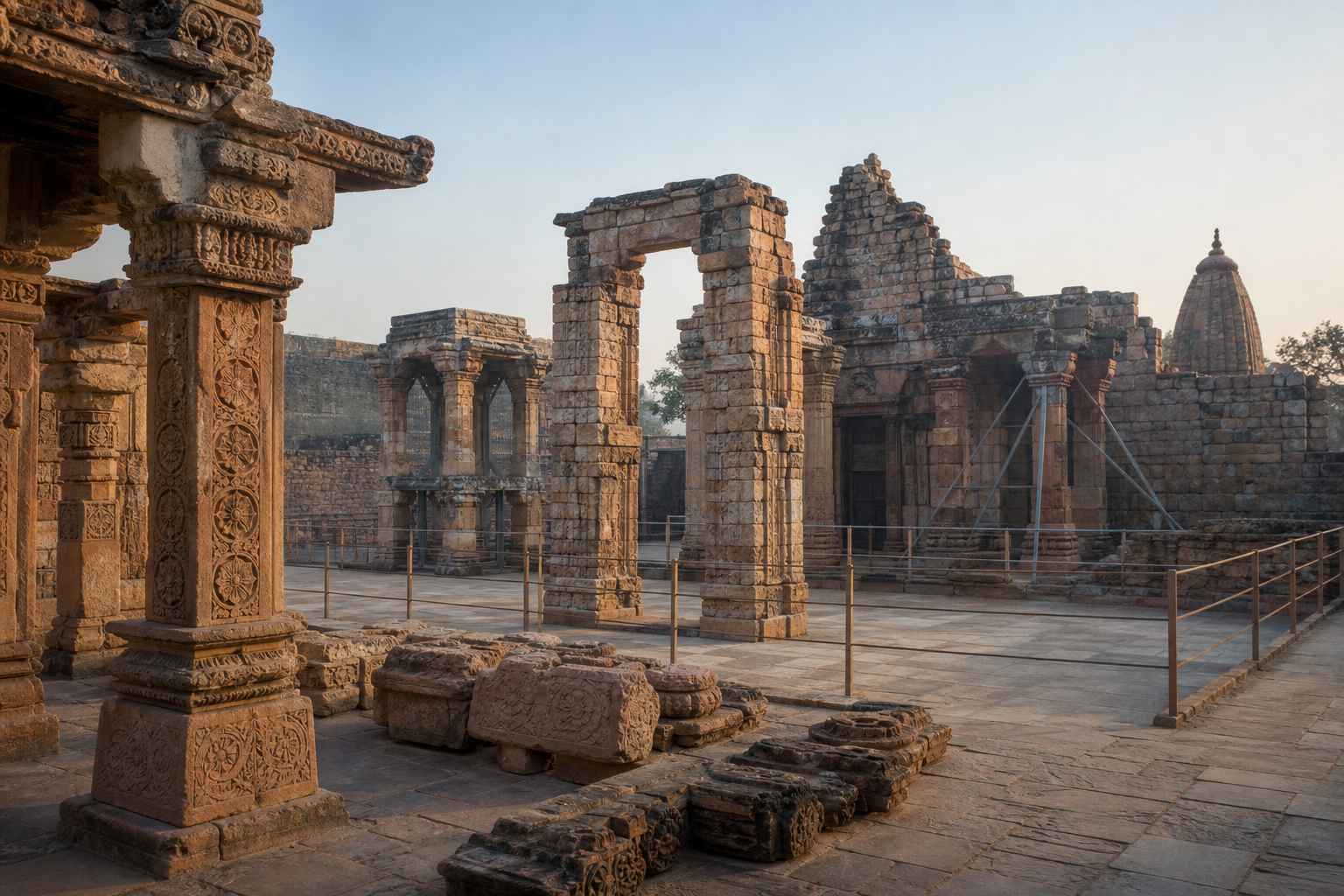
Bhojshala’s association with Raja Bhoj and Sanskrit learning gives the dispute a civilizational dimension beyond control of a medieval structure. The source describes the Hindu claim as connecting the complex with Vagdevi Saraswati, scholarship and the educational patronage of the eleventh-century Paramara ruler. It also reports that Muslims have associated the complex with the Kamal Maula Mosque, the Sufi figure Kamaluddin Chishti and a history of prayer recognized under administrative arrangements.
The High Court’s conclusions were reportedly informed by a judicially supervised ASI investigation presented in ten volumes. The material included archaeological, structural, epigraphic, scientific, photographic and video records. The source says the investigation used ground-penetrating radar, GPS mapping, architectural documentation, stratigraphic examination and compositional analysis.
According to the report’s account of the judgment, the evidence included reused architectural material, numerous pillars and pilasters, sculptures and fragments bearing temple imagery, and more than 150 Sanskrit and Prakrit inscriptions. The court accepted these elements as supporting the conclusion that the surviving monument incorporated an earlier and larger Paramara-period temple and educational complex associated with Saraswati worship.
Muslim parties reportedly disputed the survey’s neutrality, methods and interpretation, including the historical significance assigned to reused architectural components. The High Court rejected those objections, referring to the presence of nominated representatives and the multidisciplinary composition of the technical team. Those disagreements remain relevant to the principal appeal, but they do not by themselves answer whether the state may consider a different site for prayer.
The remedial controversy arises precisely because the judgment combined a decisive finding about Bhojshala with an attempt to account for the religious interests affected by that finding. Supporters of the proposed SLP may argue that alternative land improperly attaches a benefit to a rejected claim. Defenders of the paragraph may answer that an option for lawful consideration elsewhere neither changes the monument’s adjudicated character nor guarantees an allotment. The Supreme Court would have to assess the operative language, not merely the competing political descriptions of it.
What to watch if the proposed petition is filed
The source reports an intention to file an SLP, not a final Supreme Court disposition. Until the proposed pleadings and requested relief are known, the exact grounds of challenge should not be presumed. An important initial issue will be whether the Court sees a reason to intervene in a permissive direction that has not itself transferred land.
The relationship between the two sets of proceedings will also be significant. If the challenge brought by the Muslim parties places the High Court’s foundational findings under review, the Court may need to decide whether the alternative-land question can be considered independently or should await resolution of the main dispute. It may hear related issues together, link them procedurally or keep their remedies separate, depending on the cases placed before it.
Any future state action would create another layer of scrutiny. Because the reported direction requires consideration according to law, a request would still need to pass through the relevant administrative and legal requirements. Judicial permission to consider a proposal should therefore remain distinct from an executive decision to grant it.
The next phase will clarify whether paragraph 211(vii) survives as a narrow accommodation, is limited further, or is examined alongside the broader appeal over Bhojshala itself. Until then, the legally accurate description remains modest: the High Court reportedly opened a route for an application, while the announced SLP seeks to close that route before it produces an allotment.