
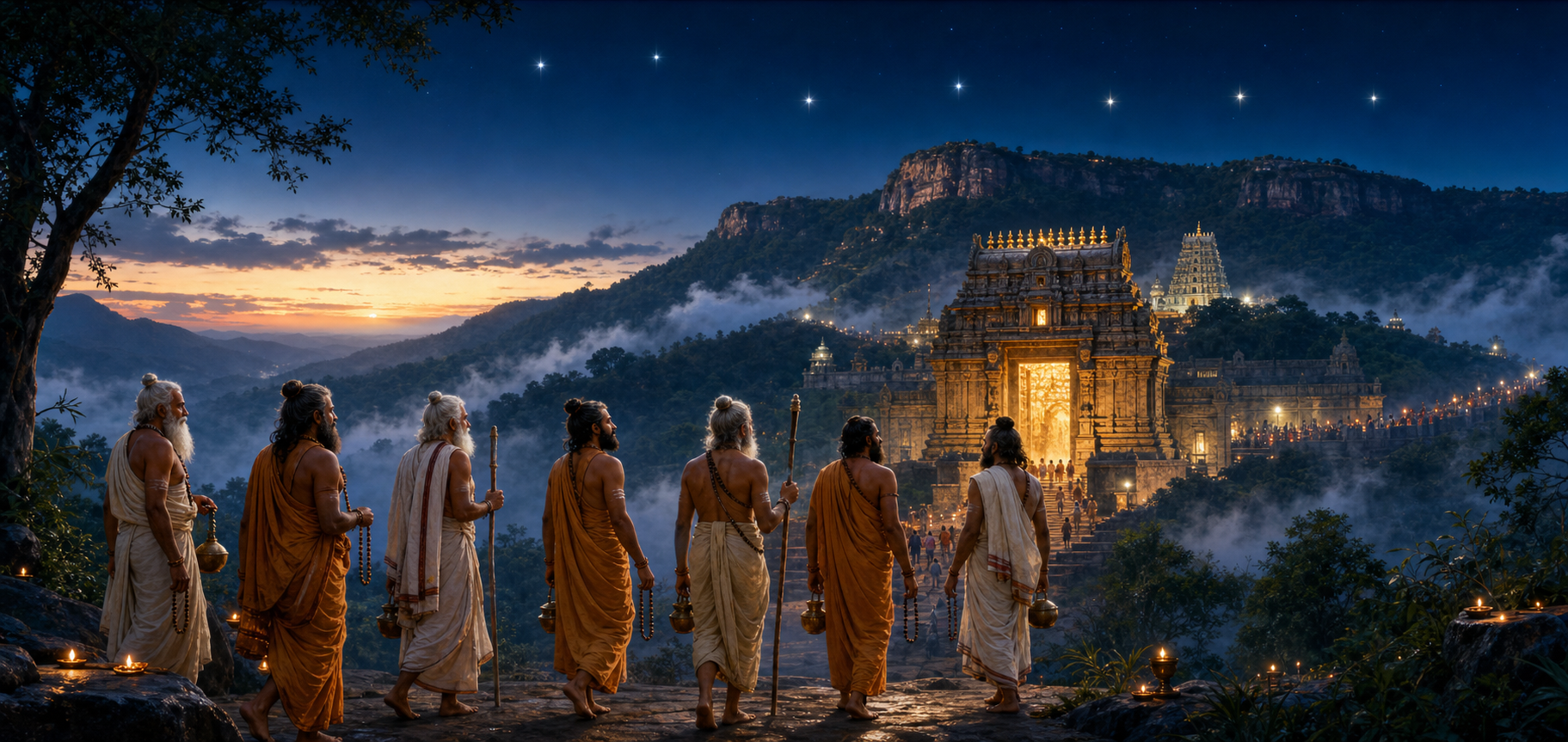
A Tirumala tradition places the Saptarishis among the worshippers who approach Lord Venkateswara on Vaikunta Ekadashi. The account is significant not as a conventional record of a datable visit, but as a devotional explanation of who is believed to be present when sacred time, temple worship and divine grace converge.
Read in that setting, the tradition connects four ideas: Tirumala as an earthly Vaikunta, the continuing presence of the ancient sages, darshan as a reciprocal encounter and Vaikunta Ekadashi as an opening toward spiritual transformation. Those connections reveal why the story remains meaningful even though its claims belong to sacred narrative rather than ordinary historical reporting.
A sacred claim about an ever-accessible Vaikunta
The source article presents the tradition within a narrative about the beginning of Kali Yuga. In that account, Lord Vishnu leaves his celestial abode and establishes himself in the Tirumala Hills as Lord Venkateswara. The Saptarishis, unable to behold him in Vaikunta, ask to receive his darshan at Tirumala at least once each year. Their request is granted for Vaikunta Ekadashi.
This sequence establishes the theological premise behind the tradition: Tirumala is not merely a site commemorating a divine presence located elsewhere. It is understood as Kaliyuga Vaikunta, an earthly place where Vishnu remains accessible in the present cosmic age. The sages therefore travel toward the same divine presence sought by human pilgrims, although the tradition places their worship in a celestial register.
The article describes the vision granted to the sages as Viswaroopa Darshan. While the Sanskrit term is widely associated with the universal form of the divine, its function here is specifically devotional. It signifies an exceptional revelation of Lord Venkateswara’s fullness and sovereignty; the account does not need to supply a detailed visual description for the expression to communicate the magnitude of the encounter.
Why the identity of the seven sages matters
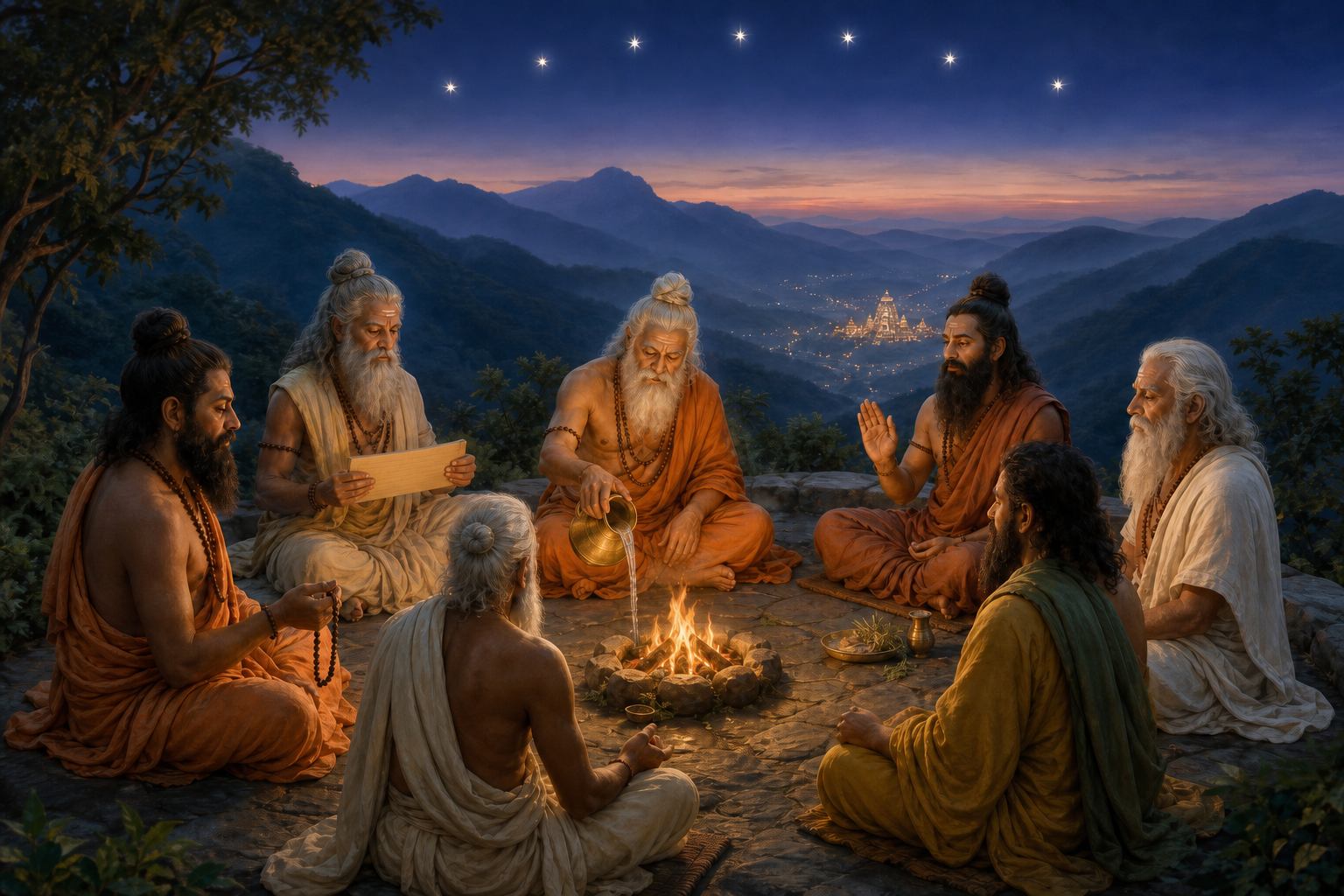
The seven figures named in the Tirumala account are Vashistha, Marichi, Pulastya, Pulaha, Atri, Angiras and Kratu. The source identifies this as a recognized Puranic grouping while also noting that Hindu texts do not preserve one unchanging Saptarishi list for every context. Different enumerations can be associated with different cosmic cycles, genealogies or theological purposes.
That variation does not weaken the narrative’s central point. The named sages are linked in the source with sacred knowledge, cosmic ancestry and the transmission of dharma. Vashistha is remembered as a Brahmarishi and teacher; Marichi belongs to creation narratives and is genealogically associated with Kashyapa; Atri is connected with Anasuya and Dattatreya; and Angiras is associated with Vedic revelation, sacred fire and teaching lineages. Pulastya, Pulaha and Kratu likewise occupy foundational cosmological genealogies.
The story consequently reverses a possible assumption about spiritual attainment. These sages possess extraordinary knowledge, yet knowledge does not make darshan unnecessary. Their stature is expressed through their longing to see the Lord. Wisdom culminates in reverence, and spiritual authority remains subordinate to the divine presence.
The source also connects the sages with the seven-star formation known in India as the Saptarishi Mandala, corresponding to the prominent pattern in Ursa Major. Within the article’s interpretation, this astronomical association reinforces continuity and vigilance: the sages belong not only to remembered antiquity but also to an enduring cosmic order.
How Vaikunta Ekadashi joins cosmic and temple time
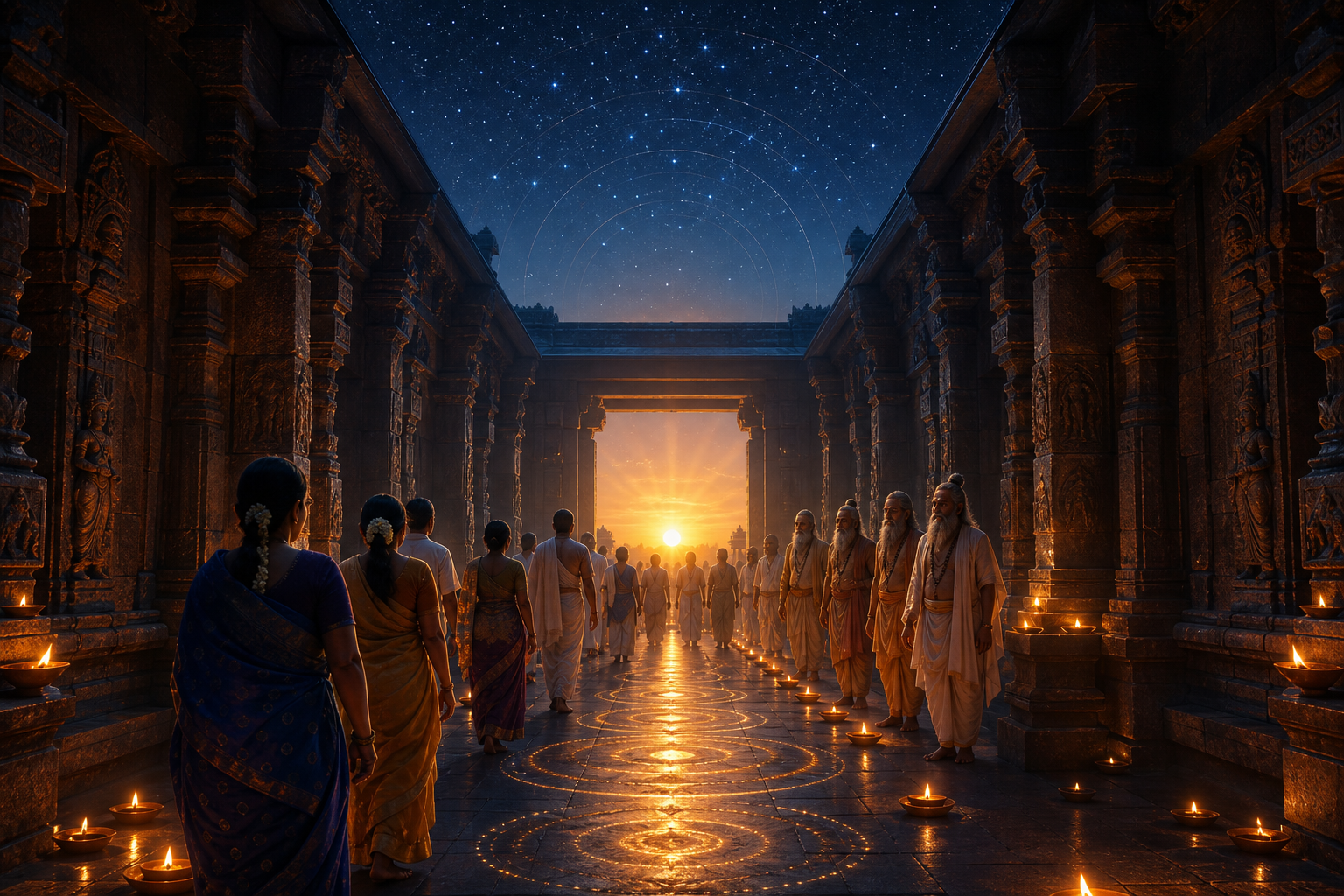
Ekadashi is the eleventh lunar day of a fortnight, and Vaikunta Ekadashi occurs during the bright fortnight of Dhanurmasa. Because its observance follows a lunisolar calendar, its Gregorian date changes from year to year. The source reports that the Tirumala observance is also called Mukkoti Ekadashi and relates that name to the devotional belief that vast hosts of divinities assemble for the darshan of Lord Srinivasa.
The annual visit of the Saptarishis fits naturally within this wider picture. Vaikunta Ekadashi is thereby understood as more than a heavily attended human festival. The temple becomes the meeting point of human pilgrimage and celestial worship, while the recurring festival makes sacred history present again. Time is not treated solely as a line separating a legendary past from the present; ritual allows the underlying divine encounter to recur.
The same relationship appears in the Vaikunta Dwaram, the sacred passage associated with entry into Vaikunta. The article, citing Tirumala Tirupati Devasthanams descriptions, identifies it with the Mukkoti Pradakshinam and reports its opening in connection with Vaikunta Ekadashi and Vaikuntha Dwadasi. It also cautions that contemporary access arrangements can be changed or extended for crowd management, so practical plans should be based on current official notices.
Ritual, darshan and the limits of a mechanical reading
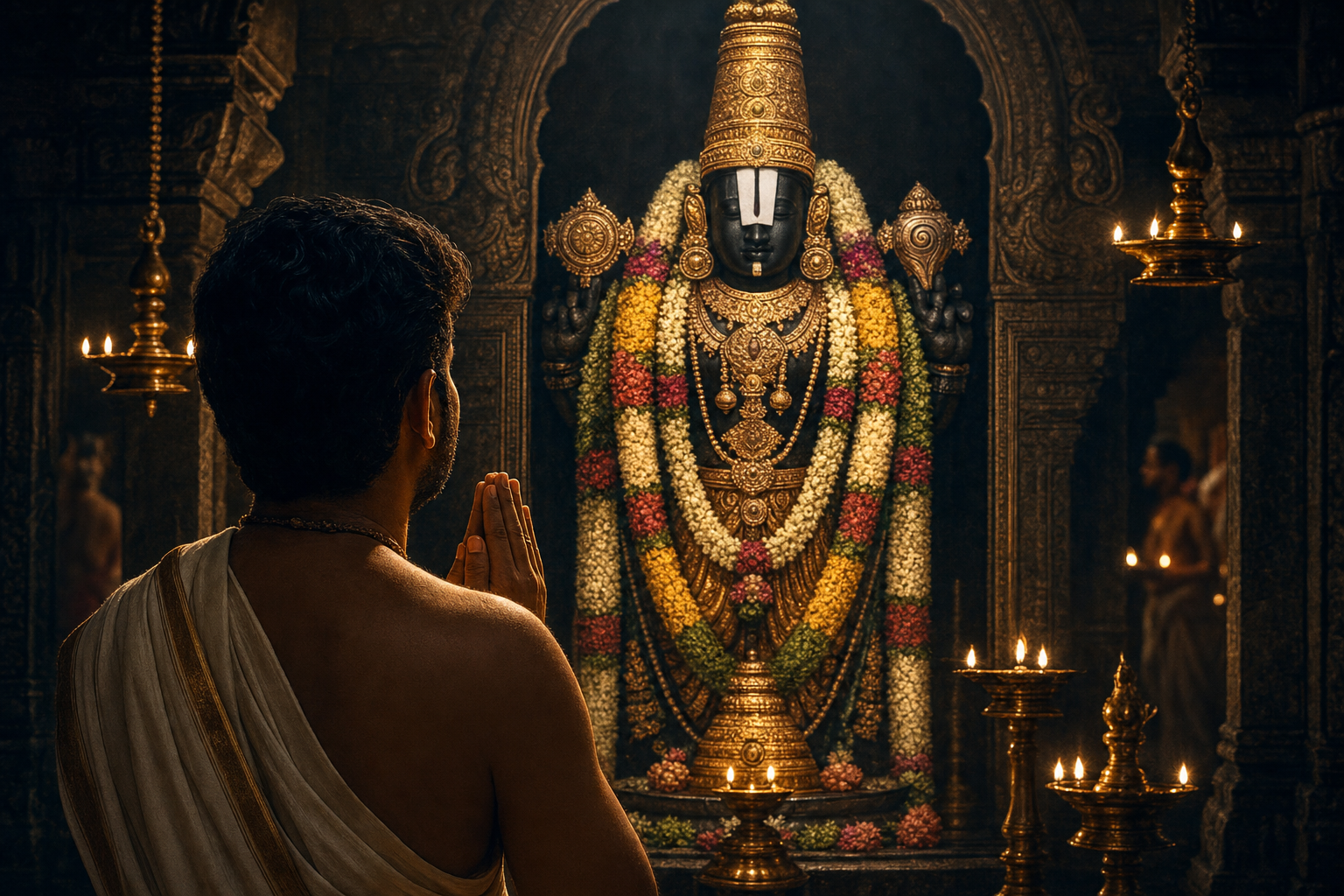
The source situates the tradition within the temple’s Vaikhanasa Agama system, under which worship is ordered through daily, weekly, monthly and annual services. This framework matters because the Saptarishi narrative is not presented as an isolated legend attached loosely to the hills. It belongs to a ritual world in which the consecrated deity receives continuing service through offerings, flowers, recitation, music and other forms of worship.
Within temple theology, darshan is reciprocal: the worshipper beholds the deity and understands that the deity also beholds the worshipper. The Saptarishis’ request is therefore not merely a desire to observe a sacred image. It expresses a longing to enter the Lord’s presence and be received there. Their annual return underscores dependence on grace rather than possession of spiritual privilege.
This understanding also prevents the Vaikunta Dwaram from being reduced to a mechanism that automatically confers liberation. The physical passage gives visible form to an inward aspiration, but the source connects its meaning with bhakti, ethical conduct, self-discipline and remembrance of the divine. Architecture provides the ritual action; spiritual disposition gives that action depth.
The tradition can thus be approached devotionally without being forced into the category of a modern eyewitness report. Recognizing its genre neither proves nor dismisses the believer’s understanding. It clarifies what the narrative is designed to communicate: Tirumala is accessible as sacred geography, the greatest seers remain devotees, and divine encounter is renewed through observance.
Key takeaways
- The source presents the Saptarishis’ visit as a sacred tradition rather than a conventionally verifiable historical event.
- The named sages are Vashistha, Marichi, Pulastya, Pulaha, Atri, Angiras and Kratu, although Saptarishi lists vary across Hindu textual contexts.
- Vaikunta Ekadashi joins celestial worship, human pilgrimage and temple ritual around Lord Venkateswara’s darshan.
- Passing through Vaikunta Dwaram signifies an orientation toward grace and liberation, not an automatic result detached from devotion and conduct.
For future pilgrims and readers, the most fruitful approach is to hold theological meaning and practical observance together: understand the tradition in its devotional register, while consulting current Tirumala Tirupati Devasthanams notices for the arrangements governing any particular festival year.