

Shravan 2026 presents an unusual mix of agreement and regional difference. Marathi, Telugu and Gujarati guides all place their Amanta month from August 13 to September 11, yet they do not give every date the same ritual emphasis.
This comparison separates the common lunar framework from the observances distinctive to Maharashtra, Andhra Pradesh and Telangana, and Gujarat. It also explains why a North Indian Sawan calendar can show an earlier month without necessarily contradicting any of them.
One lunar span, three ways of locating Shravan in the year

The three regional guides report the same opening and closing civil dates: Thursday, August 13, through Friday, September 11. They place the waxing fortnight from the opening of the month to the full-moon period around August 27-28, followed by the waning fortnight from August 29 to the concluding new-moon period. This agreement appears in the Marathi calendar guide, the Telugu calendar guide and the Gujarati calendar guide.
The month occupies a different stated position in each regional year. The Marathi and Telugu sources call Shravan the fifth lunar month after Chaitra, Vaishakh or Vaishakha, Jyeshtha and Ashadha. The Gujarati source calls it the tenth named month of Vikram Samvat 2082 when counting from Kartak; it also notes that an Adhik Jeth occurs in that Gujarati year. The difference is one of year-start convention and month counting, not a different Moon.
Key takeaways
- Marathi, Telugu and Gujarati Amanta calendars all report Shravan 2026 as August 13-September 11.
- All three sources identify four Shravan Mondays: August 17, August 24, August 31 and September 7.
- August 28 is a shared full-moon focal point, but Maharashtra, the Telugu states and Gujarat attach different combinations of observances to it.
- A regional festival date is suitable for advance planning; a city-specific panchang remains necessary for a time-sensitive puja, vrata or parana.
Where the regional observance calendars meet and diverge
The most useful comparison is not simply which region has more festivals. It is how the same lunar phases are interpreted through coastal, agricultural, household and sectarian traditions.
| Date or period | Shared calendar feature | Regional observance patterns reported by the sources |
|---|---|---|
| August 17 | First Shravan Somwar in all three calendars | The Marathi guide places Nag Panchami on this date, and the Telugu guide identifies it as Nagula Panchami. The Gujarati guide says some South Gujarat calendars recognize Nag Panchami then, while its principal Gujarati Nag Pancham appears later, on September 1. |
| August 28 | Full-moon observance period | Maharashtra combines Varalakshmi Vrat, Raksha Bandhan and the coastal observance of Narali Purnima. The Telugu guide dates Varalakshmi Vratham to August 28, includes Rakhi Purnima among the month’s major observances and notes that the Purnima period touches August 27 and 28. Gujarat observes Shravan Sud Punam and Raksha Bandhan on August 28. |
| August 31-September 5 | Transition through the waning fortnight | The Gujarati guide gives a concentrated sequence: Bol Choth on August 31, Nag Pancham on September 1, Randhan Chhath on September 2, Shitala Satam on September 3 and Krishna Janmashtami on September 4. The Marathi guide also dates Janmashtami to September 4, followed by Gopalkala and Dahi Handi on September 5. |
| September 7-11 | Fourth Monday and approach to Amavasya | The Marathi schedule adds Aja Ekadashi on September 7, Masik Shivaratri on September 9, Pithori Amavasya on September 10 and Pola on September 11. The Telugu guide closes Shravana with Amavasya on September 11 and highlights Polala Amavasya among its characteristic observances. The Gujarati month ends with Amas on September 11, before Bhadarvo begins on September 12. |
The August 17 comparison is especially instructive. A search for “Nag Panchami 2026” can return August 17 or September 1 because the label is being applied within different regional sequences. The sources do not support treating one date as a universal correction of the other; they place each observance within a particular panchang and customary setting.
The monsoon also gives these observances a regional texture. The Marathi source connects Narali Purnima with the sea, Nag Panchami with serpentine life and Pola with working cattle. The Telugu account emphasizes renewed vegetation, agricultural activity and recurring household worship. The Gujarati account draws together rain, fertility, food, health, cattle, snakes and the cooling symbolism associated with Shitala Mata. Across the sources, the religious calendar appears as a record of dependence on land, water, animals and community, not merely a timetable of temple rites.
Weekday devotion creates a shared rhythm with local accents
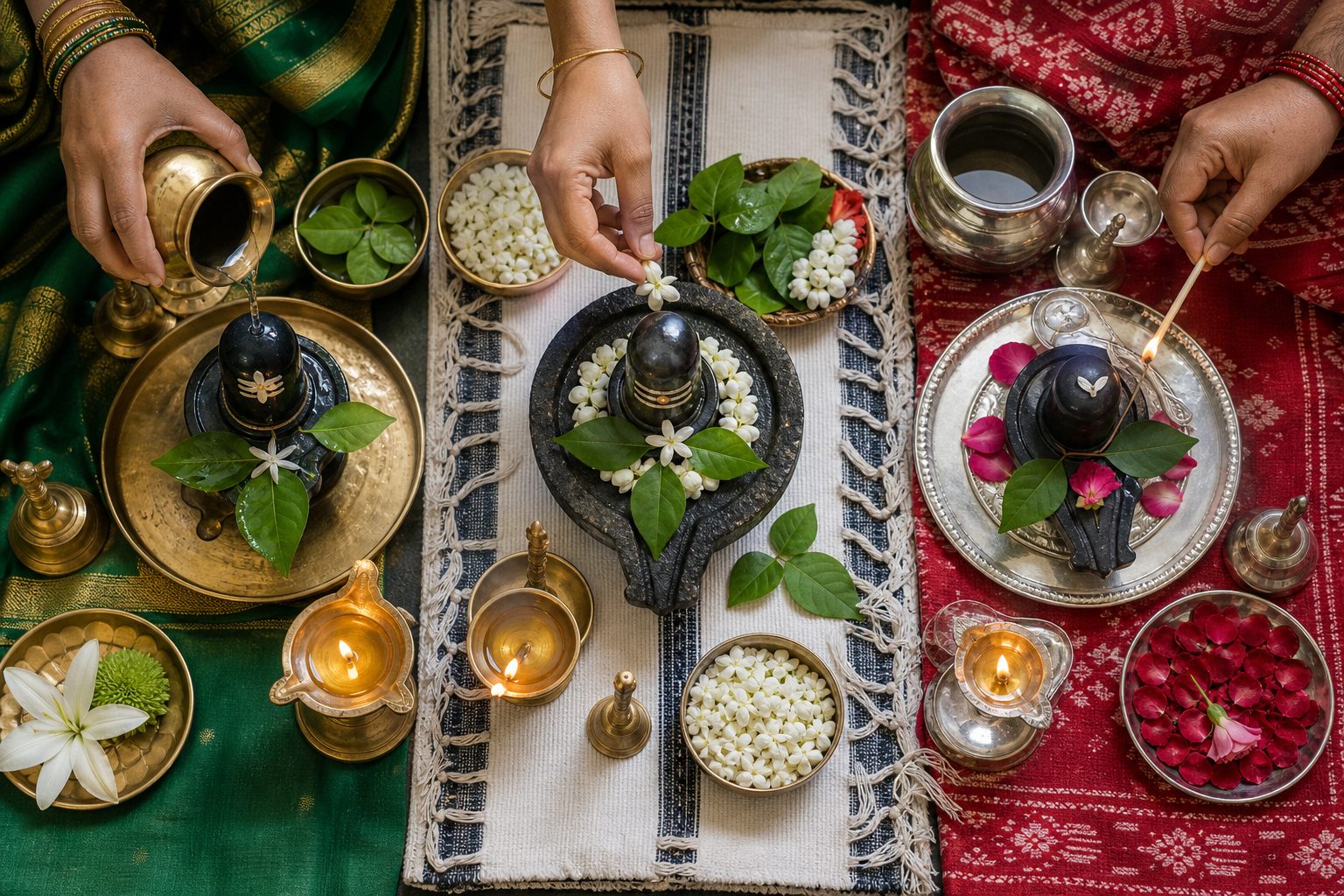
The clearest common weekly practice is Shravan Somwar. All three sources list August 17, August 24, August 31 and September 7 for Monday observance associated with Lord Shiva. They describe practices such as abhishekam, bilva offerings, mantra or stotra recitation, simplified meals, fasting and charity, while allowing for differences in family custom and physical capacity.
Beyond Monday, the Telugu guide supplies the most detailed weekday cycle. It lists Mangala Gauri worship on Tuesdays; varied Lakshmi, Vishnu, Guru or family-deity traditions on Thursdays; and particular emphasis on Mahalakshmi worship on Fridays. Because the month begins on a Thursday and ends on a Friday, it contains five Thursdays and five Fridays in that schedule. Saturday practice may be connected with Venkateswara, Hanuman, Shani or a household deity rather than a single universal prescription.
The Marathi and Gujarati accounts place similar ideas in their own settings. Both associate Tuesdays with Gauri or Mangala Gauri and Fridays with Lakshmi-oriented domestic worship, while retaining Shiva as the most visible focus of the Mondays. The Marathi guide further describes a plural calendar that accommodates Vishnu-related Ekadashis, Krishna worship, Ganapati observances and other household traditions. The Gujarati guide similarly presents Shaiva, Shakta, Vaishnava and Smarta emphases as overlapping rather than competing.
This comparison matters because a weekday designation is not automatically a command that every household perform the same vrata. The Telugu source explicitly frames participation as dependent on sampradaya and family practice. Read together, the guides portray Shravan as a common devotional season within which lineages choose different recurring disciplines.
Why an earlier North Indian Sawan calendar is not an error

The Marathi and Gujarati sources report North Indian Sawan as July 30-August 28, about a fortnight earlier than the August 13-September 11 Amanta span used in their regions. The Telugu source likewise explains that Purnimanta calendars used in several northern areas can make the named month appear to begin earlier.
Amanta and Purnimanta systems divide and name the lunar cycle at different boundaries. An Amanta month concludes at the new moon, while a Purnimanta month concludes at the full moon. The systems overlap in astronomical time but assign a different month name to part of that shared cycle. The Marathi source illustrates the effect with Krishna Janmashtami on September 4: it is described as Shravan Krishna Ashtami in the Amanta Marathi system but as Bhadrapada Krishna Ashtami in many Purnimanta almanacs.
A second source of apparent contradiction is the tithi itself. The three guides describe a tithi as a lunar division based on each 12-degree increase in the angular separation of the Moon and Sun, rather than a fixed midnight-to-midnight date. A tithi can therefore start during one civil date and end during another. Festival rules may examine the tithi at sunrise, midday, sunset, Pradosha, moonrise or the prescribed nighttime period.
The Telugu guide uses Purnima touching both August 27 and 28 to show how one lunar date can cross civil dates. It also stresses that Janmashtami depends on Ashtami during its prescribed nighttime interval, not simply the tithi printed at sunrise. The Gujarati guide offers a related example: Bol Choth is assigned to August 31 even though Chaturthi begins after that civil day has started. These are rule-based calendrical assignments, not necessarily editorial inconsistencies.
How to use the dates without flattening regional tradition
A practical planning process begins by identifying the calendar actually followed by the household, temple or lineage. A Marathi family tradition, a Telugu panchangam and a Gujarati panchang should not be mixed date by date merely because all three are Amanta. Their month boundaries agree in 2026, but their ritual sequences and names do not always coincide.
- Use August 13-September 11 as the shared month span only when following one of the three Amanta regional calendars discussed here.
- Choose the regional observance list before entering festival dates, especially for Nag Panchami or Nag Pancham and the final Amavasya traditions.
- Treat the reported civil date as an advance-planning date, then consult a panchang calculated for the actual city before a time-dependent sankalpa, puja or parana.
- Keep family or temple custom consistent when a regional calendar gives a different name or emphasis to the same lunar phase.
Location matters even within a region. The Marathi source says cities such as Mumbai, Pune, Nagpur, Nashik and Kolhapur may share a principal festival date while differing by minutes in sunrise-based intervals. The Telugu source makes the same point for Hyderabad, Vijayawada, Visakhapatnam and Tirupati, and the Gujarati source does so for Ahmedabad, Surat, Rajkot, Bhuj and Jamnagar. For diaspora observance, the Gujarati guide specifically advises using the actual local city instead of copying Indian Standard Time.
Households planning for 2026 can place the broad dates on their calendars in advance while leaving exact ritual windows open for local calculation. That preserves both the convenience of a regional overview and the precision on which living panchang traditions depend.
References
- DharmaRenaissance Blog – Shravan Maas 2026 Marathi Calendar: Essential Dates, Vrats and Festival Guide
- DharmaRenaissance Blog – Shravana Masam 2026: Complete Telugu Calendar, Sacred Vrathams and Festival Guide
- DharmaRenaissance Blog – Shravan Maas 2026 in Gujarat: Complete Sacred Dates, Vrats and Festival Guide