
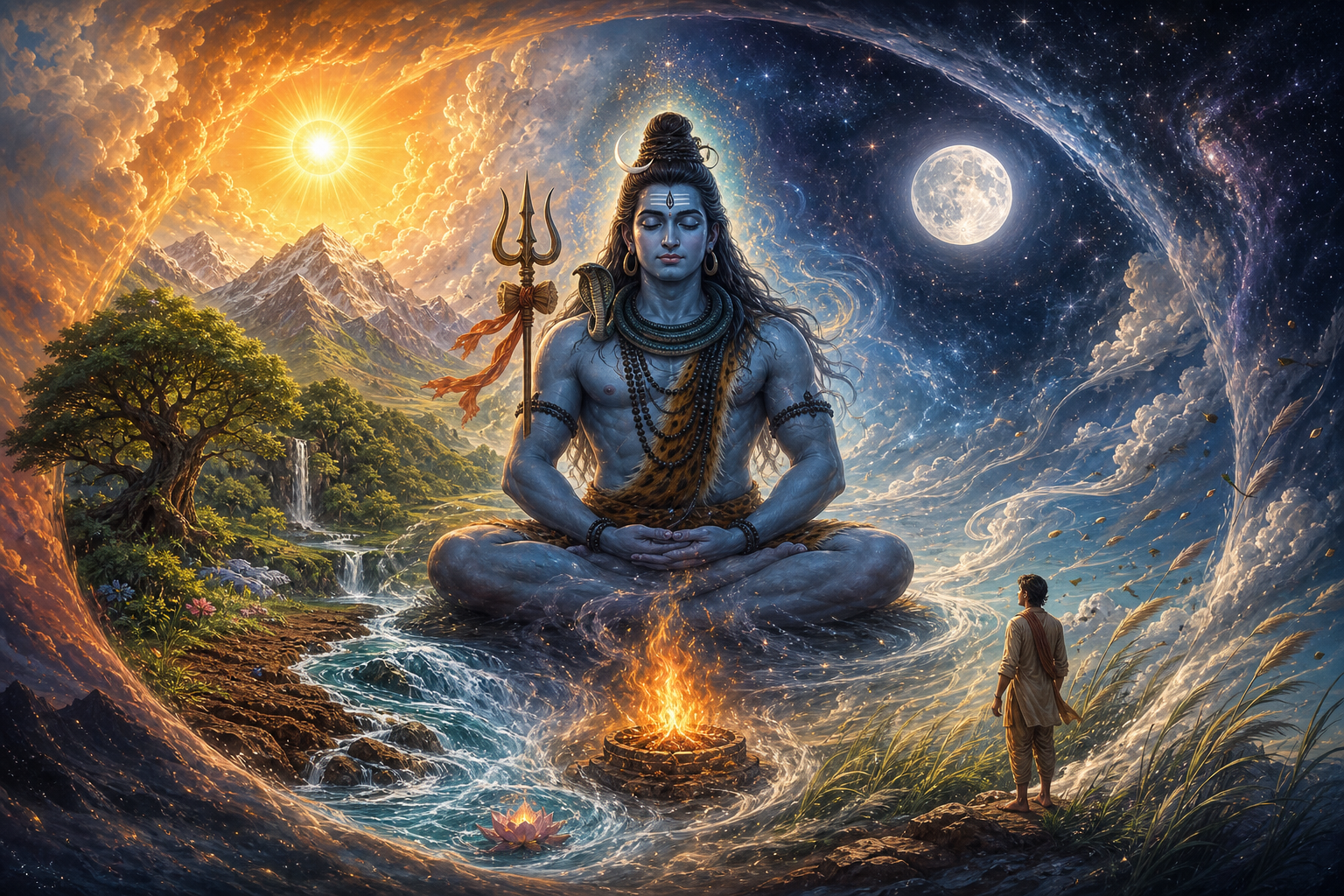
In Ashtamurti, eight is not a limit placed upon Shiva. It is a way of recognizing the limitless through the conditions that make ordinary existence possible: earth, water, fire, air, space, the sun, the moon, and the conscious being who knows and acts within the world.
The doctrine’s importance lies in how it joins several domains often considered separately. It connects the elements with celestial order, ritual offering with individual responsibility, and divine transcendence with perceptible reality. Reading its textual layers together also explains why ancient and later sources do not always present the same eight names or correspondences.
What Shiva’s “eight forms” actually means
The source article explains that the Sanskrit expression Aṣṭamūrti combines aṣṭa, “eight,” with mūrti, a word that can signify a form, embodiment, configuration, or perceptible manifestation. Although mūrti commonly refers to a consecrated image, Ashtamurti does not mean eight statues or eight independent deities. It presents one Shiva through eight cosmic bodies.
This distinction keeps the doctrine from becoming a simple catalogue of natural objects. Earth is not merely assigned a divine label, nor is Shiva reduced to the material universe. The eight forms disclose divine immanence while leaving room for transcendence: Shiva can be present as fire, breath, or consciousness without being exhausted by any of them.
Ashtamurti consequently broadens the meaning of sacred presence. Temple images and the linga remain concentrated forms of worship, but the doctrine directs attention beyond the sanctum. Ground, water, warmth, breath, spatial openness, daylight, moonlight, and the acting self all become possible sites of recognition. The sacred image is not discarded; its logic is extended across the experienced cosmos.
A doctrine formed through several textual layers
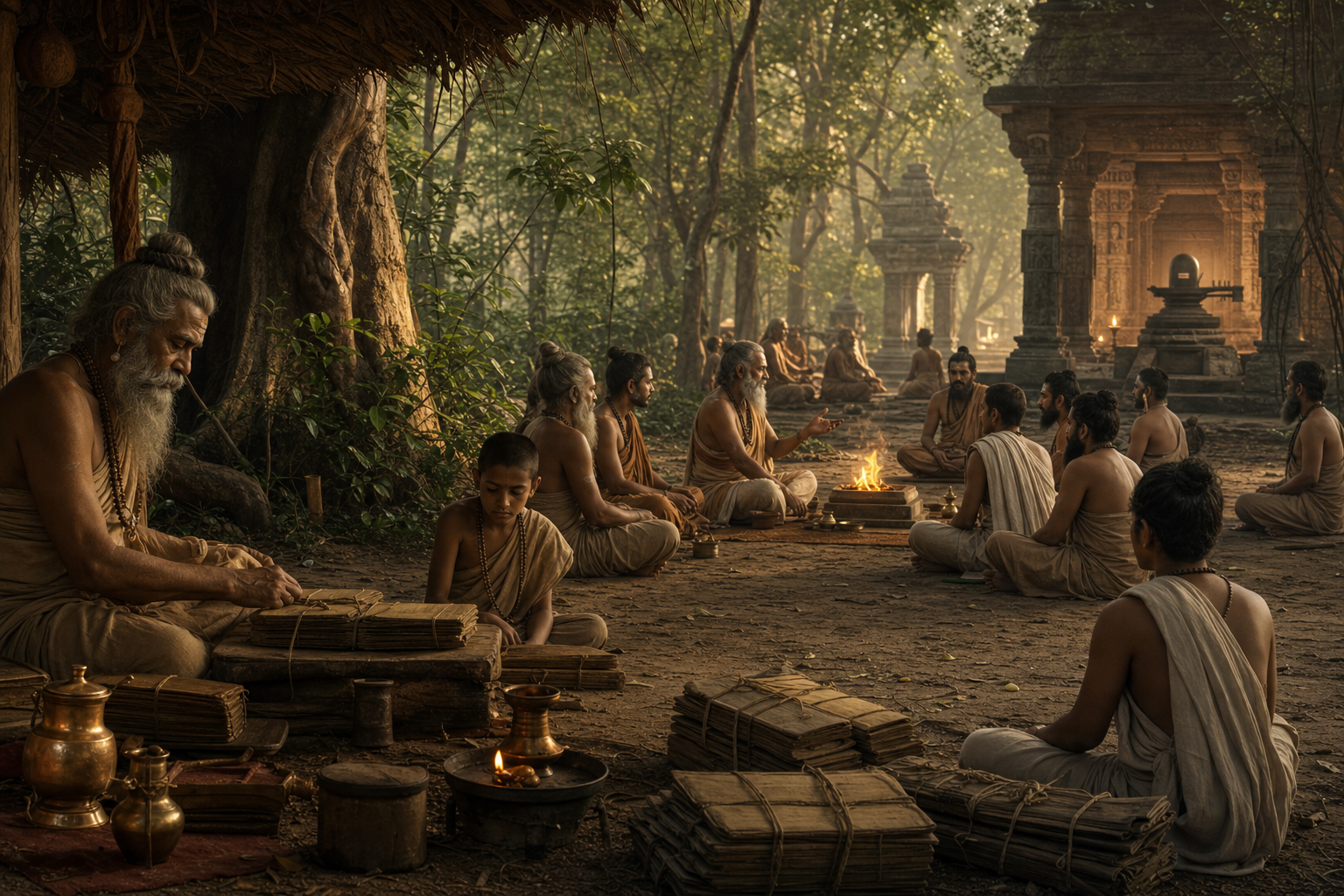
The account supplied by DharmaRenaissance presents Ashtamurti as the result of a long development rather than a fixed chart appearing unchanged in every scripture. Its Vedic background is associated with hymns that address Rudra throughout forests, mountains, waters, roads, settlements, animals, occupations, and other domains. The article points particularly to the Śatarudrīya in the Taittirīya Saṃhitā 4.5 and Vājasaneyi Saṃhitā 16. These passages do not yet give the familiar later map, but they establish its central intuition: Rudra cannot be confined to one distant or conventionally sacred location.
A more explicit precursor is reported in Śatapatha Brāhmaṇa 6.1.3.10-18. There, a divine child receives eight names: Rudra, Śarva, Paśupati, Ugra, Aśani, Bhava, Mahān Deva, and Īśāna. The source article associates these names, in that sequence, with fire, waters, plants, wind, lightning, rain, the moon, and the sun, and notes that the passage calls them eight forms of Agni.
That Vedic configuration should not be silently converted into the later Purāṇic scheme. According to the source, lightning, plants, and rain are reorganized as the doctrine develops; Aśani gives way to Bhīma in a prominent later enumeration; and the individual soul or sacrificial participant enters the eightfold structure. The differences reveal changing ritual and philosophical emphases rather than an error that must be forced into artificial uniformity.
The Śvetāśvatara Upaniṣad supplies a further conceptual bridge. The cited discussion of verses 2.17, 3.2-11, 4.10-16, and 6.11 emphasizes Rudra as the one ruler within beings, pervading the worlds while also exceeding them. Although the Upaniṣad does not merely reproduce the standard eightfold list, its attention to inward presence and cosmic lordship gives philosophical depth to the later doctrine. Shiva is not only identified with what is seen; Shiva is also associated with the interior consciousness by which anything is known.
The later map combines matter, life, time, and agency

The source article identifies the Śatarudra-saṃhitā of the Śiva Purāṇa as providing the best-known correspondence. Read alongside the account attributed to Kālidāsa’s opening invocation in the Abhijñānaśākuntalam, the scheme looks less like a list of substances and more like a compact model of existence.
| Form of Shiva | Cosmic body | What the correspondence brings into view |
|---|---|---|
| Śarva | Earth | Material support and the ground in which seeds develop |
| Bhava | Water | Primordial creation, continuity, and life-supporting flow |
| Rudra | Fire | Transformation and the carrying of ritual oblation |
| Ugra | Wind or air | Breath and the movement sustaining living beings |
| Bhīma | Ether or space | The openness in which sound and experience occur |
| Paśupati | Individual soul or sacrificial participant | Consciousness, action, offering, and accountability |
| Īśāna | Sun | Illumination and the ordering of time |
| Mahādeva | Moon | Celestial rhythm and the measurement of time |
The human or conscious member is the interpretive hinge. The source reports that the Liṅga Purāṇa names earth, water, fire, wind, space, sun, moon, and the sacrificer as Shiva’s bodies, while also allowing the eighth member to be expressed through the Ātman or jīva. These are related rather than competing formulations: the yajamāna is the person responsible for the sacrifice, while the language of self or individual soul identifies the conscious center from which knowledge and action proceed.
The source also reports an eightfold Rudra account in the Viṣṇu Purāṇa, although assignments and ordering can differ across presentations. Its appearance in a major Vaishnava Purāṇa indicates that the eightfold motif circulated within a broader Purāṇic environment. The common principle is more stable than every individual chart: Rudra-Shiva is manifested through cosmic powers and living existence.
Kālidāsa’s literary formulation makes the pattern immediately perceptible. As summarized by the source, his benedictory verse brings together water as the first creation, fire as bearer of the offering, the conscious offerer, the time-ordering sun and moon, space associated with sound, seed-bearing earth, and the air by which beings breathe. Matter, life, temporality, perception, and ritual agency therefore belong to one integrated vision.
Key takeaways
- Ashtamurti describes one Shiva manifested through eight cosmic bodies, not eight unrelated gods.
- The familiar Purāṇic mapping developed from earlier Vedic patterns and should not be projected unchanged into every older text.
- Earth, water, fire, air, space, sun, and moon encompass the material and celestial environment, while the individual self or sacrificer introduces consciousness and responsibility.
- The doctrine holds immanence and transcendence together: the world can disclose Shiva without defining the full extent of Shiva.
- Differences among textual lists are interpretively significant because they show how natural powers, ritual categories, and philosophical ideas were reorganized over time.
From cosmic classification to spiritual responsibility

Ashtamurti changes practice by changing the status of the practitioner. If the eighth form is the sacrificer, self, or individual soul, the person contemplating the cosmos does not stand outside the pattern. The observer is one of its members. Sacred action therefore includes not only an offering and its physical materials, but also intention, awareness, and responsibility for what is done.
This makes the doctrine suitable for contemplation without requiring the invention of a new ritual. Earth can be encountered as support; water as sustaining continuity; fire as transformation; air as breath; space as the condition for sound and relation; and the sun and moon as signs of ordered time. Consciousness then gathers these experiences into knowledge and action. Such attention translates a cosmological teaching into a disciplined way of perceiving ordinary life.
An ethical implication follows, though it should be stated carefully. If the elements and living participant are understood as Shiva’s bodies, treating the natural world as spiritually inert becomes difficult. Reverence for the cosmos can encourage restraint, care, and accountability. Yet Ashtamurti is broader than a modern environmental slogan: its framework also concerns ritual, perception, time, interior awareness, and the relation between unity and multiplicity.
The doctrine remains most illuminating when its two disciplines are kept together: historical care about the differences among texts, and contemplative openness to the unity they seek to disclose. Future engagement can deepen both by reading each textual layer in its own setting while allowing the eight forms to sharpen attention to the world in which spiritual life actually unfolds.