
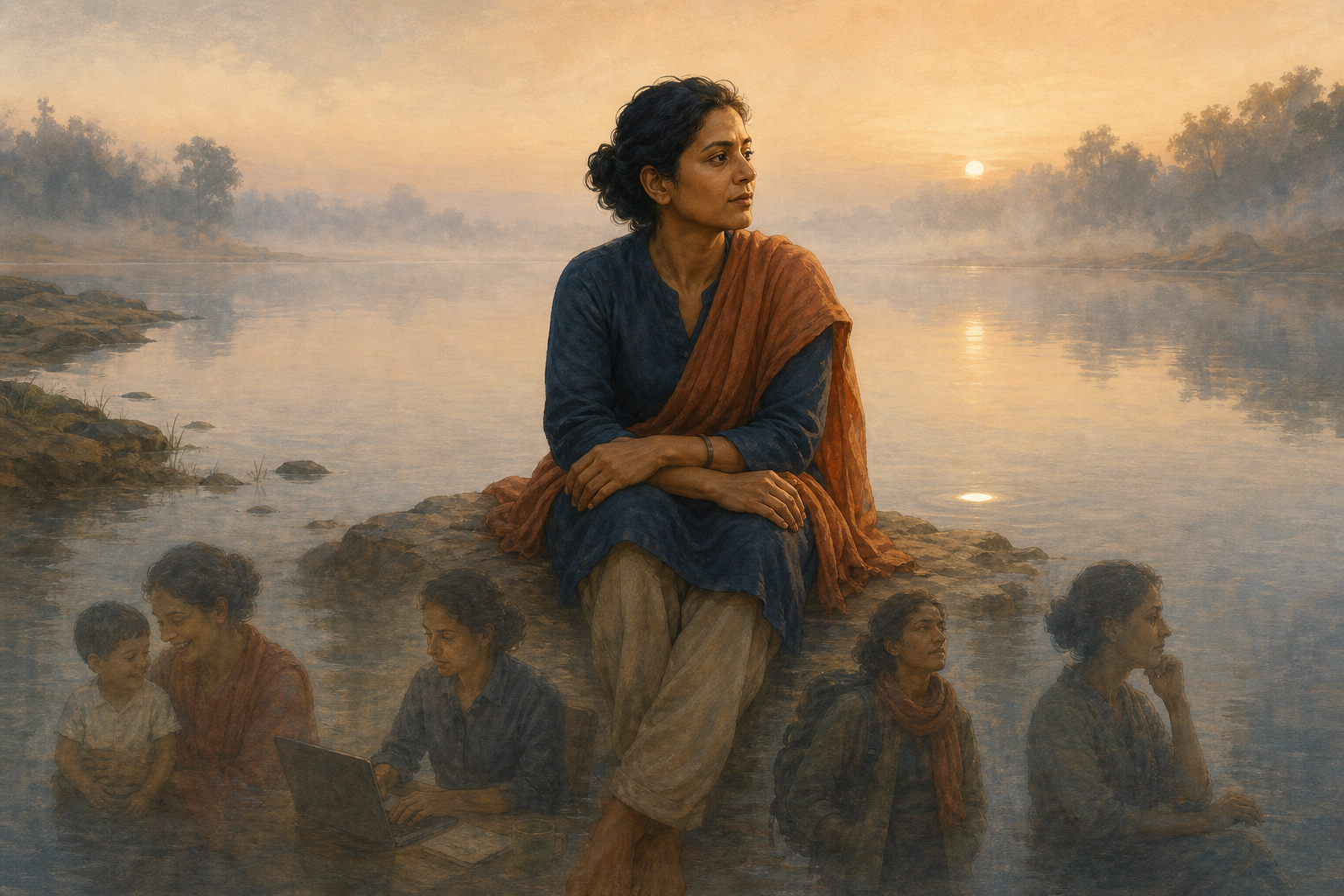
The question Who am I? becomes difficult because a human being is simultaneously embodied, socially situated, shaped by memory, morally accountable and capable of examining experience. A name, profession or religious affiliation can be accurate without being an exhaustive account of the person who bears it.
Dharmic inquiry adds a deeper question: is the apparent subject another changing feature of experience, or does it point toward a more fundamental principle? The supplied DharmaRenaissance guide shows why that question must be separated from psychological and social questions before the answers can illuminate rather than confuse one another.
One pronoun contains several questions
As the DharmaRenaissance guide explains, Who am I? can concern personal history, communal belonging, moral commitments, the first-person structure of experience or the metaphysical status of the self. These inquiries overlap, but evidence at one level does not automatically settle another. Autobiographical memory can explain how a personality developed without deciding whether consciousness has an enduring basis. A spiritual conviction likewise does not remove bodily needs, family ties or public responsibilities.
A useful synthesis is to treat identity as layered rather than to search immediately for one totalizing label. The embodied layer includes the organism and its sensations. The relational layer develops through family and society. The narrative layer arranges remembered events into a life story. The moral layer appears in commitments and choices. The contemplative layer emerges when attention turns toward the apparent knower of thoughts and perceptions. These are analytical perspectives on one life, not five separate selves.
Many confusions are therefore mismatches between a question and the kind of answer offered. Social rejection cannot be resolved merely by asserting a metaphysical identity, while professional success cannot determine the nature of awareness. A religious label may express genuine belonging without serving as a complete theory of consciousness.
Key takeaways
- Identity includes embodied, relational, narrative, moral and contemplative dimensions; no single label answers every question about the person.
- Impermanence or conditioning does not make the body, relationships and inherited culture unimportant.
- Dharmic traditions should not be compressed into one metaphysical doctrine merely because they share a civilizational setting or vocabulary of practice.
- Self-inquiry becomes credible when it supports responsibility, steadier judgment and greater consistency between values and conduct.
Diasporic identity tests the difference between continuity and confinement

The layered model is especially helpful in diasporic life. The source describes people navigating one language or set of customs at home and another at school or work. Such code-switching need not signal falseness; it may be an intelligent response to different social environments. Trouble begins when adaptation becomes habitual self-erasure, or when tradition is exaggerated primarily to satisfy an audience.
In that situation, the person is no longer simply asking what deserves loyalty. Acceptance by others starts determining which version of the self may appear. The source proposes a more stable relationship to heritage by treating identity as inherited, interpreted and enacted. Inheritance supplies memories, practices and symbols. Interpretation asks what they mean. Enactment reveals which commitments actually guide conduct.
This approach avoids two reductions. Rootlessness is not required for personal freedom, and cultural continuity does not require reproducing an imagined, unchanging past. Participation in family worship, communal service, meditation or dietary discipline may have devotional, ethical, familial and cultural meanings at once. Clarifying those meanings is more useful than forcing every practice into a single public label.
Hindu self-inquiry asks what changes and what knows change

The DharmaRenaissance article reports that the Brihadaranyaka, Chandogya and Katha Upanishads investigate whether deepest identity can be equated with the body, senses, mind, status or personality. It also emphasizes that later Hindu schools disagree about how the individual self, the world and Brahman are related. Hindu thought consequently supplies a field of arguments and disciplines, not one undifferentiated answer.
Within Advaita Vedanta, the source presents the deepest self as awareness rather than the changing body-mind complex, ultimately identifying that awareness with Brahman. The method expressed by neti neti, or not this, not this, declines to identify the final subject with any finite object that can be observed. Properly understood, this is an inquiry into the observer, not a declaration that embodied life and the world are worthless.
The guide connects this logic with atma vichara, particularly its modern association with Ramana Maharshi. Instead of constructing a more flattering personal story, the practice redirects attention from an arising thought toward the sense of the one to whom it appears. Samkhya and classical Yoga offer a related but distinct analysis by differentiating purusha, the conscious principle, from prakriti, nature and its changing processes. The comparison matters: similar contemplative movements can serve different metaphysical conclusions.
The broader Dharmic label must therefore be handled carefully. The source places Hindu, Buddhist, Jain and Sikh identities within the wider discussion while warning against erasing their differences, but its supplied treatment develops the Hindu arguments most fully. The defensible common ground is a disciplined concern with self-understanding; an identical doctrine of self should not be inferred.
Self-knowledge is tested in conduct

A layered account becomes practical when it changes how identification works. A temporary feeling can be acknowledged as an experience without being promoted into a permanent definition of the person. A career setback can alter the narrative and social layers without determining intrinsic worth. Cultural criticism can be considered without either abandoning inherited commitments or turning them into a rigid performance.
The moral test is equally important. If a claim of spiritual insight becomes a reason to neglect health, evade obligations or dismiss another person’s suffering, it has confused contemplative inquiry with exemption from ordinary accountability. The source instead connects clearer identity with ethical consistency, emotional resilience and alignment between values and action. Those outcomes should be treated as tests of understanding, not automatic promises attached to a doctrine.
The next useful step is neither to freeze identity into a definitive label nor to discard every label as unreal. It is to identify which layer a present difficulty belongs to, give that layer its due, and continue the contemplative inquiry without using it to erase the life in which insight must be expressed.