

At the entrance to a Hindu home, architecture, daily discipline, hospitality, and sacred meaning meet. The threshold is therefore best understood not as an isolated object or a fixed superstition, but as a place where movement between household life and the wider world becomes deliberate.
A careful interpretation must distinguish the physical sill from the larger ritualized doorway, enduring principles from changing forms, and textual evidence from regional or family custom. Those distinctions reveal why the threshold can remain meaningful without requiring every Hindu household to follow one design or rule.
The crossing marks a change in responsibility
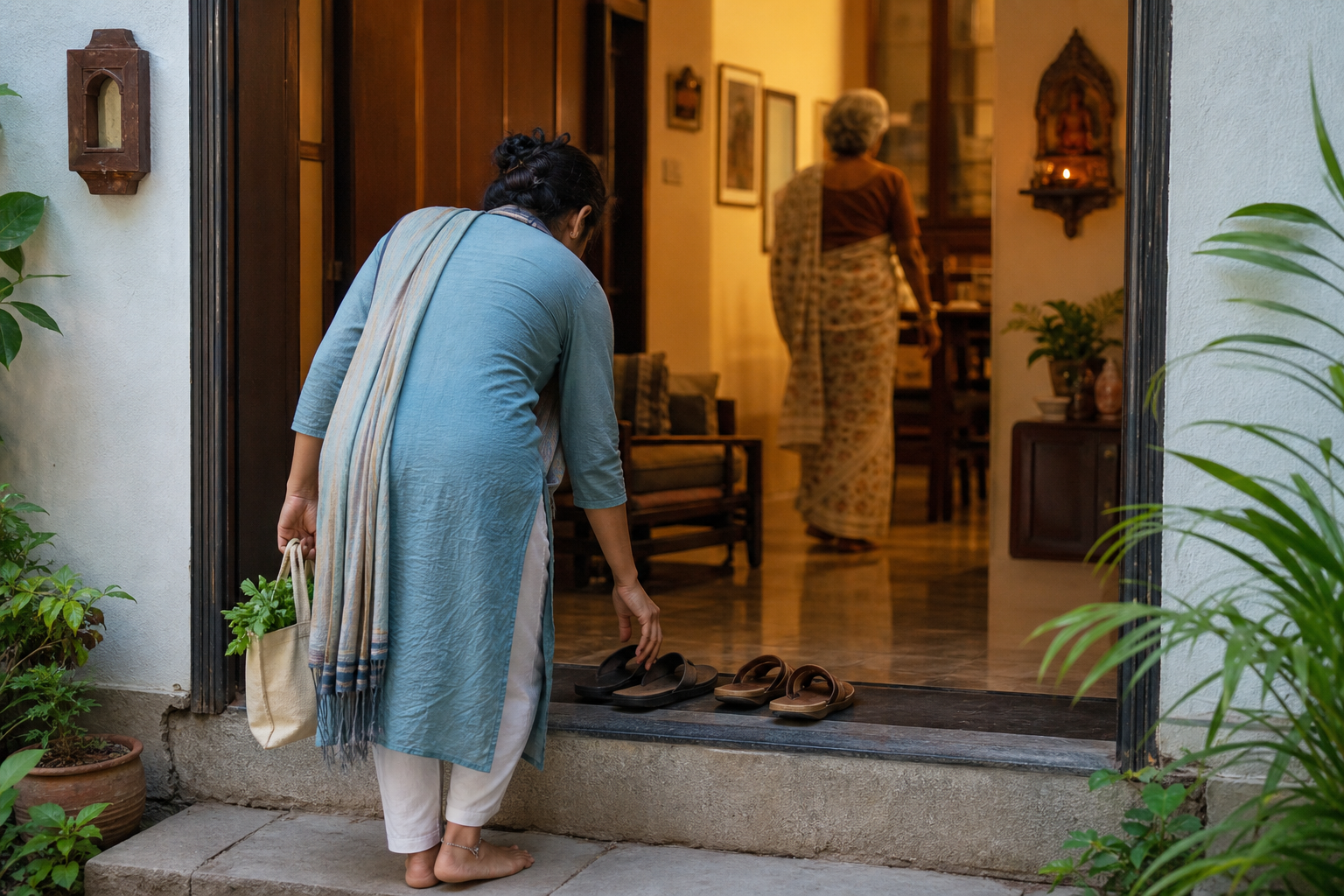
The source article distinguishes the dehali or dehalee, meaning the sill or crossing line, from the dvāra, the door or opening as a whole. It also identifies gṛha as the house or household and gṛhapraveśa as entry into a dwelling, particularly in connection with a new-home rite. These terms help clarify the parts and actions involved, but the source cautions that vocabulary and ritual associations vary across languages, periods, communities, and craft traditions.
The threshold’s central meaning is relational. Crossing inward can signal greater attention to cleanliness, household order, worship, food, elders, guests, and family responsibilities. Crossing outward can begin work, travel, exchange, or wider social obligations. This interpretation avoids treating the interior as inherently pure and the exterior as inherently impure. The source notes that roads, rivers, forests, fields, pilgrimage routes, and public gathering places may also be sacred, while conduct inside a home is not automatically dharmic.
The modern anthropological idea of liminality provides a useful analytical lens for this passage between conditions, although the source explicitly warns that it is not an ancient Hindu technical definition of dehali. A returning family member, a guest awaiting welcome, a bride entering another household, or a pilgrim departing before dawn can occupy an emotionally charged interval between departure and arrival. Ritual makes that interval visible and gives uncertainty, hope, vulnerability, and belonging an ordered expression.
The sacred entrance is both structure and ritual setting
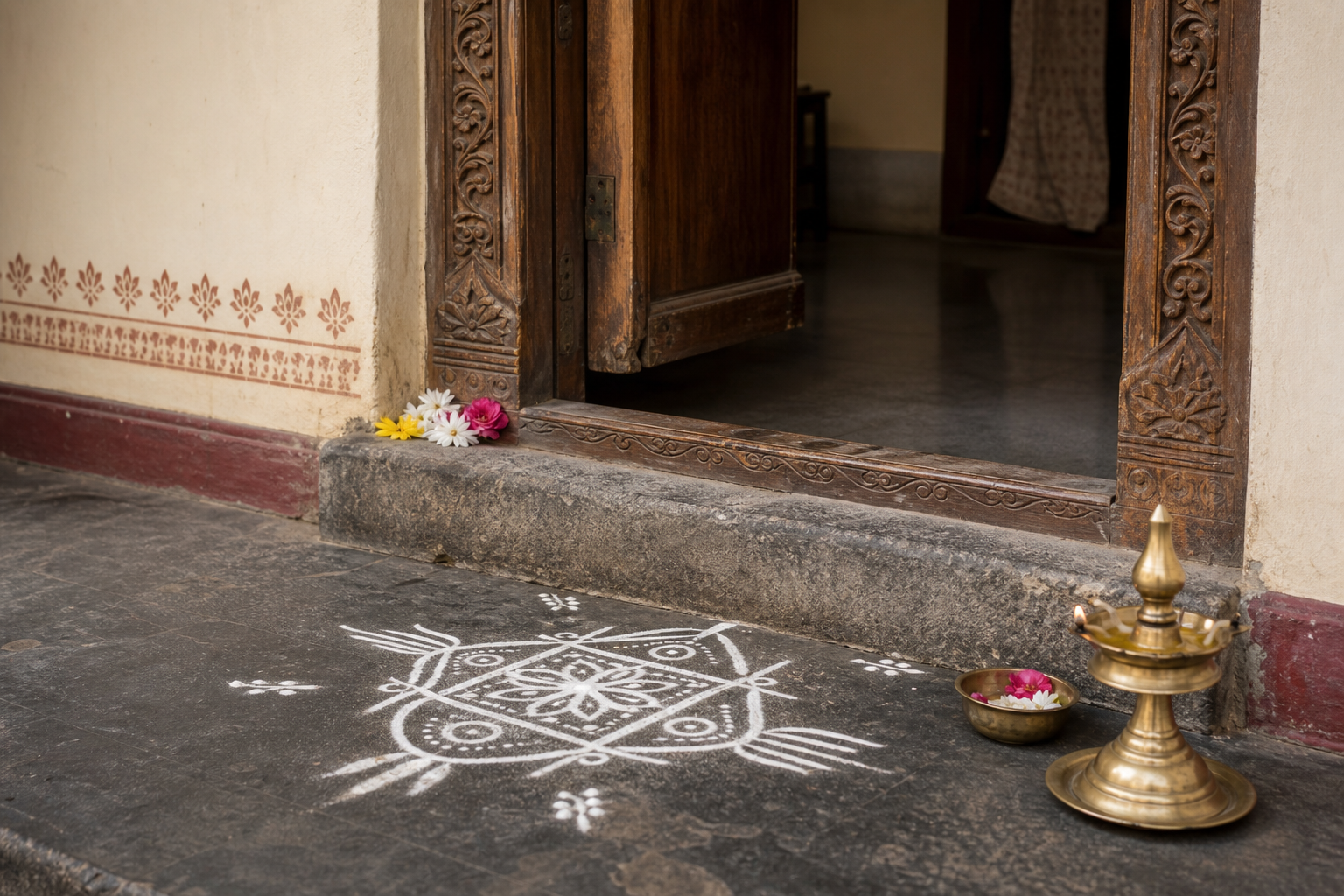
A physical threshold may be made from stone, timber, brick, or another durable material. According to the source, it can help stabilize a doorway, limit the movement of rainwater and dust, discourage pests, and mark the transition between exterior paving and an interior floor. These practical roles are not incidental to its symbolism. A junction that is continually crossed, cleaned, inspected, and repaired naturally becomes a focus of household attention.
The entrance itself is an ensemble rather than a single ritual object. The sill lies below; jambs form the sides; the lintel spans the opening; and doors regulate access. A toraṇa may hang above, signs may be placed on the frame, lamps may stand nearby, and a rangoli or kolam may occupy the ground in front. Popular usage can gather all of these features under the idea of the threshold even though they occupy different architectural locations.
This distinction resolves an apparent tension between utility and sacredness. The sill can perform ordinary architectural work while the larger entrance communicates welcome, protection, auspiciousness, or readiness to receive. Ritual meaning need not depend on claiming that every decoration is ancient or that the doorway contains a measurable supernatural force. It can arise through the disciplined treatment of a place where the household repeatedly encounters what lies beyond it.
Textual authority supports principles, not one universal doorway

The source situates Hindu domestic practice within several overlapping bodies of authority: Vedic hymns, Gṛhya Sūtras, later domestic manuals, Dharma literature, Vāstu and Śilpa traditions, Purāṇic and devotional practice, regional custom, family inheritance, and contemporary adaptation. These materials address different questions and do not amount to a single timeless instruction manual for every front door.
At the earliest textual layer it discusses, the article reports that Rigveda 7.54 and 7.55 invoke Vāstoṣpati, the guardian or lord of the dwelling, in petitions concerning recognition, well-being, and protection from harm. It also reports that Atharvaveda 3.12 offers a benediction connected with establishing a house and presents the dwelling as firm, abundant, and protective. These references support a broad theology in which a residence can be ritually addressed and integrated into sacred order. They do not, by themselves, authenticate every threshold custom now found in India or the diaspora.
The source further explains that Gṛhya Sūtras address domestic rites, including acts associated with establishing and entering a residence, while later paddhatis develop procedures according to region and lineage. Depending on the tradition, a new-home observance may involve purification, Gaṇeśa worship, Vāstu-related propitiation, sacred fire, offerings, blessings, or preparation of the first food. The role of the entrance varies, but crossing it can mark the practical completion of ritual preparation.
Vāstu literature adds another layer by considering site selection, orientation, measurement, proportion, drainage, circulation, spatial division, and the placement of openings. The article names the Mayamata, Mānasāra, and architectural portions of the Bṛhat Saṃhitā as influential but non-identical examples. Their differences, together with variables such as climate, plot shape, building type, and local craft knowledge, undermine claims that every home must have one universally auspicious entrance direction.
Taken together, these layers support continuity without demanding visual sameness. An old sacred principle does not prove that a particular modern material or pattern has an equally old history. Conversely, a recent form can still carry an inherited purpose such as welcome, protection, or an auspicious beginning. Continuity may reside in the work a custom performs rather than in an unchanged object.
Key takeaways for interpreting household practice
- Identify the actual feature. Distinguish the sill from the doorway, forecourt, lintel decorations, lamps, signs, and floor designs around it.
- Read the boundary relationally. The crossing changes context and responsibility; it does not divide an entirely sacred interior from an entirely profane exterior.
- Match claims to evidence. Vedic praise of the dwelling, domestic ritual manuals, architectural texts, and living family customs are related but not interchangeable forms of authority.
- Expect legitimate variation. Region, lineage, language, climate, building type, and inherited household practice can all shape the entrance.
- Keep function and symbolism together. Cleaning, weather protection, access, welcome, memory, and ritual attention can reinforce one another at the same architectural junction.
The doorway expresses a household ethic
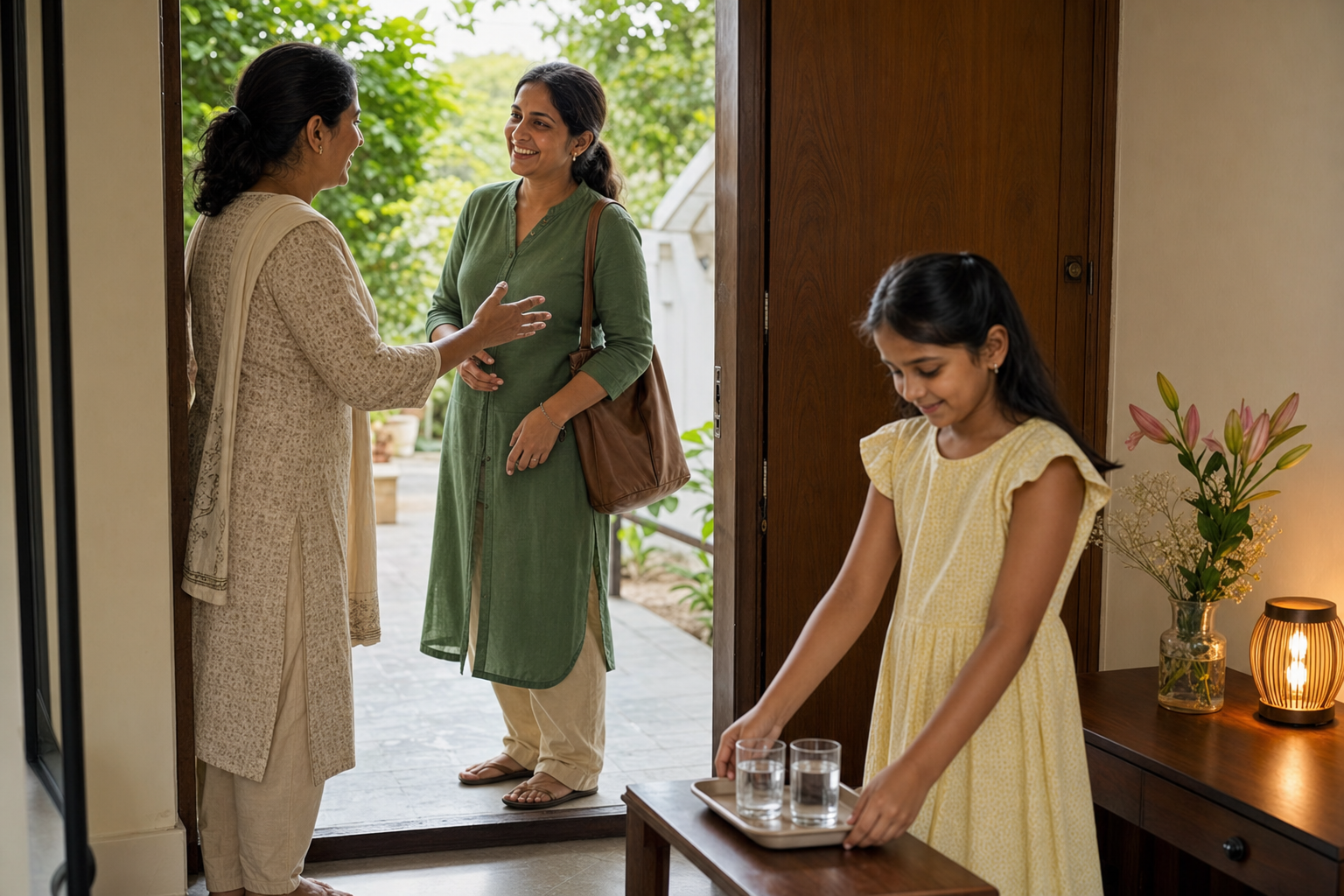
The source places the threshold within the wider responsibilities of the gṛhastha, or householder, stage of life. A home supports the preparation of food, care for children and elders, reception of guests, remembrance of ancestors, transmission of knowledge, livelihood, rest, and daily worship. The entrance matters because it is where this internally cultivated order opens toward neighbors, travelers, work, trade, and public obligation.
Practices such as removing dust-bearing footwear, maintaining the sill, placing an entrance design, or welcoming a guest can therefore be read as small disciplines of attention. Their value does not depend on turning them into universal tests of Hindu identity. A sound interpretation asks what a practice does, which authority or inheritance supports it, and how it relates to the conditions of a particular household.
This framework also leaves room for contemporary adaptation. Materials, housing forms, and visible customs may change, yet a household can continue to mark arrival and departure with cleanliness, attentiveness, hospitality, and respect. Future transmission will be strongest when families preserve those purposes while describing the history and scope of particular practices honestly.