

A Shravan observance calendar is more than a list of Mondays, Wednesdays or festival dates. It is the result of several decisions: which lunar-month system a community follows, which tithi prevails at the relevant local time, how sunrise is used, and which regional or family tradition gives a weekday its devotional meaning.
Read together, the three DharmaRenaissance guides show how to move from raw Panchang information to a usable calendar without treating one city’s dates as universal. They also explain why two apparently different Shravan schedules can both be internally valid.
Key takeaways
- Shravan dates can differ because Purnimanta and Amanta calendars assign lunar-month names differently.
- A tithi can begin or end at any clock time, so a Gregorian date may contain parts of two tithis.
- Local sunrise, location and time zone matter most when a transition occurs near the boundary used for an observance.
- A Panchang’s tithi does not reveal its Nakshatra, Moon Rashi, Yoga or auspicious intervals; those values require separate calculations.
- The calendar determines when an observance falls, while regional, family and sampradaya traditions determine whom and how a household worships.
One Shravan, several legitimate calendar windows

The central calendar distinction is between Purnimanta and Amanta, also called Amavasyanta, month reckoning. The Shravan Somvar guide reports that Purnimanta reckoning is widely followed in much of North India, while Amanta reckoning is followed in Maharashtra, Gujarat, Karnataka, Andhra Pradesh, Telangana and several other regions. Because one system closes the named month at the full moon and the other at the new moon, their Shravan beginnings can be separated by roughly a fortnight.
The Shravan Budhvar guide provides a concrete 2026 comparison. It reports North Indian Purnimanta Shravan as running from July 30 through August 28, while Marathi Amanta Shravan runs from August 13 through September 11. These are not rival claims about which lunar phases occurred. They are different established methods of assigning a month name to those phases.
| Reported 2026 frame | Shravan window | Calendar consequence |
|---|---|---|
| North Indian Purnimanta | July 30-August 28 | Shravan weekday observances are selected from this earlier window. |
| Marathi Amanta | August 13-September 11 | The regular Shravan Budhvars reported for Maharashtra are August 19, August 26, September 2 and September 9. |
| Marathi boundary on August 12 | Shravan Shukla Pratipada reportedly begins at approximately 11 p.m. | The article treats August 12 primarily as a month-boundary date because that day’s sunrise remains in Ashadha Amavasya. |
The August 12 example exposes a frequent source of conflicting calendar lists. The Budhvar article reports that some published schedules include that Wednesday because the next lunar month begins late that night. Under the customary sunrise assignment described in the article, however, the first Marathi Shravan sunrise is August 13. It therefore identifies four Wednesdays wholly within Marathi Shravan while allowing that a household may follow an inherited Panchang or priestly instruction that treats the boundary differently.
The practical question is consequently not simply, “When is Shravan?” It is, “Which Shravan calendar does this household or temple recognize?” Once that convention is fixed, the relevant Mondays, Wednesdays and other recurring observances can be selected consistently.
Why a Panchang date does not behave like a civil date

Both the daily Panchang article and the Shravan Budhvar article explain that a tithi is an astronomical interval rather than a fixed 24-hour date. It is based on the changing angular separation of the Moon and Sun, with each 12-degree interval forming one tithi. A transition can therefore occur before sunrise, during the day or late at night.
The July 21, 2026 Panchang guide illustrates the problem with a reported transition from Shukla Paksha Saptami to Ashtami at 6:59 a.m. It explains that a location where sunrise precedes the transition may still identify Saptami as the sunrise tithi even though Ashtami occupies most of the civil date. If the locally calculated transition precedes sunrise, Ashtami may already govern the ritual day. The article also cautions that the supplied 6:59 a.m. value lacks an identified reference location and should not be transferred directly to another city.
Sunrise is a widely used assignment rule, but the daily guide does not present it as universal for every rite. Depending on the observance, the determining tithi may need to prevail at sunrise, moonrise, midday, sunset, midnight or another prescribed portion of the day. This is why a date that is adequate for an informal weekly devotion may still need closer review before a formal vrata sankalpa or time-sensitive ritual.
A complete Panchang also contains several independently calculated layers. The daily article warns especially against inferring Nakshatra or Moon Rashi from a known tithi.
| Calendar element | What it represents | Why it cannot be substituted for another element |
|---|---|---|
| Vara | The weekday, often reckoned from local sunrise in traditional applications | It supplies the weekly rhythm but does not alone make every activity suitable or unsuitable. |
| Tithi | The Moon-Sun angular relationship | It is central to many vratas and festivals but does not specify the Moon’s absolute zodiacal position. |
| Nakshatra | The lunar mansion occupied by the Moon | Its boundary is calculated separately and need not coincide with a tithi change. |
| Yoga | A division based on the combined sidereal longitudes of the Sun and Moon | It follows a different astronomical quantity from tithi or Nakshatra. |
| Karana | Half of a tithi | Two karanas ordinarily occur within one tithi and may matter in muhurta assessment. |
| Moon Rashi | The Moon’s sidereal zodiac sign, commonly displayed alongside the five limbs | It depends on absolute lunar longitude and cannot be deduced from the Saptami-Ashtami sequence. |
The same separation applies to “good time” labels. The July 21 guide describes a muhurta as purpose-dependent rather than universally favourable. It also notes that intervals such as Rahu Kaal depend on local sunrise and sunset. A calendar missing the necessary location, Nakshatra, Yoga, Karana or timing data should not be completed by guessing from its tithi.
A dependable workflow for building an observance calendar

The sources collectively support a layered method for preparing or checking a Shravan schedule. This method separates questions that are often compressed into a single date label.
- Fix the place and time zone. Use the city where the observance will occur, especially when the devotee lives outside the region for which a printed calendar was prepared.
- Identify the governing month convention. Determine whether the household, temple or community follows Purnimanta, Amanta or another established regional convention.
- Confirm the locally assigned month boundaries. Check the tithi transition together with local sunrise instead of copying only the first and last Gregorian dates from a general article.
- Select the recurring weekdays inside that window. Mondays become candidates for Shravan Somvar, while Wednesdays become candidates for Shravan Budhvar only where those practices belong to the relevant tradition.
- Review boundary dates separately. A tithi beginning near sunrise or late at night may produce a legitimate difference between a transition date and the first full observance day.
- Check the rule for the particular vrata. A formal rite may depend on a tithi at a prescribed part of the day rather than on the ordinary sunrise label.
- Consult additional Panchang fields only as needed. Nakshatra, Yoga, Karana, Moon Rashi and muhurta periods should come from the same location-specific calculation rather than from inference.
- Record the convention with the published dates. A useful calendar should state its city, time zone, month system and treatment of boundary days so that readers understand what the dates mean.
This workflow also clarifies the limits of apparent precision. A clock time displayed to the minute is not automatically portable. The Shravan Somvar article specifically warns against applying calendars prepared for Delhi, Mumbai, Toronto, London or another city without adjustment. The Budhvar article similarly reports that transition times can differ slightly among locations even when the final civil observance date remains unchanged.
From calculated dates to lived weekly observance
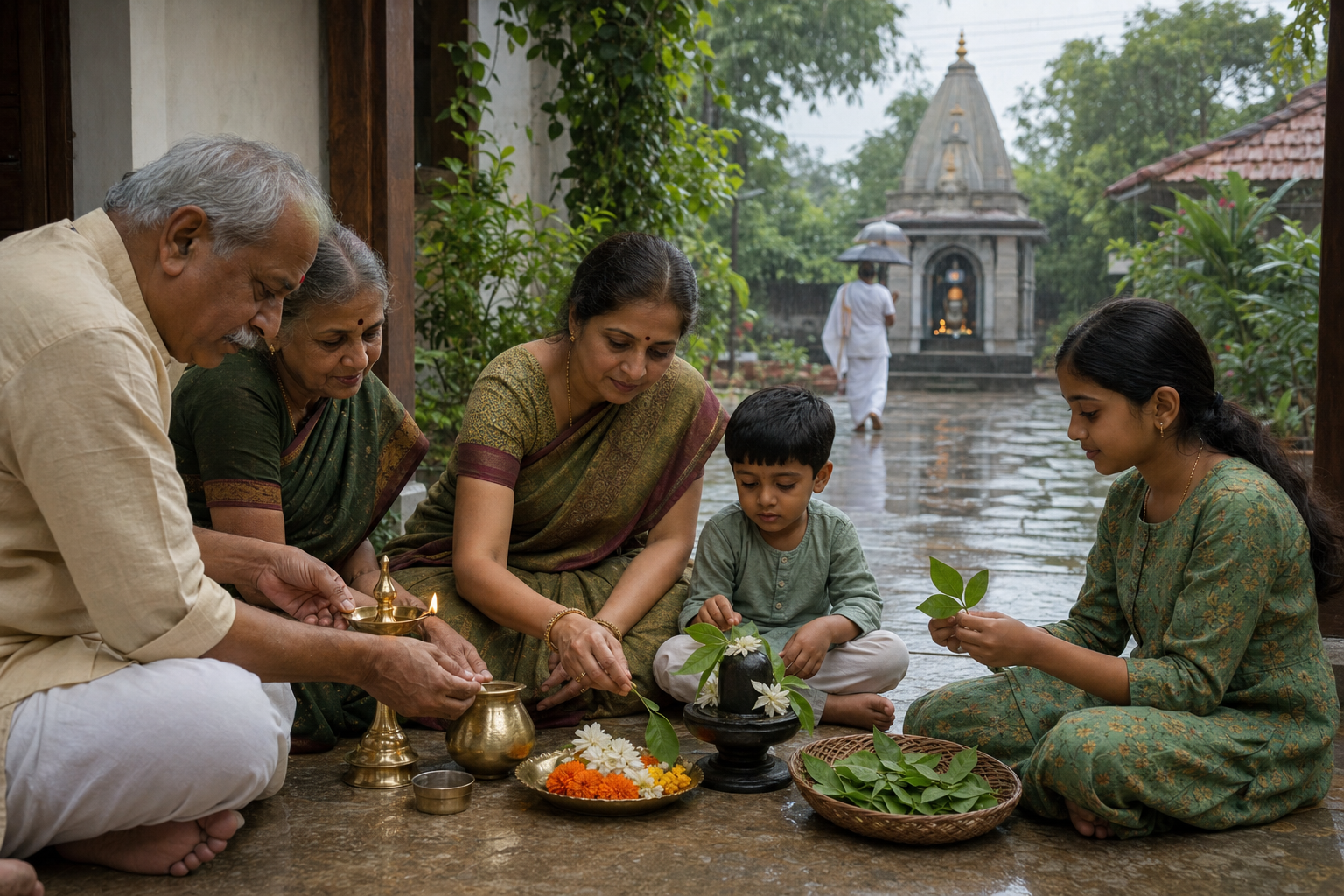
Shravan Somvar centres Shiva without imposing one fast
The Shravan Somvar guide describes the Mondays of the recognized Shravan month as occasions for Shiva worship through practices such as upavasa, puja, mantra recitation, charity and ethical restraint. It reports that the observance appears across North Indian, Marathi, Gujarati, Telugu and Kannada traditions, but it does not claim that every community follows an identical ritual procedure.
That distinction matters when turning calendar data into household instructions. The date identifies the Monday; it does not dictate whether a devotee undertakes a waterless fast, takes fruit or liquids, eats one simple meal, or maintains medically necessary meals while observing other restraints. The source explicitly presents health, medication, pregnancy, age, work and family custom as relevant considerations. It also treats plain water as sufficient for a simple household jalabhisheka and cautions against measuring devotion by the quantity or cost of offerings.
Shravan Budhvar can carry a distinctly regional focus
The Budhvar guide places Wednesday worship of Vitthal especially in Maharashtra and parts of North Karnataka, with Pandharpur as its principal devotional centre. It connects the observance with a broader culture of Vitthal bhakti while distinguishing it from the major Wari pilgrimages. Its verified Maharashtra list for 2026 is therefore a regional calendar, not a claim that every Hindu household must direct Shravan Wednesday worship to Vitthal.
The article also reports that Wednesday can carry other devotional associations. Some almanacs emphasize Budha-graha worship, some households emphasize Ganesha, and the tradition under discussion centres Vitthal. This demonstrates why a weekday name is only one layer of an observance calendar: the same vara may be interpreted through different regional and family practices.
A sound future calendar should therefore publish its assumptions as carefully as its dates. When the location, month system, sunrise rule and devotional tradition are visible, regional diversity becomes intelligible rather than appearing as calendrical error.
References
- DharmaRenaissance Blog — July 21, 2026 Panchang: Essential Tithi, Good Time, Nakshatra and Rashi Guide
- DharmaRenaissance Blog — Shravan Somvar Shiva Puja: Complete Vrat Vidhi, Mantras and Essential PDF Guide
- DharmaRenaissance Blog — Vittal Pujan on Shravan Budhvar 2026: Verified Dates and a Complete Worship Guide