
Passing Dharma to the next generation is not mainly a problem of information. It is a question of whether inherited wisdom is made credible through conduct, conversation, and relationships that leave room for inquiry.
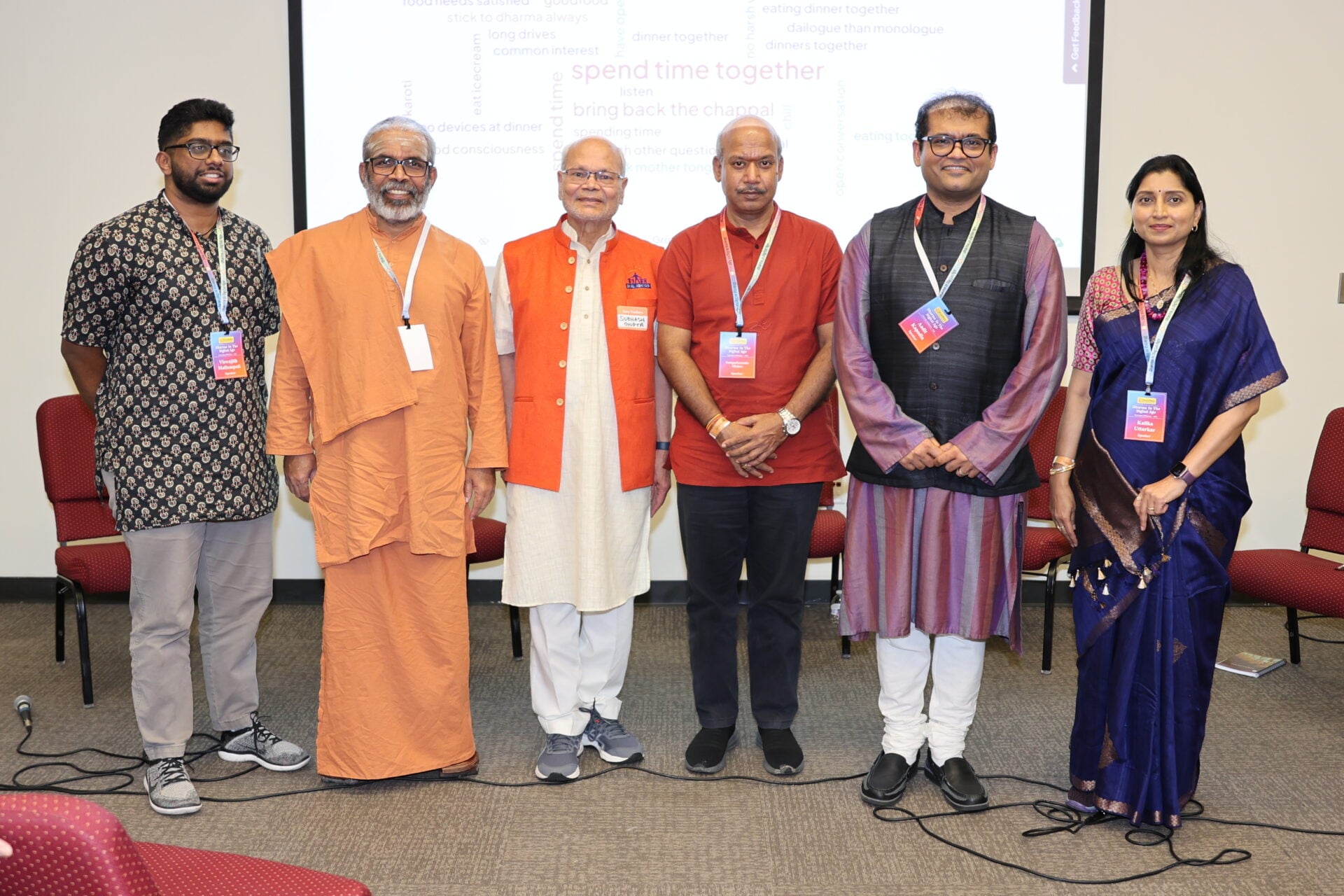
Dharma Civilization Foundation’s account of a DDA ’26 panel in Houston offers a useful framework for families facing that challenge. The discussion, moderated by Kalika Uttarkar, suggests that intergenerational trust grows when elders embody what they teach and meet younger people in the forms of communication they already understand.
Credibility comes before instruction
According to the foundation’s recap, audience responses identified ego, fear, poor listening, misunderstanding, digital fragmentation, and inconsistency between adult speech and behavior as barriers between generations. These concerns point to a relational problem: even a sound teaching may fail when the person presenting it appears unwilling to live by it.
Panelist Viswajith Malampati emphasized that younger people notice this mismatch. The implication is demanding but constructive. Before asking children to value prayer, seva, restraint, study, or reverence, adults must consider whether those values are visible in the atmosphere of the home. Practice gives words moral weight.
Swami Chidanandpuri, as summarized by the source, presented the family as a principal carrier of Dharma through periods of upheaval. This makes the household more than a private living arrangement: it becomes a place where civilizational memory is renewed through example. The same principle can strengthen Hindu, Buddhist, Jain, and Sikh families without erasing their distinct doctrines or disciplines.
The Dharmic method begins with a sincere question
The panel did not treat questioning as disobedience. The foundation reports that Sanskrit scholar Sampadananda Mishra drew attention to Upanishadic encounters involving Nachiketa and Vajashravas, Bhrigu and Varuna, Uddalaka and Shvetaketu, and Narada and Sanatkumara. In these examples, inquiry becomes part of the path to understanding rather than an obstacle to it.
This orientation changes the role of an elder. Authority need not mean possessing a quick answer to every doubt. An honest I don’t know can preserve trust and open the way to shared study. A parent, teacher, or community leader can guide a younger person toward deeper reflection without turning dialogue into a contest of wills.
That habit of respectful inquiry is a unifying Dharmic resource. Hindu darshanas, Buddhist investigation, Jain anekantavada, and Sikh traditions of learning approach truth through different frameworks, yet each can support disciplined listening and ethical self-examination. Dharmic unity becomes stronger when difference is engaged seriously rather than flattened into sameness.

Digital distance is partly a question of format
The panel also described algorithms and social media as forces that can fragment attention and encourage isolated information environments. Yet the source did not frame technology only as an enemy. Younger people already use digital media and peer networks to learn, so apparent distance from tradition may sometimes reflect an unsuitable method of presentation rather than rejection of Dharmic substance.
Families and institutions can therefore use books, podcasts, videos, stories, guided activities, and discussion groups as entrances into deeper practice. The medium should invite attention, not dilute the teaching. Digital content is most useful when it leads toward conversation, study, community, and lived discipline instead of becoming another stream of disconnected material.
A household rhythm for living tradition
Make shared attention a regular practice
Intentional time matters more than merely occupying the same room. A recurring family conversation, reading period, visit to a temple or other Dharmic institution, or shared act of seva gives generations something meaningful to experience together. Regularity allows trust to develop without forcing every meeting into a formal lesson.
Build a common vocabulary through stories
The recap encourages families to read and discuss together. Narratives offer a less defensive way to explore duty, compassion, courage, ahimsa, responsibility, and belonging. They also create opportunities for members of different ages to explain what a teaching means in their own lives.
Protect individuality while preserving continuity
Transmission should not require forcing every child into an identical mold. Elders can set clear examples and preserve inherited practices while allowing sincere questions about meaning and application. This balance supports a confident Hindu identity and wider Dharmic solidarity because belonging is rooted in understanding rather than fear.
Key takeaways
- Live the values being taught; conduct is the foundation of credibility.
- Listen before correcting, especially when a younger person raises a difficult question.
- Use stories and trusted media formats to begin conversations, not replace them.
- Make room for uncertainty and shared investigation instead of demanding instant agreement.
- Honor the distinct paths within the Dharmic family while cultivating common ethical purpose.
A confident Dharmic future will be built through households and communities where wisdom can be witnessed, questioned, practiced, and renewed. When affection and integrity support the conversation, inheritance becomes more than repetition: it becomes a living choice made by the next generation.
Inspired by this post on Dharma Civilization Foundation.
