
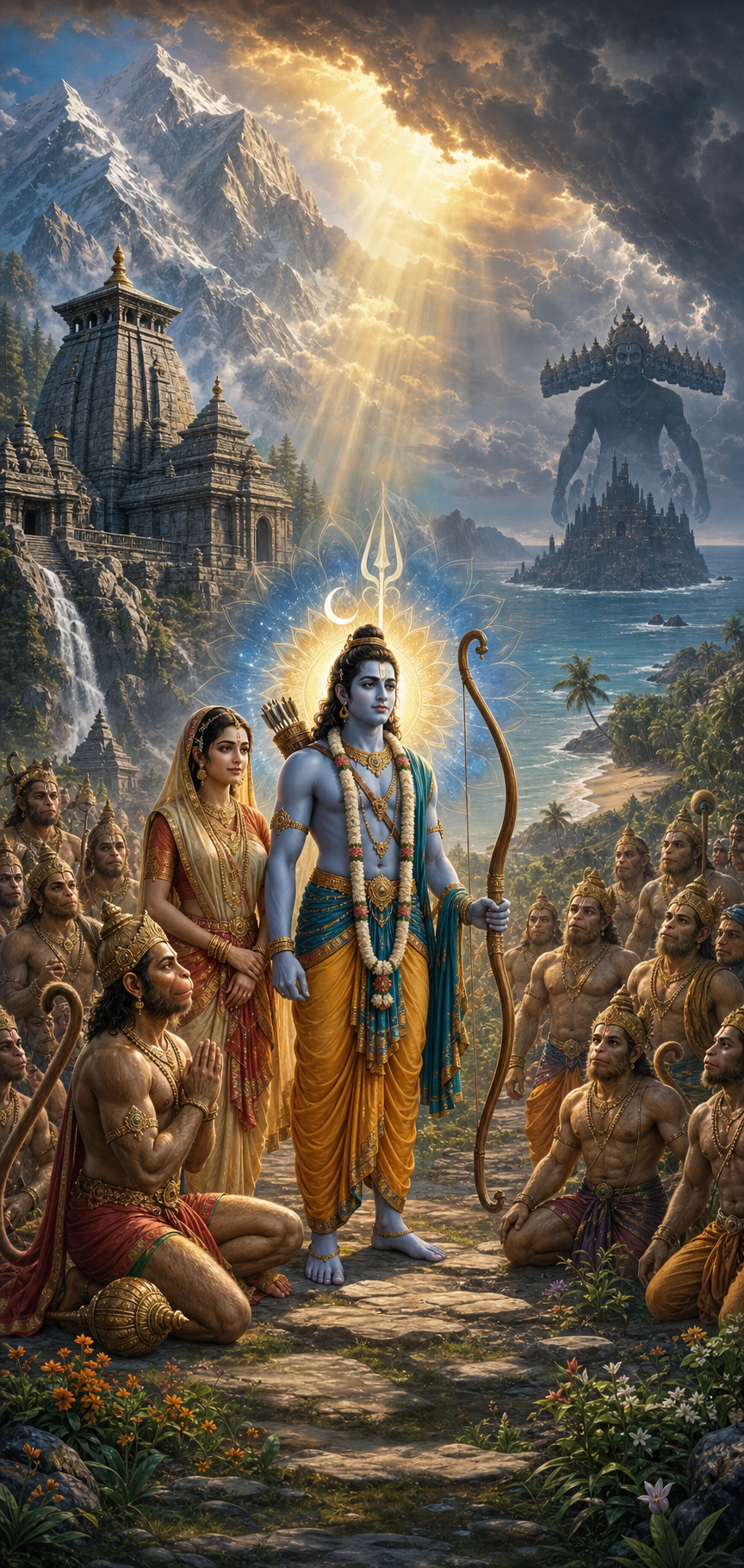
The supplied DharmaRenaissance study presents the Rāmāyaṇa material in Kedāra Khaṇḍa not as a miniature substitute for Vālmīki’s epic, but as a theological interpretation of its central conflict. Its primary questions concern the origin and moral limits of Rāvaṇa’s power, the divine purpose of Rāma’s descent, and the indispensable roles assigned to Sītā, Hanumān, and the Vānara allies.
Read in that way, the narrative offers more than an account of good defeating evil. It connects grace, devotion, knowledge, ascetic power, and dharma through a distinctly inclusive vision of Śiva and Viṣṇu.
Reading the account within its textual setting
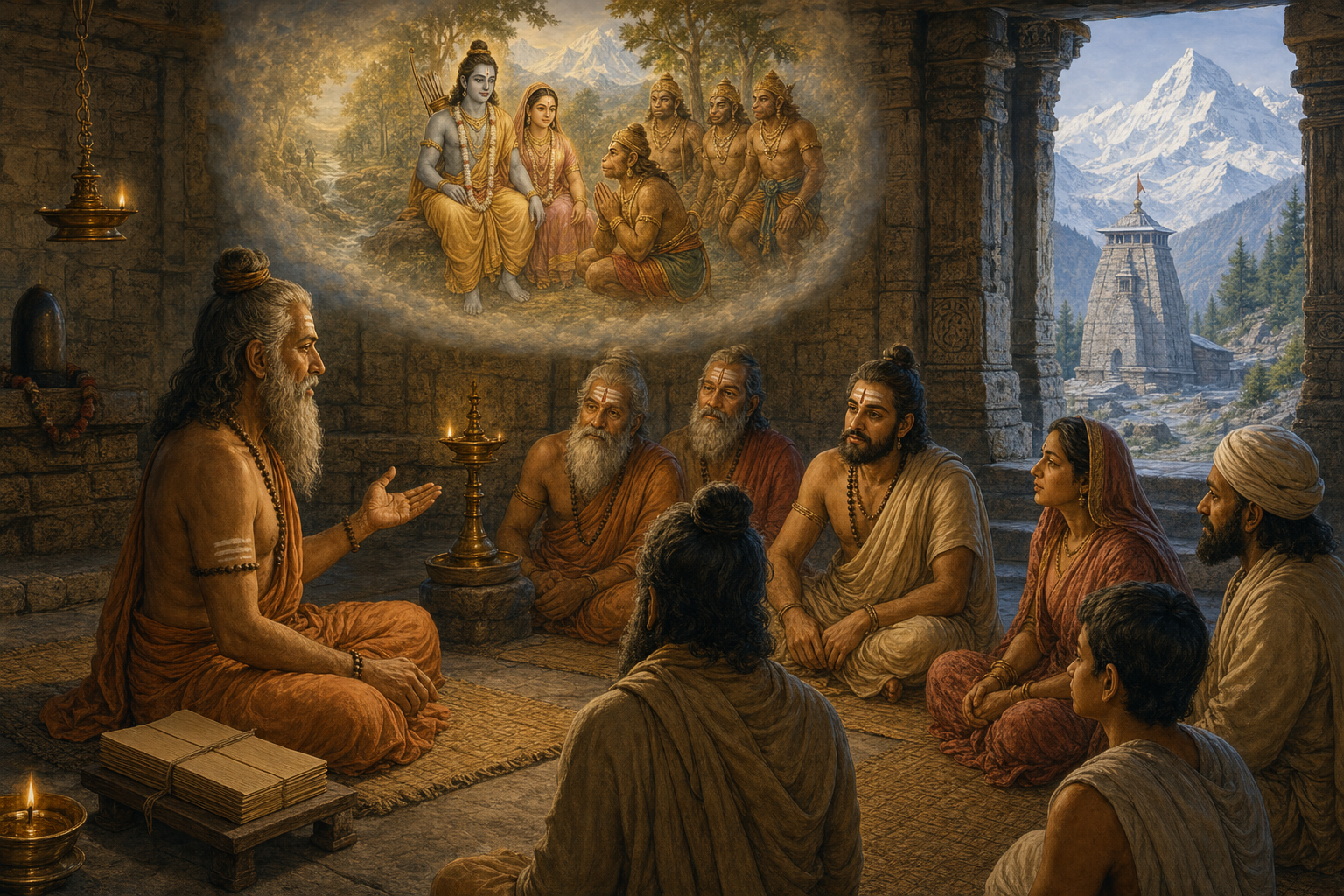
The location of the narrative needs careful definition. According to the source article, the widely circulated seven-khaṇḍa printed arrangement represented by G. V. Tagare’s English translation places Māheśvara Khaṇḍa first and Kedāra Khaṇḍa within it as the opening major section. The Rāmāyaṇa account occurs in Kedāra Khaṇḍa, chapter 8, whose translated title is “The Story of a Thief: Incarnation of Rāma.” Kedāra and Māheśvara are therefore not two parallel books containing separate versions of the story in this arrangement.
That qualification matters because “Skanda Purāṇa” names a large and varied textual tradition rather than one completely uniform work. The article reports that the Leiden University Skandapurāṇa Project studies manuscripts dated from the ninth through the nineteenth centuries and identifies a Nepalese manuscript dated to 810 CE as the oldest known dated Purāṇa manuscript. It also cautions that the early Nepalese recension does not correspond chapter by chapter with every text assembled in later printed khaṇḍa collections. The present interpretation consequently concerns the commonly available Māheśvara-Kedāra recension described by the source, not every manuscript transmitted under the Skanda Purāṇa name.
The internal design of chapter 8 is equally significant. The article describes 128 numbered verses that move from the story of a thief to teachings about devotion and the liṅga, then to Rāvaṇa’s rise, the planned incarnations associated with Rāma, and a final soteriological teaching. The opening thief episode is therefore not an accidental detour. A debtor enters a Śiva temple intending to steal its bell, yet Śiva reads the event with unexpected generosity and brings him to Kailāsa as an attendant. Before discussing heroic virtue, the chapter establishes that divine grace may exceed ordinary judgments about status, intention, and spiritual eligibility.
Hari-Hara unity supplies the narrative’s theological grammar

The source identifies the unity of Hari and Hara as the hinge between the chapter’s devotional teaching and its Rāmāyaṇa narrative. In the cited translation, verse 20 identifies Viṣṇu with Śiva and Śiva with Viṣṇu. Verse 21 associates the liṅga’s supporting pedestal with Viṣṇu and the liṅga with Maheśvara; the article also notes that preceding language joins Śiva and Śakti.
This symbolism prevents the story from becoming a competition between sectarian deities. Rāvaṇa receives extraordinary power through austerities directed toward Śiva, while Viṣṇu appears as Rāma to end the resulting oppression. Hari-Hara unity means that Rāma does not overturn Śiva’s grace as an opposing divine authority. Instead, the avatāra restores the ethical order within which every divine gift must be exercised.
The pedestal-and-liṅga imagery makes the same point in ritual form. A part cannot be understood properly when detached from the whole that supports it. Devotion becomes distorted when it isolates one manifestation of the divine and ignores the unity disclosed through another. The doctrine is therefore both metaphysical and practical: a divided vision of divinity can accompany a divided moral life.
Rāvaṇa exposes the difference between attainment and integrity
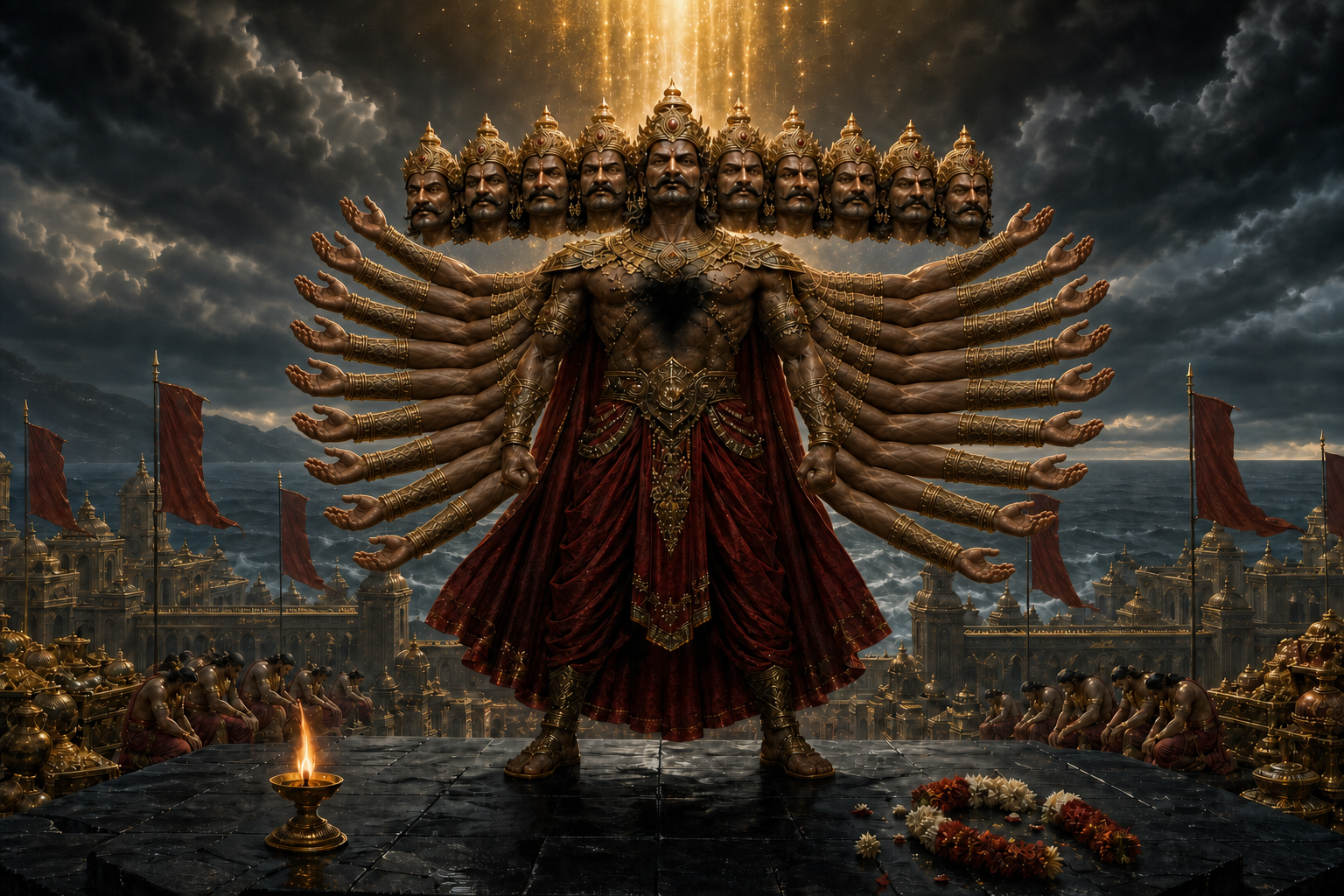
Rāvaṇa is not portrayed as powerful by accident. The source recounts his extreme austerities at Gokarṇa, including the successive offering of his heads and prolonged absorption in dhāraṇā and samādhi. Śiva is pleased, grants his desire, and enables a degree of authority that extends across the three worlds. The article also reports the chapter’s association of Rāvaṇa’s ten heads with twice the five faces attributed to Śiva.
These attainments complicate any shallow division between a pious devotee and an irreligious villain. Rāvaṇa has discipline, concentration, learning, and a real relationship to divine power. What he lacks is the ethical integration needed to govern what he has gained. His aggression toward celestial guardians and sages, his rule from Trikūṭa, and the episode in which he attempts to lift Kailāsa reveal the direction taken by capacity placed in the service of pride.
Nandī’s diagnosis, as summarized in the source, sharpens the problem. Rāvaṇa venerates the liṅga without recognizing Viṣṇu in its supporting pedestal, and Nandī’s curse anticipates his eventual defeat. The fault is not inadequate loyalty to one sect. It is a selective vision that embraces the source of power while overlooking the divine wholeness that would restrain its misuse.
The chapter thereby separates spiritual achievement from moral authorization. Austerity may produce real consequences without turning every desire of the practitioner into dharma. Indeed, the greater the acquired capacity, the more destructive an undisciplined ego can become. Rāvaṇa’s devotion explains his formidable position; it does not excuse what he does with it.
Incarnation appears as a coordinated restoration of dharma
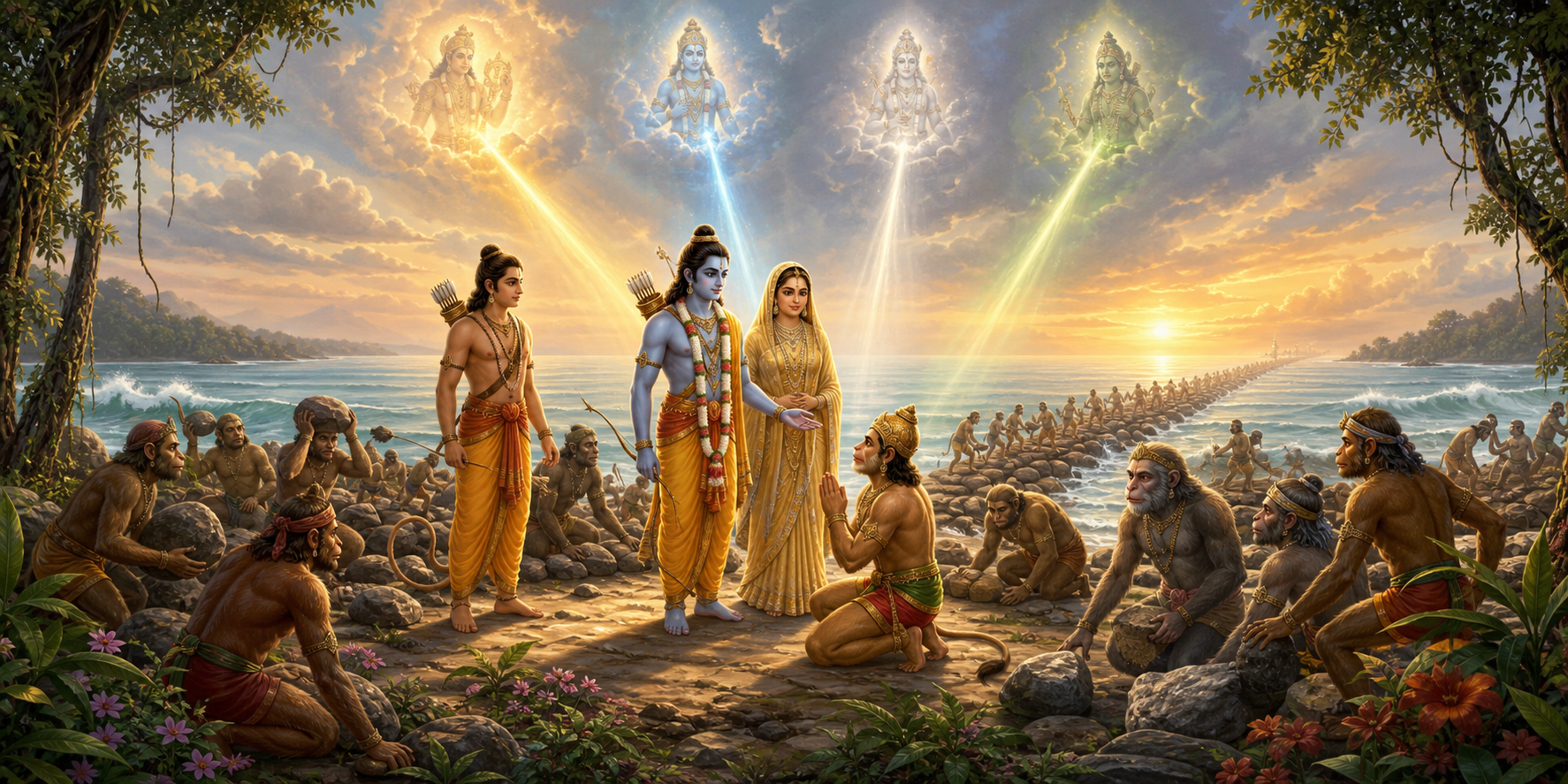
The divine answer to Rāvaṇa is presented as a constellation rather than the solitary arrival of one hero. The source assigns theological identities across the familiar cast: Rāma embodies Viṣṇu, Sītā manifests Brahmavidyā, and Hanumān embodies Nandī. It further reports that the chapter describes a divine plan for the births of Rāma, Sītā, their companions, and the Vānaras.
These identifications distribute the work of restoration across several forms of divine agency. Rāma represents ordered divine action within the world. Hanumān links Nandī’s earlier confrontation with Rāvaṇa to the later Vānara campaign. The Vānaras are not merely convenient military reinforcements; their arrival belongs to the providential structure through which Rāvaṇa’s accumulated advantages can be answered.
Sītā’s identification with Brahmavidyā gives the narrative an especially important epistemic dimension. Brahmavidyā commonly denotes liberating knowledge of ultimate reality. Within this account, Sītā cannot be reduced to an object whose recovery completes a warrior’s mission. Her presence signifies the knowledge without which the restoration of dharma would remain incomplete. Rāvaṇa can possess learning and ascetic technique while still lacking the wisdom that transforms power into right conduct.
The contrast is deliberate. Rāvaṇa tries to appropriate Sītā, yet liberating knowledge cannot be made the possession of an ego governed by domination. Rāma’s mission reunites righteous action with Brahmavidyā, while Hanumān’s service demonstrates power directed by devotion rather than self-exaltation. The cast thus embodies a theological answer to Rāvaṇa’s fragmented spirituality.
What the chapter asks readers to carry forward
Key takeaways
- The account belongs specifically to chapter 8 of Kedāra Khaṇḍa within the Māheśvara Khaṇḍa arrangement discussed by the source.
- Hari-Hara unity allows Śiva’s grace and Viṣṇu’s avatāra to operate within one divine order rather than as rival interventions.
- Rāvaṇa demonstrates that authentic austerity and acquired power do not by themselves guarantee ethical maturity.
- Rāma, Sītā, Hanumān, and the Vānaras form a coordinated response in which righteous action, liberating knowledge, devoted service, and collective aid converge.
- The thief episode and the chapter’s final teaching frame the Rāmāyaṇa material with a larger message about grace, disciplined devotion, and freedom from Māyā.
The chapter’s closing movement, as reported by the source, returns from cosmic conflict to spiritual practice. Disciplined devotion can dispel Māyā and lead beyond the temporary rewards obtained through ritual action. This ending prevents the narrative from being read only as a distant mythology of gods, demons, and miraculous births. Its enduring question is whether devotion has transformed the devotee’s way of seeing and acting.
Future study of this theology will benefit from comparing recensions without flattening their differences. Within the Kedāra account considered here, however, the interpretive direction is already clear: spiritual power becomes restorative only when joined to an undivided vision of the divine, liberating knowledge, and responsibility toward the world.