

The Śrīmad-Bhāgavatam does not discuss desire in only one register. In its Second Canto, it identifies concrete longings such as protection, strength and family continuity. In the Tenth Canto’s Rāsa Līlā, it portrays an intimacy so free of bargaining that Kṛṣṇa declares himself unable to repay the gopīs’ devotion. Read together, these passages describe a movement from fragmented wants toward love centered on the divine beloved.
The resulting theology neither condemns every ordinary need nor treats every intense feeling as spiritual. It asks what desire seeks, how mortality changes its importance, and whether the beloved is being used for personal satisfaction or served without an external price.
Key takeaways
- The Bhāgavatam permits ordinary vulnerability and aspiration to enter sacred discourse instead of demanding that they be denied.
- Mortality distinguishes temporary supports from the enduring aim around which consciousness should be organized.
- The Gauḍīya distinction between kāma and prema concerns the direction of desire, not merely the intensity or outward form of emotion.
- The Rāsa Dance presents divine intimacy as personal but noncompetitive: complete presence offered to one devotee does not deprive another.
Desire is examined under the pressure of mortality

The study of Śrīmad-Bhāgavatam 2.3.8 places the verse within King Parīkṣit’s approaching death and his question to Śukadeva Gosvāmī about what a person should hear, remember, worship and do at life’s decisive threshold. That setting changes the meaning of the chapter’s catalogue of desires. It is not simply a directory for obtaining benefits; it is an inquiry into which benefits can answer the deepest predicament of embodied existence.
According to that study, verse 2.3.8 associates an aim directed toward dharma with Uttama-śloka, understood in the received Gauḍīya reading as Lord Viṣṇu or his devotee. It also relates the extension of lineage to the Pitṛs, the desire for protection to the puṇya-janas, and the desire for strength to the Maruts. These are different aims situated within a differentiated sacred cosmology. The passage acknowledges that human attention is often divided among learning, safety, physical capacity, descendants and other finite goods.
The vocabulary reinforces that realism. The article explains that yajet, derived from the root yaj, can convey worship, sacrifice, honor or ritual offering. It also reads the expression tantuḥ tanvan as an image of lineage stretched forward like a thread. Desire is therefore not represented only as private appetite: it can carry obligations to ancestors, descendants, society and the larger sacred order.
Yet recognition is not the same as ultimacy. Protection may be reasonable, strength may support responsibility, and continuity may carry valuable inheritances, but none defeats the loss highlighted by Parīkṣit’s condition. Mortality becomes a theological test: a desired object may be a legitimate support without being the final good of the self. The article reports that the chapter’s differentiated catalogue ultimately gives way to an integrating recommendation of intense bhakti, whatever a person’s initial motive.
This makes the catalogue pedagogical. It begins where people actually stand, reveals the limited horizon of discrete benefits, and redirects attention toward the source capable of integrating life as a whole. Desire is first named, then measured.
From kāma to prema: the direction of longing changes
The Rāsa study supplies a complementary interpretive key from Gauḍīya Vaiṣṇava literature. Drawing on Śrī Caitanya-caritāmṛta, Ādi-līlā 4.165, it distinguishes kāma as desire organized around one’s own sensory gratification from prema as desire directed toward Kṛṣṇa’s pleasure. This later formulation clarifies the tradition’s reading of the Bhāgavatam, but it should not be confused with a claim that emotional intensity by itself proves spiritual attainment.
The distinction concerns intention and relationship. Similar outward expressions of affection can carry opposite inner structures. Kāma approaches the beloved as the means to an experience, possession or confirmation of the self. Prema makes the self available in service to the beloved. The transition is therefore not from strong feeling to emotional numbness; it is from acquisition to offering.
This principle connects the two source studies. The account of 2.3.8 recognizes people who seek particular outcomes, while the Rāsa analysis describes devotees who do not approach Kṛṣṇa for status, prosperity, liberation or self-validation. The passages work at different points along a spiritual trajectory rather than presenting rival attitudes toward human feeling. One maps desire before it is integrated; the other depicts desire after its governing center has changed.
Bhakti, on this reading, does not make every request selfish. A prayer for safety can arise from genuine vulnerability, and concern for descendants can express responsibility. Nor does sacred language automatically convert a request into prema. The decisive question is whether devotion remains conditional upon receiving the requested result, or whether the result itself is being placed within a larger commitment to divine service.
Rāsa Līlā portrays love beyond possession and scarcity
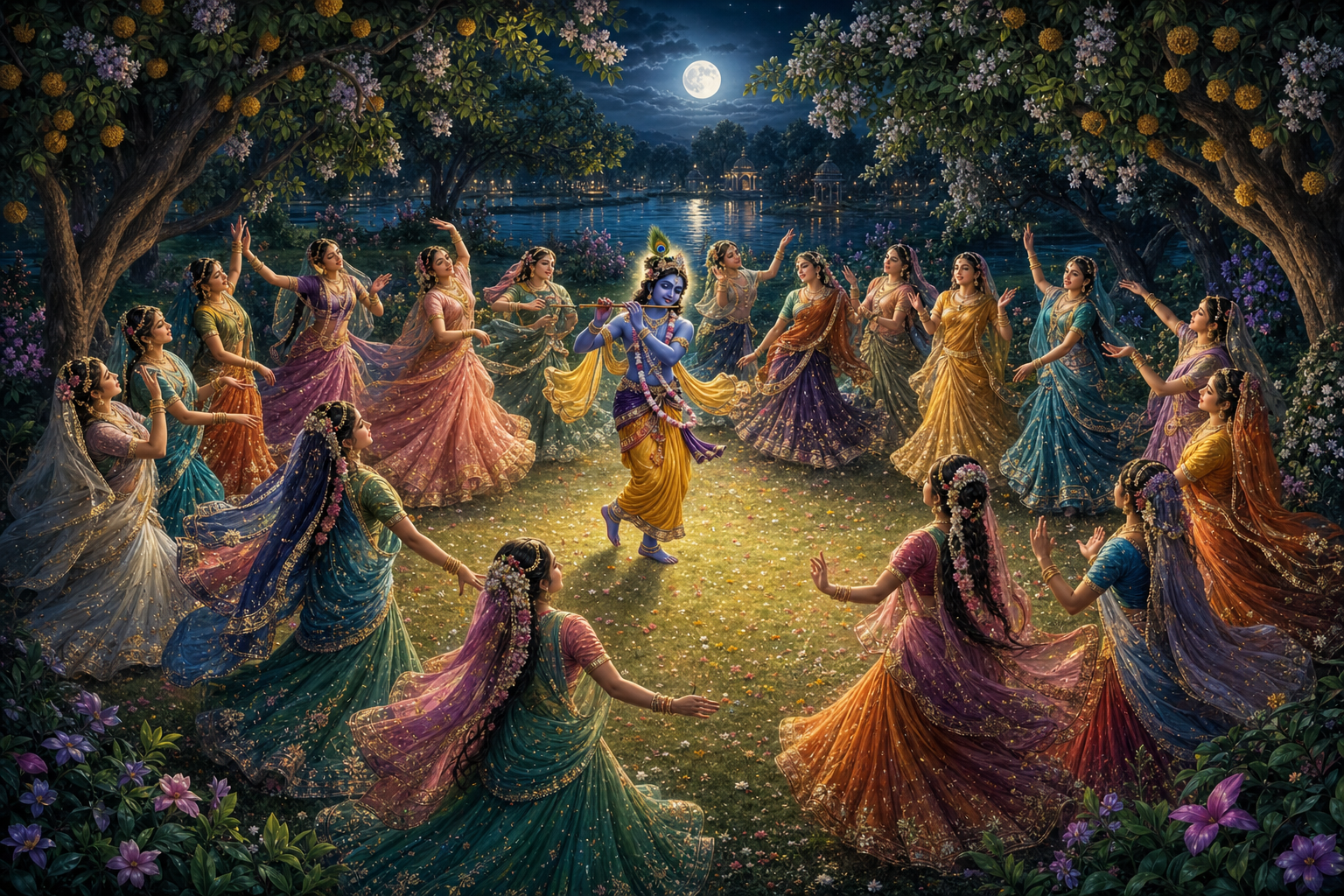
The Rāsa study cautions against isolating the dance from the five-chapter Rāsa-pañcādhyāyī. Its account moves through invitation, challenge, pride, disappearance, searching, lament, reunion and only then the dance described in Śrīmad-Bhāgavatam 10.33.1-11. That narrative sequence supplies the theological meaning that physical imagery alone cannot establish.
Separation exposes the wish to possess
The source reports that Kṛṣṇa initially advises the gopīs to return home, after which they argue that the self’s deepest duty is directed toward the divine ground of all relationships. When pride arises, Kṛṣṇa disappears. The gopīs search the forest, and their separation culminates in the Gopī-gīta before Kṛṣṇa returns and discusses different forms of loving reciprocity.
At Śrīmad-Bhāgavatam 10.32.22, immediately before the dance chapter, Kṛṣṇa declares that he cannot adequately repay their sincere service even over an immeasurably long life. The dance therefore follows an acknowledgment of devotion that cannot be settled as an exchange. Divine reciprocity is present, but it exceeds the logic of payment.
Separation performs an equally important function. The Rāsa analysis interprets it as exposing pride and possessiveness before intimacy is restored. When verse 10.33.1 describes the gopīs’ relief from the heat of separation, reunion does not erase what absence has taught. Love returns with a clearer awareness that divine presence cannot be owned.
Undivided presence does not produce rivalry
The social form of the dance carries the argument further. In verse 10.33.2, the gopīs link arms to form the circle. In verse 10.33.3, Kṛṣṇa, called yogeśvara, expands between every pair, and each gopī experiences him as personally beside her. The celestial spectators see the multiplicity that the individual dancers do not.
The Rāsa study interprets these simultaneous perspectives as a personalist account of infinity. Kṛṣṇa is not divided into inadequate portions, and no gopī receives a fraction of his attention. Divine love is wholly particular without becoming exclusive. The infinite can be completely present within each relationship while remaining completely available to all.
The order of the imagery also matters: the devotees join one another before each experiences Kṛṣṇa’s individual presence. Intimacy develops within a shared circle, not through the removal of competitors. This reverses the scarcity that often distorts ordinary desire. Another person’s grace need not be interpreted as one’s own deprivation, and distinctive relationships need not dissolve into uniformity.
The source also distinguishes rāsa, the circular dance, from rasa, the taste or relishable emotional quality of an aesthetic experience, while noting their deliberate resonance in devotional interpretation. Music, gesture, movement, fragrance and touch become a relational form of theology. Passion signifies the concentration of the affective life upon Kṛṣṇa, not impulse exempted from ethical responsibility.
A practical theology avoids both repression and imitation

Read together, the passages guard against two opposite mistakes. One is to shame every wish for safety, strength, continuity or support as spiritually defective. The other is to baptize every powerful attraction as divine love. The Bhāgavatam’s pedagogy is more discriminating: ordinary desires can be acknowledged while their means, limits and ultimate orientation are examined.
Three questions can guide that examination. Is the desired good being pursued through dharmic means? Does devotion collapse if the result is withheld? Does the desire enlarge responsibility and service, or make another being an instrument of possession? The 2.3.8 study illustrates the first question by treating protection as compatible with prudent boundaries, lawful action, community care and other responsible measures rather than domination or immunity from accountability. The Rāsa study sharpens the latter questions by locating intimacy after pride, loss and the surrender of any claim to control Kṛṣṇa.
The Rāsa narrative consequently cannot be read as permission to imitate its surface imagery while ignoring its theological frame. Its portrayal of passionate devotion follows self-examination, separation and Kṛṣṇa’s recognition of unpayable service. Removing that frame would turn a meditation on self-giving love back into the acquisitive structure the story is meant to transcend.
The continuing task for readers is to bring concrete desires into honest spiritual reflection, pursue legitimate needs responsibly, and allow devotion to change the center from which those needs are held. In that process, longing need not disappear; it can become less possessive, less competitive and increasingly capable of service.
References
- DharmaRenaissance Blog — The Rāsa Dance Revealed: Why Passionate Divine Love Is the Highest Transcendence
- DharmaRenaissance Blog — Śrīmad Bhāgavatam 2.3.8 Explained: A Powerful Map of Desire, Duty, and Devotion