
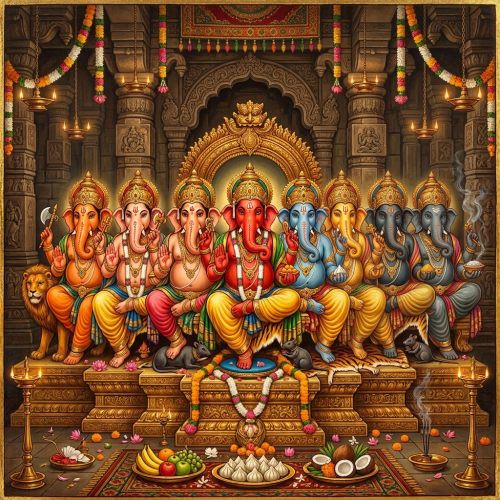
Ganesha’s incarnations can be approached as more than a catalogue of divine forms. They present devotion as a mirror: the obstacles that require removal are not only external difficulties, but also habits within the human mind.
Hindu Pad frames eight incarnations of Ganapathi as responses to eight negative forces: arrogance, ego, desire, anger, greed, delusion, inebriation and jealousy. Because the supplied source excerpt ends shortly after identifying Vakratunda as the first incarnation, the responsible focus here is the framework and its practical meaning, not an unsupported reconstruction of the remaining names or stories.
What the source establishes about the eight forms
According to Hindu Pad, the eight incarnations correspond broadly to eight human weaknesses that Ganesha overcomes. This makes the tradition an account of moral and spiritual victory as well as divine intervention. Each adversary can be understood as an obstruction to clear judgment, balanced conduct and dharmic responsibility.
The available text names Vakratunda first but does not provide the other seven names, their opponents or their individual narratives. Those details should therefore be learned from a complete traditional account rather than guessed from a truncated feed. What remains clear is the organizing insight: the remover of obstacles also teaches devotees to recognize the obstacles they carry within themselves.
Three dimensions of the inner struggle
For practical reflection, the eight weaknesses can be considered in three groups. This grouping is an editorial interpretation of the source’s list, not a taxonomy stated by Hindu Pad.
Distortions of self
Arrogance, ego and jealousy turn attention toward status and comparison. Arrogance expresses superiority, ego makes the self the fixed center of experience, and jealousy allows another person’s success to disturb one’s own balance. Together they weaken humility and fellowship.
Appetites without direction
Desire, greed and inebriation concern appetite and self-command. The lesson need not be read as a rejection of every ordinary wish. The problem begins when desire governs judgment, accumulation displaces contentment, or intoxication removes restraint. Dharma gives human energies a worthy direction rather than allowing them to become masters.
Judgment under a cloud
Anger and delusion interfere directly with perception. Anger can compress a complex situation into an impulsive reaction, while delusion prevents a person from seeing motives and consequences clearly. Invoking Ganesha before an undertaking can therefore signify a commitment to clarity before action, not merely a request for favorable circumstances.
Key takeaways
- Hindu Pad presents eight Ganesha incarnations as victories over eight human weaknesses.
- Vakratunda is the only incarnation named in the supplied excerpt, so the missing seven should not be inferred.
- The central teaching joins worship with self-examination and ethical discipline.
- The motif can support dharmic unity without erasing differences among traditions.
A shared dharmic language of self-mastery
The incarnation motif is distinctly Hindu, yet its ethical direction resonates across the wider dharmic family. Hindu sampradayas, Buddhist paths, Jain traditions and Sikhi retain their own doctrines and practices, but each gives serious attention to examining harmful impulses, disciplining conduct and loosening the rule of self-centered attachment.
This common ground does not make the traditions interchangeable. It instead reveals a civilizational conversation in which diverse paths treat inner reform as inseparable from social harmony. In this cultural sense, Hindutva is strongest when it protects the shared dharmic home while respecting the integrity of every tradition within it. Ganesha’s victory over inward disorder can thus become an image of collective strength: unity begins when pride, envy and uncontrolled appetite no longer govern relationships.
Turning the symbolism into daily discipline
The source does not prescribe a specific exercise, but its framework can inform a simple practice of reflection:
- Name the obstacle that is active, without disguising anger as principle or greed as necessity.
- Pause before speech or action so that the first impulse does not determine the outcome.
- Choose a countervailing quality such as humility, contentment, sobriety, goodwill or discernment.
- Review the result honestly and repeat the practice when the same tendency returns.
Such reflection keeps devotion connected to character. The enduring invitation of the eight-incarnation framework is to carry Ganesha’s obstacle-removing presence from the shrine into judgment, relationships and service, where inner victories can gradually strengthen the wider dharmic community.
Inspired by this post on Hindu Pad.
