
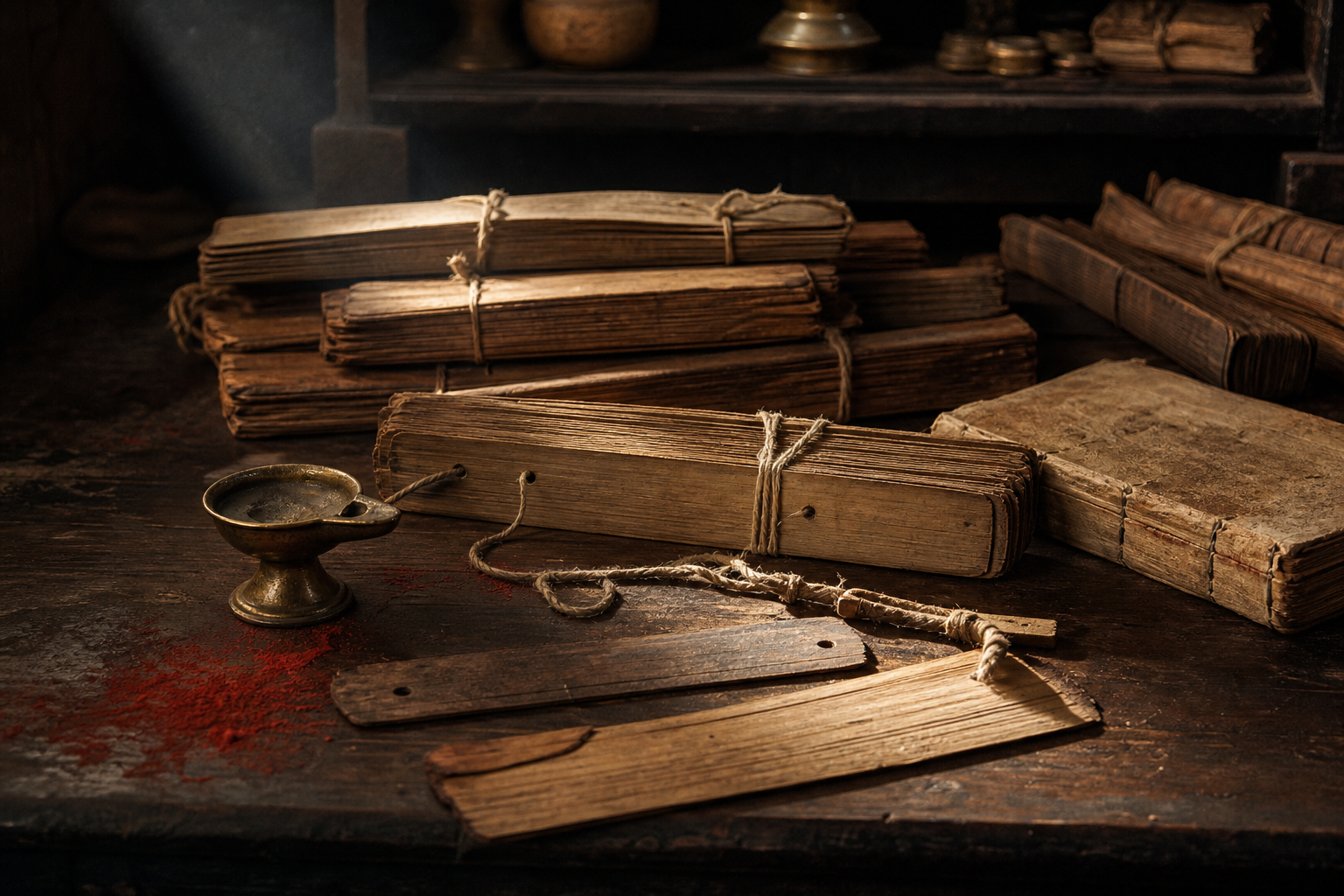
The Rudrayamala Tantra is best approached not as a single book awaiting recovery, but as a scriptural name with a long and complicated textual afterlife. Its surviving record includes recensions, incomplete manuscripts, printed editions, extracts, ritual instructions, hymns, protective texts, and citations preserved in later works.
This corpus-based view clarifies why descriptions of the Rudrayamala sometimes differ without being mutually meaningless. Chapter totals, contents, titles, and theological voices can belong to different layers of transmission. The central task is therefore to distinguish sacred authority from the material history of the texts that invoke it.
Key takeaways
- Rudrayamala can identify a revelatory tradition, textual family, recension, section, or cited authority rather than one universally stable volume.
- The surviving archive is weighted toward an Uttara division, while the reported Pūrva division is substantially lost.
- Conflicting chapter and verse totals are evidence of recensional diversity, lost material, and the expansion of a prestigious scriptural name.
- One prominent Uttara recension gives Bhairavi the teaching voice, but that arrangement should not be imposed on every Rudrayamala-related work.
From a book title to a textual family
The existing DharmaRenaissance guide explains that the Sanskrit term yāmala commonly conveys pairing, twinning, or conjunction. In Tantric literature, it can designate revelation structured around a divine pair. Rudra names a powerful form of Shiva, while Shakti appears as the dialogical partner in one of her manifestations. Rudrayamala can consequently be understood as a paired revelation of Rudra and Shakti, although no short translation exhausts the title’s literary and theological implications.
The guide also cautions against treating lists of Yamalas as one fixed canon. Names including Brahmayamala, Vishnuyamala, Shaktiyamala, and Rudrayamala recur, but their arrangement and status can vary by source, period, and region. The category belongs to the wider history of esoteric Shaiva revelation and stands close to Bhairava-oriented and goddess-centered traditions through its deities, initiatory setting, and concern with ritual and embodied transformation.
This makes the title function differently from a modern bibliographic label. In manuscript culture, an authoritative name could encompass a large corpus, a particular recension, a subordinate section, or teachings cited by a later compiler. When a hymn or ritual claims affiliation with the Rudrayamala, the attribution is historically significant, but it does not by itself establish that the material appeared in every text once circulated under that name.
The most useful working model is therefore a textual family held together by remembered authority rather than identical contents. This model preserves the importance of traditional attribution while leaving room for philological comparison among distinct witnesses.
What the surviving manuscripts and editions reveal
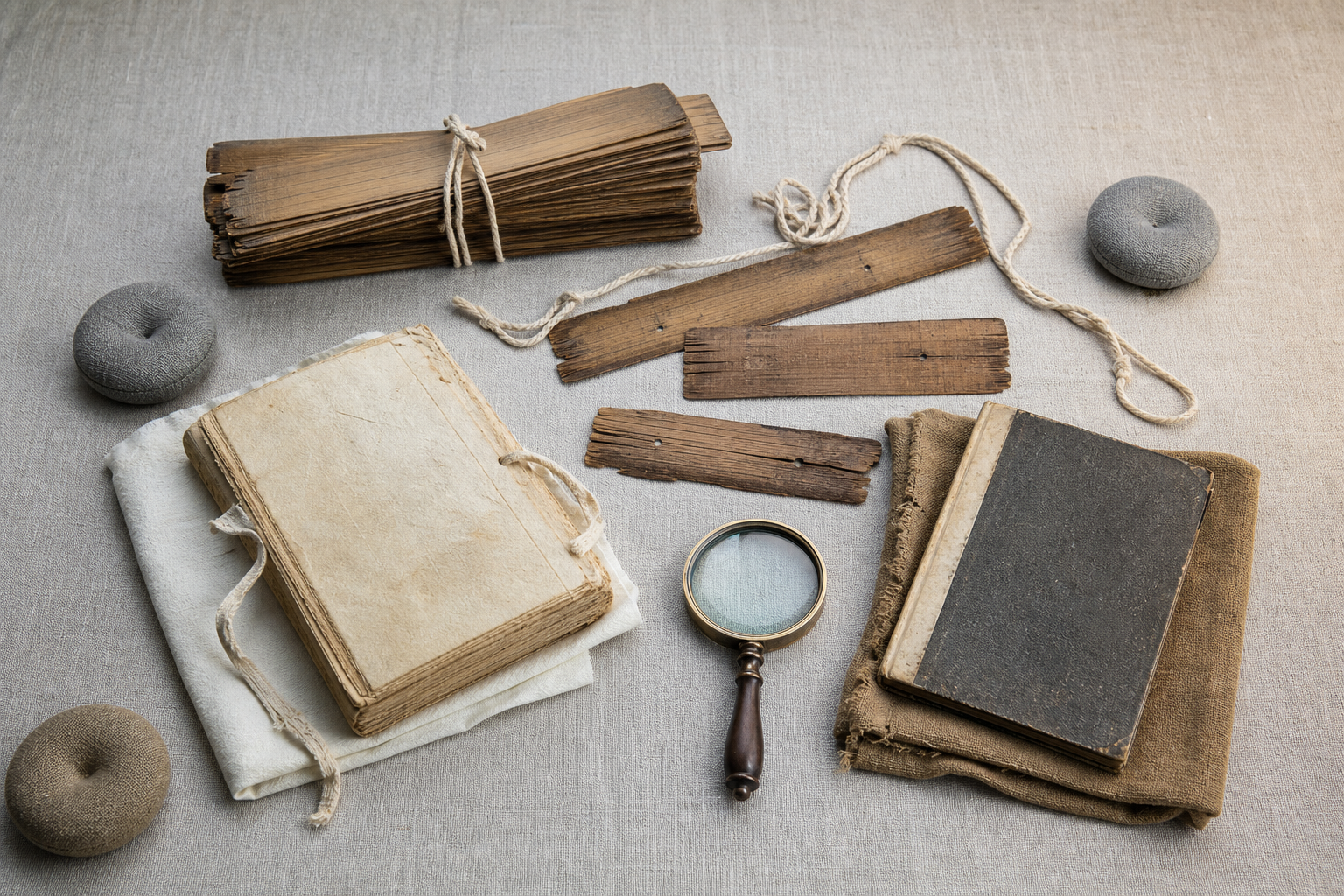
According to the DharmaRenaissance account, modern catalogues commonly distinguish a Pūrva Khaṇḍa and an Uttara Khaṇḍa. It reports that the PANDiT database records both divisions while observing that much of the first has been lost and that available editions mainly preserve the second. A CiNii bibliographic record for a two-volume Sanskrit university edition similarly identifies the publication as an Uttaratantra and notes the reported loss of the earlier part.
Even the numerical shape of the work remains unsettled. The guide notes that some cataloguing traditions describe sixty-four paṭalas, while a widely circulated printed Uttara recension has sixty-six chapters and approximately six thousand verses, chiefly in the anuṣṭubh metre. Other references envision a much larger revelation. These figures need not describe the same textual object: they may reflect different recensions, idealized totals, missing divisions, or the gradual accumulation of teachings beneath an authoritative title.
Two manuscript records cited by the guide make this diversity concrete. The Nepal-German Manuscript Preservation Project record for NAK 5/1447 describes an incomplete Sanskrit paper manuscript in Devanagari comprising 151 folios. It names Amṛtānanda as the copyist, gives the date ŚS 1716, and records the absence of folios 30v-31r. Its closing material identifies a sixty-chapter Devīrahasya within a Rudrayamala framework. This witness illustrates how missing leaves, colophons, and nested titles can affect later attempts to define a work.
The Institut Français de Pondichéry record T0992b points in another direction. As summarized by the guide, it is an incomplete thirty-one-folio transcript copied from a Tulu manuscript. Its subjects include a chariot festival, defects in preliminary sprouting rites, and expiation. The ritual passage identifies itself as the 366th instruction in a Rudrayamala said to contain thirty-nine thousand verses. Its contents and scale differ sharply from the familiar sixty-six-chapter edition, suggesting a broader ritual archive rather than another straightforward copy of the same recension.
Print expanded access but did not resolve the underlying textual plurality. The guide identifies a two-volume Uttaratantra edition published by Sampurnanand Sanskrit University in Varanasi, edited by Rāmaprasāda Tripāṭhī and carrying a foreword associated with Maṇḍana Miśra; library records reportedly date its second edition to 1991-1996. Earlier printed forms circulated from Kolkata. Such editions are important witnesses, but editorial publication cannot demonstrate that every printed passage belonged to an early, unitary archetype.
Authority, authorship, and the problem of dating
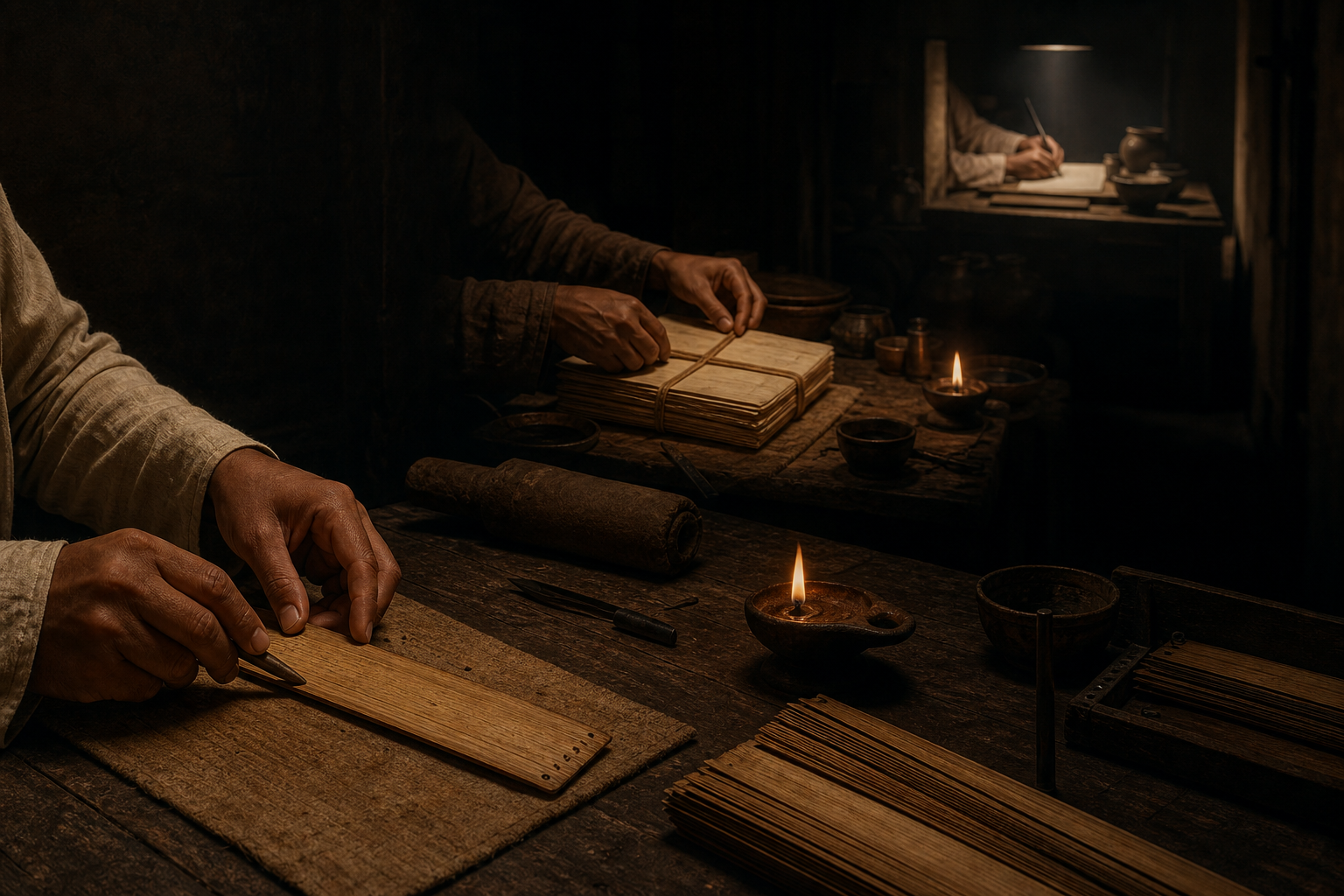
No identifiable historical author can securely be assigned to the corpus, according to the DharmaRenaissance guide. Traditional attribution places the revelation in a divine dialogue involving Bhairava or Shiva and Devi. Historical analysis, by contrast, encounters anonymous and apparently composite materials shaped by oral explanation, lineage transmission, redaction, regional copying, and expansion. These accounts address different questions: one concerns the source of sacred authority, while the other concerns the formation of surviving documents.
The same distinction is essential for chronology. A manuscript date identifies a physical witness, not necessarily the age of every teaching it contains. A named scribe produced or transmitted a copy, not automatically the underlying composition. Likewise, the date of a modern edition belongs to the history of publication rather than the first appearance of its contents.
The guide places the wider Rudrayamala authority earlier than many surviving paper manuscripts, while noting that the extant Uttaratantra is often situated in a later medieval textual environment. It also points to the Vijñanabhairava’s explicit association with Rudrayamala teachings as evidence that the name already occupied an influential doctrinal horizon before the present printed recensions were produced. This does not yield a single date for the entire corpus; it instead separates the age of an idea, the compilation of a recension, the copying of a manuscript, and the publication of an edition.
Esoteric modes of transmission help explain why those layers can be difficult to reconstruct. Initiation and controlled circulation could protect a lineage’s ritual integrity while limiting the number of copies. When manuscripts disappeared, extracts and quotations in later works could become the remaining evidence for an earlier textual form. Fragmentation, in this setting, is part of the corpus’s history rather than proof that it lacked influence.
Shakti’s teaching voice and the corpus’s wider legacy
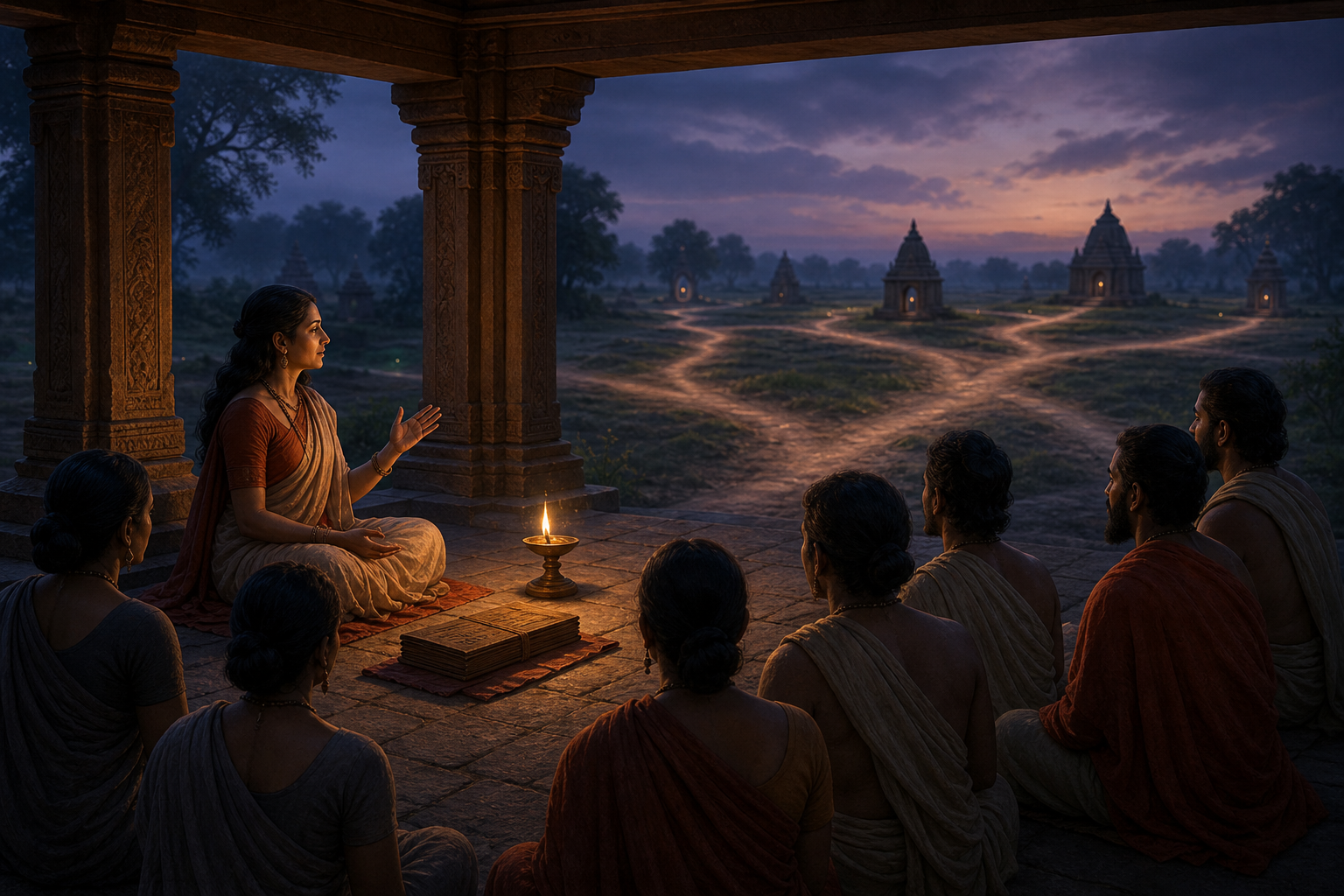
One prominent Uttara recension described in the guide gives the dialogue an especially significant arrangement: Bhairava asks questions and Bhairavi answers. Some traditional classifiers understand this as a nigama orientation, distinguishing it from an āgama pattern in which Shiva teaches and the Goddess asks. The classification cannot safely be generalized across every work connected with the Rudrayamala name, but within this recension it makes Shakti the explicit teacher of ritual, yoga, mantra, and knowledge.
The legacy of the Rudrayamala consequently extends beyond the contents of one edition. The guide reports that PANDiT catalogues associated stotras, kavacas, ritual procedures, and deity liturgies involving figures such as Bhairava, Kali, Chinnamasta, Bhavani, Shiva, Ganesha, Gayatri, and Rama. This range demonstrates the reach of the attribution, although each item still requires comparison of manuscripts, colophons, citations, and recensional relationships before its position in the corpus can be defined.
A responsible reading practice therefore asks what kind of claim each witness makes. A work may say that it occurs in the Rudrayamala, identify itself as a portion of that revelation, reproduce a teaching associated with it, or merely borrow its prestige. These possibilities are related but not interchangeable. Preserving the distinction prevents devotional reception from being dismissed and historical uncertainty from being concealed.
The Rudrayamala’s enduring importance lies partly in this capacity to connect divine dialogue, goddess authority, ritual specialization, yogic teaching, and later textual memory. Future study will depend on closer comparison of catalogued manuscripts, published recensions, attributed extracts, and quotations, allowing the relationships within the corpus to become clearer without forcing them into an artificial single-book model.