
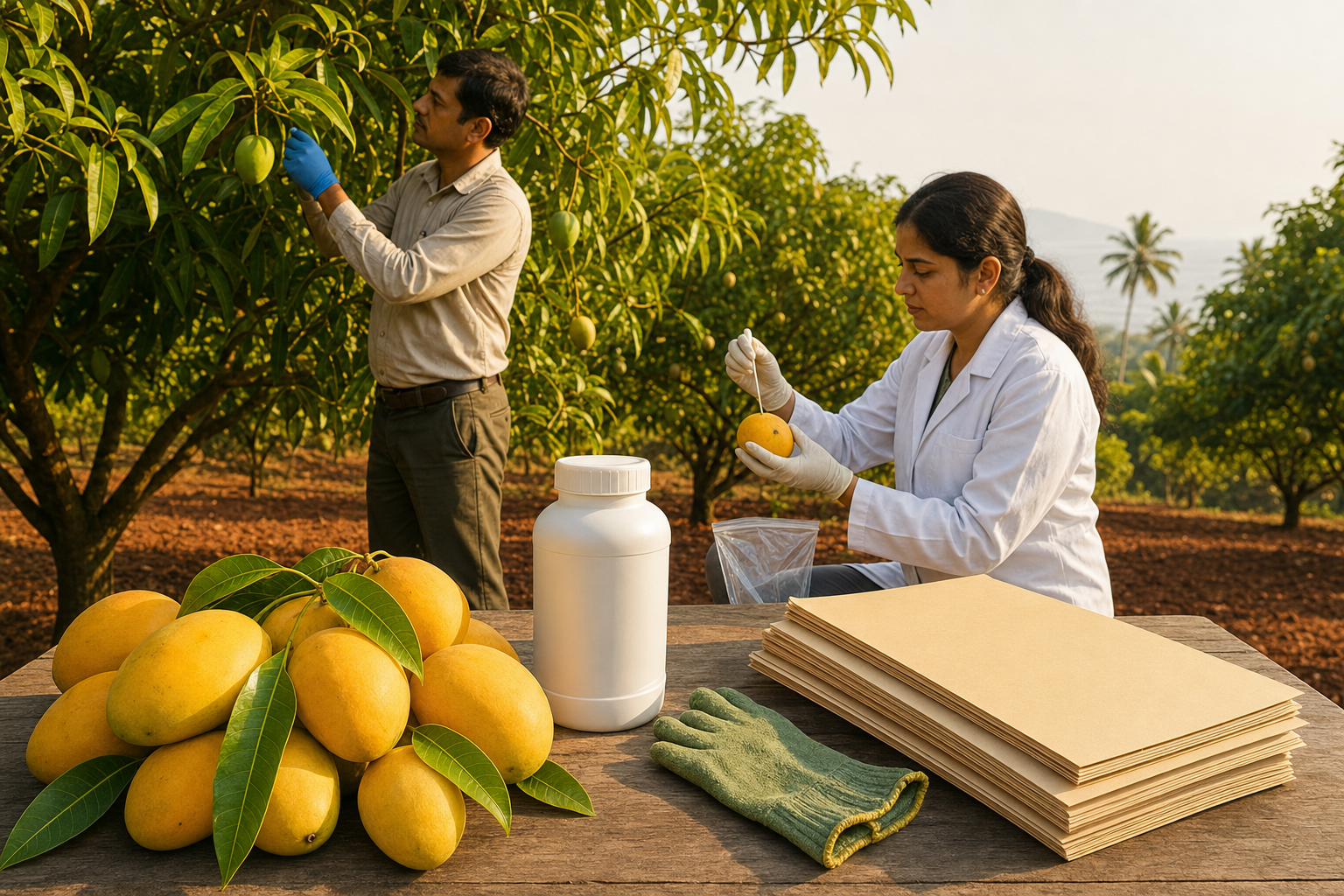
The Konkan Hapus pesticide controversy turns on a precise regulatory question: did official advice for Alphonso mango orchards match the approved uses of the pesticide formulations named in that advice? An existing DharmaRenaissance Blog report says Surajya Abhiyan, citing Right to Information records, has sought a government white paper, a high-level inquiry and accountability for any wrongdoing that is established.
Evaluating that demand requires more than comparing a spray schedule with a current pesticide list. A credible inquiry would have to connect product registration, research records, dated advisories, residue standards and evidence of actual consequences. Keeping those questions separate is essential both for protecting growers and for avoiding premature conclusions about scientists, officials or the safety of Hapus mangoes.
The dispute concerns authorised use, not pesticide names
A pesticide active ingredient being registered in India does not mean that every product containing it may be used on every crop. As the source report explains, the relevant regulatory unit is the exact formulation and its approved label claim. That claim connects a product and concentration with a crop, a target pest or disease, a dose, an application method and timing, safety precautions and, where prescribed, a waiting or preharvest interval.
This distinction changes the central question. Investigators should not ask merely whether a chemical was registered somewhere in the agricultural system. They should establish whether the formulation specified in an advisory was authorised for mango, for the named problem and under the recommended conditions when that advisory was issued. Products sharing an active ingredient can have different formulations and approved uses, so a brand name or chemical name alone cannot settle compliance.
Research results require a separate test. An agricultural university may study efficacy or residues under controlled permissions and protocols, but a successful experiment does not automatically authorise routine commercial spraying. Before a result becomes extension advice, its formulation, crop, target organism and use conditions must be reconciled with the applicable label. If advice discusses an experimental use, its research status and safeguards should be unmistakable.
Four sets of records must form one compliance chain

The source report describes a divided institutional structure. The Central Insecticides Board and Registration Committee evaluates registrations and approved uses; agricultural universities conduct research and issue extension recommendations; Maharashtra’s Agriculture Department circulates advice and performs state-level quality-control functions; the Food Safety and Standards Authority of India sets residue requirements; and the Agricultural and Processed Food Products Export Development Authority runs traceability and residue-monitoring arrangements for export supply chains.
That division of responsibility makes document reconciliation more important than generic blame. A useful inquiry framework would compare the following layers:
| Record layer | Question to answer | Evidence required |
|---|---|---|
| Registration and label | Was the exact formulation authorised for mango, the stated target and the recommended use pattern? | The registration certificate, approved label and amendments effective on the advisory date |
| Research | Was the recommendation derived from a controlled trial, and was it still experimental? | Trial permissions, protocols, efficacy and residue records, and stated conditions of use |
| Public advisory | What exactly were growers told, by whom and with what regulatory qualification? | The complete spray schedule or circular, its version, approval trail and circulation date |
| Food and trade compliance | Which residue limit and monitoring requirements applied to the fruit? | The applicable FSSAI commodity standard and, for export supply chains, relevant traceability and residue-monitoring records |
A mismatch at one layer cannot be repaired by an assumption drawn from another. An efficacy trial does not replace a label claim, an applicable residue limit does not grant permission to spray, and a current database entry does not prove what the legal position was in an earlier season.
Historical reconstruction and due process are inseparable

Pesticide registrations, restrictions and labels can change. The report therefore argues that investigators must reconstruct the position on each advisory date rather than judge older advice only against a list downloaded later. That exercise should distinguish a completely unregistered insecticide from a registered formulation that lacked a mango claim, as well as from a product whose mango approval did not cover the named pest, dose or application conditions.
The legal analysis also has to remain product- and document-specific. The report points to Section 18 of the Insecticides Act, 1968, in discussing restrictions involving unregistered or prohibited insecticides and conduct governed by the Act and its rules. It nevertheless cautions that a disputed recommendation should not automatically be characterised as a criminal offence. Any conclusion would depend on the certificate and label then in force, the way the advice was communicated, whether the use was experimental or commercial, who authorised it and what statutory duty may have been breached.
The RTI material should be handled with the same discipline. An official reply can identify what an authority disclosed, but its meaning depends on the wording of the application, the completeness of the response and the supporting annexures. A transparent white paper should publish the applications, replies, file numbers, schedules, circulars and relevant dates while identifying documents that were withheld, declared unavailable or transferred elsewhere. This would allow independent scrutiny without treating an allegation as an adjudicated finding.
Regulatory, food-safety and livelihood risks need separate proof

Registration compliance and maximum residue limits answer different questions. Registration governs whether and how a particular pesticide formulation may be used for an agricultural purpose. An MRL establishes the permitted residue concentration in a food commodity under the applicable food standard. As the source report stresses, the existence of a mango MRL does not independently authorise a pesticide use, while a laboratory result below that limit cannot retrospectively validate an off-label application.
The reverse distinction is just as important. A questionable recommendation does not by itself prove that fruit was contaminated, a worker was poisoned or an export consignment was rejected. Those outcomes require residue results, exposure evidence, consignment records or other relevant documentation. An MRL exceedance can have food-law and trade consequences, but it should not be portrayed as a complete toxicological judgment about a single serving without considering the substance, concentration and pattern of exposure.
The regional stakes extend beyond an individual orchard. The report says Alphonso mangoes from Ratnagiri, Sindhudurg, Palghar, Thane and Raigad received geographical-indication registration in 2018. Because that designation associates the fruit’s reputation with a defined region and its horticultural knowledge, weak pesticide governance could affect grower bargaining power, consumer confidence and the premium attached to the Konkan supply chain even when no particular safety outcome has yet been proved.
At the same time, pesticide advice should not be made the sole explanation for the wider difficulties facing Hapus cultivation. The report identifies weather at flowering, rainfall, humidity, pollination, soil conditions, nutrition, pests, diseases and the timing of orchard operations as interacting influences. It also cites an Indian Council of Agricultural Research observation from March 2026 about nutrient leaching affecting mango and cashew productivity in the high-rainfall Konkan region. An inquiry should therefore determine the specific contribution of disputed pesticide advice, if any, rather than collapse a complex production problem into one cause.
Key takeaways
- A pesticide’s active ingredient or brand name is not enough to establish lawful use; the exact formulation and dated label claim matter.
- University research can inform an advisory, but experimental efficacy does not itself authorise unrestricted commercial application.
- Registration status, residue compliance and proof of harm are distinct questions that require different records.
- RTI disclosures can justify scrutiny, but complete applications, replies, annexures and historical registration documents are needed before assigning liability.
- A sound inquiry must protect the Konkan Hapus reputation while accounting for the many environmental and agronomic factors affecting orchard performance.
The constructive next step is a date-indexed public dossier linking every disputed recommendation to its exact formulation, contemporaneous label, research basis and approval trail. That record would give growers usable guidance, permit fair evaluation of institutional decisions and help prevent unresolved regulatory ambiguity from following future Hapus harvests into domestic and export markets.